
Deck Building Cost Guide
How much does it cost to build a deck? See US price ranges by size and material, the main cost drivers, DIY-vs-pro savings, and resale payback.
Ask three builders what a deck costs and you will get three numbers, because what it takes to build a deck depends far more on material, size, and height than on any single per-square-foot rate. This deck building cost guide answers how much does it cost to build a deck with real 2026 figures: price ranges by material and deck size, the factors that move the total most, what you save by doing the work yourself, and how much of the spend comes back when you sell.
All dollar figures below are US national-average ranges verified in 2026 against HomeAdvisor, Ergeon, NerdWallet, Fixr, and the Zonda Cost vs Value report. They are planning ranges, not quotes. Prices shift with region, supplier, lumber market, and season, so treat the numbers as a starting frame and get three local bids before you commit.
What a New Deck Costs in 2026
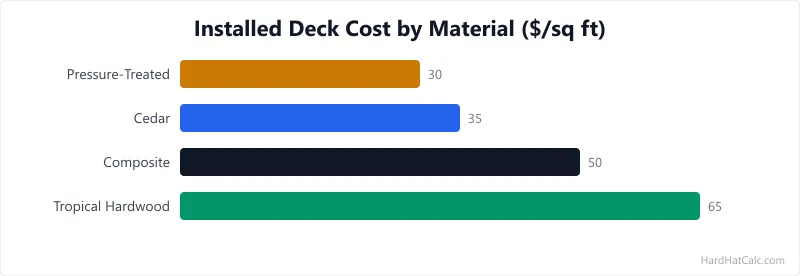
A professionally built deck in the United States runs about $30 to $60 per square foot installed for a typical wood or mid-range composite build, with the national average landing near $8,000 for a standard deck. The full spread is wider than that: a simple ground-level pressure-treated platform can come in around $25 per square foot, while a raised composite or hardwood deck with stairs and railing climbs past $70. Material is the single biggest lever, so the clearest way to read deck pricing is per square foot by decking material.
| Decking material | Installed cost (per sq ft) | What you are paying for |
|---|---|---|
| Pressure-treated softwood | $15–$50 (typically $25–$40) | Lowest upfront price; needs cleaning and sealing every 2–3 years |
| Western red cedar | $20–$45 | Natural rot resistance, softer underfoot; periodic oiling |
| Composite (Trex, TimberTech) | $35–$70 | No staining or sealing; premium PVC lines reach $80 |
| Tropical hardwood (ipe, cumaru) | $50–$80 | 40-plus-year lifespan; dense and slow to install |
Footprint matters less than most people expect, because a bigger deck spreads fixed costs like footings and the ledger connection over more square feet. Cost climbs with size, but not in a straight line, and a small raised deck can cost more than a large ground-level one. The table below gives total installed ranges by size; the bands overlap on purpose, since material grade and deck height move the total more than area alone.
| Deck size | Footprint | Total installed cost |
|---|---|---|
| Small | ~120–200 sq ft (e.g. 10×12) | $3,000–$14,000 |
| Medium | ~200–340 sq ft (e.g. 12×20) | $6,000–$19,000 |
| Large | 400+ sq ft (e.g. 20×20) | $6,000–$28,000 |
For context, a standard 200-square-foot pressure-treated deck runs roughly $5,000 to $16,000 installed depending on height and finish, and a 12×12 platform in pine sits around $3,600 to $7,200. The large band tops out near $28,000 for most builds, but a 500-square-foot tropical-hardwood deck raised six feet off the ground on a tall frame can reach $30,000 to $45,000. That ceiling is rare and rests on premium material plus heavy structural framing, so treat it as a maximum, not a typical large-deck price.
Region and timing shift these numbers as much as any design choice. Labour rates in a high-cost coastal metro can run double those in a rural county, so the same deck quote varies widely by ZIP code. Lumber and composite prices also move with the season and the wider market, and pressure-treated stock tends to cost more in spring when demand peaks. Booking the build for late autumn or winter, when crews are quieter, can trim both the labour rate and the wait for a start date.
What Actually Drives the Price
Five things decide where your deck lands inside those ranges. Knowing them lets you read a contractor's quote and see where the money is going.
Decking material. This is the largest single variable, and the gap is wide: tropical hardwood costs three to four times as much per square foot as pressure-treated pine. The surface boards are the most visible cost, but the choice also ripples into fasteners, joist spacing, and labour time, since dense hardwoods need pre-drilling and heavier composites may call for tighter joists.
Size and height. Area sets the raw material quantity, but height multiplies it. A ground-level deck needs short posts and simple footings; a deck raised eight feet for a walkout basement needs tall posts, bigger footings, lateral bracing, and a longer stair run. Raising a deck can add 30 to 50 percent to the cost of the same footprint. Sizing those posts correctly is its own line item, and a post sizing tool for 4x4, 4x6, and 6x6 columns shows when load and height force you up to a larger, pricier post.
Labour. On a professionally built deck, labour is 50 to 60 percent of the total, and up to 70 percent on complex jobs with curves, multiple levels, or intricate railing. Most contractors charge $15 to $35 per square foot for labour alone, though the real range runs from about $8 per square foot on a simple ground-level wood deck to $60 or more for rooftop and custom work. Local wage rates explain much of why the same deck costs far more in a coastal city than in a rural county.
Footings and framing. Below the boards sits the structure that carries every load, and skimping here is where decks fail. Footing count, depth, and diameter depend on soil and frost line, and each one is concrete, labour, and an inspection point. The framing lumber, beams, and joists then have to span the deck safely, sized off the real dimensions behind each nominal lumber size rather than the name on the rack. Pinning down the right joist size before you price lumber avoids paying for a mid-span beam you did not need, and a maximum joist span calculator gives those spans in seconds instead of from a 30-page table.
Attached or freestanding. An attached deck bolts to the house through a ledger board, which saves one line of beam and footings but makes the ledger the most safety-critical joint on the build, since a poorly flashed or under-bolted ledger is the leading cause of deck collapses. A freestanding deck skips the ledger and the house-flashing work, but it needs a fourth side of beam and an extra row of footings to stand on its own, which adds material and concrete. Neither is reliably cheaper across the board, and the choice usually comes down to the house wall, the soil, and local code rather than price alone.
Features. Stairs, railing upgrades, built-in seating, lighting, and a roof or a well-planned pergola are all add-ons stacked on top of the base deck. A run of code-compliant stairs, a switch from wood to cable or glass railing, or an integrated lighting system can each add four figures. These are the items that quietly turn a $9,000 quote into a $15,000 one.
Decking Material and the Cost That Follows It
The cheapest board today is not always the cheapest deck over twenty years. Each material carries a different blend of upfront price and upkeep, and the right pick depends on your budget now and how long you plan to stay.
Pressure-treated softwood is the budget default and the most common decking in North America. At $15 to $50 per square foot installed (typically $25 to $40), it is the lowest-cost way to get a sound, code-compliant deck. The trade-off is maintenance: pine needs cleaning and re-sealing every two to three years, which runs $150 to $400 each cycle on a 300-square-foot deck, and it greys, checks, and splinters if that upkeep lapses. A well-maintained pine deck lasts 15 to 25 years.
Western red cedar sits a step above pine at $20 to $45 per square foot installed. Cedar resists rot and insects naturally, feels softer underfoot, and weathers from warm red to silver-grey. It still wants oiling or staining every couple of years to hold its colour, and it is softer than composite, so it dents more easily. Cedar suits people who want real wood with less chemical treatment and accept the upkeep.
Composite decking (Trex, TimberTech, Fiberon) runs $35 to $70 per square foot installed, with cellular-PVC and premium lines reaching $80. It is a wood-and-plastic blend that never needs staining, sealing, or sanding, resists rot and insects, and carries 25-to-50-year warranties. The trade-offs are the higher upfront price, a different feel underfoot, and more heat retention in direct sun on dark colours. Over twenty years, composite often matches or beats maintained pine on total cost because you stop buying stain.
Tropical hardwood such as ipe and cumaru is the premium tier at $50 to $80 per square foot installed. Ipe is so dense it sinks in water, resists rot for 40-plus years untreated, and has a rich grain, but it is brutally hard to work: every screw hole is pre-drilled, carbide blades dull fast, and the boards weigh roughly double pine. It belongs on high-end projects where longevity and looks justify the price. For the full parts list behind any of these surfaces, from ledger flashing to post caps, the ground-up deck materials checklist lays out every component, and the deck board and fastener estimator turns your deck area and layout into board counts and surface cost.
Paying for Labour, or Doing It Yourself
Because labour is half to two-thirds of a professional deck bill, the build-it-yourself question carries real money. Removing the labour line can cut a pressure-treated deck roughly in half, which is why a DIY build is the single largest saving available on the whole project.
The saving is real, but it is not free. A first deck takes most people three to five weekends, and the cost moves from cash to time, tools, and risk. You will need or rent a circular saw, a drill-driver, a post-hole auger, a level, and a string line, plus the skill to get the structure right. Two parts of a deck punish mistakes hardest: the ledger connection to the house, which is the leading cause of deck collapses, and the footings, which are expensive to redo once concrete has cured.
I learned the value of getting the structure right the hard way while renovating our Northumberland house: the previous owner had added an outdoor structure without proper approval or footings, and putting it right cost more than building it correctly would have in the first place. The lesson travels across the Atlantic. Before any boards go down, confirm the structure can carry the load, because a deck load capacity check tells you whether your joist size and spacing handle people, furniture, and a hot tub long before the lumber arrives.
A middle path saves money without taking on the riskiest work: hire a contractor for the footings, ledger, and framing, then lay the decking and build the railing yourself. You pay for the structural expertise that matters and keep the labour saving on the finish work, which is where most of the surface-level hours sit.
Permits, Drawings, and the Line Items People Forget
The base deck is rarely the whole bill. A handful of smaller costs catch first-time builders, and most of them are non-negotiable.
The permit. Almost every US jurisdiction requires a building permit for an attached deck and for freestanding decks above a set height or size. The permit fee runs $50 to $500, often calculated as roughly 0.5 to 2 percent of project cost, and it can run higher in expensive municipalities. Skipping it risks fines, forced removal, denied insurance claims, and trouble when you sell, so it is not a corner worth cutting.
Drawings and inspections. Many permits require a plan, and a deck with an engineered ledger or footing detail may need stamped drawings, which run $500 to $2,000. Inspections are usually folded into the permit but vary by jurisdiction, so confirm what your local building department charges rather than assuming.
Stairs, railing, and lighting. A flight of code-compliant stairs adds roughly $500 to $2,600 depending on rise and material, and getting the riser and tread geometry right is exacting. Railing runs $20 to $60 per linear foot in wood or vinyl and $150 to $250 for cable, metal, or glass. An integrated lighting system adds $1,000 to $3,000 or more. Stairs in particular are easy to under-budget, so size them early with a stair rise and run calculator that sets riser height, tread depth, and stringer length for your deck-to-ground height.
Demolition and site prep. Replacing an old deck adds the cost of tearing down and hauling away the existing structure, usually $500 to $1,000, or roughly $3 to $5 per square foot for demolition and disposal. Soft or sloping ground can add grading and larger footings on top of that.
What a Deck Gives Back at Resale
A deck is one of the few home projects that returns most of its cost. The 2025 Cost vs Value report from Zonda puts a wood deck addition at about $18,300 nationally, recouping roughly 95 percent of its cost at resale, while a composite deck addition near $25,100 recoups about 88 percent. Both beat almost every interior remodel for return on investment.
Wood scores higher on percentage because it costs less to build for similar usable space, not because buyers value it more than composite. Composite recoups a smaller share but more absolute dollars, and it sells the maintenance-free story that many buyers want. Either way, a deck reliably converts most of its build cost into added home value, which makes the spend easier to justify than a kitchen or bathroom that returns far less.
Return depends on the deck being sound and sensibly sized for the house, not on premium finishes. An oversized or poorly built deck does not recoup more, and a failing one becomes a negotiating point against you. Spending on solid framing and a safe structure protects the resale value better than spending on the fanciest boards.
Building Your Own Deck Budget
You can turn these ranges into a real number for your project in five steps, working from the structure up rather than the finish down. To skip the arithmetic, estimate your own deck's cost by size, material, and height first, then use the steps to layer in features and sanity-check the result.
- Set the size and height. Decide the footprint and how far off the ground the deck sits. Height drives post size, footing depth, and stair length, so it shapes the budget as much as area.
- Pick the decking material. Choose pine, cedar, composite, or hardwood using the per-square-foot table above, and weigh the upkeep cost over the years you plan to stay.
- Size the framing. Work out joist size, spacing, and post dimensions for your span so the lumber take-off is right the first time.
- Add the features. Layer in stairs, railing, lighting, and any roof, then add the permit and, if needed, drawings.
- Get three bids. Compare your estimate against three local quotes. Wide gaps usually trace to material grade, height, or how each builder handles the ledger and footings.
The estimator below turns your deck area, board choice, and layout pattern into a board count, fastener count, and surface cost, which is the cleanest starting point for the material side of the budget. Run it with your dimensions before you talk to a contractor.
Total deck surface area (length × width). Exclude stair treads.
Standard deck boards are 2×6 (5.5" actual). Some composite boards use different widths.
Match board length to deck width to minimise end joints and waste.
Diagonal and decorative patterns require more waste for angled cuts.
Material choice drives per-board cost and fastener type.
Gap between boards for drainage and expansion. 1/8" to 3/16" is standard.
How This Is Calculated
Linear feet = deck area ÷ (board width + gap) in feet. Waste factors: straight 10%, diagonal 15%, picture-frame 18%, herringbone 20%. Boards = linear feet ÷ board length. Screws = linear feet × 0.75 joist crossings/ft × 2 screws. Cost = linear feet × cost per linear foot.
Source: Board coverage calculated from nominal-to-actual lumber dimensions per American Lumber Standard Committee PS 20. Fastener counts from DeckWise and Simpson Strong-Tie installation guides.
Build the budget from the ground up and the headline per-square-foot rate stops being a mystery. Pick the material, size the structure honestly, price the features separately, and the total falls out of parts you can each check. A deck that is sized right and built sound is the version that lasts, passes inspection, and pays you back when you sell, which is worth far more than shaving a few dollars a foot off the boards.
Frequently Asked Questions
- How much does it cost to build a 12x12 deck?
A 12x12 deck (144 square feet) typically runs $3,600 to $7,200 installed in pressure-treated pine, and $6,000 to $11,000 or more in composite, based on 2025–2026 US averages from HomeAdvisor and Ergeon. The wide spread reflects material choice, whether the deck is ground-level or raised, and local labour rates, which alone make up 50 to 60 percent of the bill. Ground-level pine builds sit near the bottom of that band; an elevated composite deck with stairs and railing pushes toward the top. Footings are a quiet cost driver, and a pier and pad footing sizer shows how depth and diameter change the concrete you pour under each post.
- Is it cheaper to build a deck yourself or hire a contractor?
Building it yourself is cheaper because it removes the labour cost, which is 50 to 60 percent of a professional deck bill and up to 70 percent on complex builds, so a DIY pressure-treated deck can cost roughly half the installed price. The catch is time, tools, and risk: a first deck takes most people three to five weekends, you buy or rent a circular saw, drill, auger, and levels, and a mistake at the ledger or footings is expensive to undo. Permit and inspection rules still apply whether or not you swing the hammer yourself. Get the framing right first by checking your maximum joist span before you order a single board.
- Does building a deck add value to your home?
Yes, and it returns more than most remodels. The 2025 Cost vs Value report from Zonda puts a wood deck addition at about $18,300 nationally, recouping roughly 95 percent of its cost at resale, while a composite deck addition near $25,100 recoups about 88 percent. Wood scores higher on percentage because it costs less to build for similar usable space, but both beat almost every interior project for return. Resale value rewards a sound, well-sized structure over premium finishes, so confirm the load your deck can carry before you spend on surface upgrades.
- Is a composite or pressure-treated deck cheaper over time?
Up front, pressure-treated pine wins easily: it installs for $15 to $50 per square foot against $35 to $70 for composite. Over 20 years the gap narrows, because pine needs cleaning and re-sealing every two to three years (roughly $150 to $400 each time on a 300-square-foot deck), while composite asks only for the occasional wash. If you plan to keep the house long term and dislike maintenance, composite often matches or beats maintained pine on total cost; if your budget today is the constraint, pine is cheaper. Compare board counts and material pricing for either choice with the deck board estimator.