
Deck Board Calculator
Free deck board calculator for wood and composite decking. Enter deck area, board size, and layout pattern for board count, fasteners, and cost estimates.
Last updated:
Total deck surface area (length × width). Exclude stair treads.
Standard deck boards are 2×6 (5.5" actual). Some composite boards use different widths.
Match board length to deck width to minimise end joints and waste.
Diagonal and decorative patterns require more waste for angled cuts.
Material choice drives per-board cost and fastener type.
Gap between boards for drainage and expansion. 1/8" to 3/16" is standard.
How This Is Calculated
Linear feet = deck area ÷ (board width + gap) in feet. Waste factors: straight 10%, diagonal 15%, picture-frame 18%, herringbone 20%. Boards = linear feet ÷ board length. Screws = linear feet × 0.75 joist crossings/ft × 2 screws. Cost = linear feet × cost per linear foot.
Source: Board coverage calculated from nominal-to-actual lumber dimensions per American Lumber Standard Committee PS 20. Fastener counts from DeckWise and Simpson Strong-Tie installation guides.
7 min read
Planning Your Deck Surface Layout
The Deck Board Calculator converts your deck dimensions into a board count, fastener estimate, and material cost. The key decision before you start is the layout pattern, because it determines waste factor, visual impact, and installation complexity.
A straight layout runs boards parallel to the house wall, perpendicular to the joists. It is the fastest to install, produces the least waste (10%), and works with any board length. Straight layouts look clean on rectangular decks but can appear plain on large surfaces.
A diagonal layout runs boards at 45 degrees to the house. The boards still cross the joists (which is required for structural support), but the angled ends require mitre cuts at every perimeter board. This adds 15% waste and takes roughly 20% longer to install than straight. The visual payoff is a more dynamic surface that draws the eye diagonally across the deck, making rectangular spaces feel larger.
A picture-frame layout adds a border of boards running perpendicular to the field (interior) boards. The border frames the deck edge with a finished look, hiding the cut ends of the field boards. The extra framing required at the border-to-field transition — typically a doubled joist or blocking — adds both material and labour. Expect 18% waste and a full day of extra installation time on a 300 sq ft deck.
Herringbone patterns interlock short boards at 90-degree angles. The visual effect is dramatic, but herringbone requires extensive blocking between joists and creates 20% waste from frequent cuts. Reserve herringbone for small feature areas (landing pads, insets) rather than full deck surfaces unless the budget supports it.
Before ordering boards, confirm the deck weight limit for your joist and beam structure — heavier materials like ipe and composite weigh 25–50% more per square foot than PT pine and may require closer joist spacing.
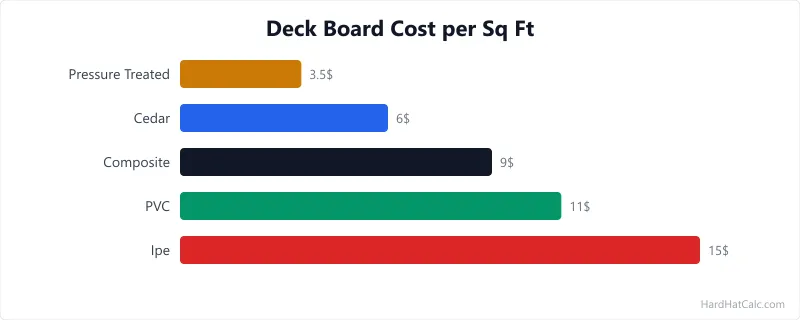
Pressure-Treated vs. Composite vs. Hardwood
Decking material is the biggest cost driver in any deck project, and the cheapest option up front is not always the cheapest over the deck's lifespan. Surface boards are only part of the bill, and the full cost of building a deck weighs them against framing, labour, and permits. To put a figure on the whole job, a project cost estimate for any deck size and material adds the frame and labour to the boards.
Pressure-treated pine is the default for budget-conscious builds. At $0.80–$1.40 per linear foot (March 2026 US averages), PT pine costs 60–75% less than composite per square foot of installed deck. It accepts stain and paint, cuts and fastens with standard tools, and is available at every lumber yard. The downsides: PT pine requires restaining every 2–3 years ($150–$400 per application on a 300 sq ft deck), it splinters as it ages, and it is susceptible to rot if stain maintenance lapses. Over 20 years, a PT pine deck that is properly maintained costs roughly $3,500–$5,000 in materials and upkeep.
Western red cedar sits between pine and composite in both cost ($2.50–$4.00/lf) and maintenance. Cedar is naturally rot-resistant and insect-resistant without chemical treatment, has a warm reddish tone that weathers to silver-grey, and is softer underfoot than composite. It still needs periodic oiling or staining (every 2–3 years) to maintain its colour. Cedar is lighter than PT pine, which makes it easier to handle but slightly less stiff — verify your joist spacing supports it.
Composite decking (mid-range: $3.00–$5.00/lf; premium: $5.00–$8.00/lf) is a wood-plastic blend that resists rot, insects, fading, and staining without any ongoing maintenance. You never stain, seal, or sand it. Premium composites carry 25–50 year warranties against fading and structural defects. The trade-offs: higher upfront cost, a different feel underfoot (some homeowners dislike the slightly hollow sound), and composite gets hotter than wood in direct sunlight. Over 20 years, composite typically matches or beats the total cost of maintained PT pine because you never buy stain again.
Ipe and tropical hardwoods ($5.00–$9.00/lf) are the premium tier. Ipe is extremely dense (it sinks in water), naturally rot-resistant for 40+ years without treatment, and has a rich chocolate-brown colour. It is also brutally hard to work with — you need to pre-drill every screw hole, carbide-tipped saw blades dull after 100 cuts, and each board weighs roughly twice as much as PT pine. Ipe is best on high-end projects where longevity and appearance justify the premium.
For a fuller breakdown of materials and fasteners for a full deck build, the deck building materials checklist covers everything from ledger bolts to post caps.
Fastener Estimation and Spacing
Deck screws hold the surface to the structure. Under-fastened boards lift and cup. Over-fastened boards split. Here is how to get the count right.
Count joist crossings per board. Each board crosses every joist it spans. With 16-inch on-centre joist spacing, a 12-foot board crosses 9 joists (12 ÷ 1.33 = 9). Each crossing gets 2 screws — one placed ¾ inch from each board edge. That is 18 screws per 12-foot board.
Select the right screw. For 2×6 PT pine decking on 2×10 joists, use #10 × 3-inch coated deck screws. The coating must match the treatment chemistry — ACQ-treated lumber requires stainless steel or approved coated screws because untreated steel corrodes in contact with the copper in ACQ. Composite decking uses manufacturer-specific colour-matched screws or hidden clip systems.
Pre-drill hardwoods. Ipe, tigerwood, and cumaru will split if you drive screws without pilot holes. Use a combination drill-countersink bit sized for your screw shank. This adds time but prevents board-destroying splits on $7-per-foot material.
Calculate total screws. Multiply total linear feet of decking by 0.75 (joist crossings per foot at 16" OC) by 2 (screws per crossing). A 300 sq ft deck with 5.5-inch boards and straight layout needs roughly 880 screws. Buy in 350-count boxes of exterior-rated deck screws — that is 3 boxes. Always buy an extra box for replacements, mistakes, and the inevitable dropped screw that disappears between boards.
Consider hidden fasteners for composite. Most composite brands offer proprietary hidden clip systems that attach boards from the edges, leaving no visible screw heads on the surface. Hidden clips cost more ($80–$150 per 100 sq ft) but produce a cleaner look and prevent mushrooming (the slight bump around screw heads that collects dirt and algae).
Do not forget perimeter fastening. The first and last boards in each run get face-screwed regardless of whether you use hidden clips for the field. Pre-drill and countersink these face screws, then fill the holes with colour-matched plugs for a finished look.
Board Coverage and Waste Reference
The table below shows how many 2×6 deck boards (5.5-inch actual width, ⅛-inch gap) you need for common deck sizes and layout patterns. Figures include waste.
| Deck Size | Area | Straight | Diagonal | Picture Frame | Herringbone |
|---|---|---|---|---|---|
| 10×10 ft | 100 sq ft | 20 boards (12 ft) | 22 boards | 23 boards | 24 boards |
| 12×16 ft | 192 sq ft | 38 boards (12 ft) | 42 boards | 44 boards | 46 boards |
| 14×20 ft | 280 sq ft | 43 boards (16 ft) | 48 boards | 50 boards | 52 boards |
| 16×24 ft | 384 sq ft | 58 boards (16 ft) | 64 boards | 67 boards | 70 boards |
| 20×20 ft | 400 sq ft | 60 boards (16 ft) | 67 boards | 70 boards | 73 boards |
Board length should match or exceed deck width to avoid butt joints (end-to-end joints) in the deck surface. Butt joints are structurally acceptable if supported by a doubled joist, but they collect water and are the first place decking shows rot. If your deck is wider than available board lengths, stagger butt joints randomly — never align them in the same joist bay.
For siding material estimates on the same project, the square footage approach is similar but the waste factors differ because siding uses different cut patterns around windows and doors.
Five Deck-Surface Details Product Brochures Skip
A few things that are not in any product brochure but make a real difference on the jobsite:
Crown boards the same direction. Every board has a natural arc (crown) from the sawmill. Sight down each board from the end before installing it and orient the crown up — this way the board sheds water to the edges rather than pooling in the centre. Cupped boards that hold water rot from the inside.
Leave expansion gaps. Wood decking expands and contracts with moisture. Leave ⅛-inch gaps between boards for drainage and ⅛ to ¼ inch at the house wall and any fixed structures. Composite decking also needs expansion gaps, but the manufacturer spec varies — some require 3/16 inch between boards and up to ½ inch at the ends. Check the installation guide for your specific product.
Acclimate boards before installation. Stack new decking on site for 3–5 days, separated by stickers (spacer sticks) to allow air circulation. This lets the wood reach equilibrium moisture content with the local climate, reducing post-installation warping and checking. Composite boards should acclimate for 24–48 hours, especially if delivered from a warehouse at a different temperature.
Plan your last board. Measure the remaining gap after laying all but the final board. If the gap is less than 2 inches, you will need to rip (lengthwise-cut) the last board. Ripping a 2×6 to less than 2 inches leaves a fragile strip that splits easily. Instead, rip the last two boards slightly narrower to distribute the difference — two 4-inch boards look far better than one full-width and one 1-inch sliver.
Plan the perimeter ground cover early. A finished deck looks unfinished if the ground around it is bare clay or weedy lawn. Mulched borders or gravel skirts around the deck base also keep splashback off the lower joist beam during heavy rain. For mulched borders, budget the cubic-yardage and refresh cycle when ordering decking materials — a 3-foot mulched skirt around a 12×16 ft deck adds about 1 cubic yard of mulch per refresh.
Worked Examples
Example 1
Scenario: A homeowner is building a 12×16-foot backyard deck (192 sq ft) with pressure-treated pine 2×6 boards, 12-foot lengths, straight layout, and ⅛-inch gaps.
Calculation: Effective board width = (5.5 + 0.125) / 12 = 0.469 ft. Raw linear feet = 192 ÷ 0.469 = 409 lf. With 10% waste = 450.6 lf. Boards = ⌈450.6 ÷ 12⌉ = 38 boards. Screws = 450.6 × 0.75 × 2 = 676 screws → 2 boxes. Cost = 450.6 × $1.10 = $496.
What this means: The deck surface needs 38 twelve-foot PT pine boards, about 676 deck screws (2 boxes), and roughly $496 in board material. Add joist framing, ledger board, posts, and footings for the complete structural budget.
Takeaway: Pressure-treated pine is the most cost-effective decking material at roughly $2.50 per square foot of deck surface (boards only). The trade-off is maintenance — PT pine needs staining or sealing every 2–3 years to prevent grey weathering and checking.
Example 2
Scenario: A contractor is pricing a 14×20-foot deck (280 sq ft) with mid-range composite boards in a diagonal pattern, using 16-foot boards and 3/16-inch gaps.
Calculation: Effective width = (5.5 + 0.1875) / 12 = 0.474 ft. Raw linear feet = 280 ÷ 0.474 = 591 lf. With 15% diagonal waste = 679.4 lf. Boards = ⌈679.4 ÷ 16⌉ = 43 boards. Screws = 679.4 × 0.75 × 2 = 1,020 → 3 boxes. Cost = 679.4 × $4.00 = $2,718.
What this means: The diagonal layout adds about 30 linear feet of board compared to the same deck laid straight. Total board cost at $2,718 is roughly 3.6× the cost of the same deck in PT pine. However, composite decking requires no staining, resists rot and insects, and carries 25–50 year fade and stain warranties.
Takeaway: Diagonal patterns look striking but increase material cost by 5% beyond straight layouts. On composite decking, that 5% waste premium is small relative to the already higher per-foot price — the visual upgrade is worth it if the budget supports composite in the first place.
Frequently Asked Questions
- How many deck boards do I need per 100 square feet?
For 2×6 boards (5.5-inch actual width) with ⅛-inch gaps and straight layout, you need approximately 20 twelve-foot boards per 100 square feet, including 10% waste. Diagonal layouts increase that to 22–23 boards. Wider gaps (3/16 inch) add about 1 extra board per 100 square feet. The exact count depends on board length — longer boards produce less waste because fewer end cuts are needed. a complete deck-build walkthrough covers framing, hardware, and railing alongside the decking surface.
- Should I use composite or pressure-treated deck boards?
Pressure-treated pine costs 60–75% less up front but requires restaining every 2–3 years, adding roughly $150–$400 per cycle for a 300 sq ft deck. Composite costs more initially but requires zero maintenance beyond occasional cleaning. Over a 20-year lifespan, total cost of ownership is similar. Choose PT pine if upfront budget is the priority and you are willing to maintain it. Choose composite if you want a maintenance-free surface and plan to stay in the home long enough to recoup the higher initial cost. Before choosing surface material, verify the joists can handle the weight using the joist span check tool — composite boards are heavier per linear foot than PT pine.
- How much spacing should I leave between deck boards?
Standard gap is ⅛ inch for wood decking installed at seasonal moisture equilibrium. If installing kiln-dried lumber in dry conditions, reduce to 1/16 inch because the boards will expand when exposed to rain. For composite decking, follow the manufacturer specification — most call for 3/16 inch between boards and up to ½ inch at butt joints and end walls to accommodate thermal expansion. Gaps that are too wide collect debris and feel uncomfortable underfoot; gaps that are too narrow trap moisture and promote rot. If the deck connects to a pergola, align the decking gap pattern with the post base locations for a clean transition.
- What waste factor should I use for diagonal decking patterns?
Use 15% waste for diagonal (45-degree) patterns. The angled cuts at the deck perimeter produce triangular off-cuts that are usually too short to reuse. Picture-frame borders add another 3% (18% total) because the border-to-field transition creates additional cuts. Herringbone patterns, which use many short pieces at alternating angles, need 20% waste. These factors assume a reasonably experienced installer — first-time builders should add an extra 5% across all patterns to account for measuring errors and learning-curve mistakes. Confirm the deck weight limit before committing to a heavy pattern like herringbone, which concentrates fastener loads at butt joints.
More Materials calculators
Browse all materials calculators — Paint coverage, roofing bundles, tile adhesive, welding time, parking lot sizing, and more.