
Mulch Calculator
Free mulch calculator for hardwood, bark, pine straw, and rubber. Enter bed size, depth, and refresh cycle for cubic yards, bags, and delivery cost.
Last updated:
Length of the bed, border, or area to mulch.
Width of the area. For curved or irregular beds, use the average width.
New install: 3 in. Annual top-up: 1-2 in. Going thicker than 4 in suffocates roots and traps moisture against trunks.
Pine straw switches the result from cubic yards to bale count — bales cover ~45 sq ft each at 3 in.
Used to convert volume to bag count for the bagged-purchase comparison. Ignored for pine straw (bales).
Bulk delivery is usually free within 10 miles of the supplier; longer hauls add per-mile fees.
Round-trip distance from supplier. First 10 miles are typically free; $3-$5 per mile applies beyond.
Annualised cost is bulk total divided by the refresh interval — the headline number most homeowners ignore when comparing types.
How This Is Calculated
Volumetric branch (hardwood, bark, rubber, dyed): Volume = length × width × (depth ÷ 12) ÷ 27 cu yd. Bags = volume in cu ft ÷ bag size (2 or 3 cu ft). Bulk cost = volume × bulk rate ($37.50 hardwood, $50 bark/dyed, $115 rubber per cu yd, mid). Bagged cost = bags × bag rate. Pine-straw branch: bales = ceil(area ÷ ((45 × 3) ÷ depth)); bale cost = bales × $6 mid. Delivery = ($4 × miles beyond 10) if selected, else $0. Annualised cost = bulk total × cycle multiplier (1.0 annual, 0.5 biennial, 0 none).
Source: Volume geometry from standard rectangular prism (length × width × depth ÷ 27 for cubic yards). Mulch density and depth recommendations from International Society of Arboriculture (ISA) tree care guidelines and consumer outreach via Trees Are Good. Pine straw bale coverage of about 45 sq ft per bale at a 3 in. depth is this site's default, typical supplier practice; the previous attribution to Southern Forest Products Association field data (a lumber association that publishes no such figure) is withdrawn as of 2026-09-02. Source-set correction of 2026-08-22: the cost-range attribution to RS Means Site Work & Landscape Cost Data 2026 and national landscape supplier surveys is withdrawn (no such 2026 product; subscription-only, never opened; no survey recorded). Municipal yard-waste rates exist free but price a different, subsidised product class (sweep record: audits/sourcing-1-retrieval/rsmeans/). The cost ranges are unchanged and ship unverified.
8 min read
Why Mulch Is a Recurring Spend, Not a One-Time Material Pour
The Mulch Calculator opens with a question every other generic mulch tool skips: how often will this bed be refreshed? Mulch is not poured concrete. Hardwood breaks down into compost in 12-24 months; cedar and cypress hold for 24-36 months; pine straw fades in colour by month 6 and decomposes by month 18; rubber lasts a decade but loses pigment. Whatever you spread today, you are committing to spreading again on a known cadence — and the cadence drives the lifetime cost more than the price-per-yard you pay this spring.
Pricing a mulch project on the one-time install number is the easiest mistake homeowners make. A $40/cu yd hardwood drop looks cheaper than a $50/cu yd cedar drop, but the hardwood will need to be refreshed every spring while the cedar runs on a biennial cycle. Over 6 years that is six hardwood drops against three cedar drops — and once you carry the labour of spreading and the recurring delivery fees into the comparison, cedar is the cheaper material regardless of the unit-price gap. The same logic flips dyed mulch (annual colour refresh required to look intentional rather than weathered) into a more expensive long-run choice than its $5/bag price suggests.
The depth question carries the same trap. A new install needs 3 inches to fully suppress weeds and hold soil moisture; an established bed only needs 1-2 inches as a top-up because the existing layer below is still functioning. Spreading 3 inches every year on a bed that already holds 2 inches of partly-decomposed material builds a 5-inch dam against the trunks and crowns of the plants — exactly the "volcano mulching" pattern that the International Society of Arboriculture warns against. The result is rotted bark, root suffocation, and rodent shelter against the trunks of trees and shrubs you spent a decade growing.
The calculator separates the one-time install from the annualised refresh exactly so this trap is visible at the order stage rather than year three. Pick a cycle up front, and the annualised cost line tells you whether the type and depth you chose actually make sense over the horizon you are planning for.
Mulch Types Compared by Five-Year Cost of Ownership
Each mulch type has a unit price (what you pay per cu yd today) and an effective annual cost (the unit price divided by how often you refresh). The table-style comparison below assumes a 200 sq ft bed at 3 in install / 1.5 in refresh, with one-time install plus refresh cycles totalling 5 years. The 5-year column is the number that should drive the type decision — not the price tag at the supplier.
Hardwood ($30-$45/cu yd bulk, $3.50-$5 per 2 cu ft bag) is the workhorse. Oak/maple shredded hardwood breaks down into the soil within 12-18 months, which means an annual refresh — and that compost contribution is genuinely useful in a flower or vegetable bed. The dark brown colour fades by August in full sun. 5-year cost: install $69 + 4 refreshes at ~$35 each = ~$209.
Bark (cedar / cypress / pine, $40-$60/cu yd bulk, $4-$7 per bag) costs more per yard but lasts twice as long. Cedar contains natural oils that deter many insects and resist fungal breakdown. The chunky bark texture also moves less in heavy rain than shredded hardwood, which makes it the right choice for sloped beds. Biennial refresh works for most installations. 5-year cost: install $93 + 2 refreshes at ~$47 each = ~$187 — cheaper than hardwood despite the higher per-yard price.
Pine straw ($4-$8 per bale, ~45 sq ft coverage at 3 in) sells in a different format entirely — bales rather than cubic yards. Pine straw is the standard groundcover in the US Southeast where pine plantations supply it cheaply. It looks natural under pines and oaks, lays in fast (no shovelling), but fades in colour by month 6 and decomposes by month 18. Annual refresh required. 5-year cost: 5 × ~$30 = ~$150 — the cheapest material option but only suitable for naturalised yards under existing tree cover.
Rubber ($80-$150/cu yd, $9-$15 per 2 cu ft bag) is a 10-year material disguised as mulch. Recycled tire crumb does not decompose, holds colour for 8-10 years, and provides genuine impact attenuation under playground equipment. The high upfront price ($230 for a 200 sq ft install) annualises favourably if you keep it 10 years ($23/year), but the material is not biodegradable and is awkward to remove if you change the design. 5-year cost: install $230 + ~$50 colour top-up = ~$280 — the most expensive in the short term, the cheapest after year 7.
Dyed mulch ($40-$60/cu yd bulk, $5-$8 per bag) is shredded hardwood coloured with iron oxide (red, brown) or carbon black. The colour holds 10-14 months in full sun, then fades and reads as cheap. Annual refresh is the only way to keep dyed mulch looking intentional — it is the highest-cost option in the long run despite the modest unit price. 5-year cost: install $93 + 4 refreshes at ~$47 each = ~$281, the same as rubber but with no impact-protection benefit. The same compaction-and-spreading labour that mulch demands also shows up in the paver bedding sand layer under any masonry hardscape running through the bed.
Coverage at Depth — Quick-Reference Volume Table
Use the table below to skip the calculator entirely when planning rough orders. Volumes are cubic yards of mulch needed at the depth and area indicated. Bag counts (in parentheses) assume a standard 2 cu ft retail bag.
| Bed Area (sq ft) | 1 in depth | 2 in depth | 3 in depth | 4 in depth |
|---|---|---|---|---|
| 100 | 0.31 cu yd (5 bags) | 0.62 cu yd (9 bags) | 0.93 cu yd (13 bags) | 1.23 cu yd (17 bags) |
| 200 | 0.62 cu yd (9 bags) | 1.23 cu yd (17 bags) | 1.85 cu yd (25 bags) | 2.47 cu yd (34 bags) |
| 400 | 1.23 cu yd (17 bags) | 2.47 cu yd (34 bags) | 3.70 cu yd (50 bags) | 4.94 cu yd (67 bags) |
| 800 | 2.47 cu yd (34 bags) | 4.94 cu yd (67 bags) | 7.41 cu yd (100 bags) | 9.88 cu yd (134 bags) |
Two things become clear fast. First, above about 2 cubic yards (roughly 27 retail bags), bulk delivery wins on cost even after the supplier minimum. The crossover varies by mulch type — hardwood crosses sooner because the bagged premium is steeper, rubber crosses later because the bulk minimum is higher. Second, going from 3 inches to 4 inches is a 33% volume increase with no proportional benefit. Tree and shrub roots respire in the top 4-6 inches of soil, and a mulch layer thicker than 3 inches restricts that gas exchange. Save the extra cubic yard.
For mixed beds with annuals or vegetables, drop the depth to 2 inches and refresh more often — annual plants benefit from the soil-amendment effect of partly-decomposed mulch tilled in at season end, and the thinner layer warms faster in spring. For permanent ornamental beds with established shrubs, 3 inches at install and 1.5 inches on refresh is the right cadence indefinitely. The companion question of how much topsoil or fill aggregate lies underneath the mulch matters too — mulch on top of compacted clay performs differently from mulch on a properly amended bed, and the underlying soil profile is what actually holds the moisture the mulch is meant to retain.
Common Mulch Mistakes — What Goes Wrong and Why
My new tree has a 4-inch mulch ring piled against the trunk. Why is the bark splitting and the leaves dropping?
Mulch piled against a tree trunk traps moisture against the bark, which the bark was never designed to handle. Trunks evolved to shed water down and outward; "volcano mulching" reverses that flow and holds water against the cambium layer. Within 12-18 months the bark begins to rot, fungi colonise the wet wood, and rodents (voles, mice) burrow through the loose mulch and chew the bark beneath the snowline in winter. By year 3 the tree is girdled and dies. Pull the mulch back to a 3-4 inch flat ring with the trunk fully exposed — the soil should be visible at the base of the tree, with the mulch starting 3 inches outward. The same arborist guidance applies under pergola posts and pavilion legs where mulch is staged decoratively against structural lumber.
I refreshed 3 inches of mulch every spring for five years. Now nothing is growing. What happened?
Annual full-depth refreshes accumulate. Year 1 at 3 inches becomes year 2 at 5 inches (3 in fresh + 2 in partly decomposed) becomes year 5 at 8-10 inches of dense, anaerobic mulch covering the root zone. Plant roots cannot respire through that depth, soil temperature swings are dampened to the point of confusing growth cycles, and water never reaches the soil below — it gets absorbed and re-evaporated within the mulch layer. The fix is removal: pull out the existing mulch back to 1-2 inches of the most decomposed bottom layer, compost the rest, and resume at 1.5 inches per year going forward.
Does mulch attract termites?
Mulch does not attract termites in the sense of pulling them in from elsewhere — termites already live in the soil throughout most of the eastern US and the Pacific Northwest. What mulch can do is hide existing termite activity from view by covering the foundation perimeter where mud tubes would otherwise be visible. The fix is a 6-inch mulch-free gap between the mulch line and the foundation siding, kept clear by trimming back annually. Cypress, cedar, and pressure-treated wood mulches contain natural compounds (cypressene, thujone, copper) that actively repel termites; hardwood and pine straw are neutral. Rubber mulch contains no organic matter and is termite-irrelevant. The same foundation-perimeter gap rule applies to siding-to-grade clearance on a finished house exterior.
My dyed black mulch turned grey within four months. Is the supplier ripping me off?
Probably not. Dyed mulches use iron oxide (red), carbon black (black), or proprietary blends to colour shredded hardwood. The dye is light-stable for 10-14 months in shade, but ultraviolet exposure breaks down the colour binder in full sun within 4-8 months. Black fades to grey first because carbon black is the most UV-sensitive pigment. Three options: (1) accept the natural greyed-out look as the second-year colour, (2) refresh annually if you want the saturated black appearance permanently, or (3) switch to bark mulch, which holds its natural brown for 18-24 months without dye. The annual-refresh path is what the dyed-mulch industry depends on commercially — recognise it for what it is when pricing a long-term mulch budget, and consider whether the dyed colour is worth the recurring spend versus a once-and-done hardscape edging install that frames the bed without requiring a colour refresh at all.
Worked Examples
Example 1
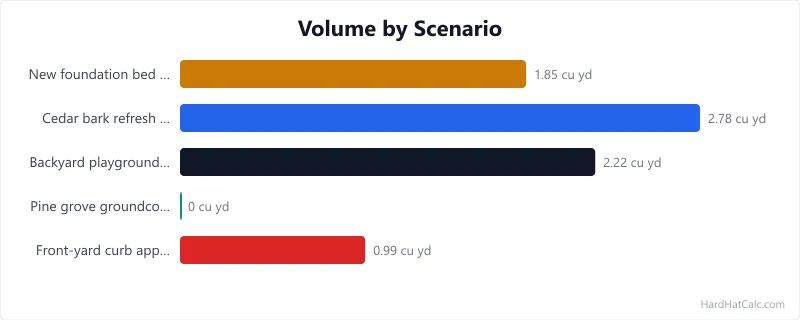
Scenario: A homeowner is mulching a new 20-foot by 10-foot foundation planting bed with shredded hardwood mulch at 3 inches deep, ordered as a bulk delivery from a supplier 5 miles away. No recurring spend yet — the question is the one-time install cost.
Calculation: Area = 20 × 10 = 200 sq ft. Depth in feet = 3 ÷ 12 = 0.25 ft. Volume = 200 × 0.25 = 50 cu ft = 1.85 cu yd. Bag count at 2 cu ft = ⌈50 ÷ 2⌉ = 25 bags. Bulk material = 1.85 × $37.50 = $69. Delivery = $0 (within 10-mile free zone). Bulk total = $69. Bagged equivalent = 25 × $4.25 = $106.
What this means: A 200 sq ft hardwood bed needs about **1.85 cubic yards** of mulch — one yard-bag truck drop. The bulk material runs **$69** with free local delivery, against **$106** in retail bagged equivalents — bulk wins by roughly a third even at this modest volume. The crossover where bagged starts beating bulk happens below about 1 cubic yard for hardwood; above that, the per-cubic-foot bulk price gap absorbs the supplier minimum and bulk is cheaper across the board until you hit a delivery zone with per-mile fees.
Takeaway: For a single one-time install above 200 sq ft, call a local landscape supplier rather than buying bags from a home centre — even with no per-mile fee, the $30-$40 you save on the material is more than the labour of waiting for a drop. If the bed will be refreshed every year, that saving compounds: at five years, $40/year is $200 of avoided spend on the material side alone.
Example 2
Scenario: A homeowner is doing the second-year top-up on an established 30-foot by 20-foot cedar bark mulch bed at 1.5 inches deep, with DIY pickup in a pickup truck. The bed runs on a biennial refresh cycle — every other spring — so the question is the per-refresh cost and the annualised spend.
Calculation: Area = 30 × 20 = 600 sq ft. Depth in feet = 1.5 ÷ 12 = 0.125 ft. Volume = 600 × 0.125 = 75 cu ft = 2.78 cu yd. Bag count at 2 cu ft = ⌈75 ÷ 2⌉ = 38 bags. Bulk material = 2.78 × $50 = $139. Delivery = $0 (DIY pickup). Bulk total = $139. Annualised at biennial cycle = $139 × 0.5 = $70.
What this means: A 600 sq ft cedar bark refresh needs **2.78 cubic yards** — about one and a half pickup-truck loads with a 1500 lb payload. The bulk material is **$139** for the refresh, which annualises to **$70/year** because the cycle is every other spring. Compare that against the same bed run as annual hardwood at $37.50/cu yd: 2.78 × $37.50 = $104/year, every year. Cedar at biennial undercuts hardwood at annual by $34/year despite the higher unit price — the cycle question reverses what the price-tag-only comparison says.
Takeaway: Cedar and cypress bark hold colour and break down 30-50% slower than shredded hardwood, so a biennial refresh keeps a finished-looking bed for half the labour and a third less cumulative cost. The trap is starting on cedar but reverting to annual refresh anyway out of habit — that erases the entire economic advantage. Decide the cycle before you order the type, then stick to it.
Frequently Asked Questions
- How many cubic yards of mulch do I need for a given bed area?
Multiply length × width (in feet) × depth (in feet — divide inches by 12) and divide by 27 to convert cubic feet to cubic yards. A 200 sq ft bed at 3 inches deep needs about 1.85 cubic yards (200 × 0.25 ÷ 27 = 1.85). The calculator handles this conversion automatically and pairs it with bag count, bulk versus bagged cost, and the annualised refresh budget. For irregular shapes, break the bed into rectangles, calculate each, and add the volumes. The excavation volume tool covers the related case of how much earth came out before the mulch goes in.
- Should I buy mulch in bulk or by the bag?
Bulk wins above about 1 cubic yard for hardwood and bark, and above about 2 cubic yards for rubber and dyed. Below those thresholds, retail bagged mulch is competitive once you account for the supplier delivery minimum. A 200 sq ft hardwood install at 3 inches needs 1.85 cu yd — bulk material runs about $69 (free local delivery within 10 miles), versus 25 retail bags at $4.25 each = $106. The same crossover-point logic shows up for aggregate base layer ordering on driveway and patio projects, where the per-mile delivery fee swings the bulk-vs-bag math the same way.
- How often does mulch need to be replaced or refreshed?
Hardwood mulch refresh is annual, bark is biennial, pine straw is annual, rubber is once per decade, and dyed is annual if you want to maintain the colour. The refresh interval is what drives the long-run cost more than the price per cubic yard you pay at the supplier. Cedar and cypress bark cost more per yard than shredded hardwood but last twice as long, so over five years cedar is actually the cheaper material. Set the refresh cycle in the calculator and the annualised cost line shows the lifetime spend rather than the one-time install number — that is the figure to compare across types.
- What is the difference between hardwood mulch and bark mulch?
Hardwood mulch is shredded oak, maple, or mixed deciduous wood including the bark, cambium, and inner wood. It breaks down into compost within 12-18 months, contributing organic matter to the soil but requiring annual refresh to maintain depth. Bark mulch is the outer bark only — usually cedar, cypress, or pine — separated from the wood at the sawmill. The natural oils in bark (cypressene in cypress, thujones in cedar) resist decomposition and deter many insects, so bark mulch holds its structure for 24-36 months and supports a biennial refresh cycle. Bark also moves less in heavy rain because of its chunky texture, which makes it the right pick for sloped beds where shredded hardwood would wash out. The companion paver bedding sand sizing covers a related question for any masonry edging that frames the bed.
- Does mulch attract termites?
No — mulch does not attract termites from outside, but it can hide existing termite activity by covering the foundation perimeter where mud tubes would otherwise be visible. Termites are already present in soil throughout most of the eastern and southern US; mulch over a colony is just additional cover. The standard preventive measure is a 6-inch mulch-free gap between the mulch line and the foundation siding, inspected annually for mud tubes. Cypress and cedar mulches contain natural insect-repelling compounds (thujone, cypressene) and are commonly chosen for foundation beds for that reason. Rubber and pine straw are termite-neutral. The same perimeter-clearance principle applies when sizing the shed foundation pad on a free-standing outbuilding — a gravel skirt around the perimeter blocks termite access in the same way.
More Materials calculators
Browse all materials calculators — Paint coverage, roofing bundles, tile adhesive, welding time, parking lot sizing, and more.