
Deck Building Materials List
Deck building materials list from footings to railings — pressure-treated lumber, joists, decking, fasteners, and hardware for a ground-up deck build.
The first material you need for a deck build is not lumber, concrete, or screws. It is a permit application. Most jurisdictions in the US require a building permit for any attached deck — and many require one for freestanding decks above a certain size or height. The permit application forces you to produce a plan with dimensions, a materials list, and (often) an engineer-stamped drawing for the ledger connection and footing design. Skipping the permit does not just risk a fine. It risks an insurance claim denial if someone falls through your deck, and it creates a disclosure problem when you sell the house.
I learned this lesson indirectly while renovating our Northumberland property: the previous owner had added a rear patio structure without building control approval, and sorting out the retrospective approval added weeks and cost to our project. Get the permit first. Then buy the materials.
This guide provides the full materials checklist for building a residential deck from the ground up — footings through railings. It is organised by construction phase so you can order in stages or price the entire project at once. Quantities are given as formulas you can scale to your deck dimensions, and the embedded calculator below helps you verify that your design handles the loads it needs to carry.
Length parallel to the joists (the direction joists span).
Width perpendicular to the joists.
2x8 is the most common residential deck joist. Larger joists span farther.
On-centre spacing between joists. 16" is standard for most deck builds.
Species affects allowable bending stress, and the IRC deck table gives southern pine slightly longer spans.
For estimation only. Structural work requires review by a licensed engineer. Local building codes take precedence over any calculator output.
How This Is Calculated
Dead load = decking (2.5 psf) + joist weight/spacing + railings (1.5 psf), based on standard lumber weights per NDS 2024. Section modulus S = 1.5 x depth² / 6. Max uniform load per joist = (8 x Fb x S) / (span² x 12). Total allowable PSF = max load per joist / tributary width. Live load capacity = total allowable - dead load. Max point load = (4 x Fb x S) / (span x 12). Occupant capacity = (live load x 60% deck area) / 160 lbs per person.
Source: Span limits per IRC 2021 Table R507.6 (deck joists, 40 psf live + 10 psf dead, No. 2 grade, wet service). Joist bending values per AWC Design Values for Joists and Rafters 2024 supplement (No. 2 grade) with a flat 0.85 wet-service factor. Live load minimum of 40 psf per IRC Table R301.5 for residential decks (some jurisdictions amend it upward; Washington adopts 60 psf). Joist self-weight per NDS Supplement Table 1B at 35 pcf. Values verified July 2026 and re-verified September 2026 at the AWC origin (DVJR 2024, NDS Supplement 2018/2024, Table 1B).
Phase 1: Foundation Materials
Every deck starts at the ground. The foundation system transfers the deck's dead load (its own weight), live load (people, furniture, snow), and lateral loads (wind, seismic) into the soil. Residential decks use one of three foundation types: poured concrete footings, pre-cast pier blocks, or helical screw piles. The choice depends on your soil conditions, frost depth, and local code requirements.
Poured Concrete Footings
This is the most common foundation for attached decks. Each footing is a column of concrete poured into a cylindrical cardboard form tube (Sonotube is the most recognised brand name) set into a hole dug below the frost line. Frost depth varies by region: 12 inches in the southern US, 36-48 inches in the upper Midwest and Northeast, and up to 60 inches in parts of Minnesota and Alaska (per IRC Table R301.2(1) and local amendments).
Materials per footing:
- Form tube: 8-inch, 10-inch, or 12-inch diameter cardboard tube, cut to the depth of the hole plus 2-3 inches above grade. A 12-inch-diameter tube is standard for most residential deck posts; 8-inch works for lightweight freestanding decks. Cost: $8-$20 per 4-foot tube section, depending on diameter. Prices as of March 2026 at major US retailers.
- Concrete: For a 12-inch-diameter tube at 36 inches deep, you need approximately 2.4 cubic feet of concrete — roughly four 80-lb bags of pre-mixed concrete per footing. For deeper frost depths, scale proportionally. At 48 inches, budget five bags per footing.
- Post base hardware: A galvanised or stainless-steel post base (Simpson Strong-Tie ABU series, for example) set into the wet concrete at each footing location. These lift the post off the concrete surface, preventing moisture wicking into the end grain. Cost: $8-$25 per base depending on the post size and load rating.
- J-bolt or threaded rod: Embedded in the wet concrete to anchor the post base. Typically 1/2-inch diameter by 8-10 inches long. Included with some post base kits; sold separately for others at $2-$4 each.
Footing count depends on your deck dimensions and the joist span. A general rule: one footing per beam support point, with beam support points spaced no more than 8-10 feet apart along the beam, and beams spaced according to your joist span capacity. A 12 × 16 foot deck with a single beam at midspan typically needs four footings: two for the beam and two for the posts at the far corners (if freestanding) or two beam footings plus a ledger connection at the house (if attached). Use the deck joist span calculator to determine your beam placement based on joist size and spacing.
Alternative Foundations
Pre-cast concrete pier blocks (Dek-Block or equivalent) sit on the ground surface and support the post in a notched socket. They cost $7-$15 each and require no digging, no concrete mixing, and no cure time. The limitation: they are not anchored to the ground. In regions with frost heave, pier blocks can shift seasonally, which is acceptable for low, freestanding decks (under 24 inches high, not attached to the house) but not for attached or elevated decks where movement could compromise the ledger connection.
Helical screw piles are steel shafts with helical fins that a machine screws into the ground like a giant corkscrew. They reach below the frost line without excavation and carry verified loads (each pile is load-tested during installation). They cost $150-$350 per pile installed, which is more expensive than poured footings but faster — no digging, no concrete curing, no waiting. They are increasingly popular in cold climates and on sites with difficult soil conditions.
Phase 2: Framing Lumber
The frame is the structural skeleton of the deck. It consists of the ledger board (if attached to the house), beams, joists, rim joists, and blocking. All framing lumber must be pressure-treated for ground contact or rated for the exposure conditions. The treated lumber grade you need depends on the proximity to ground and moisture.
Lumber Grade and Treatment
Pressure-treated lumber for decks falls into two main exposure categories defined by the American Wood Protection Association (AWPA):
- Ground Contact (UC4A): Required for any lumber in contact with the ground or embedded in concrete — posts, rim joists close to grade, and any beam sitting less than 6 inches above soil. UC4A treated lumber has higher preservative retention and costs 10-15% more than above-ground treated lumber.
- Above Ground (UC3B): Acceptable for joists, decking, and railings that are at least 6 inches above grade with adequate ventilation underneath. This is the standard deck framing treatment level.
Framing Components
Ledger board: If the deck attaches to the house, the ledger is a horizontal board (typically 2×8, 2×10, or 2×12 to match the joist depth) lag-bolted or through-bolted to the house rim joist or framing. Length: equal to the deck width at the house wall. The ledger connection is the most failure-prone element of a residential deck — per a Consumer Product Safety Commission study, ledger separation is the leading cause of deck collapses. Use 1/2-inch lag screws or through-bolts at 16 inches on centre in a staggered pattern, with proper flashing above the ledger to prevent water intrusion into the house wall. One board, plus stainless-steel flashing material (10-foot roll of peel-and-stick or bent metal flashing).
Beams: Beams run perpendicular to the joists and sit on top of the posts. For most residential decks, beams are built up from two or three 2× boards bolted together (a doubled 2×10 or tripled 2×8, for example). Beam sizing depends on the tributary span — how much joist length the beam supports — and the total load. The IRC prescribes beam sizes in Table R507.5 based on joist span and beam span between posts. Count: one beam for each row of posts. Length: the full width of the deck at each beam location.
Joists: Joists run from the ledger (or far rim joist) to the beam, spaced at 12, 16, or 24 inches on centre. Size ranges from 2×6 (short spans up to 9 feet at 16 inches OC in southern pine) to 2×12 (spans up to 16 feet 6 inches in southern pine at 16 inches OC) per IRC Table R507.6. Joist count formula: (deck length in inches ÷ joist spacing in inches) + 1, rounded up. A 16-foot-long deck at 16-inch OC spacing needs (192 ÷ 16) + 1 = 13 joists. Each joist is cut to the distance from the ledger face to the outer face of the rim joist.
Rim joists: These cap the ends of the joists on the open sides of the deck (the sides not attached to the house or a beam). They close the frame and provide edge nailing for the decking. Count: two pieces for a rectangular deck (one at the far end, one at each open side). Use the same lumber size as the floor joists.
Blocking: Short pieces of joist lumber installed perpendicular between joists at midspan (for long spans) and at the rim joist (to prevent joist rollover). Blocking count: one piece between each pair of joists at each blocking line. For 13 joists, that is 12 blocks per line.
Posts
Posts transfer loads from the beams down to the footings. Standard residential deck posts are 4×4 for decks under 6 feet tall and light loads, or 6×6 for taller decks, heavy loads, or any post that also supports the railing. IRC 2021 Table R507.4 keys maximum 4×4 post height to the deck area each post carries — a southern pine 4×4 clears 8 feet only up to about 107 square feet of tributary area, and the Douglas fir group cuts off near 65 square feet. Use 6×6 posts for any deck where the post height exceeds 4 feet or where notched posts support the beam (notching a 4×4 leaves dangerously little cross-section). Post count equals footing count: one post per footing.
Phase 3: Decking and Fasteners
Decking is the surface you walk on — the most visible part of the deck and the most variable in cost. Material choice here has the biggest impact on both upfront budget and long-term maintenance.
Decking Material Options
Three categories dominate the residential market. Prices as of March 2026. Source-set correction of 2026-08-22: the attribution to RS Means and major retailer pricing is withdrawn (the 2026 RS Means catalog carries no product under the cited naming, its data is subscription-only and was never opened, and no retailer price capture was ever recorded); the figures are unchanged and ship unverified. Regional variation of 10-20% is typical.
Pressure-treated softwood (Southern Yellow Pine, Douglas Fir) is the budget option. Cost: $1.50-$3.00 per linear foot for 5/4×6 boards (the standard decking profile — 5/4 refers to 1-inch actual thickness after surfacing). Pros: lowest upfront cost, widely available, takes stain and paint. Cons: requires staining or sealing every 2-3 years, prone to warping, checking (surface cracks), and splinters as it ages. Lifespan with maintenance: 15-25 years.
Composite decking (Trex, TimberTech, Fiberon) is a mix of wood fibers and plastic polymers extruded into board profiles. Cost: $3.50-$8.00 per linear foot for grooved-edge boards (hidden fastener compatible). Pros: no staining required, resists rot and insects, consistent colour, 25-year manufacturer warranties typical. Cons: higher upfront cost, retains heat in direct sun (uncomfortable barefoot on dark colours), cannot be stained or painted (colour is permanent), and heavier than wood.
Tropical hardwood (Ipe, Tigerwood, Cumaru) is the premium natural option. Cost: $6.00-$14.00 per linear foot. Pros: exceptional durability (30-50+ year lifespan), natural beauty, extremely hard surface resists scratches. Cons: very expensive, extremely dense (difficult to cut and drill — requires carbide tools and pre-drilling every fastener hole), and heavy (Ipe weighs roughly 70 lbs per cubic foot vs 35 lbs for pressure-treated pine). Not stocked at most building supply stores — requires specialty lumber dealer orders with 2-4 week lead times. If you are planning a covered deck or pergola roof over your decking, the roofing materials breakdown covers what you need for that overhead structure.
Decking Quantity
Decking boards run perpendicular to the joists. For a rectangular deck, the quantity calculation is: (deck width in inches ÷ board coverage width including gap) × deck length in feet. Standard 5/4×6 decking has an actual face width of about 5.5 inches, with a 1/8-inch gap between boards. Effective coverage per board: 5.625 inches. A 12-foot-wide deck needs 12 × 12 ÷ 5.625 = 25.6 boards — round up to 26 boards. Each board runs the full length of the deck (or is spliced over a joist if the deck is longer than the available board lengths).
Add 10-15% for waste — angled cuts at the perimeter, boards that warp or split, and colour matching (composite decking can vary slightly between production lots). For the 12 × 16 foot deck example: 26 boards × 16 feet × 1.12 waste = 466 linear feet of decking.
Fasteners
Decking fasteners must be corrosion-resistant. Pressure-treated lumber contains copper compounds (ACQ — Alkaline Copper Quaternary) that corrode plain steel and galvanised fasteners. Use one of the following:
- Stainless steel screws (Type 305 or 316): The gold standard. Type 316 is required within 300 feet of salt water. Cost: $0.08-$0.15 per screw — roughly $40-$75 per 1-pound box (70-100 screws per pound). Budget 350-400 screws per 100 sq ft of decking (two screws per board-joist intersection).
- Coated deck screws (ceramic or polymer coated): Cheaper than stainless but with limited warranty against corrosion — typically 10-25 years versus lifetime for stainless. Cost: $0.04-$0.08 per screw. Common brands: GRK, SPAX, FastenMaster.
- Hidden fastener systems (for grooved-edge composite): clips or tracks that fit into grooves milled into the board edges, securing the decking from below with no visible fasteners on the surface. Cost: $80-$150 per 100 sq ft depending on the system. Trex, TimberTech, and Camo each have proprietary systems.
Phase 4: Railing and Stairs
Railings are required on any deck surface 30 inches or more above grade per IRC Section R312.1. The railing system must be at least 36 inches tall (42 inches in some jurisdictions — check local amendments) and must resist a 200-pound lateral load at the top rail per IRC Section R301.5. This is not a suggestion; it is a structural requirement. A railing that looks nice but pulls away from the post under load is a safety hazard and a code violation. For elevated decks with a covered roof structure, the railing posts often double as supports for the roof framing — in that case, choosing the right truss type for your porch or pergola roof affects post sizing and spacing.
Railing Components
Posts: Railing posts are typically 4×4 lumber or hollow aluminium/composite sleeves over a metal core. Post spacing: maximum 6 feet on centre for wood railings (8 feet for metal or engineered systems, per manufacturer specs). Post count formula: deck perimeter requiring railing (exclude the house wall side on an attached deck) ÷ post spacing, plus one for each end and each corner. A 12 × 16 foot attached deck (three open sides: 16 + 12 + 16 = 44 linear feet of railing) at 6-foot post spacing needs (44 ÷ 6) + 4 corners = roughly 12 posts.
Top rail and bottom rail: Horizontal rails running between posts at the top and bottom of the baluster field. Two rails per section. Length: equal to the distance between posts (cut to fit). Material: 2×4 flat or a milled rail profile that the balusters slot into.
Balusters (spindles): Vertical infill members between the rails. IRC Section R312.1.3 requires that a 4-inch sphere cannot pass through any opening in the railing — which means balusters spaced no more than 4 inches apart on centre (3.5-inch clear gap with standard 3/4-inch-thick balusters). Baluster count per section: (section length in inches ÷ 4) + 1. A 6-foot (72-inch) section needs 19 balusters. Standard wood balusters are 2×2 × 36 inches; aluminium balusters are 3/4-inch round or square tubes.
Stairs
A deck more than 8 inches above grade needs at least one stairway for access. Stair design is governed by strict code requirements for rise, run, and width:
- Maximum riser height: 7-3/4 inches (IRC R311.7.5.1)
- Minimum tread depth: 10 inches (IRC R311.7.5.2)
- Minimum stair width: 36 inches (IRC R311.7.1)
- Handrail required: on at least one side for four or more risers (IRC R311.7.8)
The staircase dimension calculator computes the riser count, tread dimensions, and stringer length based on your total deck height. Stair materials per set of stairs:
- Stringers: 2×12 pressure-treated lumber, cut in a sawtooth pattern. For a 36-inch-wide stair, use 3 stringers (one at each side, one in the centre). Length depends on the total rise — a 48-inch-tall deck with 7.5-inch risers needs roughly 8-foot stringers. Stringer layout requires a framing square with stair gauges — or cut from a template calculated to your exact rise and run.
- Treads: Two 5/4×6 decking boards per tread (12 inches total, with a 1-inch nosing overhang on the front). Tread count equals the number of risers minus one. A 48-inch deck with 7.5-inch risers has 6.4 risers — round to 7 risers, meaning 6 treads. Each tread uses two boards cut to 36 inches.
- Risers (optional): 1×8 boards covering the vertical face of each step. Closed risers are a code requirement if the stair is more than 30 inches above grade in some jurisdictions. Open risers must not allow passage of a 4-inch sphere per IRC R311.7.5.3.
Phase 5: Hardware and Connectors
Structural hardware connects every framing member to its neighbours. This category is easy to underestimate because each piece is small and cheap — but a deck has dozens of connection points, and forgetting hardware at any of them can create a failure point that undermines the entire structure.
Hardware List by Connection Point
Joist hangers: Galvanised metal brackets that support each joist where it meets the ledger or rim joist. One per joist end that does not rest on top of a beam. For 13 joists on an attached deck with a ledger: 13 hangers at the ledger end. Use Simpson Strong-Tie LUS series (or equivalent) sized to the joist dimensions. Cost: $1.50-$4.00 per hanger depending on size and coating. Use only the manufacturer-specified nails (typically 10d × 1.5-inch joist hanger nails, not standard framing nails — the nail diameter and length are engineered for the hanger's load rating).
Post-to-beam connectors: Galvanised or stainless brackets connecting each post top to the underside of the beam. Simpson BC series or equivalent. Cost: $5-$12 per connector. One per post. These prevent the beam from sliding off the post during lateral loading (wind, seismic).
Ledger lag screws or through-bolts: 1/2-inch diameter by 4-6 inches long, staggered at 16 inches on centre along the ledger. For a 12-foot-wide deck: 9-10 lag screws. Use hot-dipped galvanised or stainless steel. Cost: $1.50-$3.00 per fastener.
Carriage bolts for built-up beams: 1/2-inch carriage bolts through-bolting the beam plies together. Space at 16-24 inches on centre, staggered top and bottom. A 16-foot doubled beam needs roughly 10-12 bolts. Cost: $1.00-$2.50 per bolt with washer and nut.
Post base anchors: Listed under Phase 1, but double-check that your post bases match the post size. A 6×6 post needs a 6×6 base — a 4×4 base will not support the larger post and fails code inspection.
Angle brackets and hurricane ties: L-shaped brackets reinforcing the joist-to-beam connection where joists sit on top of the beam (rather than hanging from a hanger). Also useful at the rim joist corners. Simpson A35 or equivalent. Cost: $0.75-$1.50 each. Budget one per joist-beam bearing point.
Miscellaneous Hardware
- Self-sealing ledger flashing (peel-and-stick membrane): 1 roll per 25 linear feet of ledger — about $30-$50 per roll
- Joist tape (self-adhesive protective membrane applied to the top edge of each joist to prevent moisture rot): 1 roll covers roughly 50 linear feet — about $18-$35 per roll
- Structural screws (GRK, SDWS, or equivalent) for post-to-beam and ledger connections where specified: $0.50-$1.50 per screw
- Galvanised nails (16d sinker for framing connections not requiring hangers): 5-lb box per 100-150 sq ft of deck — about $12-$18 per box
All hardware prices are as of March 2026, based on US national averages from major building supply retailers. Regional variation of 10-20% is typical depending on supplier and brand.
Putting It All Together: Sample Bill of Materials
Here is the consolidated materials list for a 12 × 16 foot attached deck, 36 inches above grade, with pressure-treated framing, composite decking, wood railing, and one set of stairs. This example assumes 16-inch joist spacing, a single beam at 8-foot span from the house, 4-foot post height, and 36-inch frost depth.
| Category | Item | Quantity | Estimated Cost |
|---|---|---|---|
| Foundation | 12" Sonotube (4 ft) | 4 | $64-$80 |
| Foundation | 80-lb concrete bags | 16 | $80-$112 |
| Foundation | Post base anchors (6×6) | 4 | $48-$100 |
| Framing | 2×10×12 PT (ledger) | 1 | $28-$40 |
| Framing | 2×10×16 PT (beam plies) | 2 | $56-$80 |
| Framing | 2×10×8 PT (joists) | 13 | $195-$273 |
| Framing | 2×10×16 PT (rim joists) | 2 | $56-$80 |
| Framing | 6×6×4 PT posts | 4 | $60-$100 |
| Framing | 2×10 blocking (cut from 12 ft) | 2 boards | $28-$40 |
| Decking | Composite 5/4×6×16 (grooved) | 30 boards | $1,680-$3,840 |
| Fasteners | Hidden fastener clips | ~200 | $150-$290 |
| Railing | 4×4×42" railing posts | 12 | $72-$120 |
| Railing | 2×4 top/bottom rails | 16 pieces | $80-$144 |
| Railing | 2×2×36" balusters | ~175 | $175-$350 |
| Stairs | 2×12×8 PT (stringers) | 3 | $60-$90 |
| Stairs | 5/4×6×36" treads | 12 pieces | $42-$96 |
| Hardware | Joist hangers (2×10) | 13 | $26-$52 |
| Hardware | Post-to-beam connectors | 4 | $20-$48 |
| Hardware | Ledger lag screws (1/2"×4") | 10 | $15-$30 |
| Hardware | Beam carriage bolts | 12 | $12-$30 |
| Hardware | Angle brackets | 13 | $10-$20 |
| Hardware | Ledger flashing (roll) | 1 | $30-$50 |
| Hardware | Joist tape (roll) | 1 | $18-$35 |
| Hardware | Structural screws (assorted) | 1 box | $35-$65 |
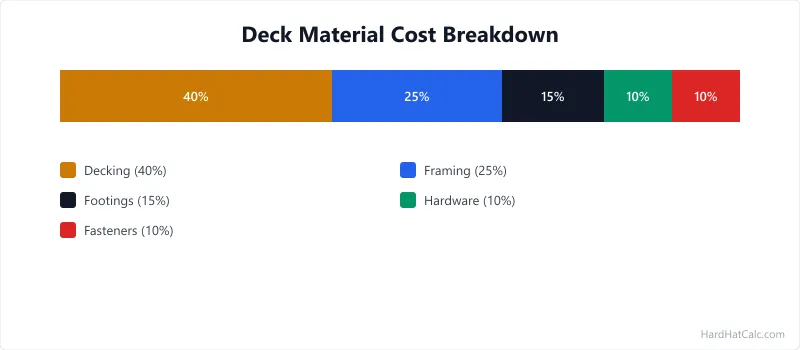
Total estimated material cost for this 12 × 16 deck: $3,090-$6,245. The wide range reflects the decking material choice — composite decking accounts for 40-60% of the total material budget. Switching to pressure-treated wood decking drops the total by $800-$2,400. Switching to Ipe hardwood adds $1,200-$3,000 on top of the composite pricing.
Labour for professional deck construction runs $15-$35 per square foot of deck area in most US markets. For a 192 sq ft deck, that is $2,880-$6,720 on top of materials. DIY builds save the labour cost but require 3-5 weekends for a deck this size, plus tool costs (circular saw, drill/driver, post hole digger or auger, framing square, level, string line, and potentially a concrete mixer). For how the whole-project total scales, the cost guide breaks down what a deck costs across sizes and materials.
Common Ordering Mistakes
These errors appear on deck projects with surprising consistency. Each one either stalls the build or creates a structural deficiency that passes unnoticed until the first inspection — or the first failure.
Wrong treatment level for the application. Using above-ground (UC3B) treated lumber for posts that contact concrete or sit within 6 inches of the ground. Ground-contact (UC4A) treatment costs slightly more but prevents premature rot at the most vulnerable points in the structure. Every post and every board within 6 inches of the soil should be UC4A.
Wrong fasteners for pressure-treated lumber. Standard galvanised nails and screws corrode in contact with ACQ-treated lumber — the copper in the treatment eats through the zinc coating within 2-5 years. Hot-dipped galvanised (HDG), stainless steel, or ceramic-coated fasteners are required. This applies to every fastener: framing nails, deck screws, joist hanger nails, lag screws, and bolts. One wrong box of nails in the joist hangers can compromise the entire joist connection system.
Forgetting the ledger flashing. Water that penetrates behind an unflashed ledger board causes rot in the house rim joist — the most expensive repair on a deck project because it involves tearing off the deck and repairing the house framing. Ledger flashing costs $30-$50 and takes 30 minutes to install. Rim joist replacement costs $2,000-$5,000. The math is not complicated.
Undersized footings for the soil conditions. A 12-inch-diameter footing on sandy soil with a bearing capacity of 1,500 PSF supports less load than the same footing on compacted gravel at 3,000 PSF. If your soil is soft, sandy, or has a high water table, the footings may need to be wider (16-inch tubes) or deeper. A soils report ($300-$600) tells you the bearing capacity before you pour. On suspect soil, it is cheaper than redoing footings that sink.
Before finalising your materials list, verify the structural capacity of your design against the intended loads. The deck weight limit calculator checks whether your joist size, spacing, and beam placement handle the dead load, live load, and snow load your deck needs to support. Running the numbers before the lumber arrives is far cheaper than adding mid-build reinforcement.
Frequently Asked Questions
- How many footings do I need for a 12×16 deck?
A typical 12×16 foot attached deck needs 4 footings: two supporting the beam at the far end of the joists and two at the corners if the beam extends to the deck edges. The exact count depends on your beam span and post spacing. If the beam spans the full 12-foot width with posts only at each end, two footings may suffice for the beam — but most builders add a centre post for a 12-foot beam span, bringing the total to 3 beam footings. A freestanding deck (not attached to the house) needs additional footings along the house side. Your local building inspector may require specific footing layouts based on your soil conditions and frost depth. A pier-footing sizer determines diameter and depth for each post footing based on load and soil bearing capacity.
- Can I use regular lumber instead of pressure-treated for deck framing?
No — untreated lumber in an outdoor deck application will rot within 3-7 years, depending on climate and exposure. All structural framing (ledger, beams, joists, posts, rim joists) must be pressure-treated lumber rated for the specific exposure condition. Posts in contact with concrete or soil need Ground Contact (UC4A) treatment. Joists and beams above grade need at least Above Ground (UC3B) treatment. The only exception is naturally rot-resistant species like redwood heartwood or white oak, which resist decay without treatment but cost two to four times more than pressure-treated pine and are rarely available in structural dimensions at standard lumber yards. For the surface layer, the deck board calculator estimates board counts and fasteners by area and layout pattern. Footing pours for the deck posts use the techniques covered in the concrete mix ratios guide, which explains 1:2:3 versus 1:2:4 mixes for residential pours.
- What size screws should I use for composite decking?
Most composite decking manufacturers specify #8 or #10 stainless steel or coated screws, 2.5 to 3 inches long, for face-fastened installation. For hidden fastener systems (the preferred method for grooved-edge composite boards), the manufacturer provides specific clips and screws designed for their product — using generic fasteners often voids the warranty. Trex, TimberTech, and Fiberon each have proprietary hidden fastener systems. Always check the decking manufacturer installation guide for the exact fastener specification before buying. Using the wrong screw can cause mushrooming (the screw head pushes up a bump of composite material around the hole), cracking, or warranty denial. Heavier composite boards also demand closer joist spacing — check the joist span tables to confirm your framing supports the chosen material.
- How far apart should deck joists be spaced?
Standard residential deck joist spacing is 16 inches on centre for most applications. Composite decking manufacturers often require 16-inch maximum spacing (some require 12-inch spacing for diagonal decking patterns). Pressure-treated wood decking can tolerate 24-inch spacing on 5/4×6 boards, though 16-inch provides a stiffer, less bouncy surface. The joist spacing also determines the maximum joist span — a 2×10 at 16-inch OC spans up to 13 feet 7 inches (14 feet in southern pine) per IRC Table R507.6, while the same joist at 12-inch OC reaches 15 feet 8 inches. Shorter spacing means more joists and more cost, but a stronger, stiffer deck. Confirm the total deck weight limit to verify the structure handles both dead load and live load at your chosen spacing.
- Do I need a permit to build a deck?
In most US jurisdictions, yes — a building permit is required for any deck attached to a house and for freestanding decks above a certain height (typically 30 inches above grade) or size. The permit process requires submitting a plan showing dimensions, materials, footing locations, and often an engineer-stamped detail for the ledger connection. Permit fees range from $100 to $500 depending on the municipality and project size. Building without a permit risks fines, forced demolition, insurance claim denial, and complications when selling the property. Some jurisdictions exempt small, low, freestanding platforms (under 200 sq ft and under 30 inches high) — check your local building department before assuming you are exempt. If the deck includes stairs, you can size footing dimensions for the landing pad at the base.