
Pier Footing Size Calculator
Size your footings right. This pier footing size calculator uses column load, soil bearing capacity, and frost depth to output width and concrete volume.
Last updated:
Total load transferred through the post or column to this footing.
IRC presumptive classes: clay/sandy clay/silt 1,500 psf. Sand and silty sand 2,000 psf. Gravel and sandy gravel 3,000 psf. Sedimentary rock 4,000 psf.
Local frost line depth. Footings must extend below this.
Square footings use lumber forms. Round footings use Sonotube cardboard forms.
For estimation only. Structural work requires review by a licensed engineer. Local building codes take precedence over any calculator output.
How This Is Calculated
Required area (sq in) = (column load in lbs / soil bearing capacity in psf) × 144. Square footing side = ceil(sqrt(area)). Round footing diameter = ceil(sqrt(4 x area / pi)). Both rounded up to the nearest 2 inches. Minimum depth = max(frost depth + 6", 12"). Concrete volume = footing area x depth / 1,728. Estimated cost = volume x $5.93/cu ft + form cost + $5 misc.
Source: Footing sizing follows IRC 2021 Section R403.1 (Minimum Width and Depth of Footings) and Table R401.4.1 (Presumptive Load-Bearing Soil Values). Frost depth requirements per IRC R403.1.4. Presumptive bearing classes per IRC Table R401.4.1 (clay class 1,500 / sand class 2,000 / gravel 3,000 / sedimentary rock 4,000 psf), verified July 2026 against four published code reproductions.
6 min read
How Soil Type Sets Your Footing Size
Every deck post, pergola column, and support pier transfers its load through a footing to the soil beneath — and that footing must spread the load over enough area that the soil can handle the pressure without settling. Get the footing too small and the structure sinks. Oversize it and you waste concrete, labour, and excavation effort.
The core relationship is straightforward: divide the total column load by the soil's bearing capacity to get the required footing area. A 4,000-lb post load on clay soil rated at 1,500 PSF needs at least 2.67 square feet of footing contact — about a 20-inch square pad. The same load on well-compacted gravel (4,000 PSF) only needs 1 square foot, which is a 12-inch pad.
Soil bearing capacity is the critical variable, and it varies dramatically. The IRC assigns presumptive values by soil type that inspectors accept for residential work without a geotechnical report. Sandy gravel handles nearly three times the pressure of soft clay. If you are uncertain about your soil type, a simple test dig to 3-4 feet reveals the composition, or your local building department can tell you the default value they use for permits in your area. For footings that also serve as fence post anchors, the post depth and footing depth requirements often overlap — size the footing for the greater of the two.
Soil Bearing Capacity Reference
The table below shows the presumptive bearing values that most jurisdictions accept for residential footing design. These are conservative — actual bearing capacity may be higher, but using the presumptive values keeps you on the safe side of the building inspector's expectations.
| Material Class (IRC) | Bearing Value (PSF) | Description | Common Locations |
|---|---|---|---|
| Clay, sandy clay, silty clay, silt | 1,500 | Sticky or floury when wet, holds shape when squeezed | River valleys, flood plains, low-lying areas |
| Sand, silty sand, clayey sand, silty gravel | 2,000 | Gritty, loose to moderately cohesive, drains well | Coastal areas, sandy plains, suburban lots |
| Gravel and sandy gravel | 3,000 | Coarse particles, excellent drainage | Glacial deposits, hillsides, quarry sites |
| Sedimentary and foliated rock | 4,000 | Layered rock — sandstone, shale, slate | Rock-shelf regions, cut hillsides |
| Crystalline bedrock | 12,000 | Solid granite-class rock | Mountain regions, shallow-bedrock areas |
Values verbatim from IRC 2021 Table R401.4.1 (the classes group by Unified Soil Classification symbols). These are conservative presumptive values — actual capacity may be higher with a geotechnical investigation. Note that sandy clay sits in the 1,500-psf clay class, not the sand class.
If you are sizing footings for a deck project, the post-load lookup helps you determine the total load each post carries before you plug those numbers in here.
Sizing Your Footing: Step by Step
Footing sizing follows a logical sequence from load to soil to dimensions. Each step builds on the previous one, and skipping ahead leads to footings that are either too small (settlement risk) or wastefully oversized.
Call 811 before digging. Underground utility lines (gas, electric, water, cable) can cause serious injury or death if struck during excavation. This free service marks buried utilities within 48–72 hours.
Determine the total load on each post. Add dead load (weight of the deck structure itself — framing, decking, railing) to live load (occupants, furniture, snow). For a typical residential deck, dead load runs 10-15 PSF and live load is 40 PSF per code. Multiply by the tributary area each post supports to get the column load in pounds.
Identify your soil type. Dig a test hole to the frost depth. Note what you hit: sticky clay, sandy mix, gravel, or rock. Match it to the IRC presumptive values in the table above. When in doubt, use the lowest value that could apply — conservative sizing costs an extra bag of concrete, while undersizing costs a jackhammer and a re-pour.
Divide load by bearing capacity. This gives the required footing area in square feet. Multiply by 144 to convert to square inches, which is more practical for sizing a footing pad.
Calculate the footing width or diameter. For a square footing, take the square root of the area. For a round footing (Sonotube), use the circle area formula solved for diameter. Round up to the nearest 2 inches — standard form tubes and lumber dimensions work in even-inch increments.
Set the depth. The footing must reach at least 6 inches below the local frost line, with an absolute minimum of 12 inches. Your local building official can confirm the frost depth for your jurisdiction — it ranges from 0 inches in southern Florida to 72 inches in northern Minnesota.
These six steps produce a footing that satisfies both the bearing capacity requirement and the frost protection requirement. The calculator above automates the maths, but understanding the sequence helps you catch input errors and explain your footing choice to an inspector. If your footings are part of a larger deck project, the footings-to-railing materials guide covers every material from the footings up through decking boards and railing.
Round vs. Square Footings
Choosing between round and square footings is partly structural and partly practical. Both work fine for residential pier footings — the deciding factors are load magnitude, available tools, and personal preference.
Round footings use Sonotube cardboard form tubes, available at any building supply store in diameters from 8 to 24 inches. Dig the hole with a post-hole digger or power auger, drop in the tube, backfill around it, and pour. The process is fast and clean. Sonotubes are the standard choice for deck posts and lighter loads because the post-hole digger workflow matches the round shape naturally. The main limitation is diameter — standard Sonotubes top out at 24 inches. If your calculation calls for a 28-inch footing, you either switch to square or special-order an oversized tube.
Square footings use lumber forms (typically 2x8 or 2x10 boards) set in a level, excavated pad. They deliver more bearing area per inch of width than round footings because a square encloses more area than a circle of the same dimension. A 20-inch square footing provides 400 square inches of bearing area; a 20-inch round footing provides only 314 square inches. For heavy loads where every square inch matters, square footings are more efficient.
For shed projects where pier blocks might replace poured footings entirely, the shed foundation calculator compares foundation options by cost and complexity.
In practice, most deck builders use round Sonotubes for posts up to about 6,000 lbs and switch to square forms for heavier loads or when the required diameter exceeds available tube sizes. Either shape satisfies code when sized to the correct bearing area.
Frost Heave: The Force That Lifts Footings
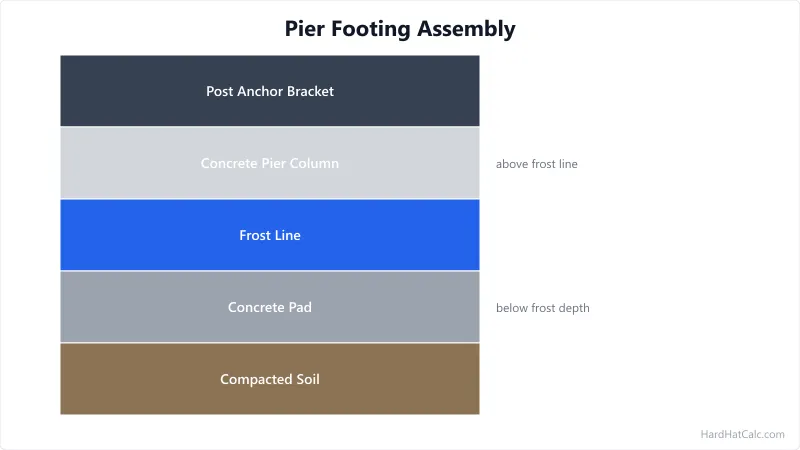
Frost heave is the silent destroyer of deck foundations. When water in the soil freezes, it expands by roughly 9% — and that expansion generates enough force to lift concrete footings, crack foundation walls, and shift entire structures. A footing that sits above the frost line is essentially sitting on a hydraulic jack that activates every winter.
The IRC requires footings to extend below the frost penetration depth for exactly this reason. The frost line varies dramatically across the US: 0 inches in coastal Southern California and South Florida, 36 inches across the mid-Atlantic and Midwest, and 60-72 inches in northern Minnesota and mountainous regions. Your local building department can provide the exact number for your jurisdiction — this is one of the first questions an inspector asks when reviewing a deck permit.
Standard practice adds 6 inches below the published frost depth as a safety margin. If your area lists a 36-inch frost line, pour your footing to 42 inches. The extra 6 inches of concrete costs almost nothing but eliminates any risk from year-to-year frost depth variation.
For large footings carrying heavy loads, adding rebar improves resistance to cracking from soil movement and freeze-thaw cycles — the rebar quantity tool sizes the steel based on footing dimensions and loading.
One common mistake: pouring footings in late autumn when the ground is already partially frozen. Frozen soil at the bottom of the hole insulates the concrete from the earth below, preventing proper bonding. If the frost retreats after the pour, the footing can settle unevenly. Pour footings when the soil at the bottom of the excavation is unfrozen and firm.
Worked Examples
Example 1
Scenario: A homeowner is sizing a footing for a deck post carrying 6,000 lbs on sand (2,000 psf presumptive bearing per IRC Table R401.4.1) with a 36-inch frost depth.
Calculation: Required area = (6,000 / 2,000) × 144 = 432 sq in. Square side = √(432) = 20.8", rounded up to 22" (nearest 2-inch increment). Minimum depth = 36 + 6 = 42" (6 inches below frost line). Volume = (22 × 22 × 42) / 1,728 = 11.76 cu ft. Cost = 11.76 x $5.93 + $5 misc = $74.74.
What this means: A 22-inch square footing needs nearly 12 cubic feet of concrete — roughly half a cubic yard. At this volume, ordering ready-mix from a local plant is more practical than hand-mixing 60-lb bags.
Takeaway: When footing volume exceeds 8-10 cubic feet, ready-mix concrete becomes more economical than bagged mix ($5-6/cu ft vs $8-10/cu ft for bags). Call your local plant — many deliver half-yard minimums.
Example 2
Scenario: A lightweight pergola post carrying 1,200 lbs bearing on sedimentary rock (4,000 psf presumptive bearing per IRC Table R401.4.1) with an 18-inch frost depth in a mild climate.
Calculation: Required area = (1,200 / 4,000) × 144 = 43.2 sq in. Round diameter = √(4 × 43.2 / pi) = 7.4", rounded up to 8". Minimum depth = max(18 + 6, 12) = 24". Volume = pi x 4² × 24 / 1,728 = 0.70 cu ft. Cost = 0.70 x $5.93 + $12 form tube + $5 misc = $21.15.
What this means: Strong bearing material and light loads produce a small footing — an 8-inch Sonotube with less than one cubic foot of concrete. Two 60-lb bags of premix (about $12 total) fills it with room to spare.
Takeaway: Do not assume every footing needs a massive pour. Rock and gravel bearing classes (3,000-4,000 psf) mean pergola and light-structure footings can be surprisingly small. Over-building wastes concrete and labour.
Frequently Asked Questions
- How do I determine soil bearing capacity for my property?
Start with a test dig to 3-4 feet and observe the soil composition. Sticky, moist clay (including sandy clay) sits in the 1,500 PSF class. Sand that drains freely indicates 2,000 PSF. Clean gravel or sandy gravel supports 3,000 PSF, and layered rock 4,000 PSF. These are the IRC Table R401.4.1 presumptive values, which most building departments accept for residential permits without requiring a formal geotechnical survey. For critical structures or unusual soil (fill dirt, peat, expansive clay), hire a geotechnical engineer — a soil bearing test costs $300-$600 and removes all guesswork. Prices and rates on this page are our own estimates as of the date shown; they change often. Enter your own figures for a current result. The earthwork volume tool can help budget for soil removal if your test dig reveals unsuitable fill that needs replacement.
- What happens if a pier footing is too small for the load?
An undersized footing sinks into the soil because the bearing pressure exceeds the soil's capacity. Settlement can be gradual over months — you notice a post dropping a quarter-inch per season — or sudden after heavy rain softens the soil and bearing capacity drops temporarily. Either way, the fix is expensive and disruptive: jack the structure to level, excavate around the existing footing, and pour a larger one. In severe cases, the original footing must be demolished entirely. Sizing footings correctly the first time costs a few extra dollars in concrete; fixing an undersized footing later costs hundreds in labour and materials. The post-to-footing load tool helps you determine the total load each post sends to its footing so you can size with confidence.
- How deep should pier footings be below the frost line?
IRC R403.1.4 requires footings to extend below the frost penetration depth for your locality, and standard practice adds 6 inches below that published depth as a safety margin. If your jurisdiction lists a 36-inch frost line, pour to 42 inches minimum. The absolute minimum footing depth regardless of frost is 12 inches, which applies in frost-free southern regions. Your local building official is the definitive source for the exact frost depth — it is one of the first items checked during a footing inspection, and guessing wrong means tearing out and re-pouring. For the concrete itself, allow adequate curing time before placing any load on the footing.
- Can I use a round footing instead of a square one?
Yes. Round footings using Sonotube cardboard forms are the standard for deck posts and lighter loads up to about 6,000 lbs. For the same width, a round footing has about 21% less bearing area than a square footing (a 20-inch circle is 314 sq in vs 400 sq in for a 20-inch square), so the diameter needs to be slightly larger to match the same area. Square footings become more practical for heavy loads because lumber forms are easier to build in large sizes than sourcing oversized Sonotubes. Either shape satisfies code as long as the total bearing area meets or exceeds the calculated requirement. For heavy footings, adding rebar improves crack resistance — run rebar spacing based on footing dimensions.
More Structural calculators
Browse all structural calculators — Beam sizing, truss pricing, load calculations, wall framing, deck capacity, and foundation tools.