
Concrete Reinforcement Calculator
Free concrete reinforcement calculator for rebar count, spacing, weight, and tie wire. Size a #3-#5 bar layout from slab dimensions per ACI 318.
Last updated:
Methodology reviewed by Doc. dr. sc. Mladenka Juradin, dipl. ing. građ., PhD, Civil Engineering (FCEAG, University of Split)
Length of the slab or footing in the long direction.
Width of the slab or footing in the short direction.
Standard slab-on-grade is 4". Footings are typically 8–12".
#3 for light slabs, #4 for standard slabs and footings, #5 for heavy-duty applications.
On-centre spacing between bars in each direction. 12" is common for residential slabs.
For estimation only. Structural work requires review by a licensed engineer. Local building codes take precedence over any calculator output.
How This Is Calculated
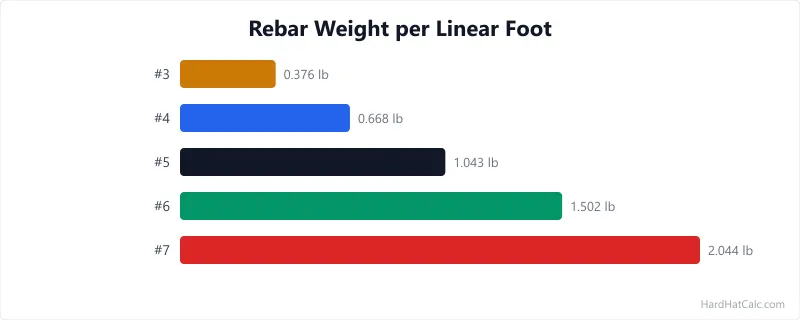
Usable dimension = slab dimension - 2 x 3 in. edge cover. Bars in length direction = floor(usable width in inches / spacing) + 1. Bars in width direction = floor(usable length in inches / spacing) + 1. Total rebar length = (lengthwise bars x usable length) + (widthwise bars x usable width), in feet. Rebar weight = total length x weight per foot (#3: 0.376, #4: 0.668, #5: 1.043 lbs/ft). Tie wire = number of intersections x 0.05 lbs per tie.
Source: Rebar spacing and cover requirements per ACI 318 (Building Code Requirements for Structural Concrete). Bar sizes and weights per ASTM A615/A615M standard. Maximum spacing limits per ACI 318, Section 7.7.2.3 (numbering stable 318-14 through 318-19). Sourcing note of 2026-09-03: ACI 318 is paywalled and has not been opened for this page. The 18-inch / three-times-thickness spacing cap, the four cover depths and the bar size table each rest on three or more free sources read directly. The minimum clear-spacing rule in the FAQ below, the greater of 1 inch, one bar diameter, or 1.33 times the maximum aggregate size, rests on a single free rendering: the UpCodes New York City Structural Concrete Code page. ideCAD's ACI 318-19 reference prints only its first two terms, and ACI's own free FAQ 754 states the aggregate term in reverse, as coarse aggregate not exceeding three-fourths the minimum specified clear spacing. Treat that one rule as thinly sourced and confirm it with your engineer or building official before you set bar spacing. Correction of 2026-09-12 (SF22-HHC-F1 R1, seat-ruled 2026-09-07): the bar count and bar lengths now respect the 3-inch edge cover this page has always instructed (bars = floor((dimension - 6 in.) / spacing) + 1, each dimension - 6 in. long); the former count placed the outer bars on the slab edge and over-counted by 7.7 percent (the 20 x 20 ft FAQ slab: 42 bars and 840 ft became 40 bars and 780 ft). The 40-bar-diameter lap splice is a rule of thumb; a Class B tension splice in 4,000 psi concrete worked through the site's own rebar lap splice calculator comes out near 50 diameters. The four cover tiers are on record from ACI's own FAQ 903, the City of Seattle's 2015 and 2021 Residential Code chapter 4, Loudoun County's cast-in-place concrete specification, the 2022 New York City Building Code chapter 19 (which points to ACI 318 for cover and clear spacing) and ICC's own R403.1.3 code-change form; the up.codes renderings this page once counted are third-party republications of code text and count as derivative, not as sources.
7 min read
Getting Rebar Quantities Right Before the Pour
Running short on rebar mid-pour is one of those mistakes you only make once. Concrete waits for nobody — the truck is on the clock, the crew is on the clock, and pausing to send someone for another bundle of #4 bar costs time, money, and quality. Over-ordering is almost as bad. Rebar is heavy (a bundle of 20-foot #4 bars weighs about 267 pounds), takes up space on site, and leftover stock is hard to return.
This calculator gives you the exact piece count and total linear footage for a rectangular grid of rebar in a slab or footing. You enter the slab dimensions, choose the bar size and spacing, and get back the number of bars in each direction, total weight, tie wire needed, and an estimated material cost.
The standard approach for slab-on-grade reinforcement is a grid pattern: bars running in both directions at equal spacing, tied together at every intersection with wire ties. This creates a mesh that distributes tensile forces from shrinkage cracking, temperature changes, and point loads. For most residential slabs — driveways, garage floors, patios — #4 bar at 12-inch spacing in both directions exceeds code minimums and provides good crack control. The steel only works if the surrounding concrete reaches its design strength, so match the bar layout to a mix that fits the application — the standard residential mixes by application walks through which proportions belong in slabs versus footings versus walls. After placing the steel, allow adequate curing time before loading the slab — rebar holds cracks tight but cannot compensate for concrete that was loaded too early.
How to Place Rebar in a Concrete Slab
Set the edge forms and compact the subgrade. Rebar placement starts after the forms are built and the gravel base is compacted and graded. Any soft spots in the subgrade will cause differential settlement regardless of how much steel you put in the concrete.
Cut rebar to length. Standard rebar comes in 20-foot lengths. For a 20-foot slab, bars span the full length. For slabs longer than 20 feet, overlap bars by at least 24 inches for #4 bar and tie the lap splice with three wire ties: 40 bar diameters is the rule of thumb, and a Class B tension splice in 4,000 psi concrete works out near 50 diameters (25 inches for #4, 31 inches for #5). Use the rebar lap splice calculator to find the correct overlap for your bar size, concrete strength and cover.
Lay the first direction. Place all bars running in one direction at the specified spacing. Use a tape measure from the form edge and mark spacing increments. Maintain 3 inches of clear cover from the slab edges — this keeps the steel from corroding where moisture can reach it. The calculator counts bars and cuts bar lengths inside that 3-inch cover, so the outer bars never sit on the form.
Lay the perpendicular direction on top. Place the second layer of bars at right angles to the first, using the same spacing. The second layer sits on top of the first.
Tie intersections. Wrap 16-gauge tie wire around every intersection or every other intersection (for slabs, tying every other one is acceptable — the concrete locks everything in place). Use a tie wire reel and a simple hook tool to speed this up.
Set bar chairs. Rebar must sit at the correct height within the slab — not on the ground. For a 4-inch slab, position the steel at mid-depth (2 inches from the bottom) using plastic or wire bar chairs (supports) at 2 to 3 foot intervals, the common practice the Wire Reinforcement Institute prints for reinforcement supports (TF 202-R-18); this page formerly said roughly 4 feet. Steel sitting on the subgrade does nothing structural and corrodes rapidly.
Rebar Sizes and Properties
| Bar Size | Diameter | Weight (lbs/ft) | Cross-Section Area (in²) | Typical Use | Cost/ft (March 2026) |
|---|---|---|---|---|---|
| #3 | 3/8" (9.5 mm) | 0.376 | 0.11 | Light slabs, temperature steel, ties | $0.30–$0.45 |
| #4 | 1/2" (12.7 mm) | 0.668 | 0.20 | Standard slabs, footings, walls | $0.45–$0.65 |
| #5 | 5/8" (15.9 mm) | 1.043 | 0.31 | Heavy footings, retaining walls, grade beams | $0.70–$1.00 |
| #6 | 3/4" (19.1 mm) | 1.502 | 0.44 | Foundation walls, columns, heavy structural | $1.00–$1.40 |
| #7 | 7/8" (22.2 mm) | 2.044 | 0.60 | Commercial foundations, bridge decks | $1.35–$1.85 |
Prices and rates on this page are our own estimates as of the date shown; they change often. Enter your own figures for a current result. This table covers the sizes common in residential slabs; the full chart of bar sizes from #3 to #18 adds the larger structural bars and their soft-metric equivalents. Prices as of March 2026, US national averages for Grade 60 rebar. Epoxy-coated rebar (green) adds 25–40% for corrosion protection in exposed or marine environments. Stainless steel rebar costs 5–8x standard but eliminates corrosion entirely. For slabs in fire-rated assemblies, check fireproofing material requirements — concrete cover over rebar doubles as fire protection in many building code tables.
Rebar vs Welded Wire Mesh: When to Use Each
When should I use rebar instead of welded wire mesh? Rebar is the better choice for structural applications: footings, grade beams, retaining walls, and any slab thicker than 5 inches. Rebar provides defined bar sizes and controlled spacing, and it stays in position during the pour when properly chaired. For slabs that carry heavy loads — garage floors with heavy vehicles, shop floors with equipment — rebar gives you more confidence in the reinforcement placement.
When is welded wire mesh acceptable? Welded wire mesh (WWM) works well for lightly loaded slabs-on-grade: sidewalks, patios, light-duty residential driveways, and interior floor slabs. Common mesh sizes are 6x6-W1.4/W1.4 (6-inch grid of light wire) and 6x6-W2.9/W2.9. Mesh is faster to lay than individual rebar — you unroll a sheet and cut to size. The drawback is that mesh tends to end up on the bottom of the slab during the pour (workers step on it and it sinks into the wet concrete), which makes it structurally useless unless it stays elevated on chairs throughout the pour.
Can I combine rebar and mesh? Yes. A common hybrid approach for driveways and garage floors uses #4 rebar at 16–18 inch spacing in both directions supplemented by a layer of wire mesh. The rebar carries the structural load and the mesh provides tighter crack control between the bars. This costs more but gives you the positioning reliability of rebar with the crack control of mesh.
Concrete Cover and Corrosion Protection
Rebar rusts. When it does, the iron oxide (rust) expands to roughly six times the volume of the original steel, which cracks the surrounding concrete from the inside out. Those spider-web cracks you see on old sidewalks and bridge decks? That is rebar corrosion at work.
The primary defence against corrosion is concrete cover — the thickness of concrete between the rebar and the nearest exposed surface. ACI 318 (the governing US concrete code) specifies minimum cover requirements based on exposure conditions:
- Concrete cast against and permanently in contact with earth: 3 inches minimum
- Concrete exposed to weather (#6 bars and larger): 2 inches
- Concrete exposed to weather (#5 bars and smaller): 1.5 inches
- Concrete not exposed to weather or in contact with ground: 0.75 inches
The four tiers are ACI 318-19 Table 20.5.1.3.1, and the IRC prints the same values in R403.1.3.5.3 for footings and R404.1.3.3.7.4 for foundation walls. Cited to IRC R403.1.3.5.3 and R404.1.3.3.7.4. The code text itself is not freely available to link; confirm the figure against the current edition or your local building department before acting. Municipal renderings of the same tiers are on record (Seattle's Residential Code chapter 4, Loudoun County's cast-in-place concrete specification, the New York City Building Code's chapter 19 pointer to ACI 318).
For a typical slab-on-grade — a garage floor or basement slab — the bottom of the slab contacts the earth, so the bottom cover should be 3 inches. The top surface is exposed to weather (freeze-thaw cycles, de-icing salts on a driveway), so the top cover needs 1.5–2 inches.
In a 4-inch slab, that leaves very little room to position the steel correctly — the bar essentially needs to sit at mid-depth. This is why bar chairs are non-negotiable. If rebar ends up on the subgrade with zero bottom cover, it will corrode and the slab will crack within 10–15 years.
If your concrete project involves structural elements like block walls or footings, the rebar requirements and cover rules differ — block wall reinforcement uses vertical bars grouted into the block cores, where cover is provided by the block shell rather than poured concrete. The steel beam calculator can help if your footing supports a steel column — the footing dimensions and reinforcement must match the column load.
Worked Examples
Example 1
Scenario: A homeowner is pouring a 20 × 12 ft driveway slab, 4 inches thick, using #4 rebar at 12-inch on-centre spacing in both directions.
Calculation: Usable width = 12 ft × 12 − 6 in. edge cover = 138 in.; usable length = 240 − 6 = 234 in. Bars in length direction = floor(138 / 12) + 1 = 12 bars, each 19.5 ft long. Bars in width direction = floor(234 / 12) + 1 = 20 bars, each 11.5 ft long. Total bars = 12 + 20 = 32. Total rebar length = (12 × 19.5) + (20 × 11.5) = 234 + 230 = 464 ft. Weight = 464 × 0.668 = 310 lbs. Tie wire = 12 × 20 intersections x 0.05 = 12 lbs. Cost = 464 x $0.55 = $255.20.
What this means: The driveway needs 32 pieces of #4 rebar totalling 464 linear feet, weighing about 310 pounds. Material cost is roughly $255 for the rebar plus around $12 of tie wire.
Takeaway: At 12-inch spacing with #4 bar, a standard driveway uses a manageable amount of steel. Order 20-foot stock lengths to span the slab in one piece and minimise lap splices.
Example 2
Scenario: A contractor is reinforcing a 50 × 80 ft commercial warehouse slab, 6 inches thick, with #5 rebar at 12-inch spacing.
Calculation: Usable width = 50 ft × 12 − 6 = 594 in.; usable length = 960 − 6 = 954 in. Bars in length direction = floor(594 / 12) + 1 = 50 bars, each 79.5 ft long. Bars in width direction = floor(954 / 12) + 1 = 80 bars, each 49.5 ft long. Total bars = 50 + 80 = 130. Total rebar length = (50 × 79.5) + (80 × 49.5) = 3,975 + 3,960 = 7,935 ft. Weight = 7,935 × 1.043 = 8,276 lbs. Tie wire = 50 × 80 × 0.05 = 200 lbs. Cost = 7,935 x $0.85 = $6,744.75.
What this means: This large slab requires 130 rebar pieces totalling about 7,900 linear feet and more than 4 tons of steel. Material cost for rebar alone approaches $6,750, plus around $200 in tie wire.
Takeaway: Commercial slabs at this scale need multiple 20-foot bars lapped together for each run. Budget for lap splice overlap (about 31 inches per splice for #5 in 4,000 psi concrete on a Class B tension splice; the 40-bar-diameter rule of thumb gives 25) and order 5-8% extra to cover waste from cuts and splices.
Frequently Asked Questions
- How much rebar do I need for a 20x20 concrete slab?
A 20x20-foot slab with #4 rebar at 12-inch spacing in both directions requires 40 bars total: 20 running in each direction, each 19.5 feet long inside the 3-inch edge cover. That is 780 linear feet of rebar, weighing approximately 521 pounds (until 2026-09-12 this page counted 42 bars and 840 feet, placing the outer bars on the slab edge). At March 2026 US average pricing ($0.45–$0.65 per foot for #4 bar), the rebar material cost is roughly $350–$505. Add about 20 pounds of tie wire ($15–$20) and 50–60 bar chairs ($20–$30). Standard #4 bar comes in 20-foot lengths, so you need 40 sticks, each cut down 6 inches, for this particular slab size. To estimate the concrete volume and weight for a slab this size, figure on roughly 5 cubic yards at 4 inches thick.
- What is the minimum rebar spacing for a concrete slab?
ACI 318 sets the minimum rebar spacing at the greater of 1 inch, one bar diameter, or 1.33 times the maximum aggregate size. For a slab with #4 bar and 3/4-inch aggregate (the most common residential mix), the practical minimum is about 4 inches on centre. That said, spacing that tight is rarely used in slabs — it is excessive for typical loading and wastes material. The most common residential slab spacings are 12 inches (adequate for driveways and garage floors) and 18 inches (sidewalks and patios). ACI 318 also caps maximum spacing at 18 inches or 3 times the slab thickness, whichever is less. Getting the right concrete mix ratio is just as important as the rebar layout for hitting your design strength.
- Do I need rebar in a 4-inch concrete slab?
For a structural slab that carries loads — a garage floor, driveway, or building floor slab — yes, reinforcement is strongly recommended even in a 4-inch slab. Unreinforced 4-inch slabs crack from concrete shrinkage, temperature changes, and minor subgrade settlement. The rebar does not prevent cracking entirely, but it holds cracks tight (under 1/16 inch) so they stay cosmetic rather than structural. Some building codes allow unreinforced slabs for non-structural applications like sidewalks and patios, but even there, at minimum a layer of welded wire mesh prevents cracks from opening wide enough to become trip hazards. After placing the rebar, allow adequate curing time before loading the slab.
- How do I calculate rebar overlap (lap splice) length?
The rule of thumb for a rebar lap splice is about 40 bar diameters for Grade 60 steel in tension: 40 × 0.5 = 20 inches for #4 bar and 40 × 0.625 = 25 inches for #5. A Class B tension lap splice in 4,000 psi concrete, worked through the development-length method of ACI 318, comes out nearer 50 bar diameters, 25 inches for #4 and 31 inches for #5, so use the rebar lap splice calculator for your bar size, concrete strength, coating and cover rather than the rule of thumb. In practice, most contractors round up to 24 inches for #4 and 30 inches for #5 to keep things simple and provide a safety margin. Overlap bars in a staggered pattern — do not place all lap splices at the same location, which creates a weak plane. The practice this page follows is to splice no more than half the bars at any single cross-section, a site convention: the ACI 318 provision behind that limit was not opened, so it is not attributed here. When figuring rebar for footings specifically, estimate footing concrete for the pad dimensions and how many bars run in each direction.
More Structural calculators
Browse all structural calculators — Beam sizing, truss pricing, load calculations, wall framing, deck capacity, and foundation tools.