
Steel Beam Size Calculator
Free steel beam size calculator for W-flange, I-beam, and C-channel shapes. Enter span and load for section modulus and L/360 deflection per AISC 360.
Last updated:
Clear span between supports — the unsupported distance the beam must bridge.
Pounds per linear foot of beam. Use the load-bearing wall calculator to determine this if unsure.
W-flange is the standard for building construction. C-channel is used for lighter loads and headers.
For estimation only. Structural work requires review by a licensed engineer. Local building codes take precedence over any calculator output.
How This Is Calculated
Maximum bending moment M = (w x L²) / 8 where w = distributed load (plf) and L = span (ft). Required section modulus S = (M x 12) / Fb where Fb = 21,600 psi for A36 steel (0.6 x Fy, the traditional ASD-era allowable, below the AISC 360-22 ASD capacity for compact braced sections). Deflection check: δ = 5wL⁴ / (384EI), limited to L/360 for live load. The calculator returns the first section in its depth-ordered table that satisfies BOTH bending and deflection requirements — whichever governs — which is not always the lightest qualifying section. If required section modulus exceeds the table maximum, a warning is displayed. Total weight = beam weight per foot x span. Estimated cost = total weight x $2.25/lb (mid-range fabricated steel, March 2026).
Source: Simplified allowable-stress sizing: Fb = 0.6 × Fy = 21,600 psi for A36 steel applied to the elastic section modulus — the ASD-era allowable (printed as Fb = 0.6Fy in the AISC Engineering Journal beam-stress cases and as 0.60Fy for non-compact sections in reference tables), a conservative simplification that understates the capacity the full AISC 360-22 ASD method assigns compact, laterally braced sections. Deflection limit L/360 for floor members per IBC Table 1604.3 (2021 Seattle Building Code Chapter 16 and the Texas 2021 IBC adoption, both opened 1 September 2026). E = 29,000 ksi per the AISC Steel Bridge Design Handbook, Chapter 1. Section properties (Sx, Ix, weight per foot) from the AISC Shapes Database v16.0 (August 2023, consistent with the Steel Construction Manual, 16th Edition, 1st Printing); re-keyed 1 September 2026, when 20 of 46 cells moved by under 1 percent from an earlier print lineage.
6 min read
Online Calculators vs Engineering Software
Professional structural engineers use software like RISA, Enercalc, or RAM Structural System to design steel beams. These tools run $500–$3,000 per license and account for dozens of variables: unbraced length, lateral-torsional buckling, web crippling, combined loading, seismic forces, and connection design. Prices and rates on this page are our own estimates as of the date shown; they change often. Enter your own figures for a current result.
This calculator handles one slice of that problem: selecting a beam size based on bending moment under uniform load for a simple span. That is the dominant design case for residential and light commercial headers, lintels, and floor beams. It gives you a credible starting point — the kind of number you need to get a material cost estimate, have an informed conversation with your engineer, or sanity-check a contractor's proposal.
What it does not cover: deflection limits (your beam might be strong enough but sag too much — run a deflection check separately), concentrated loads (a column bearing on the beam mid-span changes everything), lateral bracing (an unbraced beam loses capacity), and connection design (bolted vs welded end connections affect the beam's effective span). For anything beyond a straightforward residential header, these factors matter and require professional analysis.
Common Steel Beam Sizes for Residential Construction
| Application | Typical Span | Typical Load | Common Beam Size | Approximate Weight |
|---|---|---|---|---|
| Garage door header | 8–12 ft | 200–400 plf | W8x13 to W8x18 | 104–216 lbs |
| Bearing wall replacement | 10–18 ft | 400–800 plf | W10x22 to W12x35 | 220–630 lbs |
| Open-plan floor beam | 16–24 ft | 500–1,200 plf | W12x40 to W16x50 | 640–1,200 lbs |
| Multi-storey transfer beam | 20–30 ft | 1,000–2,500 plf | W18x55 to W24x68 | 1,100–2,040 lbs |
These are general guidelines only. Your actual beam size depends on specific loading, deflection criteria, and local building code requirements. Prices as of March 2026, US national averages: A36 steel runs $1.50–$3.00 per pound fabricated and delivered. Stainless steel or weathering steel (Cor-Ten) costs two to four times more.
Section Modulus and Deflection: Two Checks, Not One
Section modulus (S) is the single most useful number when sizing a beam for bending. It captures how efficiently the beam's cross-section resists bending forces — bigger S means the beam can handle a larger bending moment before reaching its stress limit.
The formula is straightforward: S = M / Fb, where M is the maximum bending moment (in inch-pounds) and Fb is the allowable bending stress for the steel grade. This tool uses the traditional conservative value for A36 steel — Fb = 21,600 psi, 0.6 times the 36,000 psi yield strength, applied to the elastic section modulus. The full AISC 360-22 ASD method rates compact, laterally braced beams higher (plastic section modulus over a 1.67 safety factor), so this simplification errs on the safe side; the older ASD 9th Edition's 0.66Fy ≈ 23,760 psi for compact braced sections sits between the two.
But bending is only half the story. A beam that is strong enough may still deflect too much under load, causing bouncy floors, cracked drywall, and doors that stick. The standard deflection limit for floor beams is L/360 — the beam may sag no more than 1/360th of its span under live load. A 20-foot beam (240 inches) gets a deflection budget of just 0.67 inches. The deflection formula δ = 5wL⁴/(384EI) depends on the beam's moment of inertia (Ix), not its section modulus. A deeper beam has more Ix and deflects less, which is why deflection often pushes the beam size up beyond what bending alone requires — especially on spans over 16 feet.
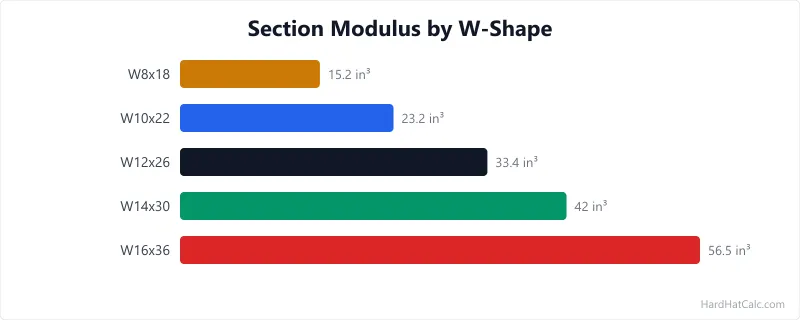
Why does beam shape matter so much? A W12x26 wide-flange beam (12 inches deep, 26 lbs/ft) has a section modulus of 33.4 in³. A solid rectangular bar of the same weight would need to be roughly 4 inches wide by 9 inches deep — and it would weigh more per foot. The wide-flange shape concentrates material in the top and bottom flanges where bending stresses are highest, leaving a thin web in the middle where stresses are low. This is why steel I-shapes are so efficient compared to solid sections.
If you already know the total load on a wall you want to open up, you can spot-check load-bearing status and convert floor and roof loads into the pounds-per-linear-foot figure this calculator needs as input.
How to Get a Steel Beam Installed
Determine the load. Calculate the total distributed load in pounds per linear foot (plf) that the beam must carry. Include all dead loads (structure weight, finishes) and live loads (occupancy, snow) from every floor the beam supports. The load-bearing wall calculator helps with this step.
Size the beam. Use this calculator to get a preliminary size, then have a structural engineer verify it. The engineer checks deflection, lateral bracing, bearing plate sizing, and connection details that simplified calculators cannot address.
Order the steel. Contact a local steel fabricator with the engineer's drawings. Lead time for residential beams is typically 1–3 weeks. The fabricator cuts the beam to length, welds any bearing plates, and drills bolt holes per the engineer's connection design.
Plan the lift. Steel beams are heavy. A W12x35 spanning 16 feet weighs 560 pounds — too heavy for manual lifting. Most residential steel beams require a small crane, telehandler, or at minimum a chain hoist rigged from temporary framing.
Install and inspect. The beam is set on bearing plates or pockets, shimmed level, and bolted or welded per the engineer's details. The building inspector must approve the installation before framing continues. Do not cover the beam with drywall until after the structural inspection.
Steel vs LVL vs Glulam: When to Choose Steel
Steel beams are not always the right answer. They cost more per foot than wood alternatives, require specialized equipment to install, and create thermal bridges in exterior walls. But in three situations, steel is the clear winner.
First, when depth matters. Steel beams carry the same load at roughly half the depth of an equivalent LVL beam. If headroom is tight — say you are opening a wall on the main floor and every inch of beam depth eats into the ceiling height — a W10 steel beam might fit where a 16-inch-deep LVL would not.
Second, when the span is long. Wood beams become impractical beyond 24 feet. The required depth gets unwieldy, deflection becomes hard to control, and a single piece of LVL or glulam that long may not be available from your supplier. Steel handles 30- to 40-foot spans routinely. For projects weighing both materials, comparing steel and wood beams covers the practical trade-offs in detail.
Third, when point loads are involved. Steel handles concentrated loads from columns or posts much better than wood, which can crush at the bearing point. If a column from the floor above lands on the beam mid-span, steel is usually the safer and simpler choice.
For spans under 16 feet carrying moderate residential loads, LVL is usually cheaper and easier to install. A framing crew can carry and set an LVL beam without a crane. Check the outdoor-deck load tool if you are sizing beams for an outdoor structure — deck beams have different deflection criteria than interior floor beams. Exposed steel in commercial or mixed-use projects may also need fireproofing treatment to meet code.
Worked Examples
Example 1
Scenario: A contractor needs a steel beam to span a 14-foot opening where a bearing wall was removed in a two-storey home. The load-bearing wall calculator shows 600 plf total distributed load.
Calculation: Span = 14 ft, load = 600 plf, beam type = W-flange. Moment M = (600 × 14²) / 8 = 14,700 ft-lbs. Convert to in-lbs: 14,700 × 12 = 176,400 in-lbs. Required S = 176,400 / 21,600 = 8.2 in³ (bending). Deflection check: required Ix = 5 × 50 × 168⁴ / (384 × 29,000,000 × 0.467) = 38.3 in⁴. Bending selects W8x13 (S = 9.91, Ix = 39.6 in⁴), which also satisfies the deflection requirement. Use W8x13. Total beam weight = 13 × 14 = 182 lbs. Estimated cost = 182 × $2.25 = $409.50.
What this means: The W8x13 meets both the bending and deflection requirements at this span and load. Its Ix of 39.6 in⁴ exceeds the required 38.3 in⁴, so bending and deflection are both satisfied by the same beam. This is typical for shorter spans where deflection does not yet dominate the design.
Takeaway: Material cost for the beam is about $410. The total installed cost including fabrication, crane, and labour typically runs $1,200 to $2,500 for this size span.
Example 2
Scenario: An architect specifies a 20-foot clear span for an open-plan living area with two floors of load above, totalling 900 plf distributed.
Calculation: Span = 20 ft, load = 900 plf, beam type = W-flange. Moment M = (900 × 20²) / 8 = 45,000 ft-lbs. Convert to in-lbs: 45,000 × 12 = 540,000 in-lbs. Required S = 540,000 / 21,600 = 25.0 in³ (bending). Deflection check: required Ix = 5 × 75 × 240⁴ / (384 × 29,000,000 × 0.667) = 167.6 in⁴. Bending selects W10x26 (S = 27.9, Ix = 144), deflection selects W10x33 (Ix = 171). Deflection governs — use W10x33. Total beam weight = 33 × 20 = 660 lbs. Estimated cost = 660 × $2.25 = $1,485.
What this means: At a 20-foot span with heavy loads, deflection demands a stiffer beam than bending alone. The W10x26 has sufficient bending capacity but its Ix of 144 in⁴ falls short of the required 167.6 in⁴ for L/360 compliance. The W10x33 (Ix = 171 in⁴) satisfies both requirements.
Takeaway: Budget $1,485 for the beam material. A 660-pound beam requires a crane or telehandler for installation — manual lifting is not safe at this weight. The jump from a W10x26 to W10x33 illustrates why deflection governs over bending for spans beyond 16 feet — a beam that passes the bending check can still sag visibly or crack finishes if its moment of inertia is too low.
Frequently Asked Questions
- What is the most common steel beam size for residential construction?
The W8x18 and W10x22 are the two most frequently specified steel beams in residential work. The W8x18 (8 inches deep, 18 lbs/ft) handles typical garage door headers and short bearing-wall replacements up to about 12 feet. The W10x22 (10 inches deep, 22 lbs/ft) covers longer spans up to roughly 16 feet with moderate loads. For open-concept renovations where walls are removed to create 18- to 24-foot openings, W12x35 and W14x38 sizes are common because the loads from multiple floors demand a much larger section modulus. For a detailed comparison of steel versus wood beam costs and performance, the trade-offs depend heavily on span length and available headroom.
- How much does a residential steel beam cost installed?
The total installed cost for a residential steel beam ranges from $1,500 to $6,000 for a typical 10- to 20-foot span as of March 2026, based on US national averages. The beam material itself runs $1.50–$3.00 per pound fabricated and delivered. A W10x22 spanning 16 feet weighs about 352 pounds (the steel weight calculator handles plate, bar, and tube), so the material cost is roughly $530–$1,060. Add $500–$1,200 for installation labour (crane rental, welding or bolting, shimming), plus $400–$800 for the structural engineer's sealed design. Steel prices fluctuate with scrap metal markets, so get a current quote rather than relying on published averages. Budget separately for the concrete footings that carry the beam end loads to the soil — undersized bearing pads are a common cause of post-and-beam settlement. If you are comparing a wood alternative, the wood-beam pricing tool prices LVL and solid-sawn options side by side.
- What is the difference between a W-beam and an I-beam?
In everyday language, people use "I-beam" to mean any steel beam with an I-shaped cross section. In structural engineering, however, the terms refer to specific product lines. W-shapes (wide-flange beams) have parallel flanges of uniform thickness — the inner flange faces are flat. S-shapes (American Standard beams, the original "I-beams") have tapered flanges that are thicker at the web and thinner at the edges. W-shapes are far more common in modern construction because their parallel flanges make connections simpler and they are more efficient for bending. Unless you are matching existing framing in an older building, W-shapes are almost always the better choice. After sizing, run a beam deflection check to confirm the selected section meets L/360 stiffness requirements.
- Can I use a steel beam calculator instead of hiring a structural engineer?
No — a calculator is a planning tool, not a design tool. This calculator gives you a preliminary beam size based on simple-span bending under uniform load. A licensed structural engineer checks additional failure modes that this calculator does not address: lateral-torsional buckling (the beam twisting under load), web crippling at supports, deflection under service loads (typically limited to L/360 for floor beams), combined axial and bending loads, and seismic or wind load combinations. The engineer also designs the connections — how the beam attaches to columns and bearing walls — which are as critical as the beam itself. Building departments require engineer-stamped drawings for steel beam installations, and no reputable contractor will install a beam without them. Start by determining the total load on your bearing wall so you have an accurate plf figure to feed into this calculator.
More Structural calculators
Browse all structural calculators — Beam sizing, truss pricing, load calculations, wall framing, deck capacity, and foundation tools.