
Deck Weight Limit Calculator
Deck weight limit calculator: check joist capacity, dead load, 40 psf live load per IRC, and safe occupant count by joist size, spacing, and wood species.
Last updated:
Methodology reviewed by Doc. dr. sc. Mladenka Juradin, dipl. ing. građ., PhD, Civil Engineering (FCEAG, University of Split)
Length parallel to the joists (the direction joists span).
Width perpendicular to the joists.
2x8 is the most common residential deck joist. Larger joists span farther.
On-centre spacing between joists. 16" is standard for most deck builds.
Species affects allowable bending stress, and the IRC deck table gives southern pine slightly longer spans.
For estimation only. Structural work requires review by a licensed engineer. Local building codes take precedence over any calculator output.
How This Is Calculated
Dead load = decking (2.5 psf) + joist weight/spacing + railings (1.5 psf), based on standard lumber weights per NDS 2024. Section modulus S = 1.5 x depth² / 6. Max uniform load per joist = (8 x Fb x S) / (span² x 12). Total allowable PSF = max load per joist / tributary width. Live load capacity = total allowable - dead load. Max point load = (4 x Fb x S) / (span x 12). Occupant capacity = (live load x 60% deck area) / 160 lbs per person.
Source: Span limits per IRC 2021 Table R507.6 (deck joists, 40 psf live + 10 psf dead, No. 2 grade, wet service). Joist bending values per AWC Design Values for Joists and Rafters 2024 supplement (No. 2 grade) with a flat 0.85 wet-service factor. Live load minimum of 40 psf per IRC Table R301.5 for residential decks (some jurisdictions amend it upward; Washington adopts 60 psf). Joist self-weight per NDS Supplement Table 1B at 35 pcf. Values verified July 2026 and re-verified September 2026 at the AWC origin (DVJR 2024, NDS Supplement 2018/2024, Table 1B).
7 min read
How Much Weight Can Your Deck Actually Hold?
Thirty people on a 12x16-foot deck during a summer barbecue. A 500-pound hot tub in the corner. A contractor stacking bundles of roofing shingles while re-roofing the house. These are real scenarios that push decks toward their structural limits — and most homeowners have no idea where those limits are.
Building codes require residential decks to support a minimum live load of 40 pounds per square foot (psf) (some jurisdictions adopt higher; Washington 60 psf). A 12x16 deck (192 square feet) must therefore handle at least 7,680 pounds of live load — people, furniture, grills, planters, snow. That sounds like a lot, and for normal use it is. At 150 pounds per person (a typical design assumption) occupying about 5 square feet each (standing with personal space), that deck could hold roughly 25–30 people before density becomes the limiting factor. You will run out of comfortable space before you run out of structural capacity — assuming the framing actually meets the 40 psf minimum.
But concentrated loads change the picture. A hot tub filled with water and six people weighs 4,000–5,000 pounds sitting on roughly 20 square feet — that is 200–250 psf on those specific joists, far exceeding the 40 psf design load. A stack of 30 roofing shingle bundles weighs over 2,000 pounds and sits on two or three joists. These point loads stress individual members, not the deck as a whole.
This calculator estimates your deck's load capacity based on the actual joist size, spacing, span, and wood species. It tells you both the distributed load capacity (how much total weight the deck holds) and the concentrated load capacity (how much a single joist can carry at its weakest point). Both numbers matter for safe use. If you need to verify that your joists can actually reach across the span, check allowable joist spans before running the weight limit numbers.
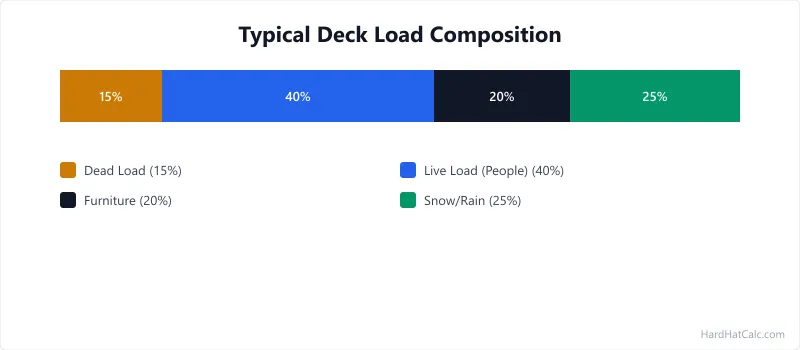
Dead Load vs Live Load: What Counts as What?
What is dead load on a deck? Dead load is the permanent weight of the deck structure itself: joists, decking boards, railings, fascia, hardware, and any permanently attached features like built-in benches or pergola posts. For a typical wood deck, dead load runs 8–12 psf. Composite decking is heavier than wood — add 1–2 psf. A roofed deck or pergola adds 5–10 psf for the overhead structure. Dead load never changes, so it permanently reduces the capacity available for live load.
What counts as live load? Everything that is not permanently attached: people, furniture, grills, planters, snow, rain on a flat deck, and any moveable equipment. Building codes set the minimum design live load at 40 psf for residential decks and 100 psf for commercial decks or assembly areas. If you host large gatherings regularly, your deck's actual live load capacity should exceed 40 psf with a comfortable margin.
What about snow load? Snow is a live load. In Northern states, ground snow loads range from 20 to 80+ psf. A deck open to the sky accumulates less snow than a roof (wind blows it off), but a roofed deck traps snow on the roof above, which adds to the dead load of the overhead structure. If your deck has a roof, the snow load on that roof transfers through the posts to the deck framing below — include it in your load calculations.
Does a hot tub count as live load or dead load? An empty, permanently installed hot tub is dead load. The water and people in it are live load. Since the hot tub's total weight (empty + water + people) is concentrated on a small area, it creates a point load problem that the standard 40 psf distributed design does not address. Hot tubs require reinforced framing — closer joist spacing, larger joists, or additional beams — directly under the tub.
Joist Span and Load Tables
These tables show maximum deck joist spans per IRC 2021 Table R507.6 at 40 psf live load + 10 psf dead load. Spans assume No. 2 grade lumber with the wet service factor included, continuous lateral support from decking, and the L/360 deflection limit. The IRC groups Douglas fir, hem-fir, and SPF into one species row set; southern pine has its own.
16-inch On-Centre Spacing:
| Joist Size | DF / Hem-Fir / SPF | Southern Pine |
|---|---|---|
| 2x6 | 8 ft 4 in | 9 ft 0 in |
| 2x8 | 11 ft 1 in | 11 ft 10 in |
| 2x10 | 13 ft 7 in | 14 ft 0 in |
| 2x12 | 15 ft 9 in | 16 ft 6 in |
24-inch On-Centre Spacing:
| Joist Size | DF / Hem-Fir / SPF | Southern Pine |
|---|---|---|
| 2x6 | 6 ft 10 in | 7 ft 7 in |
| 2x8 | 9 ft 1 in | 9 ft 8 in |
| 2x10 | 11 ft 1 in | 11 ft 5 in |
| 2x12 | 12 ft 10 in | 13 ft 6 in |
These are the code table's deck values — shorter than interior floor spans for the same joist because decks are designed wet. Your local code may have different requirements, especially in high snow-load or seismic zones. If your joist span exceeds these maximums, add a mid-span beam to reduce the effective span.
When Your Deck Is Overloaded: Warning Signs
Decks rarely fail without warning. Knowing the symptoms of an overloaded or deteriorating deck can prevent a dangerous collapse.
Bounce and deflection. Stand in the middle of the deck and bounce on your heels. Some give is normal — wood is flexible. Excessive bounce (more than about 1/2 inch underfoot) indicates joists that are undersized, over-spanned, or weakened by rot. If the deck bounces noticeably when you walk across it, the live load capacity is marginal and any additional loading (crowd, snow, hot tub) is risky.
Visible sag. Sight along the deck surface from one end. A gentle crown (upward curve) in the decking is fine — that is often intentional to shed water. A sag (downward curve) between beams means the joists have deflected beyond their elastic limit or the beam below has settled. Sagging joists have already lost a portion of their load capacity.
Connection deterioration. The most common deck failure mode is not broken joists — it is failed connections. Nails backing out of the ledger board, corroded joist hangers, split beam posts, and rotted ledger attachment points cause the majority of deck collapses. Inspect every connection annually. Replace any joist hanger with more than surface rust. Check the ledger bolts (the connection between deck and house) for tightness and wood rot around the bolt holes.
Rot at bearing points. Joists rot where they sit on beams because water collects at the contact surface. Push an awl or screwdriver into the joist ends where they bear on beams. If the tool sinks more than 1/4 inch, the wood has rotted enough to reduce its load capacity. Replace affected joists — sistering (bolting a new joist alongside the rotted one) is the standard repair.
For deck framing that supports the structure above, you can estimate stud and plate quantities for the railing posts and any framed enclosures. If your deck sits on concrete piers, the footing reinforcement must match the load each pier carries — estimate rebar pounds to cover that.
How to Reinforce a Deck for Heavy Loads
Identify the load and its location. A hot tub, heavy planter, or storage area creates a concentrated load zone. Determine the total weight and the footprint (the area it covers on the deck). Divide weight by area to get the psf demand — if it exceeds your deck's live load capacity from this calculator, reinforcement is needed.
Add joists under the load zone. The simplest reinforcement is reducing joist spacing in the loaded area. If your deck uses 16" OC joists, add intermediate joists to bring the spacing to 12" or 8" under the hot tub or heavy equipment. This doubles or triples the load capacity of that zone.
Add a beam under the load zone. For very heavy loads (hot tubs over 4,000 lbs), install a dedicated beam perpendicular to the joists directly under the load. The beam transfers the concentrated load to additional posts and footings rather than relying on the original joist-to-beam connections.
Upgrade the footings. Every new post needs a footing that can carry its share of the load. For a hot tub beam with two posts, each footing must handle half the tub's weight plus the beam and deck dead load above it. Typical hot tub footings are 24x24 inches by 12 inches deep — larger than standard deck footings.
Verify ledger and existing connections. Adding load to the deck increases the forces on every connection, including the ledger board (where the deck attaches to the house). Verify that the ledger is lag-bolted or through-bolted per code and that the siding behind it has proper flashing to prevent rot. A deck that pulls away from the house is the most common catastrophic failure. For a full rundown of every component from footings to railing, the deck materials checklist covers what you need before the reinforcement work begins.
Worked Examples
Example 1
Scenario: A homeowner with a 12x12-foot deck framed with 2x10 Southern Pine joists at 16-inch spacing wants to know if the deck can hold a party of 25 people.
Calculation: Deck area = 12 × 12 = 144 sq ft. Joist span = 12 ft (within the 14.0 ft max for 2x10 SP at 16" OC per IRC Table R507.6). Dead load: decking 2.5 + joist (3.4 / 1.33) 2.6 + railings 1.5 = 6.6 psf. Joist depth = 9.25 in, S = (1.5 × 9.25²) / 6 = 21.39 in³. Fb for SP 2x10 = 782 psi (No. 2 joist value, wet service). Max load per joist = (8 × 782 × 21.39) / (12² x 12) = 77.4 plf. Total allowable PSF = 77.4 / 1.33 = 58.1 psf. Live load capacity = 58.1 - 6.6 = 51.5 psf. Total live load = 51.5 × 144 = 7,416 lbs. 25 people at 150 lbs each = 3,750 lbs.
What this means: The deck can comfortably hold 25 standing people (3,750 lbs) within its 7,416-lb live load capacity. At a 12-foot span, the 2x10 joists are within their allowable span of 14 ft for Southern Pine at 16" OC, and the live load capacity exceeds the 40 psf code minimum.
Takeaway: The party is feasible with good margin — but note the joist choice: a 2x8 SP deck joist at 16" OC tops out at 11'-10" per the IRC deck table, so a 12-foot span needs 2x10s in the first place. Always check the "Max Allowable Joist Span" result against your actual span.
Example 2
Scenario: A contractor is building a new 12x12 deck specifically designed to hold a hot tub weighing 4,500 lbs when full. They plan 2x10 Southern Pine joists at 12-inch spacing.
Calculation: Deck area = 12 × 12 = 144 sq ft. Dead load: decking 2.5 + joist (3.4 / 1.0) 3.4 + railings 1.5 = 7.4 psf. Joist depth = 9.25 in, S = (1.5 × 9.25²) / 6 = 21.39 in³. Fb for SP 2x10 = 782 psi (No. 2 joist value, wet service). Max load per joist = (8 × 782 × 21.39) / (12² x 12) = 77.4 plf. Total allowable PSF = 77.4 / 1.0 = 77.4 psf. Live load capacity = 77.4 - 7.4 = 70.0 psf. Hot tub footprint ~25 sq ft, point load = 4,500 / 25 = 180 psf.
What this means: The deck achieves 70 psf live load capacity overall — well above the 40 psf code minimum — but the hot tub concentrates 180 psf on its footprint, far exceeding capacity under the tub area. A dedicated beam under the hot tub zone is needed to handle that concentration.
Takeaway: Even with 2x10 joists at tight 12-inch spacing, a hot tub demands a support beam directly underneath. The rest of the deck comfortably exceeds the 40 psf code minimum for normal use.
Frequently Asked Questions
- How much weight can a 12x16 deck hold?
A 12x16-foot deck framed with 2x8 Southern Pine joists at 16-inch spacing is designed to handle a minimum live load of 40 psf, which translates to 7,680 pounds distributed across the full deck area. The actual capacity depends on the joist span (whether the 16-foot dimension is the joist span), wood species, grade, and condition. If the 16-foot dimension is the joist span and joists are 2x8 Southern Pine at 16" OC, the deck meets the 40 psf minimum but has limited margin for concentrated loads. For gatherings of 20–30 people with furniture and a grill, a deck in good condition comfortably handles the load. Verify joist adequacy with the joist span tables for decks if you are unsure whether your framing meets the span table limits. To estimate the deck boards once your framing is set, the deck board count tool handles waste factors and board lengths.
- Can my deck support a hot tub?
Most standard residential decks cannot support a hot tub without reinforcement. A filled hot tub with occupants weighs 3,000–5,500 pounds depending on size, and that weight concentrates on roughly 20–30 square feet of deck area — creating a load of 100–275 psf, which is 2.5 to 7 times the standard 40 psf design load. To safely support a hot tub, you need additional joists (12" or 8" spacing under the tub), a dedicated beam underneath, and reinforced footings. Some builders pour a separate concrete pad next to the deck for the hot tub instead, which avoids the framing issues entirely. If you go the concrete route, size pier footings for the pad based on the tub's total filled weight.
- What joist size do I need for a 14-foot deck span?
For a 14-foot joist span at 16-inch on-centre spacing with 40 psf live load, you need at minimum 2x10 joists in SPF (Spruce-Pine-Fir) or Douglas Fir, or 2x8 joists in Southern Pine (which has a higher allowable stress). The 2x10 is the safer choice because it provides margin for deflection — a joist that technically meets the stress requirement might still bounce underfoot if it is close to the deflection limit. For spans over 12 feet, 2x10 is the standard recommendation regardless of species because it keeps the deck feeling solid. The post size calculator then sizes the posts under the beam to handle the combined joist loads.
- How many people can stand on a deck at once?
Using the code-minimum 40 psf live load and assuming 150 pounds per person occupying about 5 square feet each (standing room with some personal space), a deck can hold approximately 8 people per 100 square feet. A 200-square-foot deck (roughly 10x20) handles about 16 people at this density. With furniture (tables, chairs, grill) reducing usable area by 30–40%, practical occupancy drops to 10–12 people on a 200-square-foot deck. These figures assume the deck is in good condition with no rot, all connections intact, and the framing meets code. An older deck with deteriorated connections should be inspected before hosting large groups. For a complete materials rundown when building new, the deck-build component rundown covers every component from footings to railing.
- Does joist spacing affect deck weight capacity?
Yes — joist spacing directly controls the load each individual joist carries. At 16-inch on-centre spacing, each joist supports a 16-inch-wide strip of deck. At 24-inch spacing, each joist supports a 24-inch-wide strip — 50% more load per joist. Reducing spacing from 24" to 16" increases the deck's load capacity by roughly 50% for the same joist size. Going from 16" to 12" adds another 33%. Closer spacing also reduces decking deflection between joists, which makes the deck feel stiffer underfoot and prevents composite decking from sagging between supports.
More Structural calculators
Browse all structural calculators — Beam sizing, truss pricing, load calculations, wall framing, deck capacity, and foundation tools.