
Deck Joist Span Calculator
Deck joist span calculator for 2x6 through 2x12 lumber. Adjust species, spacing, and load for IRC 2021 Table R507.6 wet-service deck spans at L/360.
Last updated:
Methodology reviewed by Doc. dr. sc. Mladenka Juradin, dipl. ing. građ., PhD, Civil Engineering (FCEAG, University of Split)
Nominal lumber size. Actual dimensions are smaller (e.g. 2x8 = 1.5" x 7.25").
The IRC deck table groups Douglas fir, hem-fir and SPF together; southern pine has its own (longer) rows.
16" OC is standard for most residential decks. 12" for heavy loads.
40 psf standard residential. 60 psf for heavy use areas.
Weight of decking, joists, and fasteners. 10 psf typical for wood deck.
For joist count estimate. Joists span the width; this is along the beam.
For estimation only. Structural work requires review by a licensed engineer. Local building codes take precedence over any calculator output.
How This Is Calculated
Base span from IRC 2021 Table R507.6 (40 psf live + 10 psf dead, No. 2 grade, wet service) for the selected size, species group, and spacing. For non-standard loads: adjusted span = base span x sqrt(50 / total load). Deflection-limited span (L/360 for live load): base span x sqrt(40 / live load) × 0.95 for live loads above 40 psf. Governing span = lesser of bending and deflection spans. Joist count = ceil(deck length x 12 / spacing) + 1. Max cantilever = lesser of governing span / 4 and Table R507.6's maximum-cantilever column interpolated at a backspan equal to the governing span.
Source: Maximum spans per IRC 2021 Table R507.6 (Maximum Deck Joist Spans — 40 psf live + 10 psf dead, No. 2 grade, wet service factor included, L/360 at main span; Douglas fir/hem-fir/SPF rows include the incising factor). Cantilever limits per IRC 2021 Table R507.6 maximum-cantilever columns at the joist backspan (220-lb tip-load check at L/180); the columns embed the one-fourth-of-backspan limit that the 2018 IRC R507.6 text and AWC DCA 6 footnote 3 state explicitly. Adjustment for non-standard loads is an engineering adaptation (span × √(50/total load)), not a code table value. Values verified July 2026 and re-verified September 2026: all 36 span cells match AWC DCA 6 Table 2 (the AWC origin) and the 2021 table as printed by ICC (RB184-19 monograph), UpCodes (2021), Seattle SDCI (2021 SRC base text) and two county deck guides.
7 min read
Span Tables at a Glance
Span tables fill page after page of fine print organised by species, grade, size, spacing, and load condition. This calculator distils the deck-specific slice of that data — IRC 2021 Table R507.6, the code's own deck joist table — into an instant answer for the most common framing scenario: No. 2 grade lumber under standard residential deck loading.
The table below shows maximum allowable deck joist spans for 40 PSF live load + 10 PSF dead load — the standard residential deck case. All values are for No. 2 grade lumber with the wet service factor included, which is why deck spans run shorter than interior floor spans for the same joist. The IRC groups Douglas fir-larch, hem-fir, and spruce-pine-fir into one row set; southern pine gets its own.
| Joist Size | DF / Hem-Fir / SPF 12" OC | 16" OC | 24" OC | Southern Pine 12" OC | 16" OC | 24" OC |
|---|---|---|---|---|---|---|
| 2x6 | 9'-6" | 8'-4" | 6'-10" | 9'-11" | 9'-0" | 7'-7" |
| 2x8 | 12'-6" | 11'-1" | 9'-1" | 13'-1" | 11'-10" | 9'-8" |
| 2x10 | 15'-8" | 13'-7" | 11'-1" | 16'-2" | 14'-0" | 11'-5" |
| 2x12 | 18'-0" | 15'-9" | 12'-10" | 18'-0" | 16'-6" | 13'-6" |
Values per IRC 2021 Table R507.6 (Maximum Deck Joist Spans). The Douglas fir group rows include the incising factor used for pressure-treated western species. These spans assume standard residential deck loading and continuous lateral support from decking fastened to the top edge.
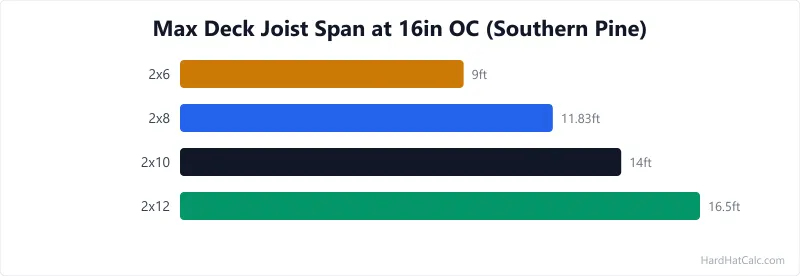
What Limits Joist Span: Bending vs. Deflection
Two physical constraints limit how far a deck joist can reach between supports, and understanding both prevents a common design mistake: building a deck that is structurally sound but uncomfortably bouncy.
Bending is the strength limit. The joist must carry the total load (dead weight of the deck plus live load from occupants and furniture) without the internal stress exceeding the wood's allowable bending strength. If a joist fails in bending, it cracks or snaps — a dramatic and dangerous failure mode. Building codes set conservative bending values for each species and grade so this never happens under normal loading.
Deflection is the stiffness limit. Even when a joist is strong enough, it can flex too much under load. Building codes cap live-load deflection at L/360 — the joist can sag at most 1/360th of its span under live load. For a 12-foot span, that is 0.4 inches. You would feel anything beyond that as a noticeable bounce underfoot, and it would eventually crack tile or grout if the deck supports a screened-in porch with a finished floor. If an existing joist has already settled into a visible dip rather than just feeling springy, that is a repair question: how to diagnose and fix a sagging floor joist covers reading the sag and knowing when it needs an engineer.
For standard residential decks (40 PSF live load, 10 PSF dead load), bending usually governs the maximum span. The joists fail the strength check before they hit the deflection limit. But for heavy-load scenarios — hot tubs, snow accumulation, dense stone planters — deflection often takes over as the controlling factor. The joists are strong enough, but they flex too much.
Once you know your joist size and span, the whole-deck capacity tool checks whether the overall deck structure can handle your intended loads including posts, beams, and footings.
How to Choose Joist Size and Spacing
Selecting the right joist size and spacing is an iterative process. Start with the span you need, then find the lightest framing that handles the load within code limits.
Measure your deck width. The span direction is usually perpendicular to the house. If the deck is 14 feet from the ledger board to the outer beam, your joists need to span 14 feet. Measure to the centre of bearing points (ledger and beam), not to the deck edge.
Look up the maximum span. Start with 2x8 at 16" OC — the most common residential choice. If the span table shows a maximum of 11'-1" (SPF group) and you need 14 feet, that combination does not work. Move up to 2x10 or tighten to 12" OC.
Upgrade size before tightening spacing. Going from 2x8 to 2x10 at 16" OC adds about 2.5 feet of span for about 25-35% more lumber cost. Going from 16" OC to 12" OC with the same 2x8 adds only about 1.5 feet of span but increases joist count by 33%. Upsizing is almost always the better value.
Check deflection for special loads. Standard tables assume 40 PSF live load. Hot tubs, heavy planters, or high snow loads require adjusting the span downward. This calculator applies the correction automatically — enter your actual expected live load.
Add cantilever if desired. Joists can extend past the outer beam by up to one-fourth of the joist backspan — but never more than Table R507.6's maximum-cantilever column, which checks a 220-lb point load at the tip and usually governs. A 2x10 SPF-group joist framed at its full 13'-7" span at 16" OC can cantilever about 38 inches. Cantilevers save on footing and beam costs by extending the deck without additional support.
Following these five steps in order prevents the most common framing mistake: choosing joist size based on what is cheapest at the lumber yard rather than what the span requires. The full deck materials list walks through every component beyond joists, from footings to railing hardware. Once your joist layout is set, estimate your decking materials to get a full picture of lumber and fastener costs.
Species Comparison for Deck Joists
Wood species is the most overlooked variable in joist selection. Many deck builders default to whatever their lumber yard stocks without checking how species choice affects span.
SPF (Spruce-Pine-Fir) is the cheapest and most widely available framing lumber in North America. It dominates the market for residential construction because it is light, easy to cut, and inexpensive. For decks, though, the IRC rates SPF, Douglas fir-larch, and hem-fir together as one species group — a 2x10 in any of them tops out at 13'-7" at 16" OC, with the incising factor for pressure-treated stock already built into the row. Between those three, the differences that matter on a deck are price, availability, and how well the boards take treatment — not span.
Douglas Fir costs 15-25% more than SPF per board foot, and for interior floors its higher stiffness buys real extra span. On decks the story is different: because the IRC rates Douglas fir, hem-fir, and SPF as one wet-service group, paying the Douglas fir premium buys durability and straighter stock, not a longer code span. It is the default species in the Pacific Northwest and widely available nationwide.
Southern Yellow Pine is the one species choice that lengthens a deck span — its own R507.6 rows run 5 to 11 inches past the Douglas fir group at 16" OC, and it is the standard species for pressure-treated lumber in the eastern US. In the Southeast, SYP is often the same price as SPF because it is locally grown. Outside that region, expect a premium similar to Douglas Fir.
For the beam that supports your joists, the beam material cost tool estimates material costs by species and size so you can compare total framing budgets. Framing is one slice of the spend, and a full breakdown of deck building costs shows where the rest of the budget goes. For a price on the finished deck rather than the frame alone, a size-and-material cost estimate ranges the material, labour, and total.
Cantilevers, Blocking, and Other Span Adjustments
Several common deck framing questions go beyond the basic span table lookup. These adjustments can affect your joist selection and are worth understanding before you finalise your framing plan.
Can I cantilever deck joists past the beam? Yes — up to one-fourth of the joist backspan (stated in the 2018 IRC R507.6 text and AWC DCA 6 footnote 3; the 2021 edition folds the limit into Table R507.6), and never more than the maximum-cantilever column of Table R507.6, which reflects a 220-lb point load at the tip and usually governs first. A southern pine 2x12 framed at a 16-ft backspan may cantilever 4'-0" per the table, but a 2x8 caps out around 2'-6" no matter how long its backspan. Because the cantilever can never exceed a quarter of the backspan, the framing behind it is always at least four times as long as the overhang — that weight is what keeps the ledger end from lifting. Cantilevers are an efficient way to extend a deck without adding another beam and set of footings.
Do I need blocking between joists? Yes, at bearing points (where joists sit on beams or the ledger) and at 8-foot intervals for 2x10 and larger joists. Blocking prevents joists from rotating or buckling sideways under load. For 2x6 and 2x8 joists, blocking at bearing points is sufficient unless your local code specifies otherwise. Solid blocking (a short piece of the same lumber nailed between joists) is stronger than cross-bracing but uses more material.
Does composite decking change the span calculation? Composite decking is heavier than wood — typically 3-4 PSF versus 2-3 PSF for cedar or pressure-treated boards. This slightly increases the dead load, which marginally reduces the allowable span. In most cases the difference is less than 2 inches and does not change the joist size selection. Where it matters is at the boundary: if your span is within 3 inches of the maximum for your joist size, rerun the calculation with the actual composite weight as dead load.
Each beam and joist layout produces post loads that your footings must handle — run pier-footing dimensions to verify the layout after finalising your framing plan.
Worked Examples
Example 1
Scenario: A homeowner is framing a 12x16-ft deck with 2x8 SPF joists at 16" OC spacing, standard 40 psf live load and 10 psf dead load.
Calculation: Base span for 2x8 SPF at 16" OC = 11.08 ft (11'-1") per IRC 2021 Table R507.6. With standard 40+10 loading, no load adjustment is needed. Governing span: 11'-1". Joist count for 16-ft deck length: ⌈16 × 12 / 16⌉ + 1 = 13 joists. Maximum cantilever: the table's cantilever column at an 11.08-ft backspan interpolates to about 2.1 ft — 25 inches (tighter than backspan/4 = 33 inches).
What this means: The 12-ft deck width exceeds the 11'-1" maximum span for 2x8 SPF at 16" OC. The joists cannot reach across 12 feet unsupported. The homeowner needs either a mid-span beam, larger joists, or southern pine — and even SYP 2x8 (11'-10") falls short of 12 feet.
Takeaway: At 16" spacing, a 2x8 in the Douglas fir/hem-fir/SPF group maxes out at 11'-1" on a deck, and southern pine 2x8 at 11'-10" — both short of 12 feet. The clean fix is 2x10: 13'-7" for the DF/SPF group and 14'-0" in southern pine.
Example 2
Scenario: A contractor is pricing a hot tub deck using 2x10 Douglas Fir at 12" OC with a 60 psf live load (filled hot tub plus occupants) and 15 psf dead load.
Calculation: Base span for 2x10 DF at 12" OC = 15.67 ft (15'-8") per IRC 2021 Table R507.6. Load factor for 75 psf total: √(50/75) = 0.8165. Adjusted bending span = 15.67 × 0.8165 = 12.79 ft. Deflection span with 60 psf live load: 15.67 x √(40/60) × 0.95 = 12.15 ft. Deflection governs at 12'-2".
What this means: At 12'-2" governing span with 12" OC spacing, the deck can handle the hot tub load within that span without a mid-span beam. The deflection limit controls the design, not bending strength — the joists are strong enough but stiffness is the constraint.
Takeaway: Hot tubs shift the governing constraint from bending to deflection. The deck might be strong enough at wider spacing but would bounce noticeably under a filled hot tub. Tighter spacing (12" OC) and stiffer species (Douglas Fir, Southern Yellow Pine) help control deflection where it matters.
Frequently Asked Questions
- How far can a 2x8 deck joist span at 16-inch spacing?
At standard 40 psf live load + 10 psf dead load, a No. 2 grade 2x8 deck joist spans 11'-1" in the Douglas fir/hem-fir/SPF group and 11'-10" in Southern Yellow Pine at 16" OC. These values come from IRC 2021 Table R507.6, which builds in the wet service factor decks need; interior floor tables run longer for the same joist. Higher grades (No. 1, Select Structural) span slightly farther — typically 5-10% more — but No. 2 is the standard design grade for residential decks. The most common upgrade when 2x8s fall short is moving to 2x10s rather than tightening spacing, because the span increase is proportionally larger for the cost. Once you settle on a joist size, the deck board calculator estimates how much decking material goes on top.
- What is the maximum cantilever for deck joists?
The IRC allows deck joist cantilevers up to one-fourth of the joist backspan, capped by Table R507.6's maximum-cantilever column (a 220-lb point-load check at the tip that usually governs first). For a 2x10 SPF-group joist at 16" OC framed at its full 13'-7" span, that works out to about 38 inches. Cantilevers must be continuous — you cannot splice a joist and then cantilever the end piece past the beam. Because the overhang can never exceed a quarter of the backspan, the backspan is always at least four times the cantilever, and that framing weight is what counteracts uplift at the ledger connection. Longer cantilevers also increase deflection at the tip, so stay well within the limit if the cantilever edge supports a railing or heavy planters. The deck capacity check verifies whether the cantilevered section can handle your intended loads.
- Do pressure-treated joists have the same span as untreated?
Yes, pressure treatment does not change the structural properties of the lumber. The span tables apply equally to treated and untreated joists of the same species and grade. The treatment adds chemicals for rot resistance, not strength. However, incised treatment — common for western species like Douglas fir and hem-fir that resist penetration — reduces allowable bending values by about 20% because the incisions cut into the wood fibres. The IRC deck table already accounts for this: its Douglas fir/hem-fir/SPF rows include the incising factor, while southern pine (which takes treatment without incising) does not need it. Either way, the spans this calculator reports already reflect treated deck lumber. The treated-species premium tool shows the price premium for pressure-treated species when comparing beam options.
- When should I use 2x10 joists instead of 2x8 for a deck?
Upgrade to 2x10s when your span exceeds the 2x8 limit for your species and spacing, when you are carrying heavy loads (hot tubs, built-in planters, snow loads above 40 psf), or when you want a stiffer deck with less bounce underfoot. The cost increase from 2x8 to 2x10 is typically 25-35% per board, and the span increase is 20-25%, making it roughly proportional in cost per foot of span. At 16" OC, a 2x10 in the SPF group spans 13'-7" versus 11'-1" for 2x8 — that extra 2.5 feet often eliminates the need for a mid-span beam, which saves far more than the per-joist premium. For a full rundown of all the materials from footings to railing, see the framing-to-railing materials guide.
More Structural calculators
Browse all structural calculators — Beam sizing, truss pricing, load calculations, wall framing, deck capacity, and foundation tools.