
Wood Beam Cost Calculator
Free wood beam cost calculator comparing Douglas Fir, Southern Yellow Pine, SPF, and LVL by species, grade, length, board feet, and hardware cost.
Last updated:
Methodology reviewed by Doc. dr. sc. Mladenka Juradin, dipl. ing. građ., PhD, Civil Engineering (FCEAG, University of Split)
Species affects price, strength, and decay resistance.
Actual width — a nominal 4x is 3.5 inches.
Actual depth — a nominal 10 is 9.25 inches.
For estimation only. Structural work requires review by a licensed engineer. Local building codes take precedence over any calculator output.
How This Is Calculated
Board feet per beam = (actual width in. x actual depth in. x length ft) / 12. Cost per beam = board feet x cost per BF for species (SPF $2.80, Douglas Fir $3.60, SYP $3.10, LVL $5.50). Hardware estimate = $35 per beam (hangers + bolts). Total = (cost per beam + hardware) x quantity.
Source: Board foot calculations per standard lumber measurement conventions (board foot = 1" × 12" × 12"). Source-set correction of 2026-08-22: the material-pricing attribution to RS Means 2026 residential cost data and national lumber distributor averages is withdrawn. The 2026 RS Means catalog carries no "Cost Data" product line, the data is subscription-only and was never opened, and no distributor average was ever recorded; the free channels publish wholesale prices per thousand board feet and producer price indexes, not the retail per-board-foot prices this page ships (sweep record: audits/sourcing-1-retrieval/rsmeans/). The per-species prices are unchanged and ship unverified.
7 min read
Comparing Wood Beam Species
The difference between the cheapest and most expensive wood beam for the same span can be 80% or more. A 12-foot 4x8 beam in SPF (Spruce-Pine-Fir) runs roughly $80-$100 as of March 2026, based on US national lumber distributor averages. Prices and rates on this page are our own estimates as of the date shown; they change often. Enter your own figures for a current result. The same dimensions in Douglas Fir climb to $110-$140, and an engineered LVL beam of comparable size reaches $150-$200.
SPF is the budget option. It works well for interior beams where moisture exposure is minimal and the span is moderate. Its allowable bending stress (Fb) for No. 2 grade sits around 875 psi per NDS 2024 Supplement Table 4A, adequate for many residential applications, but it limits the span you can achieve without upsizing. SPF has poor natural decay resistance, so it should never be used outdoors without pressure treatment.
Douglas Fir is the outdoor premium choice. With an Fb of 1,300 psi for No. 1 grade per NDS 2024 Supplement Table 4A and natural resistance to rot and insects, it handles longer spans in smaller cross-sections than SPF. Deck builders and timber-frame contractors favour it for exposed applications where both strength and appearance matter.
Southern Yellow Pine (SYP) offers the best strength-to-cost ratio in the Southeast US where it grows locally. Its Fb runs around 1,100 psi for No. 1 grade per NDS 2024 Supplement Table 4A (between SPF and Douglas Fir) and it treats exceptionally well for ground-contact applications. Outside the Southeast, shipping costs erode its price advantage.
LVL (Laminated Veneer Lumber) is the engineered option. Thin veneers of Douglas Fir or Southern Pine are laminated under pressure, producing a beam with no knots, no grain deviation, and consistent strength properties across every foot of length. LVL costs roughly double SPF per board foot, but it delivers Fb values of 2,600 psi or higher, making it the only practical choice for long spans or heavy loads in residential framing. For a deeper look at how wood stacks up against steel on cost and performance, see this steel vs wood beam comparison.
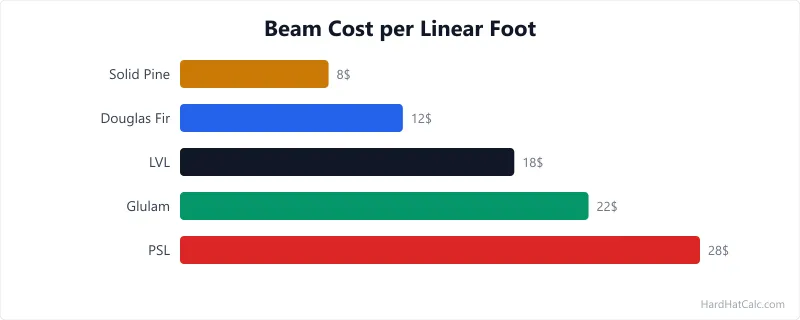
Cost Breakdown by Beam Size
Understanding how beam size affects cost helps you budget accurately before visiting the lumber yard. The table below shows per-linear-foot costs for common beam sizes across three species categories.
| Beam Size (Nominal) | Actual Dimensions | Board Feet per ft | SPF $/ft | Douglas Fir $/ft | LVL $/ft |
|---|---|---|---|---|---|
| 4x6 | 3.5" x 5.5" | 1.60 | $4.49 | $5.78 | $8.84 |
| 4x8 | 3.5" x 7.25" | 2.11 | $5.92 | $7.61 | $11.63 |
| 4x10 | 3.5" x 9.25" | 2.70 | $7.55 | $9.71 | $14.83 |
| 4x12 | 3.5" x 11.25" | 3.28 | $9.19 | $11.81 | $18.05 |
| 6x8 | 5.5" x 7.25" | 3.32 | $9.30 | $11.96 | $18.28 |
| 6x10 | 5.5" x 9.25" | 4.24 | $11.87 | $15.26 | $23.31 |
Prices as of March 2026, US national averages. Regional variation of 15-25% is typical. Add $35 per beam for hardware (hangers, through-bolts, bearing plates) regardless of size.
How to Order Wood Beams
Ordering structural lumber is not like picking boards off a rack at a big-box store. Follow these steps to get the right beam at the right price.
Determine required dimensions from engineering or span tables. Your beam size depends on the load it carries, the span it covers, and the species. Use NDS span tables or have an engineer specify the minimum cross-section. Never guess: an undersized beam is a structural failure waiting to happen.
Choose species based on application. Interior concealed beams can use SPF to save money. Exterior or exposed beams should be Douglas Fir or pressure-treated SYP. Spans over 14 feet or heavy loads point toward LVL. Once you know your beam size, verify it handles the load by running a steel beam check if you are comparing wood to steel options.
Check local availability. Not every species stocks at every yard. Douglas Fir is easy to source on the West Coast but may require a special order in the Southeast. SYP is abundant in the South but scarce in the Pacific Northwest. Call ahead: a species that is "available" but on a two-week lead time may not fit your schedule.
Get quotes from two to three suppliers. Lumber yards, building material dealers, and direct-from-mill suppliers can vary by 15-20% on the same beam. Ask about delivery charges separately: a lower beam price with a $150 delivery fee may cost more than a slightly higher price with free delivery.
Inspect on delivery. Check every beam for crown (a slight upward bow is normal and desirable; install crown up), twist (reject anything with more than 1/4" twist per 8 feet), and checking (surface cracks deeper than 1/4 the beam width compromise strength). LVL should be inspected for delamination at the edges.
Solid Sawn vs. Engineered Beams
The choice between a solid sawn beam and an engineered product like LVL or PSL is not simply about cost; it is about what the beam needs to do and where it sits in the structure.
Solid sawn beams are cut directly from a log. They are available at any lumber yard, they can be stained or finished for visible applications, and they cost less per board foot than engineered alternatives. A 4x10 Douglas Fir beam for a 12-foot deck span is straightforward to source and install. The limitation is consistency. Every piece of solid lumber contains natural defects (knots, grain deviation, juvenile wood) that reduce its effective strength below the published grade values. Two beams of the same species and grade from the same pile can have meaningfully different stiffness.
Engineered beams solve the consistency problem. LVL is manufactured by laminating thin veneers with waterproof adhesive under heat and pressure. The result is a beam where every inch has the same strength properties. No knots, no weak spots, no surprises. PSL takes the same concept further by using long parallel strands instead of veneers, producing beams that handle heavy point loads better than LVL.
For deck framing where beam cost is one piece of the lumber budget, the full joist layout planner helps you plan the joist layout that your beams will support.
When renovating a Northumberland stone cottage, the challenge was finding solid beams long enough to span rooms without interior supports. Local yards stocked nothing over 16 feet in structural grades. LVL solved the problem: available in lengths up to 60 feet and consistent enough to use without over-specifying the cross-section.
The practical rule: for spans under 14 feet with moderate loads, solid sawn lumber is usually the better value. Beyond 14 feet, or when the engineering calls for a high Fb, LVL becomes competitive or cheaper because you need a smaller cross-section to carry the same load.
Seasonal Pricing and Buying Tips
When is lumber cheapest? January and February consistently offer the lowest lumber prices of the year. Demand drops after the holiday season and before spring building ramps up. Prices typically sit 10-20% below the spring peaks that hit in April and May. If your project timeline allows, buying beams in late winter and storing them flat and covered until you need them can save meaningful money, especially on a multi-beam order.
Can I substitute a cheaper species for the one specified? It depends entirely on the engineering. A beam sized for Douglas Fir (Fb 1,300 psi) cannot be swapped for SPF (Fb 875 psi) without recalculating the required cross-section. You will likely need a deeper or wider beam in the weaker species to carry the same load over the same span, which may not fit the framing pocket or header height. If you are replacing a bearing wall, you can verify the wall's structural role and estimate the total load the beam must carry: run the numbers with both species before assuming you can downgrade.
Should I buy from a big-box store or a lumber yard? For structural beams, lumber yards win on selection, quality, and often price. Big-box stores rarely stock beams longer than 16 feet, seldom carry No. 1 or Select Structural grades, and their inventory sits in open racks where it dries unevenly. A lumber yard stocks longer lengths, better grades, and can special-order LVL and PSL products. The trade-off is that yards typically require a minimum order or charge delivery fees that big-box stores waive. For a single 12-foot beam, the big-box store is fine. For a multi-beam structural order, the yard is almost always the better call.
Does pressure treatment affect beam cost? Yes. Pressure-treated beams cost 20-35% more than untreated equivalents, depending on the retention level. Ground-contact treatment (0.40 pcf for SYP) adds more cost than above-ground treatment (0.15 pcf). If your beam will be exposed to weather or within 18 inches of grade, treatment is not optional: untreated wood in those conditions has a lifespan measured in years, not decades.
Worked Examples
Example 1
Scenario: A contractor needs two 14-ft Douglas Fir 4x10 beams for a deck renovation. The beams will be exposed, so rot resistance and appearance matter.
Calculation: BF per beam = (3.5 × 9.25 × 14) / 12 = 37.77 BF. Cost per beam = 37.77 x $3.60/BF = $135.97. Hardware (hangers + bolts) = $35 per beam. Total = ($135.97 + $35) × 2 beams = $341.94.
What this means: Material runs about $136 per beam; hardware adds 26%. Two beams plus hardware under $350 is competitive for a deck remodel in most regions. Actual cost may shift 15-25% depending on local supplier pricing and lumber market conditions.
Takeaway: Douglas Fir commands a 25-30% premium over SPF but delivers better rot resistance and higher bending strength. For outdoor applications like decks, the premium pays for itself in durability.
Example 2
Scenario: A homeowner needs a single 18-ft LVL beam (3.5" x 11.875") to replace a load-bearing wall in their basement. The beam will be concealed above the ceiling.
Calculation: BF = (3.5 × 11.875 × 18) / 12 = 62.34 BF. Cost = 62.34 x $5.50/BF = $342.87. Hardware = $35. Total = $342.87 + $35 = $377.87.
What this means: A single LVL beam runs nearly $343 in material alone — roughly double what SPF costs for the same dimensions. The premium buys consistent quality, higher allowable spans, and no natural defects that limit structural performance.
Takeaway: LVL eliminates the natural defects (knots, grain deviation) that limit solid-sawn beam strength. For spans over 14 feet or where deflection matters, LVL is often cheaper than trying to find clear-grade solid lumber.
Frequently Asked Questions
- How much does a wood beam cost per linear foot in 2026?
Solid sawn beams run $5-$15 per linear foot depending on species, width, and depth. SPF and SYP sit at the lower end, Douglas Fir in the middle, and engineered LVL at the top of the range. A 4x8 Douglas Fir beam costs about $9-$12 per foot, while a 3.5" x 11.875" LVL runs $16-$22 per foot. These are material-only prices as of March 2026, US national averages. Add 15-30% for hardware, delivery, and installation labour. If you are weighing steel as an alternative, the steel-beam sizer estimates the material cost for W-flange sections at the same span, and the steel weight calculator gives the pound-weight that drives that cost.
- Is Douglas Fir more expensive than Southern Yellow Pine for beams?
Yes, Douglas Fir typically costs 15-25% more than SYP for the same dimensions. The premium comes from its combination of higher bending strength (Fb 1,300 psi vs SYP's 1,100 psi for No. 1 grade, per NDS 2024 Supplement Table 4A) and natural decay resistance. In the Southeast US where SYP is the local species, the price gap narrows to 10-15%. In the Pacific Northwest where Douglas Fir is local, it can actually be cheaper than shipped SYP. Always compare with local suppliers because regional availability swings pricing more than published national averages suggest. For a broader comparison of wood versus steel on cost and performance, species choice is one of the key variables.
- Should I use a solid sawn beam or engineered LVL for a long span?
For spans over 14 feet, LVL is usually the better choice despite higher material cost. Solid sawn beams in long lengths are hard to find in clear grades, and the knots and grain deviation in lower grades limit their allowable bending stress. LVL provides consistent, defect-free material that lets you use a shallower beam depth for the same load. A solid 4x12 Douglas Fir might handle 14 feet, but at 18 feet you need either a 6x12 (expensive and hard to source) or a 3.5x14 LVL that costs less and fits the same framing pocket. Run a beam deflection check on whichever option you choose to confirm it meets L/360 stiffness limits.
- How do I calculate the amount of lumber I need for a built-up beam?
A built-up beam uses multiple plies of dimensional lumber bolted together. To calculate board feet, measure each ply individually: a three-ply 2x10 beam at 14 feet uses (1.5 × 9.25 × 14) / 12 = 16.2 BF per ply, so three plies total 48.6 BF. To total the board feet across every ply and board size in one pass, a board-foot take-off for a batch of boards runs the same arithmetic. The total width of a three-ply 2x10 is 4.5 inches (three times 1.5 inches actual width). Add 1/2-inch structural bolts every 24 inches on centre and construction adhesive between plies for a fully code-compliant built-up beam. The bolt and adhesive cost adds roughly $20-$30 to hardware beyond the standard hanger estimate. For deck projects, the joist sizing tables help you plan the joist layout that the beam will support. Estimating drywall to enclose an interior beam? The room-dimensions-to-sheets tool covers panels for ceiling and wall coverage around exposed beams.
More Structural calculators
Browse all structural calculators — Beam sizing, truss pricing, load calculations, wall framing, deck capacity, and foundation tools.