
Load-Bearing Wall Calculator
Free load-bearing wall calculator: enter wall length, height, and floors above to estimate tributary load and the LVL or steel replacement beam size.
Last updated:
The total length of the wall you want to assess or remove.
Floor-to-ceiling height. Standard residential is 8 ft.
0 = roof only above, 1 = one floor + roof, 2 = two floors + roof.
Combined dead load (roofing materials) + live load (snow). 30 psf is typical for moderate climates.
Half the joist span on each side of the wall. If floor joists span 14 ft from an exterior wall to this wall, the tributary width is 7 ft. Measure from the wall to the nearest parallel support on each side and enter the larger value.
For estimation only. Structural work requires review by a licensed engineer. Local building codes take precedence over any calculator output.
How This Is Calculated
Tributary width: user-entered value (half the joist span on each side of the wall). Linear load = (roof load x tributary width x 2) + (floor load x tributary width x 2 x floors above) + wall self-weight. Moment M = (linear load x span^2) / 8. LVL bending stress Fb = 2,600 psi at 12-inch depth, multiplied by (12/d)^0.136 for other depths (Weyerhaeuser TB-702, 2.0E Microllam LVL). Beam depth solves (width / 6) x d^2 x Fb(d) = M for a 3.5-inch double-ply section; utilization compares M against the factored capacity of the next standard LVL depth. Cost estimate based on $6–$12/ft/inch of depth for LVL (March 2026 estimate; the former RS Means and lumber-supplier attribution was withdrawn 2026-08-22 and the range ships unverified).
Source: Beam sizing solves the simple-span moment M = wL^2/8 for the section modulus of a double-ply 3.5-inch LVL. The allowable bending stress and its depth factor come from Weyerhaeuser Technical Bulletin TB-702 for 2.0E Microllam LVL (2,600 psi at 12-inch depth, multiplied by (12/d)^0.136 at other depths), corroborated by ICC-ES report ESR-1387. The moment formula is printed by American Wood Council Design Aid No. 6 and by the HUD Residential Structural Design Guide. The 40 psf floor live load is IRC Table R301.5, read unamended in the adopted residential codes of Seattle, Texas, Connecticut and Virginia; the 10 psf floor dead load is the span-table design basis stated by the AWC span-table tutorial and by HUD, and the ceiling IRC Section R301.2.2.2 sets for floor assemblies. Attribution correction of 2026-09-02: the previous citation of NDS 2024 for the sizing method and of ASCE 7-22 for the tributary load method is withdrawn, because neither standard was opened for a figure and the engine applies no NDS adjustment factors. Disclosure of 2026-09-02: the 8 psf wall self-weight is an ASCE 7 Table C3-1 row this site has read only in restatements (Boise Cascade technical notes GE-1 and GE-22, municipal weights-of-materials handouts); published figures for the assembly run 6 to 8 psf and IRC Section R301.2.2.2 caps an interior light-frame wood wall at 10 psf, so the 8 ships as the conservative end of that spread, not as a confirmed value. The beam cost range of $6 to $12 per foot per inch of depth is a March 2026 editorial estimate whose RS Means and supplier attribution was withdrawn 2026-08-22.
6 min read
How Do You Know If a Wall Is Load-Bearing?
"Can I knock this wall out?" That question launches a thousand renovation projects, and a fair number of expensive mistakes. Before you swing a sledgehammer, you need to determine whether the wall carries structural load from above or simply divides rooms.
Check the direction of floor joists. Look in the basement or attic. If joists run perpendicular to the wall and either lap over it or bear directly on it, the wall is almost certainly load-bearing. Joists running parallel to the wall usually mean it is a partition.
Check for a wall directly below. Load paths are vertical. If there is a wall, beam, or column in the basement directly below the wall in question, loads are likely transferring through it down to the foundation.
Check the location. Exterior walls are nearly always load-bearing. Interior walls running along the centre line of the house (parallel to the ridge) are load-bearing more often than not. Walls running perpendicular to the ridge in the centre of the house may or may not carry load depending on the floor framing layout.
When in doubt, assume it is load-bearing. The cost of a structural engineer's assessment ($300–$600) is trivial compared to the cost of repairing a sagging floor or cracked ceiling from an improperly removed bearing wall. Prices and rates on this page are our own estimates as of the date shown; they change often. Enter your own figures for a current result. For a more detailed walkthrough of the visual clues, read the guide on how to tell if a wall is load-bearing.
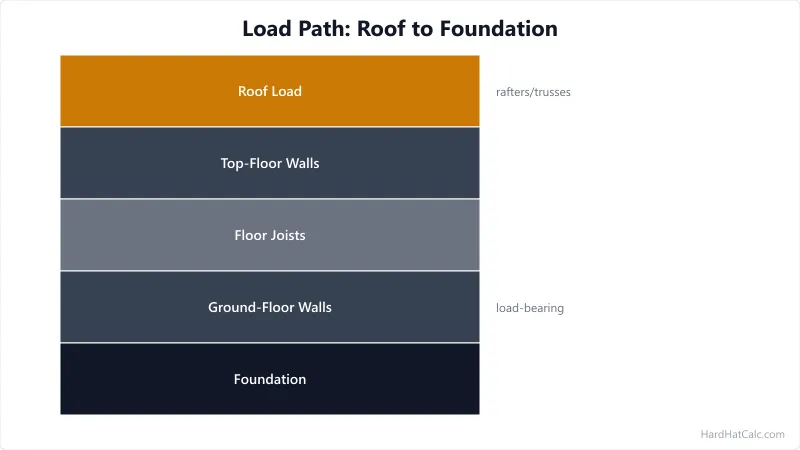
Tributary Load: The Strip of Floor Your Wall Carries
Every load-bearing wall supports a strip of floor and roof on each side called the tributary area. Think of it as the zone of influence — the portion of the structure that would collapse if the wall vanished.
For a typical residential layout with joists spanning across the house, the tributary width on each side of a centre bearing wall equals half the joist span. If your floor joists span 14 feet from the exterior wall to the centre wall, the tributary width is 7 feet. The wall carries load from both sides, so the total tributary width is 14 feet.
The loads within that tributary strip stack up: roof dead load (the weight of sheathing, shingles, and framing) plus roof live load (snow in cold climates, minimum code live load in warm ones), plus each floor's dead load (10 psf) and live load (40 psf per IRC Table R301.5), plus the self-weight of the walls between floors (8 psf for wood or steel studs with 1/2-inch drywall both sides). This calculator adds them all up and converts the result to pounds per linear foot (plf) of wall — the key input for sizing the replacement beam.
Those three figures do not rest on the same footing. The 40 psf floor live load is a code cell, printed unamended in the adopted residential codes of Seattle, Texas, Connecticut and Virginia. The 10 psf floor dead load is the span-table design basis that both the American Wood Council's span-table tutorial and the HUD Residential Structural Design Guide state, and IRC Section R301.2.2.2 caps floor assemblies at that same 10 psf. The 8 psf wall figure is the weak one: it is a row of ASCE 7 Table C3-1, a paywalled standard this site has not opened, and we have it second-hand from Boise Cascade technical notes GE-1 and GE-22 and from municipal weights-of-materials handouts that reprint the same row. Published figures for that assembly run 6 to 8 psf, and IRC Section R301.2.2.2 caps an interior light-frame wood wall at 10 psf, so the 8 ships as the conservative end of the published spread rather than as a confirmed value. IRC Section R301.4 asks for the actual weights of the materials in your building, which is what an engineer will use.
Replacement Beam Options
| Beam Type | Best For | Typical Cost/ft (March 2026) | Pros | Cons |
|---|---|---|---|---|
| LVL (Laminated Veneer Lumber) | Most residential openings under 20 ft | $15–$35/ft | Easy to work with, readily available | Must be concealed or wrapped |
| Glulam | Exposed beams, longer spans | $20–$50/ft | Attractive grain, good for visible applications | Heavier, longer lead times |
| Steel W-flange | Heavy loads, long spans, minimal depth | $25–$60/ft | Strongest per inch of depth, handles point loads well | Requires welding/bolting, harder to modify |
| Built-up dimensional (3-ply 2x12) | Short spans under 10 ft, budget projects | $8–$16/ft | Can be assembled on site with basic tools | Limited span capacity, deepest profile |
Prices as of March 2026, US national averages. Steel prices are particularly volatile — get a current quote from your steel supplier.
The per-foot prices above and the calculator's own beam-cost output ($6 to $12 per foot per inch of depth) carry no citation. This is our own estimate; no published source backs these figures. Check your results against your product data or a licensed professional before acting.
For steel beam sizing with precise section modulus calculations, size W-shapes for the span after you know the total load from this page.
Why This Calculator Is Not a Substitute for an Engineer
This tool gives you a planning-stage estimate so you can budget intelligently before hiring a structural engineer. It uses simplified assumptions that work reasonably well for standard residential framing: uniform loads, simple span conditions, and symmetric tributary areas.
Real buildings have complications that change the math. Point loads from posts above, offset bearing points, cantilevered balconies, heavy tile roofs, or concentrated loads from upper-floor bathtubs can all increase the required beam size beyond what a uniform-load calculation predicts. An engineer also checks deflection limits (the beam might be strong enough but bounce too much), lateral bracing requirements, and the adequacy of bearing posts and footings at each end of the new beam.
The cost of a structural engineer's beam design is typically $400–$800 for a residential opening. That fee buys you a sealed drawing your contractor can build from and your building inspector will accept. Trying to skip this step rarely saves money — it usually costs more when the inspector rejects the work or, worse, when the floor sags six months later.
Once you have beam dimensions from an engineer, plug them into the framing layout tool to figure out the full lumber list for reframing around the new opening.
Steps to Safely Remove a Load-Bearing Wall
Hire a structural engineer. They assess the load path, size the replacement beam, and specify post and footing requirements. This produces a sealed drawing you submit with your building permit.
Pull a building permit. Removing a load-bearing wall is structural work that requires a permit in every US jurisdiction. The permit ensures inspections at key stages — skipping it can create legal and insurance problems when you sell the house.
Install temporary shoring. Before removing anything, the contractor builds temporary walls on both sides of the bearing wall to carry the load while the beam goes in. Shoring must be engineered for the actual load — improvised supports with random lumber can fail.
Remove the wall. With shoring carrying the load, the existing studs, plates, and drywall come out. The top plate is the last piece removed because it is directly under the joists or trusses.
Install the beam and posts. The new beam slides into position, supported by posts at each end (and sometimes mid-span). Posts bear on footings that may need to be poured or reinforced in the basement below. The engineer's drawing specifies all of this.
Remove shoring, patch, and finish. Once the beam is secured and inspected, temporary shoring comes down. Drywall, trim, and flooring are patched to close the wall cavity. Plan your drywall quantities for the repaired ceiling and any new soffits around the beam.
Worked Examples
Example 1
Scenario: A homeowner wants to remove a 12-foot load-bearing wall on the first floor of a two-storey home. The joists span 16 ft from the exterior wall to this centre wall on each side, giving a tributary width of 8 ft. Moderate snow load roof.
Calculation: Wall length = 12 ft, wall height = 8 ft, floors above = 1, roof load = 30 psf, tributary width = 8 ft each side. Roof linear load = 30 × 8 × 2 = 480 plf. Floor linear load = 50 × 8 × 2 = 800 plf. Wall self-weight = 8 × 8 × 2 = 128 plf. Total linear load = 480 + 800 + 128 = 1,408 plf. Total point load = 1,408 × 12 = 16,896 lbs. Moment = (1,408 × 12²) / 8 = 25,344 ft-lbs = 304,128 in-lbs. Solving (3.5 / 6) × d² × 2,600 × (12/d)^0.136 = 304,128 (LVL Fb is 2,600 psi at 12-inch depth, adjusted by the (12/d)^0.136 depth factor) gives a beam depth of 14.3 in, where Fb works out to about 2,539 psi.
What this means: A double-ply LVL beam roughly 14.3 inches deep is needed to carry the combined roof, floor, and wall loads across the 12-foot opening. Note that the 8-foot tributary width (rather than a 7-foot assumption) increased the required depth from about 13.4" to 14.3" — getting the tributary width right matters for correct sizing.
Takeaway: A standard 14-inch LVL is a tight fit; a 16-inch LVL provides margin. Budget approximately $1,536 for the beam material alone (16" depth), plus $400-$800 for engineering and labour.
Example 2
Scenario: A ranch-style home with no upper floors — the homeowner wants to open up a 10-foot wall between the kitchen and living room. Floor joists span 14 ft to the exterior wall, giving 7 ft tributary width on each side.
Calculation: Wall length = 10 ft, wall height = 8 ft, floors above = 0, roof load = 30 psf, tributary width = 7 ft each side. Roof linear load = 30 × 7 × 2 = 420 plf. No floor load (no floors above). Wall self-weight = 8 × 8 × 1 = 64 plf. Total linear load = 420 + 0 + 64 = 484 plf. Total point load = 484 × 10 = 4,840 lbs. Moment = (484 × 10²) / 8 = 6,050 ft-lbs = 72,600 in-lbs. Solving with the depth-factored Fb ((12/d)^0.136 × 2,600 psi) gives a beam depth of 6.6 in — below the 12-inch basis depth the factor works in your favour, raising Fb to about 2,820 psi.
What this means: A relatively shallow beam handles the load because only the roof bears on this wall — no upper floors add weight.
Takeaway: A double-ply 9.25-inch LVL (the smallest standard size) provides ample margin. Estimated beam cost is around $740, making this one of the more affordable wall-removal projects.
Frequently Asked Questions
- How much does it cost to remove a load-bearing wall in 2026?
Removing a load-bearing wall and installing a replacement beam typically costs $2,500–$10,000 for a standard residential opening (8–16 ft), based on March 2026 US national averages. The range is wide because costs depend on span length, number of floors above, beam material (LVL vs steel), and whether foundation work is needed for new support posts. Short openings under 10 feet with one floor above sit at the low end; long spans with multiple floors and steel beams land at the high end. Add $400–$800 for the structural engineer and $200–$500 for the building permit. If steel is the chosen beam material, you can size structural steel for a preliminary section size and material cost estimate.
- Can I remove a load-bearing wall without a permit?
Technically you could, but it is illegal in every US jurisdiction and a terrible idea financially. Building permits exist to ensure structural work is inspected at critical stages. If you sell the house, the buyer's inspector will likely flag unpermitted structural modifications, which can kill the sale or force you to hire an engineer retroactively, open walls for inspection, and remediate any problems found. Homeowner's insurance may also deny claims related to unpermitted structural work. The permit fee ($200–$500) is a negligible fraction of the total project cost. For a detailed walkthrough of the visual clues, see the guide on identifying load-bearing walls before calling the inspector.
- What size LVL beam do I need to replace a load-bearing wall?
Beam size depends on four factors: the span (wall length being opened), the total load (from floors and roof above), the tributary width (how far the joists span to each side), and the allowable deflection. For a common scenario (12-foot opening, one floor and roof above, moderate snow load, and 8-foot tributary width) the calculator estimates a required beam depth of roughly 14 inches. A double 1.75" x 14" LVL (3.5" x 14" total) or a 16" LVL for added margin is typical. Shorter tributary widths reduce the required size, while longer joist spans increase it, sometimes by two or more depth increments. This calculator gives you a starting estimate, but the final size must come from a licensed structural engineer who accounts for your specific loading, deflection limits, bearing conditions, and local code requirements. To price the wood beam itself, the board-foot pricing tool compares species and board-foot pricing.
- How do I know if my floor joists bear on an interior wall?
Go to the basement or crawl space and look up at the underside of the floor joists. If the joists run perpendicular to the wall above and either overlap (lap splice) directly over the wall or terminate at it, that wall is carrying floor load. You may also see a beam or doubled joist directly below the wall, which confirms it as a bearing point. If joists run parallel to the wall and pass by without touching it, the wall is likely a non-load-bearing partition. In finished basements where the joists are hidden, you can sometimes infer the direction from the subfloor seam pattern or by measuring from exterior walls. The floor joist size calculator shows the maximum spans for each joist size, which helps you identify whether joists could span the full width without mid-span support.
More Structural calculators
Browse all structural calculators — Beam sizing, truss pricing, load calculations, wall framing, deck capacity, and foundation tools.