
Is Your Wall Load-Bearing?
How to tell if wall is load bearing: five visual clues from joist direction, stud stacking, headers, and the load path to check before any demolition.
Three months into renovating a stone cottage in Northumberland, I swung a pry bar into what I assumed was a simple partition wall. Behind the plaster I found a doubled-up top plate, tightly packed jack studs either side of a doorway, and a hefty timber header running the full width of the opening. That wall was holding up the bedroom floor above. Had I kept swinging, the ceiling joists would have lost their midspan support, and the upstairs floor would have started to sag — or worse. That moment changed how I approach every interior wall on a project.
This guide walks you through the same diagnostic process a renovation-minded homeowner should follow before touching any wall. You will learn five visual clues that separate a load-bearing wall from a non-structural partition. But here is the disclaimer you need to read first, and it is not a formality.
Stop Before You Swing: The Safety Warning
This guide helps you identify visual clues — only a structural engineer can confirm whether a wall is load-bearing. Getting this wrong can cause serious structural damage or collapse. A load-bearing wall transfers weight from the roof, upper floors, and sometimes even lateral wind loads down through the structure to the foundation. Remove that wall without proper temporary support and a permanent replacement beam, and you risk cracked ceilings, sagging floors, jammed doors, and in extreme cases a partial collapse that endangers everyone in the building.
No blog post replaces a site visit from a qualified professional. What this guide does is help you make a preliminary assessment so you can have an informed conversation with that professional — and avoid the expensive mistake of assuming every interior wall is "just a partition."
Top Plates, Headers, and the Load Path: A Quick Glossary
A few terms come up repeatedly. Knowing them makes the diagnostic steps below far more useful.
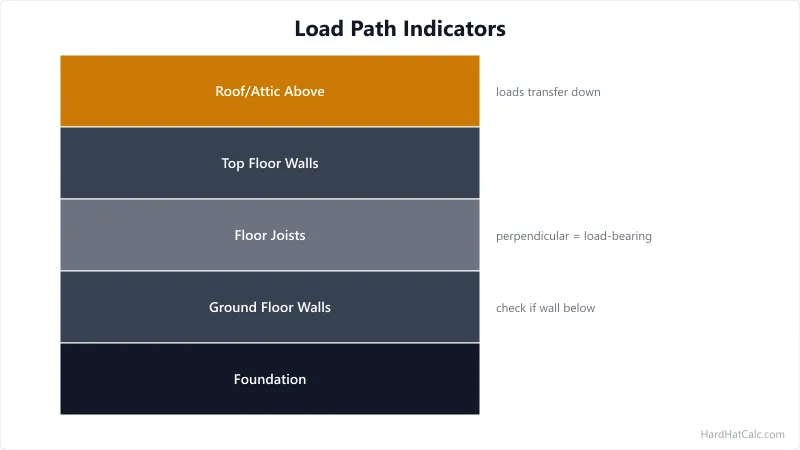
A load path is the route that weight travels from the roof down through the structure to the foundation. Every building has one. Gravity pulls the roof load down through rafters or trusses, into walls or beams, through floor joists, into more walls or columns, and finally into the footings. A load-bearing wall sits somewhere along that path. A partition wall does not — it divides space but carries no structural weight beyond its own.
Inside a framed wall, the top plate is the horizontal timber running along the top of the studs. Load-bearing walls typically have a double top plate — two layers of timber stacked and nailed together — because a single plate cannot distribute concentrated loads from joists above. A header is the horizontal beam above a window or door opening in a load-bearing wall. It transfers the load around the opening to jack studs (shorter studs that support the header from below) and king studs (full-height studs flanking the jack studs). If you open up a wall and find headers with jack studs, that is a strong signal the wall was built to carry load.
Five Visual Clues: The Diagnostic Checklist
Work through these clues in order. No single clue is definitive on its own, but when three or more point in the same direction, you have a strong preliminary answer. Treat this as a scoring exercise: the more clues that say "load-bearing," the more certain you should be — and the more critical it is to get professional confirmation before proceeding.
Clue 1: Check the Direction of Floor Joists Above
This is the single most useful clue. If you can access the floor framing from above (by lifting carpet or floorboards upstairs) or from below (from a basement or crawl space), look at which direction the joists run.
- If the joists run perpendicular to the wall (crossing over it), the wall is very likely load-bearing. The joists are landing on or near that wall and transferring their load into it.
- If the joists run parallel to the wall, the wall is more likely a partition — the joists span past it without relying on it for support.
One exception: a wall running parallel to joists can still be load-bearing if it sits directly under a beam or girder that the joists frame into. So parallel joists reduce the probability but do not eliminate it.
Clue 2: Look in the Attic or Basement
The attic and basement reveal the top and bottom of the load path. In the attic, look for walls that continue upward as knee walls or that support a ridge beam, purlins, or collar ties. If the wall below aligns with structural members in the attic, it is part of the load path.
In the basement or crawl space, look for a beam, girder, or foundation wall directly below the wall in question. A wall sitting on top of a steel beam, a concrete foundation wall, or a row of posts or columns is almost certainly carrying load from above down to those supports. A wall that lands on the middle of a floor span with no support below is more likely a partition — though not guaranteed, since some partition walls get added after original construction and might sit on reinforced joists.
Clue 3: Check If the Wall Runs Perpendicular to Floor Joists
This reinforces Clue 1 from the opposite direction. Stand in the room and determine which way the floor joists run beneath your feet (the subfloor seams, nailing patterns, or a visit to the basement can tell you). A wall running perpendicular to those joists is a strong candidate for load-bearing status because it can act as a midspan support, reducing the effective span of the joists and preventing deflection.
Walls running parallel to joists are not automatically safe to remove — but perpendicular walls deserve extra scrutiny. If you are planning to remove a wall that crosses the joist direction, budget for a replacement beam. You can size a steel replacement beam to understand what that involves before talking to your engineer.
Clue 4: Look for the Wall on Multiple Floors (Stacking)
Load-bearing walls tend to stack. If a wall on the ground floor sits directly below a wall on the first floor, and that wall sits below a wall or ridge line in the attic, all three are likely load-bearing. The load stacks vertically — roof to upper wall, upper wall to lower wall, lower wall to foundation.
- Walk through each floor and note which walls line up vertically.
- Stacked walls that also run perpendicular to joists are almost certainly structural.
- A wall that appears on only one floor with no corresponding wall above or below is more likely a partition, though you should still check the other clues.
In older homes — particularly stone or brick buildings common in Northumberland and across the UK — nearly all original walls may be structural. Internal masonry walls often carry floor joists and roof timbers even when they look like simple dividers. Do not assume an internal stone wall is non-structural just because it seems thin.
Clue 5: Check for Beams, Posts, or Thicker Framing Inside the Wall
If you can open a small inspection hole (cut a neat square of drywall or plaster that you can patch later), the internal framing tells the story. Look for these signs.
- Double top plate: two horizontal timbers stacked at the top of the studs. Partition walls typically have a single top plate.
- Headers above openings: solid timber or built-up beams above doors and windows, supported by jack studs. Partition walls often have no header — just a single flat piece of timber.
- Larger or closer-spaced studs: load-bearing walls sometimes use studs at 16-inch OC spacing or even 12-inch OC, while partitions may use 24-inch OC.
- Metal connectors or post bases: any engineered hardware connecting the wall to the floor or ceiling framing is a clear structural indicator.
Identifying these framing details is easier when you know how walls are built in the first place. The wall framing calculator breaks down stud counts, plate lengths, and header sizing for standard wall constructions — useful context for interpreting what you find behind the plaster.
The total length of the wall you want to assess or remove.
Floor-to-ceiling height. Standard residential is 8 ft.
0 = roof only above, 1 = one floor + roof, 2 = two floors + roof.
Combined dead load (roofing materials) + live load (snow). 30 psf is typical for moderate climates.
Half the joist span on each side of the wall. If floor joists span 14 ft from an exterior wall to this wall, the tributary width is 7 ft. Measure from the wall to the nearest parallel support on each side and enter the larger value.
For estimation only. Structural work requires review by a licensed engineer. Local building codes take precedence over any calculator output.
How This Is Calculated
Tributary width: user-entered value (half the joist span on each side of the wall). Linear load = (roof load x tributary width x 2) + (floor load x tributary width x 2 x floors above) + wall self-weight. Moment M = (linear load x span^2) / 8. LVL bending stress Fb = 2,600 psi at 12-inch depth, multiplied by (12/d)^0.136 for other depths (Weyerhaeuser TB-702, 2.0E Microllam LVL). Beam depth solves (width / 6) x d^2 x Fb(d) = M for a 3.5-inch double-ply section; utilization compares M against the factored capacity of the next standard LVL depth. Cost estimate based on $6–$12/ft/inch of depth for LVL (March 2026 estimate; the former RS Means and lumber-supplier attribution was withdrawn 2026-08-22 and the range ships unverified).
Source: Beam sizing solves the simple-span moment M = wL^2/8 for the section modulus of a double-ply 3.5-inch LVL. The allowable bending stress and its depth factor come from Weyerhaeuser Technical Bulletin TB-702 for 2.0E Microllam LVL (2,600 psi at 12-inch depth, multiplied by (12/d)^0.136 at other depths), corroborated by ICC-ES report ESR-1387. The moment formula is printed by American Wood Council Design Aid No. 6 and by the HUD Residential Structural Design Guide. The 40 psf floor live load is IRC Table R301.5, read unamended in the adopted residential codes of Seattle, Texas, Connecticut and Virginia; the 10 psf floor dead load is the span-table design basis stated by the AWC span-table tutorial and by HUD, and the ceiling IRC Section R301.2.2.2 sets for floor assemblies. Attribution correction of 2026-09-02: the previous citation of NDS 2024 for the sizing method and of ASCE 7-22 for the tributary load method is withdrawn, because neither standard was opened for a figure and the engine applies no NDS adjustment factors. Disclosure of 2026-09-02: the 8 psf wall self-weight is an ASCE 7 Table C3-1 row this site has read only in restatements (Boise Cascade technical notes GE-1 and GE-22, municipal weights-of-materials handouts); published figures for the assembly run 6 to 8 psf and IRC Section R301.2.2.2 caps an interior light-frame wood wall at 10 psf, so the 8 ships as the conservative end of that spread, not as a confirmed value. The beam cost range of $6 to $12 per foot per inch of depth is a March 2026 editorial estimate whose RS Means and supplier attribution was withdrawn 2026-08-22.
Room-by-Room Guidance: Common Layouts
Every house is different, but certain patterns repeat across residential construction. Use these as starting points, not guarantees.
Centre Hallway Homes
In a traditional centre-hallway layout, the walls running along either side of the hallway are frequently load-bearing. They support floor joists that span from the exterior wall to the hallway wall. The hallway itself acts as a spine for the structure. Walls dividing rooms on either side of the hallway may or may not be structural — check joist direction.
Open-Plan Ground Floors
Homes built or converted with open-plan living often had load-bearing walls removed and replaced with steel or engineered timber beams. If you see a beam running across the ceiling of an open-plan space, there was almost certainly a wall there before. The remaining walls that frame the edges of that space may still be carrying load — particularly if the beam bears into them at each end.
Two-Storey Homes
The exterior walls are always load-bearing. Beyond that, look for one or two interior walls running the length of the house (front to back or side to side) that support the upper floor joists at midspan. These central walls are the most common load-bearing interior walls in residential construction. Side-to-side partition walls that divide bedrooms are often non-structural, but verify with the joist direction test.
Bungalows and Single-Storey
Even without an upper floor, interior walls in a bungalow can be load-bearing if they support roof rafters or ceiling joists. A wall running beneath the ridge line of the roof is carrying half the roof load. Walls near the centre of the building deserve the same scrutiny as in a two-storey home.
When to Call a Structural Engineer
Call a structural engineer before removing any wall if any of the following apply.
- Three or more of the five clues above point to load-bearing.
- The wall is masonry (brick, stone, block) rather than timber-framed.
- The wall supports a floor above with heavy loads — bathrooms, kitchens with stone worktops, or storage areas.
- You plan to create an opening wider than 6 feet, even in a confirmed partition wall.
- The house predates 1940 and uses construction methods you are unfamiliar with (pre-1940 construction often predates model building codes, and framing practices — balloon framing, irregular stud spacing, non-standard lumber sizes — differ from modern platform framing).
- You are unsure after completing all five clues. Uncertainty is the clearest signal that you need professional input.
A structural engineer's site visit and report typically costs between £300 and £600 in the UK, or $400 to $800 in the US (based on 2025–2026 regional engineering firm fee surveys; actual costs vary by location and project complexity). That fee covers a written specification for any replacement beam — its size, material, bearing points, and connection details. Compared to the cost of fixing a structural failure, the engineering fee is negligible. When reviewing beam options, this comparison of steel beams and wood beams covers the trade-offs between material types, spans, and costs.
What Happens After You Confirm It Is Load-Bearing
Confirming a wall is load-bearing does not mean you cannot remove it. It means you need a plan. The standard process involves four steps.
First, a structural engineer sizes a replacement beam — steel, LVL, or glulam — that spans the opening and transfers the load to bearing points at each end. Second, a builder installs temporary support (acrow props or a needle beam) to hold the load while the wall comes out. Third, the permanent beam goes in, supported on new posts or padstones at each end. Fourth, the temporary support comes down, and the beam takes over.
The load-bearing wall calculator helps you estimate the loads involved and get a preliminary sense of beam sizing before your engineer visits. It is a starting point for conversation, not a substitute for engineering.
Lessons from a Northumberland Renovation
During my own renovation, I found that nearly every internal wall in the stone cottage was structural. The previous owners had treated internal stone walls as permanent fixtures — which they were, because those walls carried oak ceiling beams that in turn supported the upstairs floorboards. The one timber-framed partition in the house (added in the 1970s, based on the plasterboard style) turned out to be the only wall I could remove without engineering input.
The lesson: age and material matter. In a modern timber-framed house built to current codes, the load paths are relatively predictable. In an older property — especially one with stone, brick, or mixed construction — assume every wall is structural until proven otherwise. The five clues still apply, but older buildings demand more caution and professional involvement.
This guide is for preliminary assessment only. Never remove a wall based solely on visual inspection. Use the diagnostic clues to inform your thinking, then bring in a structural engineer to confirm. The cost of getting it right is a few hundred pounds. The cost of getting it wrong is measured in thousands — and sometimes in safety.
Frequently Asked Questions
- Can a wall be partially load-bearing — carrying weight in one section but not another?
Yes, this happens more often than homeowners expect. A wall might carry a beam or joist load at one end where it intersects with the main structure, while the far end simply acts as a partition. This is common when a wall runs from an exterior bearing point partway across a room. An engineer can identify exactly where the load transfers occur and may allow you to remove part of the wall while reinforcing the loaded section. The load-bearing wall checker provides a preliminary assessment of tributary load and beam sizing for the supported section.
- Does the thickness of drywall or plaster tell me anything about whether a wall is load-bearing?
Wall finish thickness alone is not a reliable indicator. Both load-bearing and partition walls can have identical drywall or plaster finishes. However, if you notice a wall is noticeably thicker than others — say 6 inches instead of 4.5 inches — it may contain larger studs (2x6 instead of 2x4) or doubled-up framing, which increases the likelihood of it being structural. The only way to know for certain is to check the framing inside, either through an inspection hole or by consulting original building plans. Use the stud-wall sizing tool to see the expected stud layout for both 2x4 and 2x6 wall assemblies.
- If my house has roof trusses instead of traditional rafters, does that change which walls are load-bearing?
It can change the picture entirely. Engineered roof trusses are designed to span from exterior wall to exterior wall without midspan support. In a truss-roofed house, interior walls on the top floor often function as partitions because the trusses do not rely on them. However, lower floors may still have load-bearing interior walls supporting the upper floor joists. And some truss designs do require interior bearing points — so check the truss engineering drawings if they are available, or have an engineer verify. The interior-bearing truss guide explains which truss designs require interior bearing and which span clear.
- What temporary support do I need before opening up a load-bearing wall for inspection?
Even cutting an inspection hole in a load-bearing wall does not require temporary support, as long as the hole is small — roughly 12 inches square — and positioned between studs without cutting any framing members. You are removing plaster or drywall only, not structure. However, if you plan to remove a stud or cut into a header for a closer look, you must install temporary support first. Acrow props (adjustable steel posts) with a spreader beam on each side of the wall are the standard approach. Never remove structural framing without shoring the load above it. If wall removal is the goal, the W-shape sizing tool helps size the replacement header or beam for the opening.