
Truss Types & Pricing
Truss types and pricing by span and cost per linear foot: king post, queen post, Fink, Howe, scissor, and attic residential trusses, with how to pick one.
You are standing in the lumber yard office, three truss quotes spread across the counter, and every one lists a different type. One says Fink. Another says Howe. The third recommends a scissor truss because your architect drew vaulted ceilings. The prices are all over the place, and nobody has explained why a few extra web members add $40 per unit to the total. This guide breaks down the six most common residential truss types — what each one looks like, how far it spans, where it works best, and what it costs as of March 2026.
SAFETY WARNING: Never cut, drill, notch, or modify a manufactured truss without written approval from a licensed structural engineer. Per TPI 1-2022 (National Design Standard for Metal Plate Connected Wood Truss Construction), even small modifications — removing a single web member to run ductwork, for example — can cause catastrophic failure of the truss and potentially the entire roof system. Trusses are engineered as complete systems; altering one member changes the force distribution in every other member.
Erection safety: During installation, unbraced trusses are unstable and can collapse in a domino chain. Temporary bracing must be installed per the truss designer's bracing plan (BCSI — Building Component Safety Information guide by TPI/SBCA) before the crane releases each truss. OSHA requires fall protection for workers setting trusses (29 CFR 1926.501), and no one should stand beneath a truss being lifted or set.
How Web Member Layout Drives Span, Cost, and Usable Space
Every roof truss does the same basic job: it transfers the weight of the roof covering, the snow load, and any wind uplift down to the bearing walls. But the internal arrangement of members — the pattern of diagonal and vertical pieces between the top chord (the sloped rafter piece) and the bottom chord (the horizontal ceiling piece) — determines how far the truss can span, how much it costs, and what you can do with the space underneath.
Pick the wrong type and you either overspend on a design that is more complex than your project needs, or you end up with a truss that cannot handle the span without a centre support wall — which defeats the purpose of using trusses in the first place. The clear span is the unsupported distance between bearing walls, and it is the single biggest factor in choosing a truss type.
The members that connect the top chord to the bottom chord are called web members. More web members mean more load paths, which means longer spans — but also more lumber, more gusset plates (the steel connector plates pressed into each joint), and a higher price tag. The six types below are listed from simplest to most complex.
The Six Common Residential Truss Types
King Post Truss
The king post is the simplest truss you can build. Picture a triangle: two sloped top chords meeting at the peak, one horizontal bottom chord, and a single vertical web member running from the peak straight down to the centre of the bottom chord. That vertical piece is the king post. Two diagonal webs run from the bottom of the king post to the midpoints of each top chord, completing the load path.
This design handles spans of 8 to 20 feet comfortably. Beyond 20 feet, the single centre web cannot distribute loads efficiently enough, and deflection becomes a problem. King post trusses are the go-to choice for small structures.
Common applications include the following.
- Garden sheds and storage buildings under 16 feet wide
- Detached garages with short spans
- Covered porches and carports
- Small additions where the roof ties into an existing structure
If you are framing a shed, the shed roof truss calculator will give you rafter lengths, lumber quantities, and costs for king post spans under 16 feet — most DIY builders can cut and assemble these on site from standard 2x4 lumber.
Cost: $3.00–$4.00 per linear foot of span for prefabricated units. A 16-foot king post truss runs roughly $48–$64 in material. Prices as of March 2026, based on US national averages from prefabricated truss manufacturers.
Queen Post Truss
Take the king post design and add a second vertical member. The two vertical posts sit at the one-third points along the bottom chord instead of at the centre, creating a rectangular panel between them. Diagonal webs connect the tops of the posts to the peak and the base of each post to the nearest bearing point.
That extra vertical member changes the load distribution in a meaningful way. Instead of funnelling all the roof load through one centre point, the queen post splits the load between two points — which allows spans of 16 to 28 feet without excessive deflection. The rectangular panel between the two posts also leaves more usable attic space than a king post, though not enough for a habitable room.
Typical uses for queen post trusses cover a range of projects.
- Two-car garages (22–24 foot spans)
- Workshops and barns
- Residential additions up to 28 feet wide
- Situations where some attic storage is desired but a full attic room is not needed
Queen post trusses cost slightly more than king posts because of the additional lumber and connector plates, but the price difference is modest relative to the span increase.
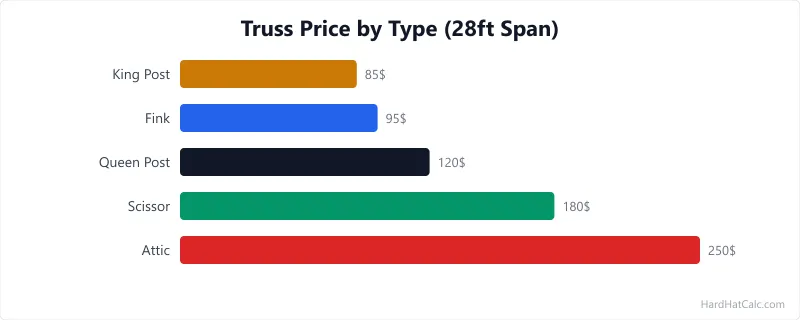
Cost: $3.75–$4.75 per linear foot of span. A 24-foot queen post truss runs approximately $90–$114 in material. Prices as of March 2026, based on US national averages from prefabricated truss manufacturers.
Fink Truss (W-Pattern)
The Fink is the workhorse of residential roof construction. If you have looked at a house being framed in the last 30 years, you have almost certainly seen Fink trusses stacked on a flatbed truck. The web pattern forms a "W" shape: two diagonal members angle downward from the peak to the bottom chord, and two more angle back up from the bottom chord to the midpoints of the top chords.
This W-pattern creates four triangular sub-panels inside the truss, each small enough to resist buckling under load. The result is a truss that handles spans of 20 to 40 feet using only 2x4 lumber for web members (though spans above 32 feet typically require 2x6 top and bottom chords). Fink trusses are mass-produced by every major truss manufacturer, which keeps prices competitive.
Fink trusses dominate in standard residential builds for good reason.
- Single-family homes with gable or hip roofs
- Spans of 20 to 40 feet — covering most residential floor plans
- Any project where cost efficiency matters more than attic space
- Production housing where the same truss design repeats across dozens of units
The downside is limited attic space. The W-pattern webs fill the interior triangle, leaving no room for storage or a future room conversion. If you need usable space above the ceiling line, look at the attic truss below.
Cost: $3.50–$4.50 per linear foot of span. A 28-foot Fink truss costs roughly $98–$126 in material. Prices as of March 2026, based on US national averages from prefabricated truss manufacturers.
Howe Truss
The Howe truss flips the diagonal web pattern compared to a Fink. Where Fink diagonals angle outward from the centre, Howe diagonals angle inward — toward the centre of the truss. Vertical members sit at evenly spaced panel points along the bottom chord, and the diagonals connect the top of each vertical to the bottom of the next one toward the peak.
In practical terms, this means the diagonal web members carry compression (they resist the inward push of loads) while the vertical web members carry tension (they are pulled taut, preventing the bottom chord from sagging). This is the opposite of a Pratt truss, where diagonals carry tension and verticals carry compression. The Howe arrangement works well for heavy, uniform loads — the verticals, being in tension, do not need to resist buckling and can use smaller lumber. This makes the Howe design efficient for longer spans and heavier loads, particularly in snow country where roof loads can reach 50 to 60 PSF.
Howe trusses appear most often in these situations.
- Residential projects in high snow-load regions
- Spans of 24 to 45 feet
- Agricultural buildings and pole barns
- Commercial buildings where heavy mechanical equipment sits on the roof
The additional vertical members mean more lumber and more gusset plates per truss, which pushes the price above a Fink of the same span by roughly 10–15%.
Cost: $4.00–$5.25 per linear foot of span. A 30-foot Howe truss costs approximately $120–$158 in material. Prices as of March 2026, based on US national averages from prefabricated truss manufacturers.
Scissor Truss
A scissor truss looks different from every other type on this list because the bottom chord is not horizontal. Instead, both bottom chord halves slope upward from the bearing walls toward the centre — forming an inverted V that mirrors the slope of the top chords but at a shallower pitch. The result is a vaulted or cathedral ceiling inside the building.
The bottom chord pitch is typically half the top chord pitch. A roof with a 10/12 top chord pitch and a 5/12 bottom chord pitch creates a vaulted ceiling that rises roughly 2.5 feet across a 12-foot half-span. Architects love scissor trusses for great rooms, churches, and any space where a flat ceiling feels too confining.
The engineering is more involved than a standard Fink or Howe. The sloped bottom chord introduces horizontal thrust at the bearing walls — the truss wants to push the walls outward. This thrust must be resisted by the wall-to-foundation connection or by a structural ridge beam. Truss manufacturers account for this in their engineering, but it often means heavier heel connections and thicker gusset plates.
Scissor trusses fit specific architectural goals.
- Living rooms, great rooms, and open-plan kitchens where vaulted ceilings are desired
- Churches and chapels
- Spans of 20 to 36 feet (beyond 36 feet, the horizontal thrust becomes difficult to manage without a ridge beam)
- Renovations where the homeowner wants to open up a flat ceiling to the roof line
Scissor trusses cost 20–35% more than a Fink of the same span. The price premium comes from heavier connections, the engineering complexity, and the fact that fewer manufacturers stock them as a standard product — many are custom orders.
Cost: $4.50–$6.00 per linear foot of span. A 28-foot scissor truss runs approximately $126–$168 in material. Prices as of March 2026, based on US national averages from prefabricated truss manufacturers.
Attic Truss (Room-in-Attic)
The attic truss — also called a room-in-attic truss — is designed to create a habitable rectangular space within the roof frame. The web members are arranged to leave a clear, open rectangle in the centre of the truss. The bottom chord acts as the attic floor, the vertical webs on each side form the knee walls, and a short horizontal chord across the top of the knee walls forms the attic ceiling.
A typical attic truss for a 32-foot span creates a usable room roughly 12 to 14 feet wide and 7.5 to 8 feet tall at the centre. The remaining triangular spaces on either side of the room (between the knee walls and the top chords) serve as storage areas accessible through small doors.
Attic trusses are heavier and more expensive than standard trusses because the bottom chord must carry floor loads (40 PSF live load for habitable space per IRC 2021 Table R301.5) in addition to holding the ceiling. Top chords and bottom chords are typically 2x8 or 2x10 lumber rather than the 2x4 used in a Fink truss.
Room-in-attic trusses work best in particular scenarios.
- Homes where the owner wants a future bonus room, home office, or bedroom without expanding the footprint
- Spans of 28 to 40 feet (narrower spans do not yield enough usable room width)
- Projects where the local building code limits the building footprint but not the height
- Cape Cod style homes and 1.5-storey designs
The weight of attic trusses — often two to three times heavier than a standard Fink due to the upgrade from 2x4 to 2x8/2x10 chords (per TPI manufacturer engineering data) — means they require a larger crane for setting and the bearing walls must be engineered for the increased loads. Factor this into your budget alongside the higher per-truss cost.
Cost: $7.00–$10.00 per linear foot of span. A 32-foot attic truss costs approximately $224–$320 in material. Prices as of March 2026, based on US national averages from prefabricated truss manufacturers.
Interior clear span from wall plate to wall plate.
On-centre spacing between trusses — typically 24" for residential.
Fink trusses are the most common residential type.
Total trusses needed. The calculator also estimates this from building length and spacing if left at default.
For estimation only. Structural work requires review by a licensed engineer. Local building codes take precedence over any calculator output.
How This Is Calculated
Material cost per truss = (span in ft x cost per ft for truss type) + connector plate cost ($12). Total material = cost per truss x quantity. Labour = ceil(quantity / 17 trusses per day) x $1,600/day (crew + crane). Delivery = $250 base + (quantity x $8–$15 per truss depending on span). Total = material + labour + delivery.
Source: Truss engineering per TPI 1-2022 (Truss Plate Institute National Design Standard). Source-set correction of 2026-08-22: the pricing attribution to prefabricated truss manufacturer catalogs and the labour attribution to RS Means residential construction data are withdrawn. No manufacturer catalog was ever recorded, the RS Means data is subscription-only and was never opened, and the free-source sweep found no industry publication that prices trusses per foot of span by web type at all (sweep record: audits/sourcing-1-retrieval/rsmeans/). The per-foot prices and the 15-20 trusses-per-day crew rate are unchanged and ship unverified.
What Drives the Price Differences
Truss pricing is not arbitrary. Five factors explain nearly all the cost variation between types and between quotes from different manufacturers.
Span length is the dominant variable. Every additional foot of span adds lumber to the chords and web members, adds connector plates at each joint, and increases the engineering complexity. The cost curve is not linear — a 36-foot truss costs more than twice what a 16-foot truss costs because the chord lumber size jumps from 2x4 to 2x6 (and sometimes 2x8) past the 30-foot mark.
Lumber species and grade affect pricing regionally. Southern Yellow Pine dominates in the Southeast and is generally 10–15% cheaper than Douglas Fir, which is standard in the Pacific Northwest. Spruce-Pine-Fir (SPF) is common in the Midwest. You rarely get to choose — the truss manufacturer uses whatever species their supply contracts cover — but it explains why quotes from manufacturers in different regions can vary by 20% or more.
Roof pitch changes the rafter length. A 6/12 pitch means the top chords are longer than those on a 4/12 pitch for the same horizontal span, which adds lumber. Steeper pitches also increase the height of the truss, which can trigger oversize load surcharges for delivery (anything taller than 13.5 feet on the truck may need a permit and escort vehicle).
Connector plate size and gauge vary with the loads. High snow-load areas and long spans require larger gusset plates and sometimes 16-gauge steel instead of 20-gauge. The steel cost per truss can jump from $8 to $18 for heavy-duty plates.
Volume and scheduling play a bigger role than most builders realise. Ordering 30 trusses gets you a better per-unit price than ordering 8, because the setup time for the manufacturing jig is the same regardless of quantity. Similarly, ordering during the off-season (November through February) often gets you 5–10% below summer pricing because the plant has capacity to fill.
Truss Cost Comparison at a Glance
The table below summarises cost per linear foot and typical span ranges for each type. Use these figures as ballpark benchmarks when comparing manufacturer quotes.
| Truss Type | Span Range | Cost per Linear Foot | Best For |
|---|---|---|---|
| King Post | 8–20 ft | $3.00–$4.00 | Sheds, porches, small garages |
| Queen Post | 16–28 ft | $3.75–$4.75 | Garages, workshops, additions |
| Fink (W) | 20–40 ft | $3.50–$4.50 | Standard residential — most homes |
| Howe | 24–45 ft | $4.00–$5.25 | Snow country, heavy loads, barns |
| Scissor | 20–36 ft | $4.50–$6.00 | Vaulted ceilings, great rooms |
| Attic | 28–40 ft | $7.00–$10.00 | Bonus rooms, Cape Cod homes |
Prices as of March 2026. Source-set correction of 2026-08-22: the attribution to TPI-certified prefabricated truss manufacturers and RS Means residential construction cost data is withdrawn (no manufacturer pricing was ever recorded; the RS Means data is subscription-only and was never opened); the figures are unchanged and ship unverified. Regional variation of 15–25% is common due to lumber supply contracts and local labour markets. Always get at least three local quotes.
Beyond Material Cost: The Full Budget Picture
The per-linear-foot figures above cover the manufactured truss only. Your total installed cost includes several additional line items that can double the material price.
Engineering and sealed drawings run $150–$400 per job. The truss manufacturer's in-house PE produces drawings stamped for your jurisdiction. This is a one-time cost per project, not per truss, so it hits small orders proportionally harder.
Delivery ranges from $250 for a local drop to $600 or more for long-haul or oversize loads. Spans above 30 feet and trusses taller than 13.5 feet often trigger surcharges. Some builders coordinate deliveries with neighbours to split the trucking cost — a practical strategy on rural jobs where the nearest truss plant is an hour or more away.
Crane rental runs $500–$700 per day for a boom truck suitable for residential work. A typical crew sets 15 to 20 trusses per day, so a 20-truss house needs one day of crane time. Attic trusses slow the pace because they weigh two to three times more than standard trusses and require more careful rigging.
Setting crew labour adds $800–$1,200 per day for a three-person crew. The crew handles bracing, alignment, and fastening once the crane places each truss. Scheduling the crane and crew on the same day as delivery eliminates one day of crane idle time — a saving of $500–$700.
Once your truss package is priced, coordinate with the rest of your roofing budget. The roofing materials guide walks through sheathing, underlayment, and shingle quantities so you can price the entire roof assembly at once. You can also run the numbers through the truss price calculator to verify that your manufacturer's quote is in the right ballpark.
Five Truss-Order Rules from Hard-Won Experience
Truss ordering is one of those tasks where a small mistake causes an expensive delay. These tips come from hard-won experience.
Get three quotes minimum. Truss pricing varies 15–20% between manufacturers because each plant has different lumber contracts and production schedules. The cheapest quote is not always the best — factor in lead time and delivery logistics.
Order early. Lead times range from two to four weeks in the off-season and stretch to five or six weeks during peak building months (April through August). A truss delay halts the entire framing schedule. Ordering a week earlier than you think you need to costs nothing; a two-week delay waiting for trusses costs plenty.
Verify the engineered drawings against your plans. Check span dimensions, roof pitch, overhang lengths, bearing points, and heel height. A mismatch caught before manufacturing is a phone call. A mismatch caught on the job site is a re-order.
Plan the crane access path before delivery day. The crane needs a firm, level pad within boom reach of the building. If your site has soft ground, overhead wires, or tight access, tell the crane operator before they show up. Moving a crane after arrival burns time at $80–$100 per hour.
Inspect every truss on delivery. Look for cracked chords, popped gusset plates, and warped members. Reject damaged trusses before the truck leaves — getting a replacement shipped later delays the set and complicates scheduling.
For a broader view of your structural options, the structural calculators hub covers beam sizing, load-bearing walls, footings, and other framing tools that complement your truss planning.
Matching the Right Truss to Your Project
Choosing a truss type is not about picking the fanciest option. It is about matching the design to three constraints: span, budget, and the intended use of the space below the roof.
For a detached garage or workshop under 24 feet wide with no plans to use the attic, a Fink truss gives you the best value. It spans the distance, it is mass-produced (which keeps lead times short), and it costs less per foot than any other type at that span range.
For a home with vaulted ceilings in the living area, scissor trusses are the only realistic option short of stick-framing with a structural ridge beam — and stick-framing costs 30–50% more in labour. Accept the 20–35% premium over Fink pricing and budget accordingly.
For a homeowner who wants a bonus room above the garage or a future bedroom in the attic, the room-in-attic truss pays for itself by avoiding a second-storey addition. The per-truss cost is roughly double a Fink, but you are getting a framed room in exchange — compare that to the $150–$250 per square foot cost of a conventional room addition.
For a barn, agricultural building, or any structure in heavy snow country, the Howe truss handles the loads more efficiently than a Fink at spans above 30 feet. The 10–15% price premium buys you a stiffer roof that is less likely to deflect under sustained snow loads.
And for small projects — sheds, porches, carports — the king post keeps things simple and cheap. At spans under 16 feet, you can build king post trusses yourself from 2x4 lumber and plywood gussets for roughly half the cost of ordering prefabricated units.
Frequently Asked Questions
- What is the cheapest truss type for a standard residential home?
The Fink (W-pattern) truss is the cheapest option for most residential spans between 20 and 40 feet, running $3.50-$4.50 per linear foot of span as of March 2026. Its popularity means manufacturers produce Fink trusses in high volume, which keeps unit costs lower than Howe or scissor designs of the same span. For very short spans under 20 feet, the king post truss is even cheaper at $3.00-$4.00 per linear foot, but it cannot handle the spans that most houses require. The span-pitch-type cost estimator provides a quick cost estimate by span, pitch, and type to verify manufacturer quotes. For projects converting attic space later, the insulation R-values guide covers climate-zone targets for the new finished area above the trusses.
- Can I convert a Fink truss attic into a room later?
No — Fink trusses cannot be modified to create attic space after installation. The W-pattern web members that give the Fink its strength run through the entire interior of the triangle, leaving no open area for a room. Cutting or removing web members to clear space destroys the structural integrity of the truss and voids the engineering certification. If you think you might want attic space in the future, specify attic (room-in-attic) trusses during the original build. Retrofitting is not feasible without removing the roof entirely and starting over. For small outbuildings where site-built rafters replace engineered trusses, the shed roof truss calculator handles rafter lengths and lumber quantities.
- How does roof pitch affect the price of a truss?
A steeper roof pitch increases truss cost in two ways. First, the top chord lumber gets longer — a 6/12 pitch requires roughly 6% more rafter length than a 4/12 pitch for the same horizontal span (rafter factor 1.118 vs 1.054), which means more lumber per truss. Second, taller trusses may exceed the 13.5-foot height limit for standard flatbed delivery, triggering oversize load surcharges of $200-$500 per trip. As a rough guide, moving from a 4/12 to an 8/12 pitch adds 8-15% to total truss material cost before delivery surcharges. The roof rafter length calculator converts pitch and span into actual rafter dimensions for comparison.
- Are scissor trusses strong enough for areas with heavy snow loads?
Scissor trusses can handle moderate snow loads up to about 30-40 PSF when engineered correctly, but they are not the best choice for heavy snow regions above 50 PSF. The sloped bottom chord creates horizontal thrust at the bearing walls, and heavy snow loads amplify that thrust beyond what standard bearing walls can resist. In high-snow areas, a Howe truss with a flat ceiling — or a scissor truss paired with a structural ridge beam to absorb the thrust — is the safer and more cost-effective engineering solution. Your truss manufacturer will run the load calculations for your specific location and flag any concerns during the design phase. If the bearing walls need reinforcement for the added thrust, you can check whether the wall is load-bearing and estimate the required framing upgrades.