
Roof Rafter Length Calculator
Free roof rafter length calculator converts span, pitch, and overhang into rafter length, birdsmouth cut depth, plumb-cut angle, and lumber order size.
Last updated:
Methodology reviewed by Doc. dr. sc. Mladenka Juradin, dipl. ing. građ., PhD, Civil Engineering (FCEAG, University of Split)
Total distance from exterior wall to exterior wall.
Rise per 12 inches of horizontal run. 6/12 is the most common residential pitch.
Horizontal projection beyond the exterior wall. Typical: 12-18 inches.
Standard gable roofs use a 2x ridge board. Shed roofs and ridge beams use 0.
Standard residential spacing is 16" or 24" OC.
For estimation only. Structural work requires review by a licensed engineer. Local building codes take precedence over any calculator output.
How This Is Calculated
Pitch angle = arctan(rise / 12). Pitch multiplier = 1 / cos(pitch angle). Run = (span / 2) - (ridge thickness / 2) for gable; full span for shed. Rafter length = (run × pitch multiplier) + (overhang × pitch multiplier). Rise = run × (pitch / 12). Plumb cut angle = pitch angle in degrees. Rafter count = (roof span × 12 / spacing) + 1 per side, doubled for gable roofs — the tool has no building-length input and uses the roof span as a stand-in, so for a building longer or shorter than its span, recompute the count with the actual length along the ridge.
Source: Rafter span-to-length conversion uses standard trigonometric rise/run relationships (rafter length = run / cos(pitch angle)). Birdsmouth geometry per standard carpentry practice (Carpentry and Building Construction, Glencoe/McGraw-Hill). Rafter tie requirements per IRC 2021 Section R802.5. Source-set correction of 2026-08-12: the AWC (American Wood Council) Span Tables for Joists and Rafters attribution for the pitch multipliers has been withdrawn. The tables were retrieved in full and are silent on the subject matter of this page: they carry no occurrence of "pitch", "multiplier", "birdsmouth" or "rafter tie", no cosine term, and they express spans as horizontal projection rather than slope length, so they hold no run-to-slope conversion factor to verify against. The multipliers themselves are unchanged and follow from the identity 1 / cos(arctan(rise / 12)) stated above; no external source now confirms them.
7 min read
Measuring and Cutting Rafters: The Full Sequence
Rafter cutting is the most geometry-intensive task in residential framing. Each rafter has three critical cuts — the plumb cut at the ridge, the birdsmouth at the wall plate, and the tail cut at the eave — and getting any one wrong means the rafter does not fit.
Calculate the rafter length from the numbers above. The calculator gives you the total length along the slope, including the overhang. This is the measurement you need for ordering lumber — always order the next standard length up from the calculated value because you cannot splice a rafter mid-span.
Mark the plumb cut at the ridge end. Set your framing square with the pitch rise on the tongue and 12 inches on the blade. The line along the tongue is the plumb cut. For a 6/12 pitch, the tongue reads 6 and the blade reads 12. This cut sits against the ridge board (or against the opposing rafter in a ridge beam system). If you have not pinned down the roof's pitch yet, work it out from a measured rise and run before laying out the square.
Measure and mark the birdsmouth. From the long point of the plumb cut, measure the rafter length along the top edge to the wall plate location. The birdsmouth is a notch cut where the rafter sits on the wall plate — it consists of a seat cut (horizontal, equal to the plate width, typically 3.5 inches for a 2x4 wall) and a plumb cut (vertical). The seat cut must not exceed one-third of the rafter depth to maintain structural capacity.
Mark the tail cut past the birdsmouth. From the birdsmouth, measure the overhang length along the top edge and mark another plumb cut. This is the tail cut — the end of the rafter at the fascia board. Some builders cut the tail plumb (vertical) and others cut a combination plumb and level cut for a decorative tail profile.
Cut a pattern rafter first. Cut one rafter carefully, test-fit it on the actual building, verify the ridge fit, birdsmouth seat, and overhang dimension, then use it as a template for all remaining rafters. Never cut the full batch from calculations alone — minor framing variations always exist.
Verify with a chalk line. After installing several rafters, snap a chalk line along the top edges. Any rafter that sits high or low relative to the line has a birdsmouth error. Fix it before sheathing — plywood over a misaligned rafter creates a visible hump or dip in the finished roof.
Pitch Multiplier Reference
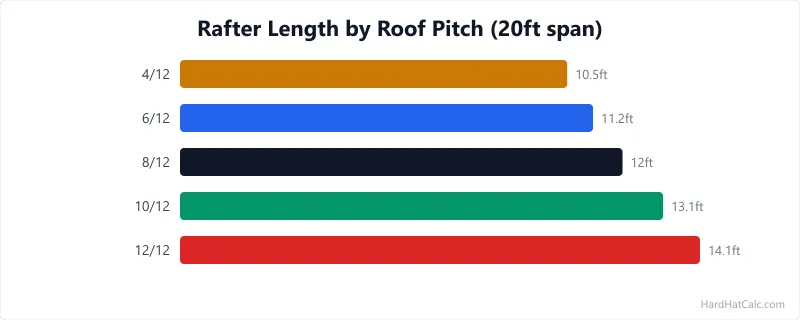
The pitch multiplier converts horizontal run to actual rafter length along the slope. It is the most important number in rafter layout because it determines how much longer the rafter is than the run.
| Pitch | Rise/Run | Angle | Multiplier | Length Added |
|---|---|---|---|---|
| 2/12 | 2" per foot | 9.5° | 1.014 | +1.4% |
| 3/12 | 3" per foot | 14.0° | 1.031 | +3.1% |
| 4/12 | 4" per foot | 18.4° | 1.054 | +5.4% |
| 5/12 | 5" per foot | 22.6° | 1.083 | +8.3% |
| 6/12 | 6" per foot | 26.6° | 1.118 | +11.8% |
| 7/12 | 7" per foot | 30.3° | 1.158 | +15.8% |
| 8/12 | 8" per foot | 33.7° | 1.202 | +20.2% |
| 9/12 | 9" per foot | 36.9° | 1.250 | +25.0% |
| 10/12 | 10" per foot | 39.8° | 1.302 | +30.2% |
| 12/12 | 12" per foot | 45.0° | 1.414 | +41.4% |
The jump from 6/12 to 12/12 nearly doubles the extra length — from 12% to 41%. This is why steep roofs use 30-41% more lumber than low-slope roofs of the same span width. A 12/12 pitch roof with a 12-foot run needs a 17-foot rafter versus 13.4 feet at 6/12.
For projects where pre-fabricated trusses make more sense than stick-framing, the rafter-vs-truss cost tool compares truss cost against the labour and material of site-cut rafters.
Birdsmouth Geometry and the One-Third Rule
The birdsmouth is the notch cut into the rafter where it sits on the top plate of the wall. It looks simple — a right-angle notch — but its depth determines the rafter's remaining bending strength at the bearing point. Cut too deep and the rafter loses bending strength at the bearing point. Cut too shallow and the rafter does not seat firmly on the plate.
The one-third rule governs birdsmouth depth: the seat cut (the horizontal cut that sits on the plate) must not remove more than one-third of the rafter depth. For a 2x8 rafter (7.25 inches actual), the maximum seat cut is about 2.4 inches. For a 2x10 (9.25 inches actual), it is 3.1 inches. A standard 2x4 wall plate is 3.5 inches wide, which means a 2x8 rafter birdsmouth cannot cover the full plate width — the seat cut stops at 2.4 inches and the rafter overhangs the inner edge of the plate by about an inch. This is normal and structurally acceptable.
The plumb cut of the birdsmouth (the vertical face that sits against the outer edge of the plate) is cut at the same angle as the ridge plumb cut. Together, the seat cut and plumb cut create a clean right-angle notch that locks the rafter onto the plate. The bearing point transfers the rafter load vertically into the wall stud below.
On steeper pitches (8/12 and above), the birdsmouth gets shallower because the seat cut angle is more acute. This naturally protects the rafter from over-cutting. On low pitches (3/12 and below), the nearly horizontal seat cut can easily be too deep — measure carefully and mark the one-third depth limit before cutting.
If the roof span is long enough to require structural support at mid-span, consider the shed roof truss calculator for truss configurations that eliminate mid-span bearing walls.
Rafters vs Trusses: Making the Choice
Site-cut rafters and factory-built trusses both frame roofs, but they serve different project types.
Rafters (stick framing) give you full use of the attic space. With no web members filling the triangle, the attic is open for storage, HVAC equipment, or future conversion to living space. Rafters are cut and installed one at a time on site by a framing crew. The trade-off is labour intensity — a skilled crew needs 2-3 days to cut and install rafters for a typical 1,500-square-foot roof, versus a single day for trusses. Rafters also require a ridge board or ridge beam, collar ties, and possibly rafter ties depending on span and pitch.
Trusses are engineered and manufactured in a factory, then delivered and crane-set in a single day. They span longer distances than rafters of the same lumber size because the web members distribute forces efficiently. A truss can span 30-40 feet without interior bearing walls, where rafters of the same size might need a mid-span support beam. The trade-off is that the web members fill the attic triangle, making it unusable as living or storage space.
For homes where attic access matters (bonus room over garage, future attic conversion, or simply accessible storage), rafters are the right choice despite higher labour cost. For production homes, large commercial roofs, and any project prioritising speed, trusses win on economics. The cost difference varies: trusses typically run $3-$7 per square foot of roof area including installation, while stick-framed rafters run $4-$10 per square foot depending on crew rates and complexity.
When ordering either option, the bundles-and-nails tool estimates the shingle quantities once the roof area is known.
Rafter Ties, Collar Ties, and Ridge Beams
Rafters push outward against the walls (a force called thrust), and three different framing members resist that thrust in different ways.
Rafter ties connect opposing rafters near the top plate (within the bottom third of the attic height). They act as tension members, preventing the walls from spreading apart under roof load. IRC R802.5 requires rafter ties when the rafter slope exceeds 3/12 and the rafters bear on the wall plates. Ties are typically 2x4 or 2x6 lumber, nailed to each rafter with at least three 16d nails per connection. Every pair of opposing rafters should have a tie unless a ceiling joist serves the same function.
Collar ties connect opposing rafters in the upper third of the attic height. They resist wind uplift forces, not lateral thrust. Collar ties are smaller (2x4 minimum) and can be spaced at 4 feet on centre rather than at every rafter. They are not substitutes for rafter ties — a roof with collar ties but no rafter ties will still push the walls outward.
Ridge beams eliminate the need for rafter ties entirely by supporting the rafter peaks on a structural beam instead of a non-structural ridge board. A ridge beam is a heavy timber or engineered beam (LVL, PSL) sized to carry the full roof load and transfer it through posts to the foundation. Ridge beams are common in cathedral ceiling designs where rafter ties and collar ties would be visible and unwelcome. The beam size is significant — a 20-foot span at 6/12 pitch with typical residential loading might require a 5.25" x 11.875" LVL.
The choice between rafter ties and a ridge beam is primarily an aesthetic and functional decision. Rafter ties are cheap and effective but fill the attic space. Ridge beams are expensive (the beam alone can cost $500-$2,000) but create clean, open ceiling lines.
Worked Examples
Example 1
Scenario: A builder is framing a standard gable roof with a 24-foot span (12-foot run per side), a 6/12 pitch, 12-inch overhang, and a 1.5-inch ridge board. Rafters at 16" OC.
Calculation: Pitch angle = arctan(6/12) = 26.57°. Pitch multiplier = 1/cos(26.57°) = 1.118. Main rafter run = 12 ft - (1.5/12)/2 = 11.9375 ft (ridge board deduction). Main rafter length = 11.9375 × 1.118 = 13.35 ft. Overhang length = 1 ft x 1.118 = 1.12 ft. Total rafter = 14.46 ft (summed before rounding) → order 16-foot lumber. Birdsmouth seat cut = rafter width (typically 3.5" for 2x lumber). Plumb cut angle = 26.57°. Rafter count = (24 × 12 / 16) + 1 = 19 per side = 38 total, using the 24-ft span as the stand-in for building length (a 40-ft-long building would need (40 × 12 / 16) + 1 = 31 per side).
What this means: Each rafter needs a 16-foot board (14.46 feet actual length rounds up to the next standard lumber length). With 38 rafters, that is 38 pieces of 2x8 or 2x10 at 16 feet, depending on the span table for the species. The 6/12 pitch adds about 12% to the horizontal run.
Takeaway: The pitch multiplier is the key conversion factor. A 6/12 pitch adds 12% to the rafter length versus the horizontal run. Steeper pitches add more: 8/12 adds 20%, 12/12 adds 41%. Always calculate the actual rafter length before ordering lumber — guessing leads to wasted cuts or short boards.
Example 2
Scenario: A homeowner is building a shed-style single-slope roof over a 16-foot span at 4/12 pitch with a 12-inch overhang and no ridge board (rafters bear on a ledger at the high side).
Calculation: Pitch angle = arctan(4/12) = 18.43°. Pitch multiplier = 1/cos(18.43°) = 1.054. Run = 16 ft (full span, no ridge deduction). Main rafter = 16 × 1.054 = 16.87 ft. Overhang = 1 × 1.054 = 1.05 ft. Total = 17.92 ft → order 18- or 20-foot lumber. Rise = 16 × (4/12) = 5.33 ft. Plumb cut angle = 18.43°. The low end sits 5.33 feet below the high end. Rafter count = (16 × 12 / 16) + 1 = 13, using the span as the stand-in for building length — swap in the actual length along the ledger for your shed.
What this means: A single-slope roof at 4/12 pitch over 16 feet needs 18-foot lumber minimum. The low pitch keeps the rafter only 5% longer than the horizontal span, but the full 16-foot run (no ridge board splitting the span) makes for a long rafter.
Takeaway: Shed-style roofs use the full span as the run (no ridge board to split it in half), which doubles the effective run compared to a gable roof of the same width. This makes the rafter length much longer than half-span gable rafters. Plan your lumber order accordingly — 18- and 20-foot boards carry a 20-30% price premium per linear foot over 16-foot and shorter stock.
Frequently Asked Questions
- How do I calculate rafter length from roof pitch and span?
Divide the roof span by 2 to get the horizontal run (for gable roofs), then multiply by the pitch multiplier. The pitch multiplier is 1/cos(arctan(pitch/12)). For a 6/12 pitch, the multiplier is 1.118. So a 24-foot span has a 12-foot run, and the rafter length along the slope is 12 × 1.118 = 13.4 feet, plus the overhang extension. Add the overhang (converted to slope length using the same multiplier) to get the total rafter length. Always order the next standard lumber length above the calculated value. Once you have the rafter length, estimate roofing shingle bundles based on the total roof area each side of the ridge.
- What is the birdsmouth cut and how deep should it be?
The birdsmouth is the notch where the rafter sits on the wall top plate. It consists of a horizontal seat cut and a vertical plumb cut forming a right angle. The seat cut depth must not exceed one-third of the rafter depth — for a 2x8 (7.25" actual), the maximum seat cut is about 2.4 inches. For a 2x10 (9.25" actual), it is about 3.1 inches. Cutting deeper weakens the rafter at its bearing point and violates the IRC. If the plate width exceeds the allowable seat cut depth, the rafter simply overhangs the inner plate edge. The wall top plate itself is sized during wall framing, where stud spacing and plate configuration affect the bearing surface.
- Do I need rafter ties or collar ties?
Rafter ties are required by IRC R802.5 for most pitched roofs to prevent the walls from spreading apart under roof load. They connect opposing rafters in the lower third of the attic and must be at every rafter pair or at alternating pairs with increased nailing. Collar ties are separate — they resist wind uplift in the upper third of the attic and can be spaced at 4 feet on centre. Collar ties alone do not prevent wall spread. If you want to eliminate rafter ties entirely (for a cathedral ceiling), you need a structural ridge beam sized to carry the full roof load. The prefab-truss comparison tool can help you compare the cost of prefabricated trusses against the labour and materials for stick-framed rafters with ties.
- How much does roof pitch affect rafter length?
The effect is dramatic. A low 3/12 pitch adds only 3% to the horizontal run, so a 12-foot run becomes a 12.4-foot rafter. A standard 6/12 pitch adds 12%, making that same run a 13.4-foot rafter. A steep 12/12 pitch adds 41%, stretching the rafter to 17 feet. Beyond the longer lumber, steeper pitches mean more expensive cuts (the birdsmouth and plumb cut angles are tighter) and more square footage of roof sheathing and shingles to cover the steeper surface area. For a complete breakdown of how to calculate roofing materials from pitch and square footage, that guide covers shingles, underlayment, and flashing.
- When should I use rafters instead of trusses?
Use rafters when you need usable attic space (bonus rooms, storage, or future conversion), when the roof has complex geometry (dormers, valleys, hips with intersections), or when site access prevents truss delivery by crane. Trusses are better for simple gable or hip roofs on production builds where speed and consistent engineering matter. Cost-wise, trusses are typically 10-25% cheaper for simple roofs when you factor in the reduced labour, but rafters can be cheaper for small projects where a crane rental and truss delivery fee would exceed the framing crew cost. The span-pitch-config cost breakdown breaks down the cost differences by span, pitch, and configuration.
More Structural calculators
Browse all structural calculators — Beam sizing, truss pricing, load calculations, wall framing, deck capacity, and foundation tools.