
Truss Price Calculator
Free truss price calculator with material, labour, crane, and delivery costs for king post, queen post, Fink, and Howe trusses by span and pitch.
Last updated:
Interior clear span from wall plate to wall plate.
On-centre spacing between trusses — typically 24" for residential.
Fink trusses are the most common residential type.
Total trusses needed. The calculator also estimates this from building length and spacing if left at default.
For estimation only. Structural work requires review by a licensed engineer. Local building codes take precedence over any calculator output.
How This Is Calculated
Material cost per truss = (span in ft x cost per ft for truss type) + connector plate cost ($12). Total material = cost per truss x quantity. Labour = ceil(quantity / 17 trusses per day) x $1,600/day (crew + crane). Delivery = $250 base + (quantity x $8–$15 per truss depending on span). Total = material + labour + delivery.
Source: Truss engineering per TPI 1-2022 (Truss Plate Institute National Design Standard). Source-set correction of 2026-08-22: the pricing attribution to prefabricated truss manufacturer catalogs and the labour attribution to RS Means residential construction data are withdrawn. No manufacturer catalog was ever recorded, the RS Means data is subscription-only and was never opened, and the free-source sweep found no industry publication that prices trusses per foot of span by web type at all (sweep record: audits/sourcing-1-retrieval/rsmeans/). The per-foot prices and the 15-20 trusses-per-day crew rate are unchanged and ship unverified.
4 min read
What Drives Roof Truss Pricing
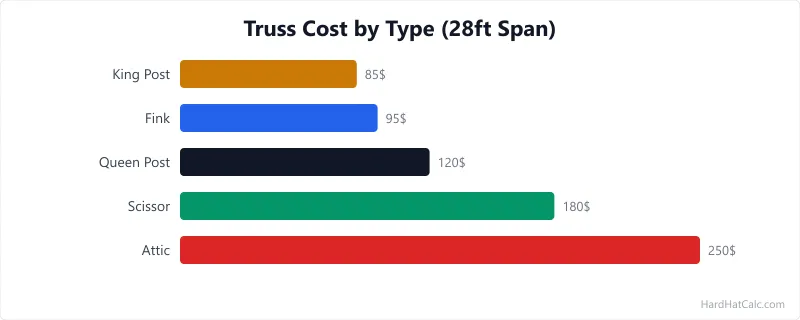
Most homeowners get sticker shock the first time they price a truss package. A 24-foot Fink truss (the workhorse of residential construction) runs $85–$120 per unit as of March 2026, based on US national averages from prefabricated truss manufacturers. Prices and rates on this page are our own estimates as of the date shown; they change often. Enter your own figures for a current result. That sounds manageable until you multiply by 20 or 30 trusses, add a crane rental, and discover that delivery alone can exceed $500 for long-span trusses.
The biggest cost variable is span length. Every additional foot of clear span adds lumber, connector plates, and engineering complexity. A 24-foot truss uses standard 2x4 web members; push past 32 feet and the manufacturer may upgrade to 2x6 chords, which roughly doubles the lumber cost per member. Truss type matters too. King post trusses (a single vertical web member) are cheapest for short spans under 16 feet. Queen post trusses add a second vertical for spans up to 22 feet. Fink (W-pattern) and Howe trusses handle longer spans but use more lumber and more connector plates.
Wood prices fluctuate seasonally. Spring building season (March–June) typically sees lumber prices 10–20% above winter lows. If your timeline allows, ordering trusses in January or February can trim the material line noticeably.
Cost Breakdown by Component
| Component | Typical Range (March 2026) | Notes |
|---|---|---|
| Lumber per truss | $45–$90 | Varies with span, chord size, species |
| Connector plates | $8–$15 per truss | Galvanised steel gusset plates |
| Engineering & seal | $150–$400 per job | One-time PE stamp for the truss package |
| Crane rental | $500–$700 per day | Boom truck for residential, crawler for commercial; based on regional equipment rental surveys |
| Setting crew labour | $800–$1,200 per day | 3-person crew sets 15–20 trusses/day on this page's estimate (unverified since the 2026-08-22 attribution withdrawal) |
| Delivery | $250–$600 | Flatbed; surcharge for spans over 30 ft |
Prices as of March 2026, US national averages. Regional variation of 15–25% is common — Southern states tend lower, Northeast and West Coast higher.
How to Order Trusses: Step by Step
Get engineered drawings. Contact a truss manufacturer with your building dimensions, roof pitch, and local snow/wind loads. They produce sealed shop drawings specific to your project — this is not optional for permitted work.
Count your trusses. Divide the building length by on-centre spacing (typically 24 inches) and add one. A 36-foot building at 24" OC needs (36 × 12 / 24) + 1 = 19 trusses. Add gable-end trusses (usually two) for a total of 21.
Get at least three quotes. Truss pricing varies widely between manufacturers because each shop has different lumber contracts and production schedules. A 15–20% spread between the cheapest and most expensive quote is normal.
Schedule the crane and crew. Trusses must be set promptly after delivery — leaving them stacked on site for weeks invites warping and damage. Coordinate crane and crew for the same day as delivery if possible.
Inspect on delivery. Check every truss against the shop drawings before the truck leaves. Damaged connector plates, cracked chords, or wrong dimensions are easier to resolve before the crane shows up.
Prefabricated vs. Stick-Built: Which Costs Less
Prefabricated trusses dominate residential construction for good reason. A crew can set 15 to 20 prefab trusses in a single day on this page's estimate (the attribution behind that rate was withdrawn on 2026-08-22 and it ships unverified), while stick-framing the same roof takes a skilled crew three to five days. Labour savings alone usually offset the higher material cost of engineered trusses.
Stick-building makes sense in two scenarios: complex roof lines with multiple hips, valleys, and dormers that would require dozens of custom truss configurations, and renovations where crane access is impossible. In those cases, a carpenter cuts and assembles each rafter on site from dimensional lumber.
For straightforward gable or hip roofs on new construction, prefab trusses cost 20–30% less than the equivalent stick-framed roof when you factor in total labour and material. If your project involves load-bearing wall modifications, have those assessed before finalising truss bearing points — changing a bearing wall after trusses are ordered means expensive re-engineering.
Planning a shed or small outbuilding instead? The shed roof truss calculator handles smaller spans where you might build trusses yourself from standard lumber.
Regional Price Variation
Truss prices swing 30–40% by region. In the Southeast US, where Southern Yellow Pine is plentiful and labour rates are moderate, a 24-foot Fink truss might run $75–$95 per unit. The same truss in the Pacific Northwest (where Douglas Fir is the default species and labour rates are higher) typically runs $100–$130.
Northeast pricing sits somewhere in between, but delivery costs tend to be higher because truss plants are fewer and farther apart. In rural areas, you might pay $400–$600 for delivery alone if the nearest manufacturer is two hours away.
Always get quotes from manufacturers within a 100-mile radius. Beyond that distance, delivery costs start eating into any material savings. Some builders coordinate with neighbours or other contractors to share a delivery truck, splitting a $500 delivery fee across two or three projects makes it much more palatable. When you have your truss quote, run the numbers through this calculator to verify the total lines up with the roofing material costs for your full roof budget.
Worked Examples
Example 1
Scenario: A homeowner is adding a 24x40-foot detached garage with Fink trusses at 24-inch on-centre spacing. The building is in a moderate snow-load area.
Calculation: At 24" OC over a 40-foot building: (40 × 12 / 24) + 1 = 21 trusses, plus 2 gable ends = 23 trusses total. Each 24-ft Fink truss: 24 ft x $4.00/ft + $12 connector plates = $108. Material: 23 x $108 = $2,484. Labour: ⌈23/17⌉ = 2 days x $1,600 = $3,200. Delivery: $250 + 23 x $8 = $434.
What this means: Total estimated cost is $6,118 for the full truss package installed. Material is 41% of the total, with crane and crew labour making up the majority at 52%.
Takeaway: Labour and crane rental dominate truss project costs. Scheduling the crew and crane for the same day as delivery eliminates a day of crane rental ($500–$700 saved).
Example 2
Scenario: A contractor is pricing 8 queen post trusses for a 32-foot clear-span workshop. The owner wants a steeper 8/12 pitch for loft storage.
Calculation: Each 32-ft queen post truss: 32 ft x $4.25/ft + $12 connector plates = $148. Material: 8 x $148 = $1,184. Labour: ⌈8/17⌉ = 1 day x $1,600 = $1,600. Delivery: $250 + 8 x $15 (over 30 ft surcharge) = $370.
What this means: Total estimated cost is $3,154. The per-truss surcharge for spans over 30 feet adds $56 to delivery alone, and the queen post design adds roughly 6% over a Fink of the same span.
Takeaway: Spans over 30 feet trigger delivery surcharges and often require a larger crane. Getting three manufacturer quotes is essential — the 15–20% spread between quotes on long-span trusses can save $200–$400 on a small package like this.
Frequently Asked Questions
- How much does a single roof truss cost in 2026?
A standard 24-foot Fink truss costs $85–$120 as of March 2026, based on US national averages. Shorter spans (16–20 ft) drop to $55–$80 per unit, while longer spans (32–40 ft) can reach $150–$220 because they require heavier chord lumber and more connector plates. These figures are material only — add $80–$120 per truss for setting labour and crane time when budgeting the full installed cost. For a broader overview of configurations and cost factors, the residential truss overview covers the common residential options.
- Is it cheaper to build trusses on site or buy prefabricated?
Prefabricated trusses are cheaper for most residential projects once you account for total labour time. Stick-framing a 24-foot span takes a two-person crew roughly 45 minutes per rafter pair, while a prefab truss is lifted and braced in 10–15 minutes. The lumber cost per truss is slightly higher for prefab because the manufacturer adds margin, but the labour savings of setting 15–20 trusses per day far outweigh that premium. Site-built rafters make financial sense only when crane access is impossible or the roof geometry is too complex for standard truss configurations. The roof rafter length calculator works out the per-rafter lumber requirement if you decide stick-framing is the better fit.
- What truss spacing should I use for a residential roof?
The standard residential truss spacing is 24 inches on centre. This works for most single-family homes with standard asphalt shingle or metal roofing and typical snow loads under 40 psf. For heavy roofing materials like concrete tile, high snow-load areas, or when you want a stiffer roof deck, 16-inch on-centre spacing is the better choice. Closer spacing increases your truss count by roughly 50% but distributes loads more evenly and reduces the chance of sheathing sag between trusses over time. After setting trusses, the shingle quantity tool estimates the shingle quantity based on roof area and pitch.
- Do I need an engineer to stamp my truss drawings?
Yes, in virtually all US jurisdictions. Building codes require that prefabricated trusses be designed by a licensed Professional Engineer (PE) and that sealed shop drawings accompany the building permit application. The truss manufacturer handles this — their in-house or contracted PE produces the drawings and stamp as part of the standard order process. The engineering fee is typically $150–$400 for a residential package and is included in most manufacturer quotes. You do not need to hire a separate structural engineer unless your project has unusual loading conditions or complex geometry that the truss manufacturer flags during design. If the trusses bear on a load-bearing wall being modified, the engineer must know about the change before finalising truss design.
- How long does it take to get trusses after ordering?
Lead times for residential roof trusses typically range from 2 to 4 weeks, depending on the manufacturer's backlog and the complexity of your design. During peak building season (April through August), lead times can stretch to 5–6 weeks. Simple gable-roof trusses with standard spans ship faster than custom configurations with piggyback trusses, raised heels, or unusual pitches. Order as early as your schedule allows — having trusses sit on site for a few days costs nothing, but a two-week delay waiting for trusses stops the entire framing schedule. Use the waiting period to finalise wall framing material lists and order lumber so both arrive on the same timeline.
More Structural calculators
Browse all structural calculators — Beam sizing, truss pricing, load calculations, wall framing, deck capacity, and foundation tools.