
Roofing Shingle Bundle Calculator
Free roofing shingle bundle calculator with pitch adjustment, waste factor, and ridge cap counts. Get bundle totals, square counts, and cost estimates.
Last updated:
Horizontal length of the roof at the eave (ground-level measurement).
Horizontal width from one rake edge to the other (ground-level measurement).
Rise per 12 inches of horizontal run. 6/12 is a common residential pitch.
Extra material for cuts, valleys, and mistakes. 10% for simple roofs, 15% for complex.
How This Is Calculated
Pitch multiplier = sqrt(144 + pitch²) / 12. Slope area = footprint area × pitch multiplier. Adjusted area = slope area × (1 + waste %). Squares = adjusted area ÷ 100. Bundles = squares × 3 (rounded up). Cost = bundles × $40 + ridge bundles × $20.
Source: Pitch multiplier geometry per NRCA (National Roofing Contractors Association) Roofing Manual. Bundle coverage rates per manufacturer specs from GAF, Owens Corning, and CertainTeed product data sheets. Source-set correction of 2026-08-12: the ASTM D225 attribution for the three-bundles-per-square figure has been withdrawn at all four places it appeared on this page. ASTM withdrew D225 in 2012, and it specified organic-felt asphalt shingles rather than the fibreglass products these rows describe, so no edition of it could source this coverage figure. No replacement standard has been substituted in its place. The figure itself is unchanged and rests on the Owens Corning, CertainTeed and IKO product data sheets named below (GAF's sheets were not opened). Ridge-cap coverage of 33 linear feet per bundle is the figure Owens Corning (ProEdge) and TAMKO (12-1/4 x 12 Hip and Ridge) print; other makers differ (CertainTeed Shadow Ridge 30 ft, IKO Hip and Ridge 12 29.5 ft, Malarkey 20 to 41 ft by line), so treat it as the assumed product and check your own bundle. Three bundles per square is printed by Owens Corning (Oakridge), CertainTeed (Landmark) and IKO (Cambridge) for their own products; Owens Corning and CertainTeed print 98.4 sq ft of coverage per three bundles, so the tool's 100 sq ft square under-orders by about 1.6 percent on those lines. GAF's sheets were not opened (its site blocks automated retrieval). Data sheets read 2026-09-02.
7 min read
Roof Pitch and Why It Changes Everything
Falls from roofs are a leading cause of construction fatalities. Always use proper fall protection (body belt and lanyard, guardrails, or safety nets) when working at height. OSHA requires fall protection for work at 6 feet or above (29 CFR 1926.501(b)(1)).
A roof's ground-level footprint tells you nothing about how many shingles you need. Roof pitch — the angle of the slope, expressed as rise over run — stretches the actual surface area well beyond the footprint. A 6/12 pitch (the most common residential pitch in the US) adds about 12% to the footprint area. A steep 12/12 pitch (a 45-degree slope) adds 41%.
Pitch is written as "X/12" where X is the number of inches the roof rises for every 12 inches of horizontal run. A 4/12 pitch is a gentle slope suitable for long ranch-style homes. A 12/12 pitch is steep enough that roofers need specialised jacks and fall-arrest gear to work safely. Most residential shingle roofs fall between 4/12 and 9/12.
The math is straightforward but easy to forget. For a pitch of X/12, the multiplier is the square root of (144 + X squared) divided by 12. A 6/12 roof has a multiplier of about 1.118, so a 1,000-square-foot footprint translates to 1,118 square feet of actual shingle coverage. Skip this step and you will be short by 100+ square feet on a typical house — that is 3–4 bundles and a second trip to the supplier.
When measuring your roof from the ground, measure the horizontal dimensions (eave length and the horizontal distance from eave to ridge). Do not try to measure along the slope from the ground — the pitch multiplier converts horizontal measurements to slope measurements mathematically. If you are working on a project that also involves truss replacement or repair, the truss drawings will list both the span (horizontal) and the pitch, saving you a trip to the roof with a tape measure.
How to Estimate Shingle Bundles: Step by Step
Measure the footprint from the ground. Walk the perimeter of the house and measure the horizontal length and width of each roof section. For a simple gable roof, you need the eave length and the horizontal distance from eave to ridge; multiplying length by width gives each section's footprint area, the same basics of working out an area in square feet used for floors and walls. For a hip roof, measure each hip section as a separate triangle or trapezoid and add them up.
Apply the pitch multiplier. Multiply the footprint area by the pitch multiplier for your roof slope. If you do not know the pitch, convert a measured rise and run into the slope factor, or measure it from inside the attic: hold a level horizontally from a rafter, measure 12 inches along the level, then measure the vertical distance from that point down to the rafter. That vertical distance is your pitch number.
Add the waste factor. For a simple gable roof (two rectangular planes), use 10% waste. For roofs with valleys, dormers, or multiple intersecting planes, use 15%. For complex roofs with turrets, curved sections, or six or more planes, use 20% or more. The waste comes from partial shingles cut to fit at valleys, ridges, rakes, and around penetrations (vents, skylights, chimneys).
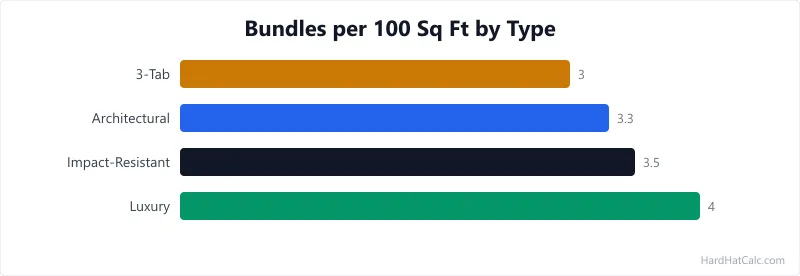
Convert to squares and bundles. Divide the adjusted area by 100 to get the number of roofing squares. Each square requires 3 bundles of standard 3-tab or architectural shingles (per manufacturer specifications). Round up to the nearest whole bundle — you cannot buy partial bundles.
Add ridge cap bundles separately. Ridge caps are specialised shingles (or field shingles cut to size) that cover the ridge line and hip lines. One bundle of ridge cap covers about 33 linear feet for the products this tool assumes (Owens Corning ProEdge and TAMKO print 33 ft per bundle; CertainTeed Shadow Ridge covers 30 ft, IKO Hip & Ridge 12 covers 29.5 ft and Malarkey lines run 20 to 41 ft), so check the coverage printed on your bundle. Measure the total ridge and hip line length and divide by 33.
Order starter strip. Starter shingles run along the eave edge, providing a seal line for the first course. One bundle covers about 100 linear feet. Measure the total eave perimeter and divide by 100.
3-Tab vs. Architectural Shingles: Cost and Coverage
The two main asphalt shingle types dominate the residential market, and the choice affects both cost per bundle and long-term value.
3-tab shingles are flat, uniform, and the cheapest asphalt option. Each shingle has three tabs that create a repeating brick-like pattern. A bundle covers roughly 33.3 square feet (3 bundles per square per manufacturer specifications). Pros: low cost ($25–$35 per bundle as of March 2026, US national averages), easy to install, lightweight. Prices and rates on this page are our own estimates as of the date shown; they change often. Enter your own figures for a current result. Cons: rated for 15–25 years, lower wind resistance (60–70 mph), no dimensional look. 3-tab shingles are steadily losing market share — several major manufacturers have reduced or discontinued 3-tab lines in favour of architectural.
Architectural (dimensional) shingles have a layered, contoured profile that creates shadow lines mimicking wood shake or slate. They cost $30–$50 per bundle, also at 3 bundles per square per manufacturer specs. Pros: 30-year to lifetime warranties, higher wind resistance (110–130 mph rated), better curb appeal, thicker construction resists hail damage better. Cons: 20–40% more expensive than 3-tab, heavier per square (about 240–300 lbs vs. 200–240 lbs per manufacturer product data sheets from GAF, Owens Corning, and CertainTeed), which occasionally matters on older roof structures.
For most re-roofing projects, architectural shingles are the better value despite the higher per-bundle price. The extended lifespan means you re-roof once instead of potentially twice over a 40-year period, and the improved wind rating may lower homeowner insurance premiums in storm-prone areas. Insurance companies in Florida, Texas, and the Carolinas increasingly require architectural-grade shingles for full roof replacement coverage. The guide on calculating all your roofing materials covers underlayment, flashing, and ventilation alongside shingle bundles for a complete material order.
If the additional weight of architectural shingles concerns you on an older home, check the deck weight limit of your roof sheathing. A healthy 1/2-inch plywood deck over 24-inch on-centre rafters handles architectural shingles without issue, but a deteriorated deck may need replacement before re-roofing.
Pitch Multiplier Reference Table
Use this table to quickly convert flat footprint area to actual slope area. Multiply the footprint area by the factor in the right column.
| Roof Pitch | Rise (in) per 12 in Run | Slope Angle (degrees) | Area Multiplier |
|---|---|---|---|
| 4/12 | 4 | 18.4° | 1.054 |
| 5/12 | 5 | 22.6° | 1.083 |
| 6/12 | 6 | 26.6° | 1.118 |
| 7/12 | 7 | 30.3° | 1.158 |
| 8/12 | 8 | 33.7° | 1.202 |
| 9/12 | 9 | 36.9° | 1.250 |
| 10/12 | 10 | 39.8° | 1.302 |
| 11/12 | 11 | 42.5° | 1.357 |
| 12/12 | 12 | 45.0° | 1.414 |
For pitches steeper than 8/12, most roofing contractors add a labour surcharge because the steep angle requires roof jacks, fall-arrest equipment, and slower progress. The material cost stays the same, but installed cost per square can increase by 20–50% on steep roofs.
Flat and low-slope roofs (below 4/12) should not use standard asphalt shingles. Most shingle manufacturers void the warranty below a 2/12 or 4/12 pitch because water drains too slowly and can wick under the shingles. Low-slope roofs need modified bitumen, TPO, EPDM, or built-up roofing systems instead.
Waste Factor: How Much Extra Do You Really Need?
Waste factor is the most debated number in roofing estimates. Too low and you run short mid-job, which means a second delivery charge and mismatched dye lots. Too high and you have 10 leftover bundles taking up garage space for years.
The waste comes from three sources. First, cut waste at edges: every shingle that meets a valley, hip, rake, or ridge must be trimmed to fit, and the offcut is scrap. A simple gable roof generates minimal cut waste because most cuts are straight lines along the rake edges. Second, penetration waste: skylights, plumbing vents, and chimney flashings each require cutting around irregular shapes, generating 2–5 square feet of waste per penetration. Third, starter and ridge materials that this calculator accounts for separately but some contractors lump into a general waste percentage.
For a typical gable roof with 2–3 penetrations, 10% waste is standard. Roofs with one or more valleys (where two roof planes meet in an interior angle) should use 12–15% because valley cuts produce angled offcuts that cannot be reused. Complex roofs with dormers, turrets, or more than four planes often need 15–20%. Some contractors report 25% waste on highly irregular roof shapes, though at that point the layout may need redesign rather than just extra material. If your project also involves replacing the underlayment beneath the shingles, order that material at the same time to lock in a single delivery charge.
If you are keeping leftover bundles, store them flat in a dry location off concrete (pallets work). Shingle dye lots vary between manufacturing runs, so leftovers from the original install are better than new bundles for small repairs. Most manufacturers recommend using leftovers within 5 years.
Worked Examples
Example 1
Scenario: A homeowner has a simple gable roof measuring 45 ft long by 28 ft wide (eave to ridge) with a 6/12 pitch. They plan 10% waste for the straightforward layout.
Calculation: Footprint area = 45 × 28 = 1,260 sq ft. Pitch multiplier = √(144 + 36) / 12 = 1.118. Slope area = 1,260 × 1.118 = 1,409 sq ft. Adjusted area = 1,409 × 1.10 = 1,550 sq ft. Squares = 1,550 ÷ 100 = 15.5. Bundles = ⌈15.5 × 3⌉ = 47 bundles. Ridge bundles = ⌈45 ÷ 33⌉ = 2. Cost = 47 × $40 + 2 × $20 = $1,920.
What this means: The roof needs 47 bundles of architectural shingles plus 2 ridge-cap bundles, totalling about $1,920 in shingle material costs.
Takeaway: The 6/12 pitch adds nearly 150 sq ft of surface area beyond the flat footprint — skipping the pitch multiplier would leave you 5 bundles short.
Example 2
Scenario: A contractor is bidding a re-roof on a large colonial with a 60 × 30 ft footprint, steep 10/12 pitch, and 15% waste to account for two valleys and a chimney penetration.
Calculation: Footprint area = 60 × 30 = 1,800 sq ft. Pitch multiplier = √(144 + 100) / 12 = 1.302. Slope area = 1,800 × 1.302 = 2,344 sq ft. Adjusted area = 2,344 × 1.15 = 2,695 sq ft (the engine carries the unrounded slope area). Squares = 2,695 ÷ 100 = 26.9. Bundles = ⌈26.9 × 3⌉ = 81 bundles. Ridge bundles = ⌈60 ÷ 33⌉ = 2. Cost = 81 × $40 + 2 × $20 = $3,280.
What this means: The steep colonial needs 81 shingle bundles plus ridge caps, with material costs around $3,280 — not including underlayment, flashing, or labour.
Takeaway: Steep pitches (10/12 and above) increase material by over 30% versus the footprint and add labour surcharges of 20-50% — factor both into the bid.
Frequently Asked Questions
- How many bundles of shingles do I need per square?
Three bundles cover one roofing square (100 sq ft) per manufacturer specifications, for both standard 3-tab and most architectural shingles. Some premium heavyweight architectural shingles require 4 or even 5 bundles per square — check the label on the specific product you are buying. Each bundle weighs 60–80 lbs for standard shingles and up to 100 lbs for premium lines per manufacturer product data sheets (GAF, Owens Corning, CertainTeed), which matters for carrying bundles up a ladder and for overall roof load calculations. For the full materials list beyond shingles, the guide on calculating all roofing materials covers underlayment, flashing, and ventilation.
- Can I install new shingles over old ones without tearing off?
Most building codes allow one layer of new shingles over one existing layer (two layers total). Going over two layers is prohibited nearly everywhere because the weight exceeds the designed roof load capacity. Even where a second layer is allowed, a tearoff is usually better: it lets you inspect and repair the deck sheathing, install new underlayment, and starts the new roof with a flat surface. Roofing over old curled or buckled shingles transfers those imperfections to the new layer, reducing lifespan and voiding some warranties. If the existing trusses or rafters show signs of sagging, a truss replacement cost estimate should come before the re-roof.
- What is the cheapest time of year to buy roofing shingles?
Late fall and winter (October through February) offer the lowest shingle prices in most US markets. Demand drops because cold weather slows installations, and distributors discount inventory to clear warehouse space. Prices as of March 2026 show a 10–15% premium during peak season (May–August) compared to off-season pricing. If your re-roof is not urgent, buying shingles in January and storing them for a spring install can save $200–$500 on a 30-square roof. Order underlayment at the same time to lock in a single delivery charge.
- How do I measure roof area without climbing on the roof?
Use a satellite measurement tool (Google Earth, EagleView, or a roofing supplier measurement service) to get the footprint area from an aerial view. Then apply the pitch multiplier from the table above. If you do not know the pitch, go into the attic with a level and tape measure: hold the level horizontal against a rafter, measure 12 inches along the level, then measure straight down from that point to the rafter. The vertical distance is your pitch number. Satellite measurements are typically accurate within 2–5% for simple roof shapes. Once you have the area, the gutter sizing calculator uses the same roof measurement to size your drainage system. For a deeper walkthrough on sizing, the downspout-and-gutter sizing guide explains the math step by step.
- Do I need different shingles for different sides of the roof?
No — use the same product on all sides. However, south-facing and west-facing roof planes receive more sun and heat, which ages shingles faster than north-facing planes. Some homeowners choose darker colours for north-facing slopes (less heat absorption concern) and lighter colours for south-facing slopes (to reduce cooling loads), but this is an aesthetic choice, not a structural one. All shingle colours from a given product line carry the same warranty and performance ratings regardless of which direction they face. Understanding insulation R-values for the attic below the shingles has a bigger impact on cooling costs than shingle colour alone.
More Materials calculators
Browse all materials calculators — Paint coverage, roofing bundles, tile adhesive, welding time, parking lot sizing, and more.