
Insulation R-Values Explained
Insulation R values explained: what R-value and U-factor mean, how IECC climate zones set minimums, and which materials give the highest R-value per inch.
A house with R-13 walls in Climate Zone 5 spends roughly 25-30% more on heating than the same house with R-21 walls. That gap is not a vague estimate — it comes straight from energy modelling software (REM/Rate) used by energy auditors and code officials. The difference on a 1,500 sq ft single-storey house in upstate New York works out to $350-$500 per year in natural gas costs at 2026 prices. Over a 20-year ownership period, that is $7,000-$10,000 in excess heating bills — far more than the $1,500-$2,500 it costs to upgrade from R-13 fiberglass batts to R-21 blown cellulose or mineral wool in the same wall cavities.
R-value is the number that quantifies this difference, and understanding what it actually means — not just which number is bigger — helps you make insulation decisions that balance cost, performance, and building code requirements. This guide explains R-value from the physics up, walks through the IECC 2021 climate zone requirements, compares insulation materials by R-per-inch, and addresses the real-world question of diminishing returns: when does adding more insulation stop paying for itself?
Find your zone at energy.gov/energysaver. Zones 1-2 are the Deep South; 6-7 are the northern US and Alaska.
Where the insulation will be installed. Each area has different R-value minimums.
Total surface area to insulate, not floor area.
Batts for new construction cavities, blown-in for retrofits and attics, spray foam for maximum R per inch.
Cavity depth limits achievable R-value for batts and blown-in. Select "Attic" for open attic floors.
Square feet one package of batts covers. 32 sq ft is a typical small package (a single 15 × 93 in batt covers about 9.7 sq ft) — check your product's coverage and enter it here. Used for batt types only.
Square feet one bag covers at R-13, printed on your product's bag or coverage chart. Blown fiberglass: Johns Manville Climate Pro B-7700 prints 181.3 sq ft per bag at R-13 (5.00 in., 5.5 bags per 1,000 sq ft; its 125.4 figure is the R-19 row); blown cellulose 65.6 to 72.3 sq ft per bag (Greenfiber SupremePlus: no joists to 2x6 joists). Used for blown-in types only.
How This Is Calculated
Required R-value = IECC 2021 Table R402.1.3 lookup by climate zone and application area. Achievable R-value = R-value per inch × cavity depth (inches). Batt packages needed = area ÷ package coverage (default 32 sq ft per package; enter your product's figure). Blown-in bags = area × (required R ÷ 13) ÷ bag coverage at R-13 (default 181.3 sq ft/bag fiberglass, 65 sq ft/bag cellulose; enter your product's figure). Spray foam board feet = area × (required R ÷ R per inch). Estimated cost = area × cost per sq ft.
Source: R-value requirements from IECC 2021 Table R402.1.3 (R-value alternative — insulation minimum R-values by component), including cavity-only and cavity-plus-continuous-insulation alternatives for wall assemblies, with the R402.2.1 ceiling exception. Source-set correction of 2026-08-22: the material-cost attribution to RS Means Residential Construction Cost Data 2026 is withdrawn (no such 2026 product; subscription-only, never opened), and the free-source sweep found no independent replacement: the NREL residential measures database itself lists RS Means among its inputs, and the DOE and NAIMA insulation guides publish no dollar figures (sweep record: audits/sourcing-1-retrieval/rsmeans/). The cost figures are unchanged and ship unverified. Source-set correction of 2026-09-02 (SF20-A7, Q-A6-4 ruling applied): blown-in bag coverage at R-13 previously carried a blanket "NAIMA technical bulletins" attribution that was never independently opened and is withdrawn. Blown fiberglass now defaults to 125 sq ft per bag (Johns Manville Climate Pro B-7700 prints 125.4, rounded down) and blown cellulose to 65 sq ft per bag (Greenfiber SupremePlus prints 65.6 sq ft per bag with no joists and 72.3 between 2x6 joists at 16 in., rounded down to the low end; the page read those two columns backwards until 2026-09-12, the figure itself is unchanged), each on its own manufacturer's coverage chart; both are now an editable per-product input (bagCoverage) rather than a fixed constant, replacing the prior fixed 40 / 36 sq ft per bag. R-per-inch by type and the 32 sq ft default batt-package coverage remain this site's typical values, unattributed; the "Insulation Types Compared" section names the manufacturer spread around each figure (Owens Corning Thermal Batt, ROCKWOOL Comfortbatt, Johns Manville Climate Pro, Greenfiber SupremePlus). Correction of 2026-09-12 (SF22-HHC-F1 E4, seat-ruled 2026-09-07): the 125.4 sq ft per bag figure read from the Johns Manville Climate Pro B-7700 attic card on 2026-09-02 is that card's R-19 / 7.00 in. row (8.0 bags per 1,000 sq ft); the R-13 / 5.00 in. row, the reference the bag formula scales from, prints 5.5 bags per 1,000 sq ft and 181.3 sq ft per bag, and the blown-fiberglass default is now 181.3 (the former default over-ordered by 45 percent; the Zone 2 attic preset moves 28 to 19 bags). Knauf Jet Stream MAX prints 178.2 sq ft per bag at R-12 / 4.5 in. (5.6 bags per 1,000 sq ft) on its Canadian fact sheet, the same range. The bag formula scales bags linearly with R from the R-13 row; the makers' own charts run steeper at depth (Johns Manville prints 22.4 bags per 1,000 sq ft at R-49 against the linear 20.7 from its R-13 row, and 27.9 at R-60 against 25.4), so at attic R-values the linear count runs 8 to 16 percent under the printed chart: enter your chart's figure at the target R for an exact count. The IECC 2021 Table R402.1.3 minimums are on record from three renderings: the DOE / PNNL Building America Solution Center table (every zone and component, the 2021 column matches the seven-zone table this page uses cell for cell, with the basement-wall figure taken as the continuous-insulation option), the DOE Building Energy Codes Program 2021 IECC determination (Table D.5, ceiling R-49 zones 2-3 and R-60 zones 4-8) and Delaware DNREC's 2021 IECC residential changes guide (ceiling 49 to 60, wood-frame wall 20 or 13+5 to 30 or 20+5ci or 13+10ci or 0+20ci).
What R-Value Actually Measures
R-value measures thermal resistance — how effectively a material resists the flow of heat through it. The higher the R-value, the slower heat moves through the material. Heat flows from warm to cold, always. In winter, heat moves from your heated interior through the walls, ceiling, and floor to the cold exterior. In summer, the direction reverses. Insulation slows this transfer in both directions.
The unit is formally defined as the temperature difference (in degrees Fahrenheit) required to produce one BTU of heat flow per hour through one square foot of material. In practice, you do not need to work with that definition directly. What matters is this: R-value is additive. An R-13 batt plus R-5 continuous rigid foam equals R-18 total. A 2×6 wall cavity filled with R-21 fiberglass plus R-5 exterior foam board equals R-26 total. You can stack materials and add their R-values to get the assembly total.
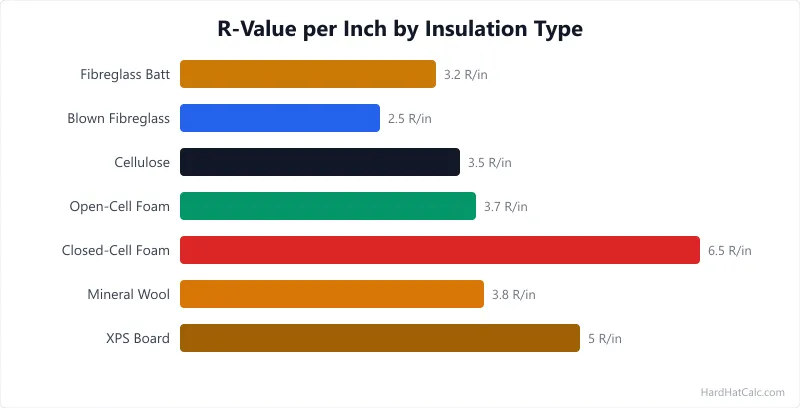
R-value is also thickness-dependent. Every insulation material has a characteristic R-value per inch — the thermal resistance provided by a single inch of that material. Fiberglass batts deliver R-3.2 per inch. Closed-cell spray foam delivers R-6.5 per inch. To reach R-20 with fiberglass, you need 6.25 inches of depth. To reach R-20 with closed-cell spray foam, you need only 3.1 inches. The insulation material determines R-per-inch; the cavity depth determines how much total R-value you can fit.
R-Value vs. U-Factor: Two Sides of the Same Coin
Building codes and window specifications often use U-factor instead of R-value. U-factor is the inverse of R-value: U = 1/R. A wall with R-20 insulation has a U-factor of 0.05. A window with a U-factor of 0.30 has an R-value of 3.3. Lower U-factor means less heat transfer, just as higher R-value means less heat transfer. The IECC uses both: R-value for opaque assemblies (walls, ceilings, floors) and U-factor for fenestration (windows, doors, skylights).
The reason codes use U-factor for windows is that window thermal performance depends on the frame, glass, coatings, and gas fill working together — you cannot simply add R-values of individual window components. A double-pane window with low-E coating and argon gas fill achieves U-0.30 (R-3.3), while a triple-pane version reaches U-0.20 (R-5.0). Neither number is the R-value of the glass alone; it is the whole-unit performance measured by standardised testing (NFRC protocols).
IECC 2021 Climate Zones and R-Value Minimums
The International Energy Conservation Code divides the United States into seven climate zones based on heating degree days and cooling degree days. Each zone prescribes minimum R-values for walls, ceilings, floors, and basement walls (IECC 2021, Table R402.1.3, the R-value compliance path). These are not suggestions — they are code requirements enforced by building inspectors at the framing inspection stage.
The zone boundaries roughly follow latitude, modified by altitude and proximity to large bodies of water. Zone 1 covers southern Florida and Hawaii; Zone 7 covers northern Minnesota, northern Maine, and Alaska. The sharpest step sits at the Zone 3-to-4 boundary — running roughly through southern Virginia, Kentucky, Missouri, and Kansas — where wall minimums climb from R-20 to R-30 and attic minimums from R-49 to R-60. Floors then rise from R-19 to R-30 at the Zone 4-to-5 line, and basement walls from R-10 to R-15.
| Climate Zone | Exterior Walls | Ceiling / Attic | Floor | Basement Walls |
|---|---|---|---|---|
| Zone 1 (Hot-Humid) | R-13 | R-30 | R-13 | None |
| Zone 2 (Hot) | R-13 | R-49 | R-13 | None |
| Zone 3 (Warm) | R-20 or R-13+5ci | R-49 | R-19 | R-5 |
| Zone 4 (Mixed) | R-30 or R-20+5ci or R-13+10ci | R-60 | R-19 | R-10 |
| Zone 5 (Cool) | R-30 or R-20+5ci or R-13+10ci | R-60 | R-30 | R-15 |
| Zone 6 (Cold) | R-30 or R-20+5ci or R-13+10ci | R-60 | R-30 | R-15 |
| Zone 7 (Very Cold) | R-30 or R-20+5ci or R-13+10ci | R-60 | R-38 | R-15 |
The "+ci" notation means continuous insulation — rigid foam board or spray foam applied to the exterior face of the wall sheathing, unbroken by framing members. Continuous insulation is more thermally efficient per R-value than cavity insulation because it eliminates thermal bridging through the wood studs. A 2×4 stud has an R-value of about 4.4 (wood at R-1.25 per inch × 3.5 inches), which is far less than the R-13 batt next to it. The stud acts as a thermal shortcut — heat flows preferentially through the wood rather than the insulation. Continuous exterior insulation covers the studs and the insulation equally, breaking this shortcut. That is why the wall rows carry continuous-insulation alternatives such as R-13 cavity plus R-10 continuous foam in Zones 4-7, and why Section R402.2.1 lets a lower attic value satisfy the headline figure where the full insulation height clears the wall top plate at the eaves: R-49 stands in for R-60, and R-38 for R-49.
The insulation requirement calculator identifies your climate zone and checks whether your planned insulation assembly meets code. If you are renovating an older home, it also shows how far your existing insulation falls short of current code — a useful data point for prioritising upgrades.
Insulation Materials Compared by R-Value per Inch
Not all insulation materials perform equally at the same thickness. R-value per inch is the critical comparison metric because it determines how much thermal resistance you can fit into a given cavity depth. In a standard 2×4 wall with 3.5 inches of cavity, the material choice determines whether you achieve R-11 or R-23 — a 2× difference from the same wall thickness.
| Insulation material | R-value per inch | Form | R-value in a 3.5″ 2×4 cavity |
|---|---|---|---|
| Blown fibreglass (loose-fill) | R-2.5 | Loose-fill | R-8.8 |
| Fibreglass batt | R-3.2 | Batt | R-11.2 |
| Cellulose (dense-pack) | R-3.5 | Loose-fill | R-12.3 |
| Open-cell spray foam | R-3.7 | Spray foam | R-13.0 |
| Mineral wool (Rockwool) | R-3.8 (3.8-4.2) | Batt | R-13.3 |
| EPS rigid board | R-3.8 | Rigid board | R-13.3 |
| XPS rigid board | R-5.0 | Rigid board | R-17.5 |
| Polyiso rigid board | R-6.0* | Rigid board | R-21.0 |
| Closed-cell spray foam | R-6.5 | Spray foam | R-22.8 |
*Polyiso is labelled up to R-6.5 per inch at 75°F but loses R-value in cold weather, dropping to about R-5.0-5.5 per inch near 25°F, so R-6.0 per inch is the safer planning figure for cold-climate exterior use. The values are nominal ratings from manufacturer and US DOE data; real-world performance depends on installation quality, which the thermal-bridging section below covers. The cavity column applies each per-inch rate to a 3.5-inch 2×4 bay.
Fiberglass Batts: R-3.2 per Inch
Fiberglass is the most common residential insulation by installed volume. It is inexpensive ($0.50-$0.80 per sq ft for R-13, $0.70-$1.10 for R-19, March 2026 US prices), widely available, and familiar to every contractor. Batts come pre-cut to fit standard stud cavities: R-13 for 2×4 walls, R-19 for 2×6 walls, R-30 for 2×10 ceiling joists. The material is non-combustible, does not absorb moisture, and does not support mould growth.
The weakness of fiberglass is installation quality. Batts must fit the cavity precisely — compressed batts lose R-value, gaps around wiring and plumbing create thermal bridges, and batts that are cut too short leave exposed wall cavity at the top or bottom. Studies by Oak Ridge National Laboratory found that typical fiberglass batt installations achieve only 60-70% of the rated R-value due to compression, gaps, and misalignment. Blown-in fiberglass performs better because it fills the cavity completely, conforming around obstructions. When the choice comes down to batts or foam for a particular wall, how the two compare on air sealing, moisture, and cost works through the trade-off.
Mineral Wool (Rockwool): R-3.8 per Inch
Mineral wool delivers about 19% more R-value per inch than fiberglass (R-3.8 versus R-3.2). At that rate a 3.5-inch batt works out near R-13.3, though denser products are rated higher: Rockwool's ComfortBatt carries an R-15 label for a 2×4 cavity and R-23 for a 2×6, about R-4.2 per inch. Mineral wool batts are also denser and more rigid — they hold their shape in the cavity rather than sagging over time, and they resist air movement through the insulation better than fiberglass. For soundproofing, mineral wool is the standard recommendation because its density absorbs low-frequency noise that fiberglass passes through.
Mineral wool costs roughly 30-50% more than fiberglass ($0.90-$1.40 per sq ft for R-15 batts). It is non-combustible up to 2,150°F (fiberglass melts at around 1,000°F), making it the preferred choice for fire-rated assemblies and exterior continuous insulation. The main trade-off is dust: mineral wool produces more airite dust during cutting than fiberglass, and it requires a sharp blade rather than the dull knife used for fiberglass.
Cellulose: R-3.5 per Inch
Cellulose is recycled newspaper treated with borate fire retardant. It is blown into wall cavities and attic floors using a machine. Dense-pack cellulose (3.5 lbs per cubic foot density) fills cavities completely, conforming around wiring, plumbing, and irregular framing — eliminating the gaps and compression issues that plague batt insulation. A 2×4 wall dense-packed with cellulose achieves R-12.5 (3.5 × 3.5 inches), slightly below an R-13 batt but with better real-world performance because the cavity is fully filled.
Cellulose is the cheapest blown insulation at $0.60-$1.00 per sq ft installed. The borate treatment provides fire resistance and insect resistance (borates are toxic to termites and carpenter ants). The downside: cellulose absorbs moisture more readily than fiberglass or mineral wool. In wall cavities without adequate vapour control, cellulose can absorb moisture from humid air and settle, creating an insulation gap at the top of the wall. A properly installed vapor barrier on the warm side prevents this issue.
Closed-Cell Spray Foam: R-6.5 per Inch
Closed-cell spray polyurethane foam delivers the highest R-value per inch of any common residential insulation. A 2-inch layer in a 2×4 wall achieves R-13 while leaving 1.5 inches of cavity depth for wiring and plumbing. A 3-inch layer reaches R-19.5 — exceeding the R-19 code requirement for 2×6 walls in a 2×4 cavity. Closed-cell foam is also an air barrier, a vapour barrier (at 2+ inches), and a structural reinforcement (it adds racking strength to the wall assembly).
The trade-offs are cost and environmental impact. Closed-cell spray foam costs $1.50-$3.00 per board foot installed (one board foot = 1 sq ft × 1 inch thick), making it 3-5× more expensive per R-value than fiberglass. The blowing agents in closed-cell foam (HFOs in current formulations) have higher global warming potential than the CO₂ in fiberglass or the recycled newspaper in cellulose. For a cost comparison, the spray foam insulation cost calculator estimates the per-project cost by area and thickness.
Open-Cell Spray Foam: R-3.7 per Inch
Open-cell foam fills cavities completely (like closed-cell) but at a much lower density and cost. It delivers R-3.7 per inch — comparable to mineral wool but with the air-sealing benefit of spray foam. A 2×4 wall cavity filled with open-cell foam achieves R-13. Open-cell foam costs $0.50-$1.00 per board foot — roughly half the cost of closed-cell. It is not a vapour barrier (its open cell structure allows moisture to pass through) and adds no structural strength.
Rigid Foam Board: R-3.8 to R-6.0 per Inch
Rigid foam boards (EPS, XPS, polyiso) are used for continuous insulation on wall exteriors, under slabs, and on foundation walls. EPS (expanded polystyrene, the white beadboard) delivers R-3.8 per inch at the lowest cost. XPS (extruded polystyrene, pink or blue boards) delivers R-5.0 per inch with better moisture resistance. Polyisocyanurate (polyiso, foil-faced) is labelled up to R-6.5 per inch at 75°F but loses R-value in cold weather (dropping to R-5.0-5.5 at 25°F), so R-6.0 per inch is the safer planning figure. For masonry wall insulation, rigid foam is the standard approach because it can be applied directly to the interior or exterior face of concrete or block walls.
The Diminishing Returns Curve
R-value has a diminishing returns relationship with energy savings. The jump from R-0 (no insulation) to R-13 reduces heat loss through a wall by roughly 92%. Adding more insulation from R-13 to R-20 reduces the remaining 8% of heat loss by another 35% — saving roughly 3% more of the original heat loss. Going from R-20 to R-40 cuts the remaining heat loss in half again — but that remaining amount is only about 5% of the original uninsulated heat loss, so the savings are small in absolute terms.
This curve means the first insulation you add has the highest return on investment, and each additional increment costs more per unit of energy saved. For most residential walls, the economic sweet spot is R-20 to R-25 in cold climates and R-13 to R-15 in mild climates. Attics, where adding insulation is cheap and easy, justify higher levels — R-49 to R-60 — because blown insulation costs only $0.30-$0.50 per sq ft per R-value in open attic spaces.
The practical takeaway: upgrade your worst-insulated surfaces first. If your attic has R-19 and your walls have R-13, adding R-30 to the attic (bringing it to R-49) saves more energy per dollar than upgrading the walls from R-13 to R-20. After the attic, focus on air sealing (which reduces convective heat loss regardless of R-value), then basement/crawl space insulation, then wall upgrades. Walls are last because they are the most expensive surface to insulate and already have the highest R-value per dollar from cavity-fill insulation.
Thermal Bridging: The R-Value You Lose
The R-value printed on the batt label is the R-value of the insulation alone. The actual thermal performance of your wall assembly is lower because of thermal bridging — heat flowing through the wood studs, metal fasteners, window frames, and other non-insulated components that penetrate the insulation layer.
In a standard 2×4 wall at 16-inch stud spacing, the studs occupy about 25% of the wall area (considering plates, headers, cripples, and blocking in addition to the vertical studs). Each stud has an R-value of about 4.4, while the insulation between them is R-13. The effective R-value of the whole wall — accounting for the parallel heat flow paths through insulation and through studs — drops to about R-10.5. That is 19% less than the labelled R-13.
Continuous insulation eliminates this penalty because it covers the studs. Adding R-5 rigid foam to the exterior of the same wall brings the total to R-18 at the insulation and R-9.4 at the studs — the difference between paths narrows, and the whole-wall effective R-value rises to about R-14.5. This is why the IECC allows R-13 cavity + R-5 continuous as an alternative to R-20 cavity alone — the continuous insulation delivers better real-world performance despite a lower total R-value on paper.
Real-World Renovation Decisions
Understanding R-value is particularly useful when renovating older homes where the existing insulation is thin, damaged, or missing entirely. During our Northumberland renovation, we opened walls that had been insulated with 2 inches of decades-old fiberglass — roughly R-6.5 — in a house that needed R-20 minimum for the local climate. The gap between existing and required was enormous, and closing it was one of the highest-return investments we made.
Three principles guided our insulation decisions, and they apply to most renovation projects:
Insulate from the top down. The attic is the cheapest surface to insulate (no wall demolition needed, just blow insulation on top of existing) and has the most temperature difference in winter (hot air rises). If you have a limited budget, start here. The roof assembly above the attic insulation also matters — gaps or damage in the roofing material layers let wind wash through attic insulation and slash its effective R-value. After the attic, do the basement or crawl space (often accessible without demolition), then walls (which usually require opening the wall cavity).
Air seal before insulating. Insulation slows heat conduction — the slow movement of heat through solid materials. But most heat loss in older homes is convective — warm air physically moving through cracks, gaps, and holes into unconditioned spaces. Sealing the attic plane (around light fixtures, plumbing penetrations, duct boots, and the top plates of interior walls) can reduce heating costs by 15-25% before you add a single batt. Insulation added on top of leaky air barriers performs at a fraction of its rated R-value because air flows through it.
Match insulation to the cavity. Filling a 2×4 cavity (3.5 inches deep) with insulation rated for a 2×6 cavity (5.5 inches deep) does not give you a higher R-value — it compresses the insulation and reduces its R-value. Use R-13 batts in 2×4 walls and R-19 or R-21 batts in 2×6 walls. If you want higher R-value in a 2×4 wall, the options are denser materials (mineral wool R-15, closed-cell spray foam R-23) or adding continuous exterior insulation.
Frequently Asked Questions
- How do IECC climate zones set minimum wall and ceiling R-values?
The IECC 2021 sets a minimum R-value for each building component in each climate zone, in Table R402.1.3. Walls start at R-13 in Zones 1 and 2, step to R-20 in Zone 3, and reach R-30 from Zone 4 north, with continuous-insulation paths accepted in place of the cavity-only figure: R-13+5ci in Zone 3, R-20+5ci or R-13+10ci in Zones 4-7. Ceilings run R-30 in Zone 1, R-49 in Zones 2 and 3, and R-60 from Zone 4 up; Section R402.2.1 allows R-49 in place of R-60, and R-38 in place of R-49, where uncompressed insulation clears the wall top plate at the eaves. Floors range from R-13 in Zones 1-2 to R-38 in Zone 7. Your local jurisdiction may amend these figures, so check with your building department before ordering material. A climate-zone R-value tool checks your planned levels against the code minimums for your zone.
- Is higher R-value always better for insulation?
Higher R-value reduces heat transfer, but the returns diminish rapidly. Going from R-0 to R-13 eliminates about 92% of conductive heat loss. Going from R-13 to R-26 eliminates about half of the remaining 8%. Beyond R-30 in walls, the incremental energy savings rarely justify the cost — the payback period stretches beyond the useful life of the insulation. Focus your insulation budget on reaching code minimums everywhere first, then exceed code in attics (where insulation is cheap to add) and on air sealing (which multiplies the effectiveness of any R-value). The retrofitting cost calculator shows payback periods for insulation upgrades alongside HVAC and window improvements.
- What is the best insulation material for walls?
It depends on the wall type and budget. For new construction with 2×6 framing, mineral wool or dense-pack cellulose gives strong R-value at moderate cost. For 2×4 walls where you need the most R-value in a shallow cavity, closed-cell spray foam (about R-23 in 3.5 inches at R-6.5 per inch) is the top performer but costs 3-5x more. For retrofit projects where you cannot open the walls, blown-in fiberglass or cellulose injected through small holes is the only practical option. No single material is "best" — the right choice balances R-value, cost, moisture management, and installation method for your specific wall assembly. When the shortlist narrows to foam versus batts, the spray foam vs fiberglass comparison weighs them head-to-head, and the spray foam cost calculator prices open-cell and closed-cell by area and thickness.
- Does insulation R-value decrease over time?
Some types lose R-value, others do not. Fiberglass and mineral wool maintain their rated R-value indefinitely if they stay dry and uncompressed. Cellulose can settle 10-20% over time in wall cavities if not installed at proper density (3.5 lbs/cu ft for dense-pack), reducing R-value proportionally. Closed-cell spray foam loses a small amount of R-value in the first 1-2 years as the blowing agent partially diffuses out of the cells, then stabilises. Polyiso rigid foam boards lose R-value in cold temperatures — rated at R-6.5 per inch at 75 deg F but dropping to R-5.0-5.5 at 25 deg F. Age-related degradation is generally small compared to the impact of installation quality. For masonry walls where R-value starts very low, the masonry baseline R-value tool shows the baseline before you add insulation.
- What does continuous insulation mean in building codes?
Continuous insulation (abbreviated "ci" in code tables) is insulation that runs unbroken across the structural framing members — typically rigid foam board or spray foam applied to the exterior face of the wall sheathing. Unlike cavity insulation (batts or blown-in between studs), continuous insulation covers the studs and eliminates thermal bridging. The IECC allows lower cavity levels where continuous insulation makes up the difference, because the continuous layer insulates the studs as well as the bays, but which trade is allowed depends on the zone. The Zone 3 wall row of Table R402.1.3 reads R-20 or R-13+5ci, so R-13 cavity plus R-5 continuous stands in for R-20 cavity alone there. From Zone 4 north the cavity-only figure is R-30 and the accepted continuous paths are R-20+5ci or R-13+10ci, so R-13+5ci no longer qualifies that far north: the continuous layer has to double to R-10 before an R-13 cavity passes. Adding continuous insulation also requires a vapor barrier analysis to ensure moisture does not condense inside the wall assembly.