
Vapor Barrier Calculator
Vapor barrier calculator for crawl spaces, basements, and under-slab. Enter area and 6-, 10-, or 20-mil poly for sheeting, seam tape, and fasteners.
Last updated:
Crawl space full encapsulation covers both the ground and walls up to the sill plate.
Ground area of the crawl space, basement, or slab. Used for floor coverage.
Perimeter walls × wall height. Set to 0 if covering only the floor.
Thicker poly resists punctures from foot traffic and ground debris. 20-mil for crawl spaces.
Check the size printed on your roll. 10-mil rolls run 2,940 sq ft (14×210 ft) at Stego, Americover, Viaflex and Husky. 20-mil rolls run 1,500 sq ft (10×150 ft) at Americover and Viaflex, down to a 500 sq ft (10×50 ft) stock size. No 6-mil roll was opened, so 1,000 sq ft ships untested — confirm it against your own roll.
Overlap between adjacent poly sheets. Code minimum is 6 inches; 12 inches is standard.
How This Is Calculated
Total area = floor area + wall area (by application). Seam overlap factor = 1 + (overlap inches ÷ roll width in inches; 168 for 10-mil rolls, 120 for 6-mil and 20-mil). With 5% waste: poly sq ft = total area × overlap factor × 1.05. Rolls = poly sq ft ÷ roll coverage (the Roll Coverage input, sq ft per roll from your product). Tape = 1 roll per 500 sq ft. Fasteners = 1 pack per 200 sq ft (crawl/basement) or per 500 sq ft (walls).
Source: Material quantities based on IRC 2021 Section R408.3 (crawl space vapor retarders) and ASTM E1745 (under-slab vapor retarders). Roll coverage move of 2026-09-02 (Q-A6-12 ruling): the 10-mil default was 1,000 sq ft (a 10 x 100 ft assumption); Stego Wrap, Americover VaporBlock, the Viaflex VB10 flyer and the Husky/Poly-America product page all print 14 x 210 ft = 2,940 sq ft for their own 10-mil rolls, read 2026-09-02, and the default now matches. The 20-mil default was 780 sq ft (12 x 65 ft); Americover VaporBlock Plus and the Viaflex VBP20 flyer print a 10 x 150 ft = 1,500 sq ft special-order/stock size, which is now the default, while Husky prints a different 14 x 105 ft = 1,470 sq ft 20-mil roll and Americover also stocks a smaller 10 x 50 ft = 500 sq ft 20-mil roll — makers do not agree on 20-mil roll geometry the way they do on 10-mil, so the Roll Coverage input lets you enter the figure printed on your own roll (opened range 500 to 2,940 sq ft). No 6-mil product page was opened, so the 6-mil default (1,000 sq ft, 10 x 100 ft) ships labelled untested. The seam-overlap math now uses the roll width tied to each ruled roll size (14 ft for 10-mil, 10 ft for 6-mil and 20-mil) rather than a flat 10 ft assumed for every thickness. Stego Tape's 3.75 in x 180 ft roll (read 2026-09-02) confirms the shipped seam-tape size; that figure was not moved.
9 min read
Where and Why You Need a Vapor Barrier
A vapor barrier blocks moisture from migrating through building assemblies where it causes rot, mould, and structural damage. The Vapor Barrier Calculator estimates poly sheeting, seam tape, and fasteners for the four most common residential applications: crawl space floors, crawl space full encapsulation, under-slab installations, and wall cavities.
Ground moisture is the primary driver for crawl space and under-slab barriers. Soil holds moisture year-round, and that moisture evaporates upward through any uncovered surface. An uncovered crawl space floor can release 10–15 gallons of water vapour per day into the space beneath your house. That moisture condenses on cold surfaces — floor joists, subfloor sheathing, ductwork, plumbing — creating the conditions for mould growth, wood rot, and insect damage. Covering the crawl space floor with poly sheeting reduces moisture emission by 90–95%.
Under-slab barriers serve the same purpose but with an additional structural consideration. Water vapour that passes through concrete reacts with floor coatings (epoxy, paint), lifts adhesive under tile and VCT, and damages laminate and hardwood flooring installed over the slab. ASTM E1745 classifies under-slab vapor retarders by three performance levels (A, B, C) based on puncture resistance and water vapour permeance. Those are measured properties: sheet thickness on its own does not determine an E1745 class, and this calculator does not derive a class from the mil value you enter. Check the product data sheet for the class a specific product carries.
Wall cavity barriers prevent warm, humid interior air from reaching the cold exterior sheathing during winter, where it condenses and wets the structural framing. In cold climates (zones 5–7), the IRC requires a vapor retarder on the warm side of exterior walls. In mixed climates (zones 3–4), the requirement depends on the wall assembly. In hot-humid climates (zones 1–2), the vapor retarder goes on the outside because the moisture drive is inward. Getting the placement wrong traps moisture inside the wall assembly and accelerates rot. A climate-zone insulation tool helps match your climate zone before placing a wall vapor barrier.
Poly Sheeting Thickness and Application Guide
The table below matches poly thickness to application. Thicker poly costs more but resists punctures from foot traffic, gravel, and construction debris.
| Application | Minimum Thickness | Recommended Thickness | Code Reference |
|---|---|---|---|
| Wall cavity (warm side) | 6 mil | 6 mil | IRC R702.7 |
| Under-slab (non-habitable) | 6 mil | 10 mil | IRC R506.2.3 |
| Under-slab (habitable) | 10 mil | 15 mil | ASTM E1745 |
| Crawl space floor (vented) | 6 mil | 10 mil | IRC R408.3 |
| Crawl space floor (encapsulated) | 6 mil | 20 mil | IRC R408.3.2 |
| Crawl space walls (encapsulation) | 6 mil | 20 mil | IRC R408.3.2 |
Crawl space encapsulation — covering both the floor and walls with continuous poly, sealed at all seams and penetrations — requires the heaviest material because people walk on it during inspections and maintenance. A 6-mil poly in a crawl space tears within a year of regular access. A 20-mil product like Stego Wrap or Americover Premium survives decades of foot traffic, tool dragging, and HVAC technician visits.
For under-slab installations, the poly must survive the concrete pour: workers walking on it, rebar chairs poking through, wheelbarrow traffic, and the weight of 4–6 inches of wet concrete. A 10-mil product handles this if the gravel base is properly graded (no sharp rocks protruding). For guaranteed protection, 15-mil is the professional standard.
Wall cavity barriers are always 6-mil because they face no mechanical stress after installation. The poly gets stapled to the stud faces before drywall goes up and is never touched again. Thicker poly in wall cavities is wasteful and harder to work with — it does not conform to stud bay corners as easily.
Roll dimensions vary by product, and it changes both how many rolls you order and the seam-overlap math above. Stego Wrap, Americover VaporBlock, the Viaflex VB10 flyer and the Husky/Poly-America product page all print their 10-mil rolls at 14 ft × 210 ft (2,940 sq ft per roll), and this calculator's overlap factor now spreads your seam allowance over that 14 ft width instead of a flat 10 ft. Their 20-mil rolls run 10 ft × 150 ft (1,500 sq ft) as a special-order or stock size at Americover and Viaflex; Husky's 20-mil line instead runs 14 ft × 105 ft (1,470 sq ft), so makers do not agree on 20-mil roll geometry the way they do on 10-mil. No 6-mil product page was opened for this update, so the 6-mil default (1,000 sq ft, a 10 ft × 100 ft roll) ships untested. Check it against your own roll before ordering. The Roll Coverage field starts at 1,000 sq ft; each preset sets it to the figure above for that thickness, and it accepts anything from 500 to 2,940 sq ft, the range these manufacturers print across their 10-, 15- and 20-mil lines. Enter the sq ft printed on your own roll for an exact count.
Installing a Crawl Space Vapor Barrier
Crawl space vapor barrier installation is straightforward but physically demanding. You are working in a confined space with limited headroom, often on your back or hands and knees. Plan the job when the crawl space is dry — installing poly on wet or standing-water ground just traps the water and creates a worse problem.
Clear the crawl space. Remove debris, rocks, old insulation scraps, and anything that could puncture the poly from below. Grade the soil flat if there are humps or depressions — a smooth surface extends the poly lifespan and prevents standing water puddles under the barrier.
Roll out the poly from the far end. Start at the point farthest from the access opening and roll toward the exit. Unrolling in this direction means you are always working on clean poly, not tracking dirt across previously covered areas. Run the poly up the foundation walls at least 6 inches above grade (12 inches for full encapsulation). Hold the wall overlap in place with mechanical fasteners or butyl tape.
Overlap seams by 6–12 inches. Adjacent sheets must overlap to create a continuous barrier. Six inches is code minimum; 12 inches is recommended for crawl spaces where foot traffic can shift the material. Seal every overlap with butyl seam tape pressed firmly along the full length — no gaps, no skipped sections.
Seal around penetrations. Pipes, conduits, and support piers that pass through the poly must be sealed individually. Cut the poly to fit around the penetration, then seal the cut edge with butyl tape or mastic. A single unsealed penetration can admit enough moisture to undermine the entire barrier.
Secure the wall overlap. For full encapsulation, attach the poly to the foundation wall using mechanical termination bars — horizontal strips screwed into the concrete or block wall that clamp the poly edge. Butyl adhesive alone may peel off concrete over time, especially in humid conditions. Termination bars provide a permanent mechanical hold.
Install a dehumidifier in encapsulated crawl spaces. Sealing the crawl space traps whatever moisture is already inside. Without active dehumidification, humidity can rise above 60% and promote the mould growth you were trying to prevent. A commercial-grade crawl space dehumidifier (sized for the volume) maintains 50–55% relative humidity year-round. Drain the condensate to a sump pump or gravity drain.
For crawl spaces with spray foam insulation on the rim joists, the foam serves as both insulation and vapor barrier for the rim joist area. The poly barrier on the ground and walls handles the remaining surfaces. If the crawl space walls are load-bearing or you need to assess their structural capacity, a bearing-wall sizing tool helps size headers and posts before you seal them behind encapsulation.
Vapor Barrier vs. Vapor Retarder: When It Matters
The terms "vapor barrier" and "vapor retarder" are often used interchangeably, but they describe different levels of moisture resistance. The distinction matters for code compliance and for preventing moisture problems in wall assemblies.
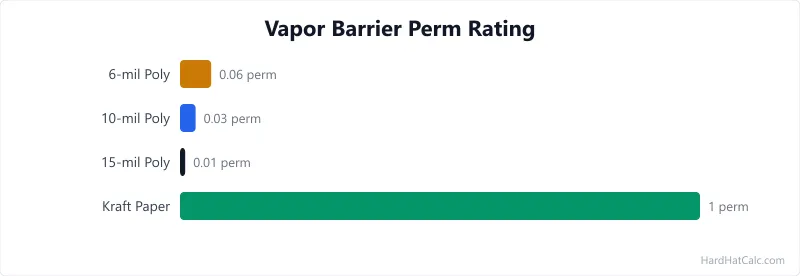
Vapor barriers have a permeance rating of 0.1 perms or less. Polyethylene sheeting (6-mil and thicker) falls in this category at roughly 0.06 perms. Vapor barriers block virtually all moisture vapour from passing through. They are appropriate for crawl space floors, under-slab installations, and the warm side of walls in cold climates where you want to prevent interior moisture from reaching the cold sheathing.
Vapor retarders have a permeance rating between 0.1 and 10 perms. Kraft paper facing on fiberglass batts is a Class II vapor retarder at roughly 0.5 perms. Latex paint on drywall is a Class III retarder at roughly 5–10 perms. Vapor retarders slow moisture movement without blocking it completely, which allows some drying potential through the assembly.
When to use a vapor barrier (poly sheeting):
- Crawl space ground cover (always, regardless of climate)
- Under concrete slabs (always)
- Warm side of exterior walls in climate zones 5–7 (cold climates)
- Marine climate zone 4 (IRC R702.7)
When to use a vapor retarder (kraft facing or paint) instead of poly:
- Exterior walls in climate zones 3–4 (mixed climates). Full poly on the warm side can trap summer moisture driven inward by air conditioning, causing condensation inside the wall.
- Exterior walls in climate zones 1–2 (hot-humid climates). The vapor retarder goes on the exterior side here — the moisture drive is inward. Interior poly in a hot climate traps condensation on the drywall side.
- Any wall assembly with exterior rigid foam insulation. The foam is a vapor retarder on the cold side — adding poly on the warm side creates a double vapor barrier that traps moisture in the cavity.
Getting vapor barrier placement wrong is worse than not having one at all. A misplaced barrier traps moisture inside the wall where it cannot dry in either direction. If you are unsure about your climate zone or wall assembly, the insulation requirement calculator identifies your zone and the associated code requirements, including vapor retarder placement.
Common Questions About Vapor Barriers
Vapor barrier decisions generate more confusion than most building science topics. These are the questions that come up most often during renovation projects.
Can I use Tyvek as a vapor barrier? No. Tyvek (and similar house wraps) are weather-resistant barriers, not vapor barriers. Tyvek has a permeance of roughly 58 perms — it blocks liquid water but allows water vapour to pass through freely. That is by design: house wrap goes on the exterior to shed rain while letting wall cavity moisture escape outward. A poly vapor barrier on the interior warm side serves the opposite function — it prevents interior moisture from entering the cavity.
Do I need a vapor barrier in my basement? For the floor (under a slab or over a dirt floor), yes. For the walls, it depends on how you are finishing them. If you are framing and insulating interior basement walls, a vapor barrier on the warm side of the insulation is standard practice in cold climates. If you are using rigid foam insulation directly against the concrete wall, the foam itself acts as a vapor retarder and no additional poly is needed — in fact, adding poly between the foam and the concrete can trap moisture.
What happens if I overlap seams without tape? Untaped seams allow moisture to pass through the overlap gap. In a crawl space, this can reduce the barrier effectiveness by 30–50% depending on how many seams are exposed and how well they overlap. Tape costs $12 per roll and takes 10 minutes per seam. There is no rational reason to skip it.
Is thicker poly always better? For crawl spaces and under-slab applications, yes — thicker poly resists punctures and lasts longer. For wall cavities, no — 6-mil is the standard and any thicker material is harder to work with in stud bays without adding meaningful benefit. The poly in a wall cavity faces no mechanical stress after the drywall goes up, so puncture resistance is irrelevant.
Worked Examples
Example 1
Scenario: A homeowner is encapsulating an 800 sq ft crawl space with 400 sq ft of perimeter walls, using 20-mil poly with 12-inch seam overlaps.
Calculation: Total area = 800 + 400 = 1,200 sq ft. 20-mil roll width = 10 ft (120 in, unchanged by the 2026-09-02 move). Overlap factor = 1 + 12/120 = 1.10. With 5% waste: 1,200 × 1.10 × 1.05 = 1,386 sq ft. Rolls (20-mil, 1,500 sq ft/roll — the Americover special-order and Viaflex stock size) = ⌈1,386 ÷ 1,500⌉ = 1 roll. Tape = ⌈1,386 ÷ 500⌉ = 3 rolls. Fasteners = ⌈1,200 ÷ 200⌉ = 6 packs. Cost = 1 × $200 + 3 × $12 + 6 × $15 = $326.
What this means: Full crawl space encapsulation needs 1 roll of 20-mil poly (at the 1,500 sq ft roll size), 3 rolls of seam tape, and 6 packs of fasteners/stakes at roughly $326 in materials. This does not include a dehumidifier, which most encapsulated crawl spaces need to maintain humidity below 60%.
Takeaway: Crawl space encapsulation is one of the highest-ROI moisture control investments. It reduces floor humidity, prevents mould growth on joists and subfloor, and can lower heating costs by 15–20% by eliminating cold air infiltration through the floor assembly.
Example 2
Scenario: A contractor is installing a 10-mil vapor barrier under a 1,200 sq ft garage slab before the concrete pour, with 12-inch seam overlaps.
Calculation: Total area = 1,200 sq ft (floor only). 10-mil roll width = 14 ft (168 in, the ruled width all four makers print). Overlap factor = 1 + 12/168 = 1.07. With waste: 1,200 × 1.07 × 1.05 ≈ 1,351 sq ft. Rolls (10-mil, 2,940 sq ft/roll — Stego, Americover, Viaflex and Husky all agree) = ⌈1,351 ÷ 2,940⌉ = 1 roll. Tape = ⌈1,351 ÷ 500⌉ = 3 rolls. No fasteners (concrete holds poly). Cost = 1 × $110 + 3 × $12 = $146.
What this means: One roll of 10-mil poly (at the 2,940 sq ft roll size four manufacturers print) and 3 rolls of tape at $146 protects the garage slab from ground moisture. The poly goes down on top of the gravel base, seams taped, edges turned up the form boards 2–3 inches. Concrete is then poured directly on the poly.
Takeaway: Under-slab vapor barriers are required by IRC 2021 Section R506.2.3 for habitable spaces and recommended for garages. Skipping the barrier saves $146 on a pour that costs $8,000–$15,000 — not a rational trade-off. Ground moisture migrating through bare concrete causes efflorescence, floor coating failures, and musty smells that persist for the life of the building.
Frequently Asked Questions
- What thickness of vapor barrier should I use for a crawl space?
For crawl space ground cover, use at least 6-mil poly (IRC R408.3 minimum). A 10-mil product provides better puncture resistance for crawl spaces with regular access. For full crawl space encapsulation (floor + walls, sealed and conditioned), 20-mil poly is the professional standard — it withstands foot traffic during inspections, resists tears from tools and equipment, and lasts 20+ years without replacement. The cost difference between 6-mil and 20-mil poly is roughly $0.08 per square foot, which is negligible relative to the labour cost of installing it. Pair the crawl space barrier with insulation suited to your climate zone for maximum energy performance.
- Do I need a vapor barrier under a concrete slab?
Yes. IRC 2021 Section R506.2.3 requires a vapor retarder between the soil and any concrete slab in habitable space. Even for garages and non-habitable slabs, a vapor barrier prevents ground moisture from migrating through the concrete and causing efflorescence (white salt deposits), coating delamination, and musty odours. Use 10-mil minimum for habitable spaces. The barrier goes on top of the gravel base, seams overlapped 6–12 inches and taped, before the concrete is poured. If you plan to install flooring on the slab later, the underlayment calculator estimates the additional moisture protection layer between slab and finish floor.
- What is the difference between a vapor barrier and a vapor retarder?
A vapor barrier has a permeance of 0.1 perms or less and blocks nearly all moisture vapour. Polyethylene sheeting (6 mil+) is a vapor barrier at 0.06 perms. A vapor retarder has a permeance between 0.1 and 10 perms and slows moisture movement without stopping it completely. Kraft-faced insulation (0.5 perms) and latex paint (5–10 perms) are vapor retarders. The choice depends on climate zone and wall assembly — cold climates use vapor barriers on the warm side, mixed climates use vapor retarders, and hot-humid climates may not need an interior vapor barrier at all. The R-values explained guide covers how vapor management and insulation type interact by climate.
- How do I seal vapor barrier seams properly?
Overlap adjacent sheets by 6–12 inches (12 inches recommended for crawl spaces). Seal every overlap with butyl-based seam tape, pressing firmly along the full length to eliminate air gaps. Do not use duct tape, packing tape, or masking tape — these adhesives fail within months in the humid, temperature-cycling environment of a crawl space or wall cavity. Butyl tape maintains adhesion for 20+ years. At wall terminations and pipe penetrations, use mechanical fasteners (termination bars or stakes) plus butyl mastic for a permanent, airtight seal. For below-grade foundation walls that need both waterproofing and vapour control, the exterior membrane sizer sizes the exterior barrier.
More Materials calculators
Browse all materials calculators — Paint coverage, roofing bundles, tile adhesive, welding time, parking lot sizing, and more.