
Spray Foam Cost Calculator
Spray foam insulation cost calculator for open- and closed-cell foam. Enter area, R-value, and foam type for board feet, material, and labour totals.
Last updated:
Methodology reviewed by Doc. dr. sc. Bojan Milovanović, dipl. ing. građ., PhD, Civil Engineering (FCE, University of Zagreb)
Total wall, ceiling, or roof deck area to receive spray foam.
Closed-cell is denser, stronger, and acts as a vapour barrier. Open-cell is cheaper and better for soundproofing.
Check your climate zone requirements. Wall cavities typically need R-13 to R-21; attics R-38 to R-60.
Professional installation typically runs $0.50-$1.50 per board foot for closed-cell, $0.25-$0.80 for open-cell.
Spray foam waste runs 5-15% on flat walls, 15-25% on irregular surfaces like cathedral ceilings. This is our own estimate; no published source backs these figures. Check your results against your product data or a licensed professional before acting.
How This Is Calculated
Thickness = target R-value / R per inch (6.5 for closed-cell, 3.7 for open-cell). Board feet = area × thickness × (1 + waste%). Material cost = board feet × material rate per bd ft. Labour cost = board feet × labour rate per bd ft. Total = material + labour.
Source: Board foot calculations per SPFA (Spray Polyurethane Foam Alliance) technical guidelines. Open-cell R-3.7 per inch is carried by ICC-ES ESR-1826, whose "TABLE 1—THERMAL RESISTANCE (R-VALUES)" lists 3.7 at 1-inch thickness for Huntsman Building Solutions Classic, Classic Ultra and Classic Ultra Select, described in that report as "low-density, open-cell, polyurethane foam plastic insulations and air barrier systems that are 100 percent water-blown with an installed nominal density of 0.5 pcf". Closed-cell R-6.5 per inch: manufacturer evaluation reports on record print 5.7–7.5 per inch; we use 6.5 as a conservative default. The record (re-read 2026-09-12) holds four manufacturer families: Huntsman Building Solutions ESR-2629 (FOAM-LOK 2000/2000AB, LaPolla) 5.7 at 1 inch, ESR-3500 7.1 (ProSeal/ProSeal LE) and 6.7 (ProSeal H5), the Heatlok HFO Pro data sheet 7.4; BASF ESR-2642 WALLTITE LWP 6.9, MAX 7.4 and ONE 7.5; Carlisle SealTite PRO Closed Cell 6.9; Johns Manville Corbond MCS 6.8 (aged). None prints 6.5. The nine-value mean is 6.93 per inch, which at the page defaults (1,000 sq ft, R-20, 10 % waste) would give 3,174 board feet against the 3,385 the 6.5 default returns, so the default orders about 6.6 % more foam than the mean and sits on the conservative side. Open-cell 3.7 sits inside the 3.6 to 4.0 spread on record (BASF ENERTITE CCRR-1032 prints 3.9 and 4.0, Carlisle SealTite PRO High Yield 3.6 at 1 inch). Source-set correction of 2026-08-22: the labour-rate attribution to RS Means Residential Construction Cost Data 2026, Division 07 21 29 is withdrawn (no such 2026 product; subscription-only, never opened). SPFA, the industry association, states it cannot legally provide cost information, and no free source publishes installed board-foot rates (sweep record: audits/sourcing-1-retrieval/rsmeans/). The labour rates are unchanged and ship unverified.
8 min read
Open-Cell vs. Closed-Cell: The Cost-Performance Split
Spray foam insulation splits into two products that share a name but differ in nearly every measurable property. Choosing between them determines your project cost, required thickness, moisture management strategy, and long-term energy performance.
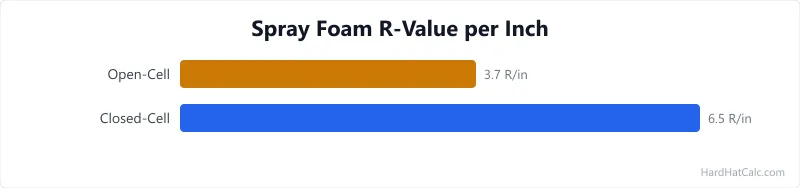
Closed-cell spray foam (ccSPF) delivers roughly R-6.5 per inch, a conservative default inside the 5.7 to 7.5 per inch range that manufacturer evaluation reports and data sheets on record print across four manufacturer families (Huntsman FOAM-LOK 2000 at 5.7, ProSeal H5 at 6.7, ProSeal at 7.1 and Heatlok HFO Pro at 7.4; BASF WALLTITE at 6.9, 7.4 and 7.5; Carlisle SealTite PRO at 6.9; Johns Manville Corbond MCS at 6.8), at an installed density of about 2 lbs per cubic foot. It cures into a rigid, structural material that adds racking strength to walls — enough that some builders use it as a code-compliant alternative to plywood sheathing on timber-framed walls. The closed-cell structure makes it a Class II vapour retarder at 1.5 inches thick and a vapour barrier above 2 inches, meaning it controls moisture movement without a separate poly sheet. The trade-off is cost: closed-cell material runs $0.45-$0.65 per board foot before labour, and installation adds $0.50-$1.50 per board foot depending on access, thickness, and regional labour rates. As of March 2026, fully installed closed-cell foam costs $1.00-$2.15 per board foot across most US markets.
Open-cell spray foam (ocSPF) delivers R-3.7 per inch at 0.5 lbs per cubic foot — roughly half the R-value per inch and a quarter of the density. It cures into a soft, spongy material that excels at sound dampening but adds no structural value. Open-cell is vapour-permeable, which means walls can dry in both directions — an advantage in mixed climates where seasonal moisture drive reverses. Material cost is $0.15-$0.30 per board foot, and installed prices range $0.40-$1.00 per board foot. The catch is thickness: reaching R-38 in an attic requires over 10 inches of open-cell foam, which needs deep framing cavities or purpose-built channels.
Current blowing agents affect this comparison. Since 2021, most closed-cell foams in the US use HFO blowing agents (Honeywell Solstice or Chemours Opteon) with a global warming potential (GWP) under 1 — a massive improvement over the older HFC agents with GWPs above 1,000. This matters for green building certifications and for homeowners who weigh environmental impact alongside energy savings. Open-cell foams use water as the blowing agent and have always had negligible GWP. For a broader comparison that includes batts, blown-in, and mineral wool, you can run an R-value check to match R-value targets to material thickness and cost across all common insulation types.
Calculating Board Feet and Installed Thickness
The unit of measure in spray foam pricing is the board foot — one square foot of coverage at one inch thick. A project that covers 1,000 sq ft at 3 inches thick uses 3,000 board feet of foam. Every quote you receive from a spray foam contractor should be in board feet, and understanding the math behind that number protects you from inflated bids.
Determine your target R-value from your climate zone. IECC 2021 Table R402.1.2 sets minimums by zone. Zone 3 walls need R-20 or R-13+5ci. Zone 5 walls need R-20+5ci or R-13+10ci. Attic floors range from R-30 (Zone 1-2) to R-60 (Zone 7-8). If you are building new or doing a full gut renovation, these are the minimums your inspector will check.
Divide R-value by R per inch to get thickness. Closed-cell at a typical R-6.5/inch (manufacturer evaluation reports on record print 5.7 to 7.5 per inch; check your own product's ICC-ES report for its exact figure) needs 3.23 inches for R-21. Open-cell at R-3.7/inch needs 5.68 inches for the same R-21. This thickness determines whether foam fits your framing — a 2x4 wall has 3.5 inches of cavity depth, so closed-cell works but open-cell falls short and would need a deeper wall.
Multiply area by thickness to get raw board feet. A 1,200 sq ft wall at 3.23 inches = 3,876 board feet. This is the theoretical minimum assuming perfect coverage and zero waste.
Add your waste factor. Flat, accessible walls with consistent cavity depth run 5-10% waste. Cathedral ceilings, irregular framing, and hard-to-reach areas push waste to 15-25%. Rim joists and band boards are among the worst for waste because the small, irregular surfaces mean more overspray relative to the area being covered.
Price per board foot installed varies by region and thickness. Most contractors quote installed price (material + labour combined) between $1.00 and $2.15 for closed-cell and $0.40 and $1.00 for open-cell. Thicker applications sometimes get volume discounts because the setup cost is the same regardless of how many passes the crew sprays. Get at least three quotes and make sure each one specifies board feet, foam brand, and blowing agent type.
Spray Foam Pricing by Application Zone
Project costs vary widely by where the foam goes in the building. Access difficulty, required thickness, and substrate condition all affect the final per-board-foot price. Prices as of March 2026. The former RS Means and contractor-survey attribution was withdrawn on 2026-08-22; these figures ship unverified.
| Application | Foam Type | Typical R-Value | Thickness | Cost/Sq Ft Installed | Notes |
|---|---|---|---|---|---|
| Exterior walls (2x4 cavity) | Closed-cell | R-13 to R-21 | 2-3.2 in | $3.00-$6.50 | Most common residential application |
| Exterior walls (2x6 cavity) | Closed-cell | R-21 to R-33 | 3.2-5 in | $4.50-$10.00 | Full cavity fill or flash-and-batt |
| Exterior walls (2x6 cavity) | Open-cell | R-13 to R-21 | 3.5-5.5 in | $1.75-$5.00 | Full cavity fill, needs separate vapour strategy in cold climates |
| Attic floor | Open-cell | R-38 to R-49 | 10-13 in | $5.00-$10.00 | High volume, open access = lower per-bd-ft labour |
| Cathedral ceiling / roofline | Closed-cell | R-30 to R-49 | 4.6-7.5 in | $7.00-$15.00 | Overhead work, multiple passes, higher waste |
| Crawl space walls | Closed-cell | R-10 to R-15 | 1.5-2.3 in | $2.50-$5.00 | Confined space increases labour rate |
| Rim joists / band boards | Closed-cell | R-13 to R-21 | 2-3 in | $4.00-$7.00 | Small areas, high per-unit labour |
| Metal building | Closed-cell | R-19 to R-25 | 3-4 in | $3.50-$7.50 | Direct-to-steel, large open areas |
Flash-and-batt is a common hybrid approach: 1-2 inches of closed-cell foam sprayed against the sheathing provides the air seal and vapour control, then the remaining cavity is filled with fiberglass batts. This combines the air-sealing performance of spray foam with the lower cost of batts. A 2x6 wall with 2 inches of closed-cell (R-13) plus R-15 batts achieves R-28 at roughly 60% of the cost of filling the entire cavity with closed-cell. Homeowners considering this approach alongside other thermal envelope options can compare total project costs with the insulation requirement calculator.
Hidden Costs and Contractor Red Flags
The board-foot price in a spray foam quote does not capture the full project cost. Several line items consistently surprise homeowners who compare quotes only on the per-board-foot number.
Thermal barrier coverage. Building code (IRC R316.4) requires a 15-minute thermal barrier over spray foam in habitable spaces. Half-inch drywall satisfies this requirement and is the standard approach in walls and ceilings. But in unfinished basements, crawl spaces, and attics, the foam may be left exposed — and if it is, you need an intumescent coating ($1.50-$3.00 per sq ft) or an ignition barrier ($0.50-$1.00 per sq ft for thin plywood or sheathing). Some codes allow the foam itself to qualify if it passes specific fire tests, but this depends on the product and jurisdiction. Ask your contractor what their quote includes for thermal barrier compliance.
Trimming and cleanup. Spray foam expands beyond the cavity surface and must be trimmed flush before drywall can be installed. Some contractors include trimming in their price; others charge $0.10-$0.25 per sq ft extra. On a 1,200 sq ft wall job, that is $120-$300 of unexpected cost. Overspray on windows, electrical boxes, and framing surfaces needs scraping or solvent removal — again, sometimes included, sometimes not.
Electrical and plumbing coordination. Spray foam locks around wires and pipes, making future modifications difficult. All electrical, plumbing, and HVAC rough-in must be complete and inspected before foam goes in. If your project timeline slips and the foam crew arrives before the electrician finishes, you either delay the foam (losing your scheduled slot) or foam around incomplete work and pay an electrician premium to fish wires through cured foam later.
Contractor red flags to watch for. Spray foam is a specialised trade with real risks when done poorly. Avoid contractors who: cannot name the specific foam product and blowing agent they use; quote by square foot instead of board feet (this hides the actual thickness they plan to spray); will not provide a copy of their SPFA certification; skip the 24-hour re-entry period after spraying (off-ratio foam emits isocyanate vapour that causes respiratory sensitisation); or refuse to leave the manufacturer's batch sticker on site. A waterproofing project below grade often pairs with spray foam work — the membrane and drainage board tool estimates membrane and drainage board quantities for foundation walls.
When Spray Foam Is Not Worth It
Spray foam is the highest-performing insulation option in most applications, but it is not always the most cost-effective choice. Several scenarios favour cheaper alternatives.
Standard attic floors with accessible joists. Blown-in cellulose or fiberglass achieves R-38 to R-60 at $1.50-$3.00 per sq ft installed — roughly half to a third of open-cell spray foam. The attic floor is one of the few locations where air sealing can be achieved separately (caulk and canned foam around penetrations) before blowing insulation on top. Unless you need a conditioned attic for ductwork or storage, blown-in wins on cost per R-value.
Walls with intact air barriers. If your wall assembly already has a good air barrier (taped ZIP sheathing, sealed housewrap, or existing spray foam), adding fiberglass batts or mineral wool to the cavity provides the same R-value at a fraction of the cost. Spray foam's main advantage in walls is air sealing, not R-value — if the air barrier problem is already solved, you are paying a premium for a benefit you already have. When framing new stud walls, designing the air barrier into the sheathing system from the start can eliminate the need for spray foam entirely, and the full foam-versus-fiberglass comparison covers when the cheaper batt is the smarter buy.
Gut renovations where you control the assembly. When you are framing new walls, you can design the air barrier into the sheathing system and use cheaper cavity insulation. Flash-and-batt (1-2 inches of closed-cell plus batts) gives you the air seal at the sheathing plane and fills the cavity inexpensively. A full cavity of closed-cell in a 2x6 wall costs $7-$15 per sq ft installed; flash-and-batt achieves 80% of the performance for 50% of the cost.
Small, accessible projects. Spray foam contractors typically have minimum job charges of $1,500-$3,000 because the equipment setup, mixing, and cleanup time is the same regardless of project size. If you need to insulate 100 sq ft of rim joist, the per-board-foot price will be high because the overhead is spread across fewer units. For small jobs, rigid foam board (XPS or polyiso) cut and sealed with canned foam is the more economical approach.
Worked Examples
Example 1
Scenario: A homeowner in climate zone 5 (northern Illinois) is insulating 1,200 sq ft of exterior wall cavities with closed-cell spray foam to meet the IECC R-20+5ci requirement using cavity fill alone at R-21.
Calculation: Thickness = R-21 / 6.5 = 3.23 inches. Board feet = 1,200 × 3.23 × 1.10 waste = 4,265 bd ft. Material = 4,265 × $0.55 = $2,346. Labour = 4,265 × $1.00 = $4,265. Total = $2,346 + $4,265 = $6,611. Cost per sq ft = $6,611 / 1,200 = $5.51.
What this means: Closed-cell foam at R-21 requires just 3.23 inches — thin enough to fit inside a 2×4 wall cavity with room for drywall. The total project runs about $6,600 for 1,200 sq ft of wall area, which is typical for a 1,500 sq ft single-storey home.
Takeaway: Closed-cell foam in wall cavities costs $5-$7 per sq ft installed, roughly 2-3 times more than fiberglass batts. The payback period depends on your heating costs, but the air-sealing benefit often matters more than the R-value bump — SPF eliminates drafts that fiberglass allows through.
Example 2
Scenario: A homeowner is insulating a 1,500 sq ft attic floor with open-cell spray foam to reach R-38 in climate zone 4 (Nashville, Tennessee).
Calculation: Thickness = R-38 / 3.7 = 10.27 inches. Board feet = 1,500 × 10.27 × 1.08 waste = 16,638 bd ft. Material = 16,638 × $0.22 = $3,660. Labour = 16,638 × $0.50 = $8,319. Total = $3,660 + $8,319 = $11,979. Cost per sq ft = $11,979 / 1,500 = $7.99.
What this means: Open-cell at R-38 needs 10.27 inches — thick, but the material is cheap at $0.22 per board foot. The project total of nearly $12,000 reflects the sheer volume: over 16,600 board feet of foam. Labour dominates because of the multiple passes needed to build up 10+ inches.
Takeaway: For attic floors, blown-in cellulose at $1.50-$2.50 per sq ft achieves R-38 for a third of the spray foam cost. Open-cell foam makes more economic sense on attic rooflines (cathedral ceilings) where air sealing at the roofline is the goal, not just R-value on the floor.
Frequently Asked Questions
- How much does spray foam insulation cost per square foot installed?
Closed-cell spray foam costs $3.00-$15.00 per square foot installed, depending on the thickness and application. Standard exterior walls (2-3 inches of closed-cell for R-13 to R-21) run $3.00-$6.50 per sq ft. Cathedral ceilings and roofline applications cost more because of overhead work and higher waste. Open-cell spray foam is cheaper at $1.75-$10.00 per sq ft, but it requires roughly twice the thickness for the same R-value. These prices include material and professional labour as of March 2026 and vary by region, contractor, and project size. A tool to size insulation thickness shows the minimum R-value your climate zone demands before you price the foam.
- Can I spray foam insulation myself to save money?
DIY spray foam kits exist (Touch N Foam, Foam It Green, Tiger Foam) and cost $0.50-$1.00 per board foot for closed-cell. However, professional-grade results require precisely heated, pressurised equipment that maintains the correct component ratio (A:B) within tight tolerances. Off-ratio foam — where the chemical mix is wrong — does not cure properly, emits harmful isocyanate vapours, and can cause respiratory sensitisation that requires professional remediation costing $10,000-$30,000 to remove. DIY kits are reasonable for small jobs like rim joists or small wall sections, but walls and ceilings over 200 sq ft warrant a certified SPFA contractor. The R-values explained guide compares spray foam performance against batts and blown-in alternatives.
- Does spray foam insulation pay for itself in energy savings?
The payback period depends on your climate, existing insulation, energy prices, and the alternative you would have chosen. In cold climates (zones 5-7), upgrading uninsulated walls to R-21 closed-cell foam typically saves $800-$1,500 per year in heating costs for a 2,000 sq ft home. At a project cost of $6,000-$10,000, the simple payback is 5-10 years. The air-sealing benefit often outweighs the R-value benefit — homes with spray foam test 40-60% tighter on blower door tests than fiberglass-insulated homes, reducing heating and cooling loads beyond what R-value alone would predict. A full energy retrofitting cost estimate puts spray foam payback in context with other envelope upgrades.
- Is closed-cell or open-cell spray foam better for basement walls?
Closed-cell is the standard choice for basement and below-grade walls. At 2 inches thick it acts as both insulation (R-13) and a vapour barrier, preventing soil moisture from reaching the interior. Open-cell foam is vapour-permeable and will absorb moisture from damp foundation walls, which can lead to mould behind the foam. The exception is a basement wall that has been properly waterproofed from the exterior and has no moisture issues — in that case, open-cell works and costs less. But most basements have some moisture, and closed-cell eliminates the risk. For CMU block basements, the foam-thickness R-value tool shows how foam thickness changes the assembly's total thermal performance.
- How thick does spray foam need to be to meet code in a 2x4 wall?
A 2x4 wall has 3.5 inches of cavity depth. Closed-cell spray foam at R-6.5 per inch reaches R-22.75 in a full 3.5-inch fill — more than enough for the R-20 wall requirement in climate zones 4-5. For zone 3 walls (R-13 minimum), just 2 inches of closed-cell suffices, leaving room for wiring and future modifications. Open-cell foam at R-3.7 per inch would only reach R-12.95 in a full 3.5-inch 2x4 cavity, falling short of even the minimum R-13. Open-cell needs at least a 2x6 cavity (5.5 inches = R-20.35) to meet most wall insulation codes. The 2x4-vs-2x6 framing tool helps you decide between 2x4 and 2x6 stud walls based on insulation goals.
More Materials calculators
Browse all materials calculators — Paint coverage, roofing bundles, tile adhesive, welding time, parking lot sizing, and more.