
Masonry Wall R-Value Calculator
Masonry wall R value calculator for CMU block, core fill, insulation, and furring. Add each layer for the assembly's composite R-value and U-factor.
Last updated:
Nominal width of the concrete masonry unit. 8-inch is the most common for residential and light commercial.
Grouted cores add structural strength but reduce R-value. Empty, grouted, perlite and vermiculite values follow CMHA TEK 06-02C at 135 pcf; the foam-insert value is this site's own estimate.
Continuous insulation on the exterior face of the CMU. XPS at R-5/inch, polyiso at R-5.8/inch. PIMA's own published long-term thermal resistance (LTTR) for polyiso runs 5.74 to 5.95 per inch; a printed R-6 per inch is the fresh, unaged rating.
Interior furring or stud wall with insulation. Framed interior walls add the most R-value but reduce floor space.
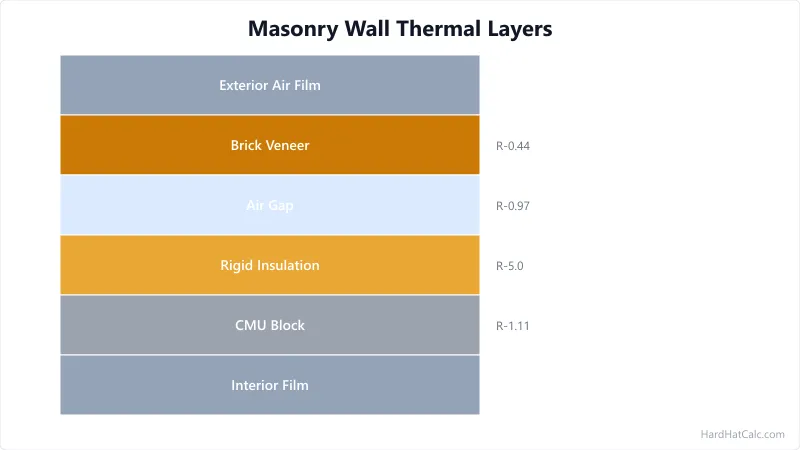
Exterior cladding adds minor R-value. Brick veneer with an air gap contributes about R-1.0.
How This Is Calculated
Total R = R(CMU block, surface air films included) + R(exterior finish) + R(exterior insulation) + R(interior furring/insulation). U-factor = 1 / total R-value. CMU R-values are tabulated by block width and core fill from CMHA TEK 06-02C Table 2 (135 pcf) for empty, grouted, perlite and vermiculite cores, and each cell already includes the exterior (0.17) and interior (0.68) surface air films (TEK footnote A), so no separate film term is added; the foam-insert column is this site's own estimate.
Source: R-value calculation method per ASHRAE Fundamentals Handbook Ch. 27 (Thermal Resistance of Building Assemblies). CMU core R-values for empty, grouted, perlite-filled and vermiculite-filled cores follow CMHA (formerly NCMA) TEK 06-02C, "R-Values and U-Factors of Single Wythe Concrete Masonry Walls", Table 2 at the 135 pcf normal-weight row this page names, adopted 2026-09-05 for all twenty comparable cells (SF20-A8 ruling 4; the document was opened 2026-09-02 on cmha.org's own PDF endpoint and its hash re-checked 2026-09-05). The grouted column reads TEK's 100% solid units column at 4 in. and its solid grouted column at 6 to 12 in., as the tables print them (the 6-in. sub-table prints "Solid Grouted"; corrected 2026-09-12). TEK 06-02C Table 2 footnote A prints "Surface air films are included", so every CMU cell already carries the 0.17 exterior and 0.68 interior films TEK Table 5 lists; since 2026-09-12 (SF22-HHC-F1 E1) the engine no longer adds those films a second time — the former sum overstated a bare 8-in. wall by 42.7 percent (R 2.84 against the TEK cell R 1.99). The two film values are printed as separate layers on material-only values by the ASHRAE Handbook (Fundamentals 2017, ch. 15 worked example: exterior 0.03 and interior 0.12 m2-K/W from Table 1, Chapter 26) and by the Masonry Advisory Council sample R-value calculations (outside air film 0.17, inside air film 0.68), which is why the TEK with-films cell is added to the other layers without a film term. The foam-insert column is this site's own estimate: TEK 06-02C tabulates polyurethane foamed-in-place cores and states that molded polystyrene inserts are not among its tabulated fills, and no insert maker's table was reachable. Exterior insulation values from manufacturer data (Owens Corning FOAMULAR for XPS; PIMA published LTTR for polyiso). The interior furring and stud-wall effective values and the finish figures are unverified conventions (the brick-veneer R-1.0 is stated on a material-plus-air-gap basis: the Masonry Advisory Council prints 4-in. brick at R-0.44 material-only, while the Brick Industry Association prints "brick veneer alone" at R-2.0 as an assembly figure under the 2000 IECC mass-wall table — different bases, recorded side by side), and the residential IECC 2021 mass-wall thresholds are rendered by the Building America Solution Center (Zone 4 except Marine: 8/13) but the page still issues no code-compliance verdict because the furring, finish and foam-insert layers are not verified. Ruling records: audits/sf20-a8-rulings-2026-09-03.md; audits/sf22-hhc-f1-rulings-2026-09-12.md.
9 min read
Why Masonry R-Values Confuse Everyone
Masonry thermal performance is the most misunderstood topic in residential energy auditing. A standard 8-inch concrete block wall has an R-value of just 1.99 with empty cores on CMHA TEK 06-02C's table for 135 pcf block — barely more than two panes of glass. Homeowners and even some contractors assume the sheer thickness and weight of a block wall implies good insulation, but thermal mass and thermal resistance are different properties that serve different purposes.
Thermal mass (the ability to absorb, store, and slowly release heat) helps moderate temperature swings in climates with large day-night temperature differences. A masonry wall absorbs daytime heat and releases it at night, smoothing the indoor temperature curve. This effect is real and measurable — it is why energy codes give masonry "mass wall credits" that allow lower R-value targets compared to lightweight framed walls. But thermal mass cannot replace insulation. Without added resistance to heat flow, a CMU wall in a cold climate bleeds heat all winter.
The confusion deepens because CMU R-values depend heavily on what fills the cores. An empty 8-inch block has R-1.99. Fill those same cores with perlite loose fill and the R-value rises to 3.88 on the same TEK 06-02C table. The molded EPS foam-insert figure this page uses for an 8-inch block, R-5.7, is this site's own estimate: TEK 06-02C tabulates foamed-in-place polyurethane rather than inserts. This calculator accounts for each layer of the assembly: the block itself (with the two surface air films TEK already folds into its cell), core fill material, exterior continuous insulation, interior furring or stud walls, and cladding. The result is the composite R-value that shows how much heat the wall loses on a cold day; it does not issue a code-compliance verdict, for the reasons stated beside the results.
For background on the R-value system itself — what the number means, how climate zones set the floor, and which materials deliver the highest R per inch — how R-values are built from material layers covers the rules that apply to every insulation type, masonry included. For framed walls and other insulation types, the R-value sizing tool covers climate zone requirements for conventional stud-framed construction.
CMU R-Values by Block Width and Core Fill
The R-value of a concrete masonry unit depends on its width, the density of the concrete, and what fills the cores. The table below uses normal-weight concrete (135 pcf) values from CMHA (formerly NCMA) TEK 06-02C, "R-Values and U-Factors of Single Wythe Concrete Masonry Walls", Table 2, for the empty, grouted, perlite and vermiculite columns (adopted 2026-09-05 for all twenty cells; the grouted column is TEK's 100% solid units figure at 4 and 6 inches and its solid grouted figure at 8 to 12 inches). Lightweight CMU (below 105 pcf) provides higher R-values but is less commonly available and costs more.
| Block Width | Empty Cores | Grouted Solid | Perlite Fill | Vermiculite Fill | EPS Foam Inserts (our estimate) |
|---|---|---|---|---|---|
| 4 inch | R-1.64 | R-1.24 | R-2.16 | R-2.10 | R-2.4 |
| 6 inch | R-1.85 | R-1.45 | R-3.02 | R-2.92 | R-4.0 |
| 8 inch | R-1.99 | R-1.66 | R-3.88 | R-3.75 | R-5.7 |
| 10 inch | R-2.06 | R-1.86 | R-4.60 | R-4.45 | R-7.5 |
| 12 inch | R-2.11 | R-2.07 | R-5.58 | R-5.38 | R-9.3 |
The EPS foam-insert column is not a TEK 06-02C figure: that document tabulates polyurethane foamed-in-place cores (R-2.24 to R-5.86 across the same widths) and states that molded polystyrene inserts are not among its tabulated fills, and no insert maker's table was reachable when this page was checked. This is our own estimate; no published source backs these figures. Check your results against your product data or a licensed professional before acting.
Grouted cores have the lowest R-value because concrete (about R-0.08 per inch) is a far better conductor than air. Grouting is required at reinforced cells for structural integrity — the cells with vertical rebar must be filled with grout. But non-reinforced cores can remain empty or receive insulation. The best thermal strategy for a reinforced masonry wall is to grout only the structurally required cells and fill all others with perlite or foam inserts.
Perlite and vermiculite are loose granular minerals poured into the cores after the wall is laid. They flow around rebar obstructions and settle into the full core depth. Perlite slightly outperforms vermiculite because of its lower density. Both can be treated with silicone to resist moisture absorption, which is important in below-grade applications where foundation walls sit against damp soil. Below-grade masonry also needs a vapor barrier on the interior face to prevent soil moisture from migrating through the block and wetting the insulation.
EPS foam inserts are molded polystyrene blocks shaped to fit the specific CMU core geometry. They are placed by the mason during wall construction — each insert drops into the core before the next course is laid. Foam inserts provide the highest R-value per core because solid EPS (R-3.8 to R-4.2 per inch) outperforms granular fills. The downside is labour: placing inserts slows the mason's production rate by 10-15%.
Adding Insulation to Existing Masonry: Interior vs. Exterior
Existing masonry buildings that need thermal upgrades face a strategic choice: insulate from the inside or the outside. Both approaches work, but they have different effects on moisture behaviour, usable floor space, and the building's appearance.
Exterior continuous insulation (ci) is the gold standard for masonry retrofit. Rigid foam boards (XPS, polyiso, or mineral wool) are mechanically fastened or adhered to the outside face of the CMU, then covered with a weather-resistant cladding — stucco, metal panels, or thin brick. If brick is the chosen finish, estimate count and mortar by bond pattern before ordering — Flemish or English bonds use 50% more bricks than running bond on the same wall. Exterior ci keeps the masonry warm, which prevents interstitial condensation, preserves the thermal mass benefit, and eliminates thermal bridging at any interior framing. The drawback is cost and disruption: exterior insulation requires scaffolding, new flashing at windows and doors, and extended cladding details that add $5-$12 per sq ft to the wall assembly. For buildings where exterior appearance must be preserved (historic districts, shared walls), exterior ci may not be an option.
Interior framed walls are the most common approach for residential masonry retrofits. A 2x4 stud wall built against the inside face of the block, filled with batt insulation, and finished with drywall adds R-8 to R-13 of effective insulation depending on the batt grade and framing factor. The approach is familiar to any framing crew and uses standard, inexpensive materials. The cost per square foot is $3-$6 including framing, insulation, and drywall — though before filling that stud wall, it is worth weighing batt insulation against spray foam for a cold masonry surface.
The risk with interior insulation on masonry is moisture. The CMU wall becomes cold in winter (because the insulation keeps heat on the interior side), and moisture-laden interior air that reaches the cold block surface can condense. This is especially problematic in air-conditioned buildings in humid climates, where summer moisture drives inward. A vapour retarder on the warm side of the insulation (the interior face, in heating-dominant climates) reduces condensation risk. In mixed climates, a smart vapour retarder (MemBrain or Intello) adjusts its permeability with humidity levels. If your building is also addressing the concrete block structure itself, the concrete block wall cost calculator estimates block, mortar, and labour for new CMU construction.
Meeting Energy Code with Mass Wall Assemblies
The IECC gives masonry and concrete walls reduced insulation requirements compared to wood-framed walls because thermal mass moderates peak heating and cooling loads. The code calls these "mass walls" — defined as walls with a heat capacity exceeding 6 BTU per sq ft per degree F, which any solid or grouted CMU wall exceeds. Here is how to use the mass wall pathway to your advantage.
Identify your climate zone and the mass wall R-value requirement. IECC 2021 Table R402.1.3 lists mass wall insulation by zone as two values — the second applies when more than half the insulation sits on the interior of the wall: Zone 1-2 R-3/4ci, Zone 3 R-8/13ci, Zone 4 R-8/13ci, Zone 5 R-13/17ci, Zone 6 R-15/20ci, Zones 7-8 R-19/21ci. These run well below the framed-wall minimums (R-30 or R-20+5ci) in the same zones — the mass wall credit at work.
Calculate your current assembly R-value. Sum the R-values of each layer: CMU block (by width and core fill), any existing insulation, and finish materials. An uninsulated 8-inch CMU wall totals R-1.99 on TEK 06-02C, and that cell already includes the two surface air films (0.17 exterior, 0.68 interior — TEK Table 5, the ASHRAE Handbook and the Masonry Advisory Council print the same pair), so do not add them again.
Determine the insulation deficit. Subtract your current R-value from the code requirement. In zone 5 with exterior insulation, an uninsulated 8-inch wall has a deficit of 13 - 1.99 = 11.01. This is the minimum R-value of insulation you need to add. Round up to the nearest commercially available product thickness.
Choose your insulation strategy. Exterior ci is simplest for code compliance because it is continuous and free of thermal bridging — an R-15 XPS board delivers R-15, period. Interior stud walls with batts suffer framing losses of 15-25% depending on stud spacing, so you need to oversize the batt to hit your effective R target.
Document the assembly for plan review. Building inspectors want to see the R-value calculation showing each layer and the total. Include the insulation manufacturer's tested R-value. For the CMU layer, cite CMHA TEK 06-02C directly rather than this page, and treat the foam-insert figure here as an estimate. This calculator's output provides the layer-by-layer breakdown.
How Steel Studs and Furring Strips Short-Circuit Your Insulation
Thermal bridging is the silent killer of masonry wall insulation projects. Every structural element that penetrates or bypasses the insulation layer creates a conductive pathway that reduces the overall assembly performance far below the nominal insulation R-value.
In a masonry wall with interior furring, the most common thermal bridges are the steel or wood furring strips themselves. A 1x3 wood furring strip at 16 inches on-centre creates a framing factor of about 10% — meaning 10% of the wall area has wood (R-1.0 per inch) instead of insulation (R-3.7 to R-6.5 per inch). The effective R-value of the insulated portion drops accordingly.
Steel studs are far worse. Light-gauge steel framing has a thermal conductivity roughly 400 times that of wood. A 3.5-inch steel stud wall with R-13 batts has an effective R-value of only about R-5.5 — the steel studs short-circuit 60% of the batt's insulation value. This is why ASHRAE 90.1 and IECC require continuous insulation outboard of steel-framed walls in most climate zones.
For masonry retrofits using interior steel studs, the solution is to add a layer of continuous rigid foam between the CMU face and the steel framing. Even 1 inch of XPS (R-5) breaks the thermal bridge path and restores most of the batt's performance. The added cost is modest — about $0.50-$0.75 per sq ft for 1-inch XPS installed — but the thermal benefit is substantial.
Masonry ties, shelf angles, and lintels that penetrate exterior insulation are another bridge source in cavity wall construction. Stainless steel ties conduct less heat than carbon steel and are specified in high-performance assemblies. Thermal break clips and pads at shelf angles can reduce heat loss at floor lines by 40-60%. These details matter most in cold climates, where the temperature differential across the wall is large.
Worked Examples
Example 1
Scenario: A commercial building in climate zone 5 (Chicago) has 8-inch CMU walls with empty cores, no insulation, and painted block on both sides. The owner wants to know the current R-value and what it takes to meet IECC 2021 mass wall requirements.
Calculation: Current assembly: R(CMU 8" empty, TEK 06-02C at 135 pcf, surface air films included) = 1.99. Total R = 1.99. U-factor = 1/1.99 = 0.503. Zone 5 mass walls need R-13ci when the insulation goes on the exterior (the standard value in IECC 2021 Table R402.1.3). Deficit = 13 − 1.99 = 11.01. Adding 3 inches of exterior XPS (R-15) brings the total to 1.99 + 15 = 16.99, comfortably clearing R-13ci.
What this means: An uninsulated 8-inch CMU wall has almost no thermal resistance — R-1.99, films and all, is less than half an inch of rigid foam. The thermal mass of the block stores and releases heat, which helps in some climates, but it does not replace insulation. Three inches of exterior XPS brings the assembly past the zone 5 mass-wall figure.
Takeaway: Mass wall credits in the energy code let masonry buildings meet lower R-value thresholds than framed walls because thermal mass moderates temperature swings. An 8-inch CMU wall needs only R-13ci (exterior) in Zone 5 where a framed wall needs R-30 — but the CMU still needs exterior insulation to get there.
Example 2
Scenario: A homeowner in zone 4 (Nashville) is renovating a 1960s ranch with 8-inch CMU exterior walls. They plan to add a 2x4 stud wall with R-13 batts on the interior and want to know if this meets current code.
Calculation: Assembly: R(CMU 8" empty, TEK 06-02C, surface air films included) = 1.99 + R(2x4 studs + R-13 batts, effective) = 10.2. Total R = 12.19. Because the insulation is on the interior, the Zone 4 mass wall requirement is the higher R-13 value (IECC 2021 Table R402.1.3). Total 12.19 falls 0.81 short of 13.
What this means: An interior stud wall with R-13 batts brings the assembly to R-12.19 — 0.81 short of the R-13 zone 4 figure once the surface air films are counted only once, and the stud-wall effective value is itself a convention. The 25% framing factor in a 2x4 wall at 16 inches on-centre reduces the effective R-value from R-13 to about R-10.2 due to thermal bridging through the wood studs.
Takeaway: To close the gap, adding even 0.5 inches of rigid foam behind the drywall (R-2.5 XPS) pushes the total to R-14.69. Alternatively, filling the CMU cores with perlite adds R-1.9 on the TEK 06-02C table (from 1.99 to 3.88) without losing any floor space.
Frequently Asked Questions
- What is the R-value of an 8-inch concrete block wall without insulation?
An 8-inch concrete masonry unit wall with empty (air-filled) cores and normal-weight (135 pcf) concrete has an R-value of 1.99 on CMHA TEK 06-02C's Table 2, the figure this calculator uses since 2026-09-05 — and that cell already includes the interior and exterior surface air films (R-0.68 + R-0.17, TEK footnote A), so the bare-wall assembly is R-1.99, U-factor 0.503. This is extremely low by modern energy code standards — zone 4 requires R-13 for mass walls with interior insulation, and zone 5 requires R-17. Without added insulation, an 8-inch CMU wall loses heat at roughly the rate of a double-pane window. A target R-value tool shows exact code minimums by climate zone for both mass and framed walls.
- Does filling CMU cores with insulation meet energy code requirements?
Core fill alone rarely meets modern energy code requirements. An 8-inch CMU with perlite-filled cores reaches R-3.88 on TEK 06-02C, and even with EPS foam inserts the block reaches only about R-5.7 on this site's own estimate. The lowest IECC mass wall requirement is R-3ci in zones 1-2, which perlite-filled cores can meet. But zones 3 through 8 require R-8ci to R-17ci, which demands additional continuous insulation on the exterior or an insulated interior stud wall. Core fills are valuable as part of a layered strategy — they reduce the amount of additional insulation needed and provide some thermal break at the CMU layer. For pricing the additional insulation, the spray foam cost calculator estimates board-foot costs for both open and closed cell.
- Is it better to insulate a block wall from the inside or outside?
Exterior insulation is thermally superior because it keeps the masonry warm (reducing condensation risk), preserves the thermal mass benefit, and eliminates bridging at interior framing. However, it requires new exterior cladding, costs more ($8-$18 per sq ft vs. $3-$6 for interior framing), and may not be feasible on buildings with shared walls or historic facades. Interior insulation with a 2x4 or 2x6 stud wall is more affordable and works well in heating-dominant climates when a proper vapour retarder is included. Most residential masonry retrofits use interior framing for practical and cost reasons. If you choose the interior route, you can check stud spacing for the wall and lumber quantities for the new partition.
- How much R-value does brick veneer add to a masonry wall?
A standard 4-inch clay brick veneer adds about R-0.44 from the brick itself (the Masonry Advisory Council's material-only figure) plus R-0.56 from the air gap between the brick and the backup wall, totalling approximately R-1.0 for the veneer layer on this page's material-plus-gap basis; the Brick Industry Association's R-2.0 for "brick veneer alone" is an assembly figure under the 2000 IECC mass-wall table, a different basis. This is a minor contribution to the overall assembly. Brick veneer is primarily a weather screen and aesthetic finish, not an insulation strategy. The air gap behind the veneer should be a minimum of 1 inch for drainage and ventilation — filling it with insulation defeats the drainage function unless a proper drainage mat is used. For the mortar that bonds the veneer, the wall-area-to-bags tool estimates bags by wall area and joint thickness.
More Materials calculators
Browse all materials calculators — Paint coverage, roofing bundles, tile adhesive, welding time, parking lot sizing, and more.