
Concrete Block Wall Cost
Concrete block wall cost calculator: enter wall size for CMU block count, Type S mortar bags, #4 rebar, and labour totals on a complete masonry project.
Last updated:
Total length of the block wall.
Height in feet. Each course of 8" blocks adds 8" (0.67 ft) of height.
8x8x16 is standard for most walls. 12x8x16 is used for taller or load-bearing walls.
Standard mortar joint is 3/8". Thicker joints (1/2") are easier for beginners.
For estimation only. Structural work requires review by a licensed engineer. Local building codes take precedence over any calculator output.
How This Is Calculated
Courses = ceil(wall height in inches / 8). Blocks per course = ceil(wall length in inches / 16). Total blocks = courses x blocks per course x 1.05 waste factor. Mortar bags = blocks / 12 x joint width ratio. Vertical rebar = wall length / 48" + 1. Horizontal rebar = floor(courses / 4) x wall length / 20 ft per piece. Material cost = blocks + mortar + rebar. Labour = ceil(blocks / 160 per day) x $575/day.
Source: Block layout per CMHA (formerly NCMA) CMU-TEC-001-23 (Concrete Masonry Unit Shapes, Sizes, Properties, and Specifications). Reinforcement layout (vertical bars at 48 in. on centre plus a bond beam every fourth course) is this site's default, typical trade practice for residential block walls, not a value taken from a masonry code: CMHA TEK 15-01B pairs 48 in. spacing with #5 and larger bars, never #4, and local adopted codes vary (the City of Menifee, CA standard prints #4 vertical at 24 in. maximum; the City of Rancho Cucamonga standard prints #4 at 48 in. for walls under 5 ft), while this calculator counts and prices 20-ft #4 sticks (2026-09-12, SF22-HHC-F1 R8 on the R1 wording); TMS 402 (Building Code Requirements for Masonry Structures) was not opened (the publisher's site is walled to automated retrieval and the standard is sold), and the previous attribution of the 48 in. figure to ACI 530/TMS 402 is withdrawn as of 2026-09-02. Mortar yield of 12 blocks per 80-lb bag is Sakrete's own printed yield for its Mortar Mix Type N and Type S products ("Will lay 12 = 8" (200 mm) concrete block, 35 standard bricks or 10 ft2 (1.0 m2) of cultured stone"); neither sheet prints a joint thickness inside that cell (the 1/8 in. figure belongs to the adjacent stucco-coverage cell; corrected 2026-09-12). The same sheets print a linear bag ladder, 40 lb lays 6, 60 lb lays 9, 80 lb lays 12, so the yield scales with bag size. Quikrete Mortar Mix 1102 and Mason Mix 1136 print up to 13 for the same unit and Amerimix prints 12 (AMX 400) and 14 (AMX 500), none of the three stating a joint width; 12 is the low (more-mortar) end of that cluster. No manufacturer sheet opened states the joint width its yield assumes; this page applies the flat per-block yield at its 3/8 in. default and scales it linearly by the mortarJoint ratio for other joint widths, which no publisher prints. Value moved from an unsourced 8.5 blocks per bag as of 2026-09-02 (SF20-A7, Q-A6-14 ruling). ASTM C270 specifies mortar proportions and properties, not coverage, and is not cited for this figure. Type S mortar remains the mortar type this page assumes. Source-set correction of 2026-08-12: the block layout attribution has been repointed from TEK 5-9A, which is titled "Concrete Masonry Corner Details" and covers how corners are built rather than unit geometry, so it could not source the module dimensions this page applies. The parenthetical title "(Concrete Masonry Units)" previously given for TEK 5-9A here was also wrong. CMU-TEC-001-23 carries the figures the engine uses: nominal face dimensions of 8 in. high by 16 in. long, and specified dimensions 3/8 in. less than nominal so the module holds with 3/8 in. mortar joints, worked through for a nominal 8 x 8 x 16 in. unit at 7 5/8 in. and 15 5/8 in. The 11 5/8 in. specified width used for the 12 in. unit is not printed in that document and follows from its own nominal-minus-3/8-in. rule. No value changed. Value adoption of 2026-08-22 (owner ruling, SF17-F): mason productivity is 135-190 standard 8x8x16 units per mason per day per CMHA TEK 04-01A, Typical Concrete Masonry Productivity Rates, Table 1 (basis: Kolkoski, Masonry Estimating, Craftsman Book Company, 1988); the engine adopts 160 blocks per day, within the published 135-190 range, replacing the withdrawn unsourced 80-120 figure. The mason-plus-labourer day rate ($450-$700, engine $575) remains unverified.
7 min read
The Real Cost of a Block Wall
Stacking blocks looks simple. The reality is that a concrete block wall has at least five cost categories that trip up first-time builders: blocks, mortar, rebar, grout fill, and labour. Skip any one of them in your budget and the project goes over before the first course is laid.
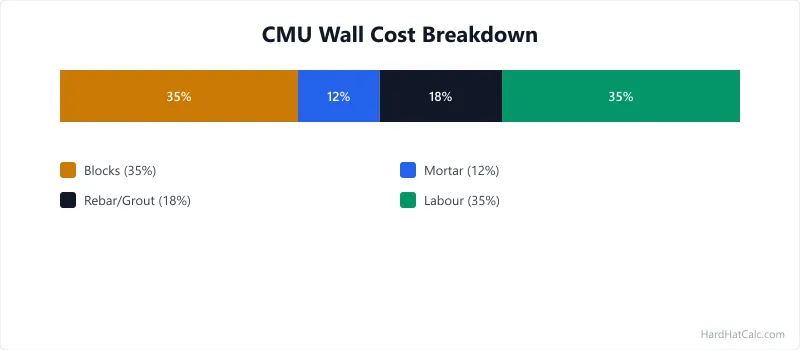
Blocks themselves are cheap: $1.85–$2.50 each for standard 8x8x16 CMU (concrete masonry unit) at big-box retailers as of March 2026. Prices and rates on this page are our own estimates as of the date shown; they change often. Enter your own figures for a current result. A 24-foot retaining wall that is 6 feet tall is 144 square feet of wall face. At about 1.125 blocks per square foot (the 8x16-inch face with mortar joints), that is 162 blocks, roughly 170 after a 5% waste factor. Block cost is approximately $315–$425. Then you add 15 bags of mortar at $10–$15 each ($150–$225), 10 pieces of rebar at $10–$14 each ($100–$140), and grout to fill the reinforced cells ($75–$125 in concrete mix). Material alone is $640–$915.
Labour is where budgets really stretch. A skilled mason with a labourer lays 135–190 standard blocks per day under good conditions, per CMHA TEK 04-01A (Typical Concrete Masonry Productivity Rates). At $450–$700 per day for the pair (a day rate that ships unverified), a 170-block wall takes one to two days of labour: $450–$1,400. Add a footing (which you need for any structural or retaining wall) and the total installed cost for this modest 24x6-foot wall lands between $1,300 and $2,925.
This calculator breaks down each line item so you can see where the money goes. The numbers here are estimates for budgeting: get quotes from local masons for project-specific pricing, because labour rates vary by 30–50% between regions.
Material Costs at a Glance
| Material | Unit | Cost Range (March 2026) | Notes |
|---|---|---|---|
| Standard block (8x8x16) | each | $1.85–$2.50 | Gray CMU, medium weight |
| Larger block (12x8x16) | each | $2.75–$3.75 | Thicker walls, taller retaining |
| Type S mortar (80 lb bag) | bag | $10–$15 | ~12 standard blocks per bag |
| Grout fill (80 lb bag) | bag | $6–$9 | For filling rebar cells |
| #4 rebar (20 ft stick) | piece | $10–$14 | Grade 60, vertical + horizontal |
| Rebar tie wire (3.5 lb roll) | roll | $8–$12 | One roll does ~200 ties |
| Wall cap blocks | each | $3.50–$6.00 | Flat cap or bullnose for top course |
| Waterproofing (5 gal bucket) | bucket | $35–$55 | Below-grade walls only |
Prices as of March 2026, US national averages from home centre and masonry supplier pricing. Volume discounts of 10–20% are common when ordering full pallets (90–108 blocks per pallet for 8x8x16). Always order at least 5% extra blocks — breakage during delivery and cutting is unavoidable.
Block Wall Reinforcement Requirements
Building codes treat unreinforced block walls as a relic. Any wall that retains soil, supports structural loads, or stands taller than 4 feet in a seismic zone needs steel reinforcement.
The layout this calculator assumes, typical trade practice for residential block walls rather than a code figure, is vertical rebar at 48 inches on centre (every 4 feet) and horizontal rebar (in bond beam blocks) every fourth course. CMHA TEK 15-01B pairs 48-inch spacing with #5 and larger bars, never #4, and local adopted codes vary: the City of Menifee, CA standard prints #4 vertical at 24 inches maximum, while Rancho Cucamonga prints #4 at 48 inches for walls under 5 feet. This calculator counts and prices 20-foot #4 sticks, so a #5 layout costs more per stick. Your local code and engineer set the actual minimum (roughly every 32 inches of height). The vertical bars are set in the block cells, which are then filled with grout (fluid concrete) to lock the rebar in place. Grout follows its own mix proportions, usually a fine-aggregate 1:3 cement-sand blend per ASTM C476, which is one of the standard recipes covered in what 1:2:3 means and which mix matches the application. Horizontal rebar runs through special bond beam blocks (also called U-blocks or lintel blocks) that have a channel cut in the top for the bar.
Retaining walls face lateral soil pressure and need heavier reinforcement. A 6-foot retaining wall typically requires #5 vertical bars at 32 inches on centre and horizontal #4 bars every other course. The vertical bars extend down into the footing (12 inches minimum embedment) and up through the full wall height. For block walls that also serve as foundation walls, estimate mortar quantities separately from the block cost to get a tighter budget.
For a straight garden wall or privacy fence wall under 4 feet tall in a low-seismic area, some codes allow unreinforced construction with control joints every 20–25 feet. Even where code allows it, adding rebar is cheap insurance — the steel cost for basic reinforcement adds $1.50–$3.00 per square foot of wall area, and it prevents catastrophic failure if the soil settles or a car bumps the wall.
The rebar and footing requirements for block walls overlap with slab reinforcement patterns — size rebar quantities for the footing separately if your footing is wider than the wall.
CMU Blocks vs Poured Concrete: Cost and Suitability
Block walls and poured-in-place concrete walls serve many of the same functions (foundations, retaining walls, basement walls) but they differ in cost, speed, and suitability.
Cost: For walls under 8 feet tall and under 50 linear feet, block walls are usually cheaper. The materials are bought in small quantities from local suppliers, no forming system is needed, and a single mason can do the work. For larger walls (full basement foundations, long retaining walls) poured concrete becomes more economical because the forming crew works faster. The crossover point is typically around 500–800 square feet of wall area, where the form rental and concrete truck delivery make sense.
Speed: A poured wall is faster once the forms are set. A 100-foot foundation wall can be poured in a single day; the same wall in block takes 5–8 days of masonry. But form setup adds 2–3 days on the front end, so the total schedules are closer than they appear.
Strength and waterproofing: Poured concrete walls are stronger in lateral loading (resisting formwork pressure from fresh concrete) and inherently more waterproof because there are no mortar joints. Block walls have hundreds of mortar joints, each one a potential leak path. Below-grade block walls need waterproofing membrane on the exterior face, while poured walls can often get by with dampproofing (cheaper).
DIY feasibility: Block walls win here by a wide margin. Laying blocks is slow, labour-intensive work, but it requires no specialized equipment beyond a trowel, level, string line, and mason's hammer. Poured concrete requires formwork (rented or built), a concrete pump or truck with chute access, and vibration equipment — none of which a typical homeowner owns.
For above-grade garden walls, privacy walls, and small retaining walls under 4 feet, block is almost always the right choice for cost and simplicity. Beyond block and poured concrete, the rundown of retaining-wall prices across timber, gabion, and natural stone shows where each material lands per square foot of wall face and which suits a given budget and height.
Building a Block Wall: From Footing to Cap
Pour the footing. Every structural block wall needs a concrete footing. Run footing volumes to size the pad: the standard residential footing is twice the wall width and at least 8 inches thick. For an 8-inch block wall, that is a 16-inch-wide by 8-inch-thick footing. Set vertical rebar dowels in the wet footing at 48-inch spacing, extending at least 24 inches above the footing surface. These dowels will align with the block cells and tie the wall to the footing.
Lay the first course dry. Set the first course of blocks without mortar to check spacing. The goal is to end with a full or half block at each end, since cutting blocks to odd lengths weakens the joint and looks poor. Adjust the starting point or the mortar joint width slightly to make the layout work.
Set corner leads. Build up the corners first, 3–4 courses high, stepping back one block per course to create a stair-step pattern. Use a level on every block in every direction. The corners establish the alignment for the rest of the wall. String a mason's line between the corners for each course to keep the wall straight.
Fill between corners. Lay blocks between the corner leads, following the string line for alignment. Butter the head joint (vertical mortar joint) and the bed joint (horizontal) with about 3/8 inch of mortar. Tap each block into position with a rubber mallet, checking level and plumb as you go.
Install bond beams. Every fourth course (or as specified by code), use bond beam blocks with horizontal rebar. Fill the bond beam cells with grout and vibrate or rod the grout to eliminate voids around the rebar.
Fill and grout vertical cells. Once the wall reaches full height, fill all cells containing vertical rebar with grout. Code requires grouting every cell with rebar; ungrouted cells in non-reinforced areas can be left hollow (which reduces weight) or filled for maximum strength.
Cap the wall. Install cap blocks, concrete cap, or stone cap on the top course. Cap blocks are solid; they prevent water from entering the hollow cores and freezing, which cracks block walls from the inside out.
Worked Examples
Example 1
Scenario: A homeowner is building a 16-foot long, 4-foot tall garden retaining wall using standard 8x8x16 blocks with 3/8-inch mortar joints.
Calculation: Courses = ⌈4 × 12 / 8⌉ = 6. Blocks per course = ⌈16 × 12 / 16⌉ = 12. Raw blocks = 6 × 12 = 72, with 5% waste = ⌈72 × 1.05⌉ = 76 blocks. Mortar = ⌈76 / 12 × 1.0⌉ = 7 bags. Vertical rebar = ⌈16 × 12 / 48⌉ + 1 = 5 pieces. Horizontal rebar runs = floor(6 / 4) = 1, horizontal pieces = ⌈1 × 16 / 20⌉ = 1. Total rebar = 5 + 1 = 6 pieces. Material cost = (76 x $2.15) + (7 x $12.50) + (6 x $12) = $163.40 + $87.50 + $72.00 = $322.90. Labour = ⌈76 / 160⌉ x $575 = $575. Total = $897.90.
What this means: This modest retaining wall needs 76 blocks, 7 bags of mortar, and 6 pieces of rebar for about $323 in materials. With one day of professional labour at $575, the total project cost is roughly $898.
Takeaway: Short retaining walls are manageable DIY projects. The material cost is under $325, and saving the $575 labour charge makes it worthwhile if you have basic masonry skills and a free weekend.
Example 2
Scenario: A contractor is pricing a 32-foot long, 8-foot tall basement wall using 12x8x16 blocks (thicker for below-grade structural use) with standard 3/8-inch mortar joints.
Calculation: Courses = ⌈8 × 12 / 8⌉ = 12. Blocks per course = ⌈32 × 12 / 16⌉ = 24. Raw blocks = 12 × 24 = 288, with 5% waste = ⌈288 × 1.05⌉ = 303 blocks. Mortar = ⌈303 / 12 × 1.0⌉ = 26 bags. Vertical rebar = ⌈32 × 12 / 48⌉ + 1 = 9 pieces. Horizontal rebar runs = floor(12 / 4) = 3, horizontal pieces = ⌈3 × 32 / 20⌉ = 5. Total rebar = 9 + 5 = 14 pieces. Material cost = (303 x $3.25) + (26 x $12.50) + (14 x $12) = $984.75 + $325.00 + $168.00 = $1,477.75. Labour = ⌈303 / 160⌉ x $575 = 2 x $575 = $1,150. Total = $2,627.75.
What this means: A full-height basement wall at 32 feet requires 303 blocks, 26 bags of mortar, and 14 rebar pieces. Materials total about $1,478 and 2 days of professional masonry adds $1,150, bringing the project to roughly $2,628.
Takeaway: Below-grade basement walls using 12-inch blocks cost roughly $10 per square foot installed ($2,627.75 ÷ 269.3 sq ft = $9.76 per square foot of blocks ordered, which includes waste). The thicker blocks add about 50% to block cost versus 8-inch units but are required for most basement applications by code.
Frequently Asked Questions
- How many concrete blocks do I need per square foot of wall?
Standard 8x8x16 blocks cover 0.89 square feet each (the nominal 8x16-inch face including mortar joints). That means you need approximately 1.125 blocks per square foot of wall area. In practice, round to 1.13 blocks per square foot and add 5% for waste and breakage — so about 1.19 blocks per square foot ordered. For a quick count: multiply the wall area in square feet by 1.2 and round up. A 100-square-foot wall (for example, 20 feet long by 5 feet high) needs roughly 120 blocks including waste. The mortar bag tool gives you a tighter estimate of mortar bag quantities based on joint thickness and wall area. For projects considering brick veneer instead of CMU, the brick estimator covers count and mortar for modular and UK-metric formats. The 5% waste allowance, the joint-width scaling of the mortar yield, the rebar layout default and the 160-blocks-per-day productivity pick are this site's conventions. This is our own estimate; no published source backs these figures. Check your results against your product data or a licensed professional before acting.
- What type of mortar should I use for a concrete block wall?
Type S mortar per ASTM C270 is the standard choice for structural block walls, retaining walls, and any below-grade application. It has high compressive strength (1,800 psi minimum average at 28 days under the ASTM C270 property specification, as printed in BIA Technical Notes 8 Table 2 and CMHA TEK 09-01A) and excellent bond strength, which matters for walls that resist lateral loads from soil or wind. Type N mortar (750 psi minimum on the same table) is acceptable for non-structural above-grade walls like garden walls and decorative screens where loading is minimal. Type M mortar (2,500 psi minimum) is the strongest but is only needed for foundation walls in direct contact with earth under heavy loads. For most residential block projects, buy pre-mixed Type S mortar in 80-pound bags — it is the safest all-purpose choice. Below-grade walls also need a waterproofing membrane on the exterior face to prevent moisture migration through the mortar joints.
- How tall can a concrete block wall be without a footing?
Building codes require a footing for any freestanding block wall over 2 feet tall, and in practice, even low garden walls benefit from a footing. Without a footing, a block wall sits on soil that expands, contracts, and settles with moisture and temperature changes, which cracks the mortar joints and tilts the wall within a few years. A concrete footing distributes the wall weight over a larger soil area and provides a stable, level base. The footing must extend below the frost line in your area (typically 24–48 inches deep in Northern states) to prevent frost heave from lifting the entire wall. A footing yardage tool sizes the pad width and depth based on wall weight and soil bearing capacity.
- Can I build a concrete block retaining wall myself?
Retaining walls under 4 feet tall (measured from the bottom of the footing to the top of the wall) are reasonable DIY projects for someone comfortable with masonry basics. The work is physically demanding: each 8x8x16 block weighs about 35 pounds, mortar bags weigh 80 pounds, and you will be lifting and placing hundreds of them. Walls taller than 4 feet involve significant lateral soil pressure and require engineered design for footing size, reinforcement spacing, and drainage behind the wall. Most jurisdictions require a building permit and engineering for retaining walls over 4 feet. Even for short walls, install drainage (a perforated pipe in gravel behind the base of the wall) to prevent water pressure from building up and pushing the wall over. For dry-stacked landscape walls without mortar, the retaining wall block calculator handles segmental units with drainage gravel included in the estimate.
- How long does it take a professional mason to build a block wall?
A skilled mason with a labourer typically lays 135–190 standard blocks per 8-hour day, per CMHA TEK 04-01A, Typical Concrete Masonry Productivity Rates (standard 8x8x16 units; basis Kolkoski, Masonry Estimating, 1988). This rate includes mixing mortar, setting blocks, tooling joints, and maintaining plumb and level. A 24-foot wall that is 6 feet tall (171 blocks with the 5% waste factor) takes 1–2 days of masonry work. Add one day for footing excavation and pour, and one day for grouting reinforced cells and capping. Total project timeline for a modest retaining wall: 3–4 working days. Complex walls with pilasters, curves, or decorative patterns reduce the daily block count to 60–80. Spec the rebar grid for the footing and grouted cores to get a complete steel order alongside the block count.
More Structural calculators
Browse all structural calculators — Beam sizing, truss pricing, load calculations, wall framing, deck capacity, and foundation tools.