
Concrete Pressure Calculator
Free concrete pressure calculator using ACI 347R-14. Enter pour rate, temperature, and height to find lateral pressure on formwork for walls and columns.
Last updated:
Methodology reviewed by Doc. dr. sc. Mladenka Juradin, dipl. ing. građ., PhD, Civil Engineering (FCEAG, University of Split)
Total height of the concrete pour from base to top of form.
Vertical rise rate of concrete in the form. Typical residential: 3-5 ft/hr. Fast commercial: 7-15 ft/hr.
Temperature of the concrete at placement. Lower temperatures slow setting and increase lateral pressure — a 50°F pour can produce 40% higher pressure than a 70°F pour at the same rate.
Cement chemistry affects setting time. Retarders and blended cements (slag or fly ash) slow setting and increase lateral pressure on forms.
Normal-weight concrete is 150 pcf. Lightweight is 90-120 pcf.
For estimation only. Structural work requires review by a licensed engineer. Local building codes take precedence over any calculator output.
How This Is Calculated
ACI 347R-14 formwork pressure (Section 4.2.2, Table 4.2.2.1a(a)). Walls up to 14 ft tall poured slower than 7 ft/hr: p = Cw x Cc x (150 + 9000R/T). Walls taller than 14 ft at any rate under 7 ft/hr, and all walls poured at 7 to 15 ft/hr: p = Cw x Cc x (150 + 43,400/T + 2800R/T). Walls poured faster than 15 ft/hr take full hydrostatic pressure, p = w x h. Cc = chemistry coefficient per Table 4.2.2.1a(b): 1.0 for Type I, II or III cement without a retarder; 1.2 for Type I, II or III with a retarder; 1.2 for blended cement (under 70% slag or under 40% fly ash) without a retarder; 1.4 for blended cement with a retarder. Cw = unit weight coefficient per Table 4.2.2.1a(c): 0.5 x (1 + w/145), not less than 0.80, below 140 pcf; 1.0 from 140 to 150 pcf; w/145 above 150 pcf. Every equation is floored at 600 x Cw psf and capped at hydrostatic w x h. Equivalent head = pressure / unit weight. T = concrete temperature (deg F), R = pour rate (ft/hr), w = unit weight (pcf), h = pour height (ft).
Source: Lateral pressure per ACI 347R-14 (Guide to Formwork for Concrete) Section 4.2.2: equation applicability per Table 4.2.2.1a(a) (walls ≤14 ft at rates under 7 ft/hr; taller or faster walls up to 15 ft/hr; full hydrostatic beyond 15 ft/hr), chemistry coefficient Cc per Table 4.2.2.1a(b), unit weight coefficient Cw per Table 4.2.2.1a(c), 600·Cw psf minimum, wh maximum. Checked August 2026 against ACI's own published 347R-14 excerpt (ACI Online CEU Program, concrete.org); the two equations, the 600·Cw minimum, the wh maximum, the applicability table and both coefficient tables are quoted from that publisher copy in the site's provenance registry.
7 min read
What Happens When Formwork Pressure Is Wrong
Underestimating lateral pressure leads to formwork blowouts — one of the most expensive and dangerous failures on a concrete job site. Overestimating it leads to over-built forms that waste lumber, labour, and time.
The concrete pressure calculator applies the ACI 347R-14 method to estimate maximum lateral pressure on wall and column formwork. Fresh concrete behaves as a fluid immediately after placement, exerting lateral pressure against the form walls. As the concrete near the bottom begins to stiffen and develop internal shear strength, it supports itself and pressure stops building. The race between rising concrete level and setting time determines the peak pressure.
A blowout typically starts as a small bulge in the form face where the sheathing deflects outward between studs. The bulge concentrates stress on the fasteners holding the stud to the waler, and if the waler or tie fails, the form opens suddenly. Wet concrete pours out in a wave, coating everything nearby and leaving a void in the wall that must be chipped out and re-poured. Repair costs for a residential basement blowout run $2,000 to $8,000 depending on the extent of damage and concrete wasted. Understanding how concrete weight loads the forms helps you appreciate why even modest walls generate serious lateral forces.
Over-building formwork is safer but costly. Each additional waler, tie, and strongback adds material and labour. For a commercial project forming thousands of square feet of wall, the difference between walers at 24-inch spacing (adequate for 700 psf) and walers at 16-inch spacing (adequate for 1,100 psf) represents hundreds of dollars in lumber and hours of extra assembly time. Knowing the actual design pressure lets the contractor build forms that are strong enough without being wasteful.
How Pour Rate and Temperature Drive Pressure
Understanding the two variables you can control on a job site — pour rate and concrete temperature — gives you practical tools to manage formwork pressure.
Pour rate is the primary lever. Doubling the pour rate roughly doubles the excess pressure above the 150 psf baseline. At 3 ft/hr and 70 deg F the formula gives 536 psf, below ACI 347's 600-psf design floor, so 600 governs. At 6 ft/hr and 70 deg F, it jumps to 921 psf. Slowing the pour is free — it only costs time. If your formwork is marginal, reduce the pour rate before spending money on stronger forms.
Temperature controls setting speed. Warm concrete sets faster, which means the lower layers stiffen sooner and support themselves. At 90 deg F, a 4 ft/hr pour's formula value is 550 psf, so the 600-psf design minimum governs. The same pour at 40 deg F produces 1,050 psf. Cold-weather pours are inherently harder on formwork because the concrete stays fluid longer, building more pressure before it stiffens.
Cement chemistry and admixtures shift the timeline. Plain Type I, II, or III cement without admixtures rates Cc = 1.0 in ACI 347's chemistry table. A retarding admixture extends the fluid phase and raises Cc to 1.2; blended cements with slag or fly ash rate 1.2 on their own; and a retarded blended mix rates the full 1.4. If you are using a retarder for workability, your forms must handle more pressure. The background on how cement type and unit weight vary by mix design explains why ACI 211 specifies different cement types for footings, slabs, and tall walls — and how those choices feed into the Cc and Cw factors above.
Vibration resets the clock. Internal vibration re-liquefies concrete that has started to stiffen. Excessive vibration or revibrating deep layers can temporarily restore full hydrostatic pressure in the lower portion of the form. Limit vibrator insertion depth to the current lift and one lift below, per ACI 309.
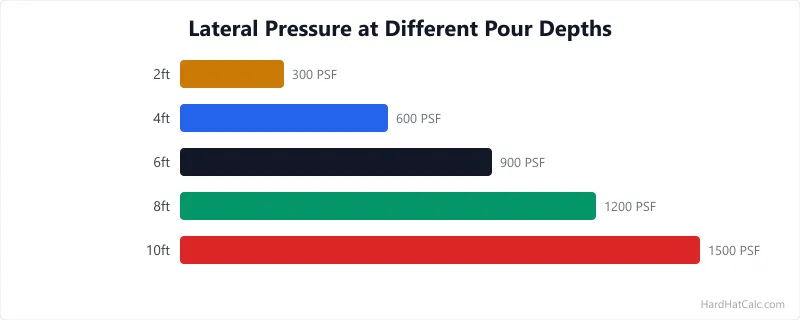
Height sets the ceiling. Pressure cannot exceed hydrostatic — the weight of a full column of fluid concrete from top to bottom. For a 10-foot wall at 150 pcf, that ceiling is 1,500 psf. If the ACI formula gives a number above hydrostatic, use hydrostatic as the design pressure.
ACI 347 Pressure Formulas Explained
The ACI 347R-14 pressure equations are empirical — derived from field measurements on hundreds of concrete pours, not from pure physics. They correlate lateral pressure with the variables that matter most in practice: pour rate, temperature, cement type, and unit weight.
For walls up to 14 feet tall with pour rates below 7 ft/hr, the formula is: p = Cw x Cc x (150 + 9000R/T), where p is in pounds per square foot, R is the pour rate in feet per hour, and T is the concrete temperature in degrees Fahrenheit. The constant 150 represents a baseline pressure that exists even at negligible pour rates. The 9000R/T term captures the interaction between rising concrete level and setting speed.
For walls taller than 14 feet (at any rate under 7 ft/hr) and for all walls poured at 7 to 15 ft/hr, the formula shifts: p = Cw x Cc x (150 + 43400/T + 2800R/T). The added 43400/T term acknowledges that in tall or fast pours the concrete column acts more like a true fluid and temperature effects become more pronounced. Beyond 15 ft/hr, ACI 347 sends wall design to full hydrostatic pressure.
Two boundary conditions apply. First, the calculated pressure cannot exceed hydrostatic (unit weight times total height). If the formula predicts more than hydrostatic, the concrete must be fully fluid from top to bottom — an unusual situation that only occurs at very high pour rates or very low temperatures. Second, the pressure must be at least 600 x Cw psf as a minimum design value regardless of conditions.
The coefficient Cw adjusts for unit weight. For 140-150 pcf concrete, Cw = 1.0. Lightweight concrete at 110 pcf gives Cw = 0.88 (0.5 x (1 + 110/145), never taken below 0.80). Above 150 pcf, Cw = w/145 — heavyweight 175-pcf shielding concrete designs at about 1.21.
For columns — narrow forms where the pour rate is typically much higher — ACI 347 recommends using full hydrostatic pressure (unit weight times height) as the design value, since the concrete cannot stiffen fast enough in the confined space. This calculator focuses on wall formwork, where the equations above apply. For guidance on proportioning the concrete mix to hit a target strength while maintaining workable slump, use the mix ratio tool before scheduling your pour.
Formwork Design Pressure Reference
The table below shows lateral pressure for common residential and commercial wall pour scenarios using Type I cement and normal-weight (150 pcf) concrete.
| Pour Rate | Temp 40°F | Temp 60°F | Temp 70°F | Temp 90°F |
|---|---|---|---|---|
| 2 ft/hr | 600 psf | 600 psf | 600 psf | 600 psf |
| 3 ft/hr | 825 psf | 600 psf | 600 psf | 600 psf |
| 4 ft/hr | 1,050 psf | 750 psf | 664 psf | 600 psf |
| 5 ft/hr | 1,275 psf | 900 psf | 793 psf | 650 psf |
| 6 ft/hr | 1,500 psf | 1,050 psf | 921 psf | 750 psf |
| 7 ft/hr | 1,725 psf | 1,200 psf | 1,050 psf | 850 psf |
All values use Cc = 1.0 (Type I/II/III, no retarder), Cw = 1.0 (150 pcf), and walls up to 14 feet tall; formula values below the 600-psf ACI design minimum are shown as 600 psf. For retarded or blended mixes, multiply by 1.2 before applying the floor. For a retarded blended mix, multiply by 1.4.
Form tie spacing and waler requirements depend on the form face material. Standard 3/4-inch B-B plywood (Exterior grade) with 2x4 studs at 12 inches on centre handles approximately 600 to 700 psf. For pressures above 1,000 psf, move to steel walers or reduce stud spacing to 8 inches. The retaining wall block calculator addresses a related but different problem — gravity-based resistance to lateral earth pressure rather than fluid pressure from fresh concrete.
Field Adjustments and Safety Factors
The ACI 347 equations give design pressures, but field conditions add variables that formwork builders must account for.
Should I add a safety factor above the calculated pressure? ACI 347 does not prescribe a safety factor for the pressure calculation itself — the formulas already incorporate conservative assumptions from field data. However, the formwork components (plywood, studs, walers, ties) must be designed with allowable stress values that include built-in safety factors per NDS or steel design codes. Most commercial formwork designers add 10 to 15% to the calculated pressure as contingency for pour rate variations and concrete temperature changes during the pour.
What if the concrete arrives hotter or colder than expected? Request the batch plant hold the concrete temperature within 10 degrees of your design assumption. If the truck arrives colder than expected, slow the pour rate proportionally. A 10-degree drop in temperature at a 5 ft/hr pour rate increases pressure by roughly 100 to 150 psf — enough to stress marginal formwork.
How does pumped concrete differ from bucket or chute placement? Pumped concrete hits the form at higher velocity and can create impact loads not captured by the ACI 347 static pressure formulas. When pumping into tall forms from the top, the concrete free-falls and the impact pressurises the lower layers. ACI 347 recommends treating the placement as full hydrostatic for the first 10 feet below the discharge point when pumping. After that zone, the standard pressure formula applies. For below-grade pours where formwork contacts soil, applying a waterproofing membrane to the exterior face after form stripping prevents moisture intrusion through the cured wall.
Does rebar congestion affect pressure? Dense rebar mats restrict concrete flow, causing local head buildup above the congestion point. This trapped head can exceed the ACI 347 calculated pressure locally. In heavily reinforced walls, vibrate thoroughly to prevent bridging and verify that the concrete flows through the rebar mat. If bridging occurs, the form below the obstruction sees reduced pressure while the form above sees increased pressure.
Worked Examples
Example 1
Scenario: A foundation contractor pours an 8-foot basement wall at 4 ft/hr in 70 degree F weather using Type I cement at 150 pcf. They need to know the maximum lateral pressure on the plywood forms.
Calculation: Pour height = 8 ft, pour rate (R) = 4 ft/hr, temperature (T) = 70 deg F, Cc = 1.0 (Type I), Cw = 1.0 (150 pcf). ACI 347 wall formula for R <= 7 ft/hr: p = Cw × Cc × (150 + 9000 × R / T) = 1.0 × 1.0 × (150 + 9000 × 4 / 70) = 1.0 × (150 + 514.3) = 664.3 psf. Hydrostatic maximum = 150 × 8 = 1,200 psf. Since 664 < 1,200, the ACI formula governs. Maximum lateral pressure = 664 psf. Formwork load per linear foot at 4-ft base = 664 × 1 = 664 plf.
What this means: The lateral pressure peaks at 664 psf — about 55% of full hydrostatic pressure. This is a moderate pressure that standard 3/4-inch plywood sheathing with 2x4 studs at 12-inch spacing and double 2x4 walers at 24-inch spacing can handle. The pour rate of 4 ft/hr allows the concrete near the bottom to begin stiffening before the full head of concrete builds up.
Takeaway: At 664 psf, standard residential formwork systems are adequate. If the pour rate increased to 7 ft/hr, pressure would jump to 1,050 psf — requiring tighter stud spacing or stronger walers. Slowing the pour rate is the cheapest way to reduce formwork requirements.
Example 2
Scenario: A commercial contractor pours a 20-foot-tall wall at 6 ft/hr in 40 degree F weather with a retarded blended-cement mix (Cc = 1.4). They are concerned about cold-weather pressure buildup.
Calculation: Pour height = 20 ft (over the 14-ft limit for the first wall equation, so the taller-wall equation applies even at R < 7), R = 6 ft/hr, T = 40 deg F, Cc = 1.4 (retarded blended mix), Cw = 1.0 (150 pcf). p = Cw × Cc × (150 + 43,400 / T + 2,800 × R / T) = 1.0 × 1.4 × (150 + 1,085 + 420) = 1.4 × 1,655 = 2,317 psf. Hydrostatic maximum = 150 × 20 = 3,000 psf. Since 2,317 < 3,000, the ACI formula governs. Equivalent head = 2,317 / 150 = 15.4 ft of concrete.
What this means: Cold weather combined with a retarding admixture dramatically increases lateral pressure. The same wall poured at 70 deg F with plain Type I cement would see about 1,010 psf — the cold-weather retarded mix generates 2.3 times more pressure. The Cc factor of 1.4 and the low temperature both work against the contractor.
Takeaway: At 2,317 psf, this pour requires heavy-duty forming: steel-framed panels or engineered plywood forms with steel walers. Slowing the pour helps less on a tall wall — at 3 ft/hr the taller-wall equation still gives about 2,023 psf, because the 43,400/T cold-weather term dominates. Real relief comes from warmer concrete or a non-retarded mix. Budget an extra $2-$4 per square foot of form face for cold-weather tall pours.
Frequently Asked Questions
- Does pouring concrete faster increase pressure on formwork?
Yes, pour rate is the single largest controllable factor affecting lateral pressure. The ACI 347 formula shows a direct linear relationship between pour rate and pressure. At 70 degrees F with Type I cement, increasing the pour rate from 3 ft/hr to 6 ft/hr raises the formula value from 536 psf (below the 600-psf design floor, which governs there) to 921 psf. Faster pours fill the forms before the lower concrete has time to stiffen and support itself, so the fresh concrete column acts more like a full fluid. Slowing the pour rate is the most cost-effective way to reduce formwork requirements. Once the pour is complete, curing conditions determine when you can safely strip the forms.
- Why does cold weather increase concrete formwork pressure?
Cold concrete sets slower. The cement hydration reaction that causes concrete to stiffen is temperature-dependent — it slows dramatically below 50 degrees F and nearly stops below 40 degrees F. While the concrete stays fluid, it continues to behave as a heavy liquid, transmitting its full weight laterally against the forms. A wall poured at 40 degrees F generates roughly 60 to 90% more lateral pressure than the same pour at 70 degrees F, depending on pour rate. This is why cold-weather pours require either stronger formwork, slower pour rates, or heated concrete. Adjusting the concrete mix ratio with a higher cement content can help offset slow winter setting, though it raises material cost.
- What is the maximum pressure fresh concrete can exert on formwork?
The theoretical maximum is full hydrostatic pressure: the unit weight of concrete times the total pour height. For normal-weight concrete at 150 pcf, a 10-foot wall produces a maximum hydrostatic pressure of 1,500 psf at the base. In practice, the ACI 347 calculated pressure is usually lower because the concrete near the bottom begins to set before the pour reaches full height. Full hydrostatic pressure only occurs when the concrete remains fully fluid from top to bottom — typically during very fast pours, very cold conditions, or when retarding admixtures delay the initial set by several hours. The concrete slab weight calculator can help you estimate the unit weight if your mix uses lightweight aggregate rather than standard stone.
- How do I design formwork to resist the calculated pressure?
Start with the maximum lateral pressure from this calculator, then size each formwork component to resist it. Work from the form face inward: the sheathing (typically 3/4-inch plywood) spans between vertical studs, the studs span between horizontal walers, and the walers are held by form ties anchored to the opposite form wall. Each component must carry its tributary pressure without exceeding its allowable bending stress or deflection limit. Standard 3/4-inch plywood with 2x4 studs at 12 inches on centre handles about 650 psf. For pressures above 1,000 psf, switch to closer stud spacing (8 inches), double walers, or steel-framed panel systems. Once the concrete has cured and forms are stripped, apply a waterproofing membrane to below-grade wall faces before backfilling.
More Structural calculators
Browse all structural calculators — Beam sizing, truss pricing, load calculations, wall framing, deck capacity, and foundation tools.