
Concrete Mix Ratio Calculator
Free concrete mix ratio calculator for cement, sand, and aggregate by volume and weight, covering 1:2:3, 1:2:4, and 1:3:6 ratios with water and bag counts.
Last updated:
Methodology reviewed by Doc. dr. sc. Mladenka Juradin, dipl. ing. građ., PhD, Civil Engineering (FCEAG, University of Split)
Ratio by volume. 1:2:4 is the most common general-purpose mix for residential work.
Total finished concrete volume needed. 27 cu ft = 1 cubic yard.
Type I/II Portland cement is standard for most residential work. Blended cements improve durability.
Ratio of wet concrete volume to total dry ingredient volume. 0.67 is standard — sand fills aggregate voids.
For estimation only. Structural work requires review by a licensed engineer. Local building codes take precedence over any calculator output.
How This Is Calculated
Parse mix ratio (e.g. 1:2:3) into cement:sand:aggregate parts. Dry volume = finished volume / yield factor (default 0.67). Component volumes = dry volume x (part / total parts). Cement bags = cement volume x 94 lb/cu ft / 94 lb per bag. Water = cement weight x W/C ratio (0.45 for rich mixes, 0.50 for lean) / 8.33 lb/gal. Total weight = sum of all component weights. Sand density ~100 lb/cu ft, aggregate ~105 lb/cu ft (site typical values). Method: the ratio-parts dry-volume model of this site (editorial); 94 lb of cement = about 1 cu ft per USDA NRCS NEH Part 645 Subpart L; water 8.33 lb/gal per TTB.
Source: The ratio-parts dry-volume method (parts of cement, sand and aggregate scaled from the finished volume by a yield factor, default 0.67) is the default estimating method of this site, typical trade practice for small batches; it closed as an editorial model on 2026-09-05 (SF20-A8 ruling 9). Legs opened: 94 lb of bulk cement = about 1 cu ft per the USDA NRCS National Engineering Handbook, Part 645, Subpart L, Concrete (March 2025); water 8.33 lb per gallon per the TTB Scientific Services density page, with NRCS (8.3 lb per gallon) and the Caltrans Concrete Technology Manual (62.4 lb per cu ft) agreeing; water-cement 0.50 as the general ceiling and 0.45 for demanding work per NRCS (CS-31) and the Caltrans chapter 3 worked example; the 1:2:3 recipe as the general-purpose mix both Quikrete and Sakrete print on their Portland cement data sheets (neither attaches a strength figure). The other six ratios, every strength label, the 0.67 yield factor and the sand 100 and aggregate 105 lb per cu ft typical densities are figures of this site with no published source opened (the Wisconsin DOT loose laboratory measure was ruled not a leg for the sand figure, which stays at 100). ACI 211.1 (the absolute-volume proportioning guide) was not opened (sold by ACI) and does not describe this shortcut; its attribution was withdrawn on 2026-09-02. PCA Design and Control of Concrete Mixtures is cited for general practice only; the PCA pages opened in SF20-A6 are silent on the yield factor.
- ACI 211.1 — Concrete Mix Proportioning (not opened; sold by ACI; the absolute-volume method, not the ratio shortcut used here)
- PCA Design and Control of Concrete Mixtures
- USDA NRCS National Engineering Handbook, Part 645 Subpart L — Concrete (94-lb sack = about 1 cu ft; water 8.3 lb/gal; w/c limits)
- TTB Scientific Services — density of water (8.33 lb/gal)
- Caltrans Concrete Technology Manual, Chapter 3 — review of concrete mix designs
- Quikrete Portland Cement technical data sheet (1:2:3 concrete mix, 94-lb bags)
- Sakrete Portland Cement Type I/II technical data sheet (1:2:3 general purpose concrete, 94-lb bags)
7 min read
Standard Concrete Mix Ratios and Their Strength
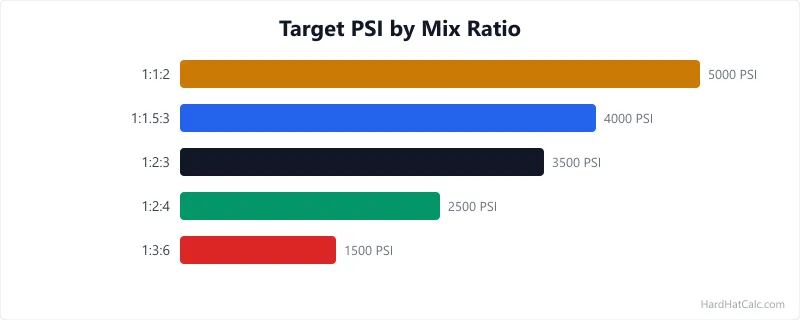
Concrete mix ratios express the proportions of cement, sand, and coarse aggregate by volume. Richer mixes (more cement relative to aggregate) produce stronger concrete but cost more per cubic yard. The concrete mix ratio calculator converts any standard ratio into the exact quantities of each ingredient you need for your project volume.
| Mix Ratio | Approx. Strength (psi) | Typical Application | Cement per cu yd |
|---|---|---|---|
| 1:1:2 | 5,000+ | Precast, heavy structural | ~10 bags |
| 1:1.5:3 | 4,000 | Foundations, columns | ~8 bags |
| 1:2:3 | 3,500 | Slabs, footings, general structural | ~7 bags |
| 1:2:4 | 2,500 | Driveways, sidewalks, patios | ~5.5 bags |
| 1:3:5 | 2,000 | Light-duty slabs, garden walls | ~4 bags |
| 1:3:6 | 1,500 | Bedding, non-structural fill | ~3.5 bags |
| 1:4:8 | 1,000 | Mass fill, large volume backfill | ~2.5 bags |
Strength values are approximate 28-day compressive strengths and depend on water-cement ratio, curing conditions, and aggregate quality. The 1:2:3 row is the general-purpose recipe Quikrete and Sakrete both print on their Portland cement data sheets, without a strength figure attached. The other six ratios and every strength label in this table: This is our own estimate; no published source backs these figures. Check your results against your product data or a licensed professional before acting.
Bag counts assume standard 94-lb bags of Portland cement and a yield factor of 0.67. Always buy 5 to 10% extra cement to account for spillage and variations in aggregate moisture content.
These ratios are the recipe behind the pour. If you would rather buy a ready-named bag or order a graded mix by designation, that guide maps each named product to the strength it delivers.
Where Does the Missing Volume Go?
If you measure out 1 cubic foot of cement, 2 cubic feet of sand, and 3 cubic feet of gravel, you do not get 6 cubic feet of concrete. You get roughly 4 cubic feet. The yield factor — typically 0.65 to 0.70 — accounts for the fact that smaller particles fill the voids between larger ones.
Sand grains nestle into the spaces between gravel pieces. Cement powder fills the remaining gaps between sand grains. Add water, and the paste coats every particle and fills whatever air voids remain. The result: your combined dry ingredients compact into roughly one-third less volume than you measured out dry.
This calculator defaults to a yield factor of 0.67, which works well for most standard mixes with well-graded aggregate. If your aggregate is uniformly sized (all the same diameter), the yield factor drops toward 0.60 because the particles do not pack as efficiently. If you are using a blend of fine and coarse aggregate that is well graded across multiple sieve sizes, the yield factor can reach 0.72 to 0.75.
Getting the yield factor wrong by even 10% can mean running short mid-pour — a serious problem when you need to fill a footing form continuously. When sizing concrete footings, an incorrect yield factor can leave the trench half full at the worst possible moment. For any pour over 10 cubic feet, measure a test batch first: mix one full bag of cement with the proportional sand and aggregate, then measure the resulting volume. Divide the measured volume by the dry ingredient volume to get your actual yield factor.
Mixing Concrete on Site: The Right Sequence
Measure dry ingredients by volume. Use a 5-gallon bucket or a known container as your measuring unit. For a 1:2:3 mix, measure 1 bucket of cement, 2 buckets of sand, and 3 buckets of gravel. Consistency between batches matters more than exact precision — use the same bucket and fill it to the same level each time.
Combine dry ingredients first. Add the aggregate to the mixer, then the sand, then the cement. Run the mixer for 1 to 2 minutes until the dry blend is uniform in colour. If hand-mixing in a wheelbarrow, blend with a hoe until no streaks of cement are visible.
Add water gradually. Start with about two-thirds of the calculated water amount. Add the rest in small increments, mixing for 30 seconds between additions. The target consistency is a thick paste that holds its shape when squeezed but slumps under its own weight — a 3 to 4-inch slump for most residential work.
Check workability before pouring. The mix should slide off a shovel cleanly without sticking. If it is too stiff, add water in half-gallon increments. If too soupy, add small amounts of sand and cement in the original ratio. Every gallon of excess water per cubic yard reduces the 28-day strength by approximately 200 to 300 psi.
Pour and consolidate immediately. Site-mixed concrete begins setting within 30 to 60 minutes in warm weather. Work the concrete into forms, tap the sides to release air pockets, and screed the surface level. For rebar grid sizing, place rebar or mesh before pouring and ensure minimum 1.5 inches of cover from any formed surface.
Water-Cement Ratio and Its Effect on Strength
The water-cement ratio (W/C) is the single most controllable factor affecting concrete strength. Understanding this relationship prevents the most common mistake in site-mixed concrete: adding too much water.
What is the water-cement ratio? It is the weight of water divided by the weight of cement in the mix. A W/C of 0.45 means 0.45 pounds of water for every pound of cement. Lower ratios produce stronger, more durable concrete because excess water creates capillary pores as it evaporates during curing. Those pores weaken the hardened paste.
What W/C ratio should I target? For structural elements (footings, slabs bearing loads, columns), use 0.40 to 0.45. For general flatwork (patios, sidewalks), 0.45 to 0.50 is adequate. For non-structural applications, 0.50 to 0.55 improves workability without consequence. Never exceed 0.60 — the resulting concrete is weak and porous. The guide on understanding concrete mix ratios covers how W/C ratio interacts with aggregate selection and admixtures for different project types.
Why does everyone add too much water? Because dry, stiff concrete is hard to work with. It does not pour easily, it resists screeding, and it takes more effort to consolidate into corners of forms. Adding water makes the mix flow — but it also destroys strength. A 4,000 psi mix at W/C 0.45 drops to 2,500 psi at W/C 0.65. Use a plasticiser admixture (available at home centres) to improve workability without adding water.
Does aggregate moisture affect my water calculation? Absolutely. Wet sand can carry 5 to 8% moisture by weight, which is free water entering the mix. On a rainy day, reduce added water by the estimated moisture in the sand. Squeeze a handful — if water drips out, the sand is carrying 5-8% moisture that counts toward your W/C ratio.
Site-Mixed vs Ready-Mix vs Bagged: Choosing the Right Approach
The method you use to produce concrete depends on volume, quality requirements, and access to the pour location.
Pre-bagged concrete (Quikrete, Sakrete) is the simplest option. Each 60 or 80-lb bag contains pre-proportioned cement, sand, and aggregate — just add water. Convenient for small jobs: setting fence posts, mailbox bases, and patching. The drawback is cost: at $5 to $8 per 80-lb bag (March 2026 home centre prices), a single cubic foot costs roughly $8 to $13. A cubic yard from bags runs $220 to $350, compared to $130 to $170 delivered from a ready-mix plant.
Site-mixed concrete — what this calculator is designed for — lets you buy raw ingredients separately and blend them in a portable mixer or wheelbarrow. For volumes between 3 and 27 cubic feet, site-mixing often hits the sweet spot: cheaper than bags, no minimum order or short-load fee from a ready-mix supplier. You also control the mix ratio precisely, which matters for non-standard applications. The limitation: mixing is physical work, and quality depends on consistent proportioning and water control.
Ready-mix concrete arrives in a truck, fully mixed to specification. For anything over 1 cubic yard (27 cu ft), ready-mix is almost always the right choice. The concrete is batched by computerised systems, tested for quality, and delivered at the correct slump. Most plants have a 1-yard minimum with a short-load surcharge ($30 to $60) for orders under 3 yards. The truck needs access within 30 to 40 feet of the pour location — if your backyard footing is 150 feet from the street, you will need a concrete pump ($200 to $500 rental) or a lot of wheelbarrow runs.
For projects that involve concrete slab weight calculations — like elevated slabs where the supporting structure must handle the dead load — site-mixed concrete works just as well as ready-mix, provided you maintain consistent proportioning and proper curing.
Worked Examples
Example 1
Scenario: A homeowner sets 10 fence posts and needs a 1:2:3 mix to fill each 10-inch-diameter hole to a depth of 24 inches. Total volume needed is approximately 10.9 cu ft.
Calculation: Mix ratio = 1:2:3, total volume = 11 cu ft (rounded up), yield factor = 0.67. Total ratio parts = 1 + 2 + 3 = 6. Dry material needed = 11 / 0.67 = 16.42 cu ft. Cement = 16.42 / 6 = 2.74 cu ft. At 94 lbs per cu ft of bulk cement, that is 257 lbs = 2.74 bags (round up to 3 bags of 94 lbs). Sand = 2.74 × 2 = 5.48 cu ft. Aggregate = 2.74 × 3 = 8.21 cu ft. Water = 2.74 × 0.45 × 94 / 8.33 = approximately 13.9 gallons.
What this means: Three bags of Portland cement, about 5.5 cubic feet of sand, and 8.2 cubic feet of aggregate yield enough 1:2:3 mix for 10 fence posts with a small surplus. The yield factor of 0.67 accounts for the fact that sand fills the voids between aggregate particles — the final mixed volume is roughly two-thirds of the combined dry ingredient volume.
Takeaway: Buy 3 bags of cement, 6 cubic feet of sand (roughly 500 lbs), and 9 cubic feet of gravel (roughly 900 lbs). Total material cost runs $30-$50 at a home centre. Pre-mixed bags would cost roughly $55-$80 for the same volume, making site-mixing worthwhile for this quantity.
Example 2
Scenario: A contractor pours a small 4-inch patio slab measuring 6 × 8 feet using a 1:2:4 general-purpose mix. Total concrete volume is 16 cu ft.
Calculation: Mix ratio = 1:2:4, total volume = 16 cu ft, yield factor = 0.67. Total ratio parts = 1 + 2 + 4 = 7. Dry material = 16 / 0.67 = 23.88 cu ft. Cement = 23.88 / 7 = 3.41 cu ft = 321 lbs = 3.41 bags (round to 4 bags). Sand = 3.41 × 2 = 6.82 cu ft. Aggregate = 3.41 × 4 = 13.64 cu ft. Water = 3.41 × 0.50 × 94 / 8.33 = approximately 19.2 gallons.
What this means: The 1:2:4 mix uses more aggregate relative to cement than the 1:2:3 mix, reducing material cost while still achieving adequate strength for a patio slab (approximately 2,500 psi). Four bags of cement, 7 cubic feet of sand, and 14 cubic feet of gravel produce enough concrete for the slab with a modest over-pour allowance.
Takeaway: Budget roughly $50-$70 for the raw materials. A ready-mix delivery truck typically has a minimum order of 1 cubic yard (27 cu ft) with a short-load fee — for 16 cu ft, site-mixing or pre-bagged concrete is more economical. Mix in a rented mixer ($40-$60 per day) to keep the work manageable.
Frequently Asked Questions
- How much sand and aggregate do I need per bag of cement in a 1:2:3 mix?
In a 1:2:3 mix the proportions are by volume, so every 94-lb bag of cement — roughly 1 cubic foot of bulk cement — pairs with about 2 cubic feet of sand and 3 cubic feet of coarse aggregate. Enter your total pour volume above and the calculator scales those proportions across the whole batch, then applies the yield factor that accounts for sand settling into the gaps between the stones. Order the coarse aggregate separately with the gravel volume tool once you know the cubic feet you need.
- How many bags of cement do I need for 1 cubic yard of concrete?
The number of bags depends on your mix ratio. A standard 1:2:3 structural mix requires approximately 7 bags (94 lbs each) of Portland cement per cubic yard. A 1:2:4 general-purpose mix uses about 5.5 bags. A lean 1:3:6 fill mix requires roughly 3.5 bags. These figures assume a yield factor of 0.67 and standard 94-lb bags. Always round up and buy one extra bag to avoid running short mid-pour, since running out of cement is worse than having a partial bag left over. If your project involves pouring footings, you can check footing dimensions and estimate the total volume you need to order. For a slab, column, or wall, size the pour by shape to turn dimensions straight into cubic yards and a bag count.
- How do I convert the calculator results into cubic yards or total weight?
The tool reports cement directly as 94-lb bags, so that figure needs no conversion. For the sand and aggregate volumes, divide any cubic-foot value by 27 to get cubic yards (27 cubic feet = 1 cubic yard), the unit bulk suppliers usually quote. To gauge the weight you will be moving, sand runs about 100 lb per cubic foot and coarse aggregate about 105 lb per cubic foot; once the slab is poured, the slab weight estimator turns the finished volume into the dead load your structure has to carry.
- How do I adjust a concrete mix ratio for wet sand?
Wet sand contains free moisture that counts as mixing water. Damp sand typically carries 2 to 4% moisture by weight; wet sand after rain may hold 5 to 8%. For a mix using 7 cubic feet of sand at 100 lb/cu ft density, 5% moisture means 35 lbs of extra water is already in the mix — about 4.2 gallons. Reduce your added water by this amount. If you skip this adjustment, the excess water raises the water-cement ratio and weakens the final concrete by 15 to 25%. The squeeze test is a quick field check: grab a handful of sand and squeeze. If water runs out freely, reduce your added water by at least 5%. If the sand holds its shape but feels damp, reduce by 2 to 3%. Order the right sand class (construction-grade, sharp) using the sand volume tool before this step — fill sand or play sand carries fines and rounded grains that weaken the mix more than the moisture issue does. Once the corrected mix is poured, proper curing conditions are equally important for reaching the target strength.
More Structural calculators
Browse all structural calculators — Beam sizing, truss pricing, load calculations, wall framing, deck capacity, and foundation tools.