
Concrete Curing Time Calculator
Concrete curing time calculator using mix PSI, temperature, humidity, and thickness to schedule form removal and loading against 28-day design strength.
Last updated:
Methodology reviewed by Doc. dr. sc. Mladenka Juradin, dipl. ing. građ., PhD, Civil Engineering (FCEAG, University of Split)
Target compressive strength at 28 days. Residential: 2,500–4,000 psi.
Average daily temperature during the first 7 days of curing.
Average humidity. Higher humidity improves curing.
Thicker elements retain heat and cure faster internally.
For estimation only. Structural work requires review by a licensed engineer. Local building codes take precedence over any calculator output.
How This Is Calculated
Temperature factor: above 70°F = 1.0 + (temp − 70) × 0.002; below 70°F = 0.30 + 0.70 × ((temp − 32) / 38)^0.7. Humidity factor = 0.70 + (RH / 100) × 0.30. Thickness factor = 1.0 + min((thickness − 4) × 0.01, 0.15). Combined factor = temp × humidity × thickness. Strength at 1, 3 and 8 days = mix strength × base gain% × combined factor (65% at 8 days per ACI 306R-16 Table 8.8, Type I at 70°F; 16% and 40% are site planning fractions). Strength at 28 days = mix strength. Days to full load = 28 / combined factor.
Source: Strength-gain milestones: 65% at 8 days is ACI 306R-16 Table 8.8 (Duration of recommended protection for percentage of standard-cured 28-day strength; Type I cement, 70°F; 11 days at 50°F; Types II and III 10 and 4 days at 70°F; the table also prints 50% at 4 days, 85% at 16 and 95% at 23 at 70°F), read from ACI's own free excerpt and applied 2026-09-12 (SF22-HHC-F1 E7; the milestone stood at 7 days as a site planning fraction until then). The 1-day 16% and 3-day 40% fractions, and the table's 14-day 90% and 56-day 104% rows, are this site's planning figures that ACI does not print; the 28-day figure is the design strength you enter (100%, no longer labelled 99%). Packaged 5,000-psi mixes print 30/50/70/100% at the same ages on their own data sheets (Quikrete 5000 No. 1007 and TCC Tech-Mix High-Strength 5000: 1,500 / 2,500 / 3,500 / 5,000 psi under ASTM C39; Sakrete 5000 Plus: 2,500 / 3,500 / 5,000 at 3, 7 and 28 days), and 4,000-psi packaged mixes print 62.5% at 7 days (Quikrete 1101, Sakrete High-Strength: 2,500 / 4,000 psi), so the fractions here run slower at every early age; those sheets describe high-early-strength products and declared minima, not a measured curve, which is why the lower fractions stay. The 28-day result is the design strength you enter (ACI 318-25 Chapter 19 basis); the temperature, humidity and thickness adjustment factors stretch the schedule (days to full design load = 28 / combined factor) and scale the 1, 3 and 8-day milestones, never the 28-day strength (engine correction of 2026-09-05, SF20-A8 ruling 2). Those adjustment factors are a simplified model of this site's own, not the Nurse-Saul maturity method (ASTM C1074), which NRMCA CIP 39 describes as linear in temperature above a datum and which needs continuous temperature logging. Cold-weather figures: NRMCA CIP 27 (definition, placement temperatures by section size, freeze loss, calcium chloride cap, thermal differential) and WSDOT Standard Specifications M 41-10 Division 6 (protection temperatures, form removal); the 500 psi freeze threshold rides ACI 306R-16. Ruling record: audits/sf20-a8-rulings-2026-09-03.md.
- NRMCA CIP 27 — Cold Weather Concreting
- NRMCA CIP 11 — Curing In-Place Concrete
- WSDOT Standard Specifications M 41-10, Division 6 (curing, cold weather, form removal)
- Quikrete 5000 High Early Strength Concrete Mix (No. 1007) data sheet
- Sakrete 5000 Plus Concrete Mix TDS
- TCC Materials Tech-Mix High-Strength 5000 Concrete Mix TDS
- ACI 318-25 Building Code
- ASTM C1074 Maturity Method
8 min read
The 28-Day Myth and What Actually Happens
Ask anyone how long concrete takes to cure and you will hear "28 days." That number is everywhere: on bag mix instructions, in contractor conversations, even in building code shorthand. But 28 days is a testing benchmark, not a finish line. Concrete does not stop gaining strength at day 28; it continues to hydrate and harden for months, sometimes years.
The 28-day mark became standard because early concrete engineers needed a consistent point to compare mix designs. The American Concrete Institute adopted it as the reference age for compressive strength testing, and the construction industry treated that testing convention as a completion date. In reality, concrete at 28 days has reached roughly 99% of its design strength under ideal conditions (70°F, adequate moisture). Under real-world conditions — cold weather, low humidity, thin pours — concrete at 28 days might have reached only 50–75% of its target, which this calculator expresses as a longer schedule to the design strength rather than a lower 28-day figure.
This matters for scheduling. If you strip formwork based on a calendar rule ("28 days and done") rather than actual strength gain, you risk loading concrete that has not reached the capacity your engineer assumed. The rebar planning tool helps size the steel that compensates for tensile weakness, but rebar cannot fix concrete that was loaded before it was ready.
How Temperature and Moisture Drive Curing
Concrete curing is a chemical reaction called hydration: Portland cement reacts with water to form calcium silicate hydrate crystals that bind the aggregate into a solid mass. The amount of water in the original batch sets the ceiling on final strength: the water-cement ratio that drives final strength is the single most important variable in the mix design, before curing conditions even come into play. Two conditions control the speed of that reaction: temperature and moisture availability.
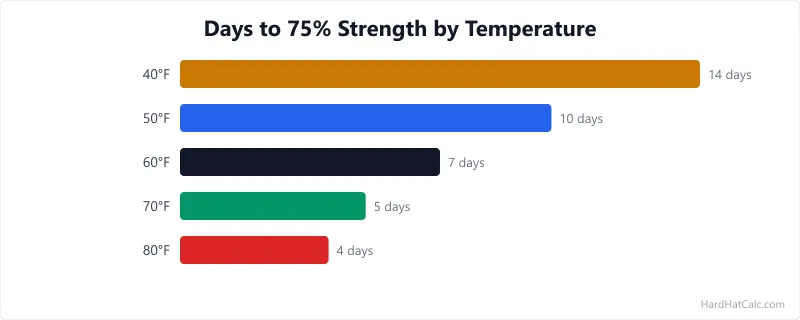
Temperature acts as a throttle. Above 70°F, hydration accelerates modestly. Below 70°F, it slows dramatically. At 40°F, concrete gains strength at roughly half the rate it would at 70°F. Below 32°F, hydration effectively stops, and if the water in the pore structure freezes before the concrete reaches 500 psi, ice crystals permanently disrupt the cement matrix. That damage cannot be repaired.
Moisture matters just as much. Hydration consumes water. If the concrete surface dries out — from wind, sun, or low humidity — the reaction stalls in the outer layer. The interior may continue curing, but the surface develops micro-cracks and chalky, weak material called laitance. This is why curing compounds, wet burlap, and plastic sheeting exist: they keep moisture available at the surface where it evaporates fastest.
NRMCA CIP 27 (Cold Weather Concreting) defines cold weather as a period of more than three consecutive days with an average daily temperature below 40°F and an air temperature not above 50°F for more than half of any 24-hour period. When temperatures drop below 32°F, this calculator flags a freeze risk warning: CIP 27 puts the potential strength of concrete that freezes fresh at a reduction of more than 50%, and it will not be durable. CIP 27 gives the concrete temperature to hold as placed by section size: 55°F for sections under 12 inches, 50°F for 12 to 36 inches, 45°F for 36 to 72 inches (the thinner the section, the warmer the concrete). WSDOT holds its concrete at or above 40°F for the first seven days of the cold-weather protection period and 35°F for the rest of it. Protection methods include insulated blankets, heated enclosures, ground thawing before placement, and using hot mix water (up to 140°F). For concrete in insulated wall assemblies, insulation R-value requirements affect the curing environment by trapping heat inside the form. Calcium chloride accelerator can speed early strength gain but should not exceed 2% by weight of cement (CIP 27), and it increases long-term corrosion risk on embedded steel; use non-chloride accelerators when rebar is present.
Thick pours have an advantage. An 8-inch foundation wall retains heat and moisture better than a 4-inch sidewalk, so the interior cures faster. But thick pours also generate more heat from hydration, which can create thermal cracking if the temperature differential between the interior and surface exceeds about 35°F (CIP 27). For massive pours (footings over 3 feet thick, bridge piers), contractors use special low-heat cement mixes to avoid thermal cracking.
The temperature, humidity and thickness factors this calculator multiplies together, and the 28-divided-by-factor schedule they drive, are not taken from a published model. This is our own estimate; no published source backs these figures. Check your results against your product data or a licensed professional before acting.
Typical Strength Gain by Day
| Age | % of 28-Day Strength (Type I, 70°F) | Basis | Typical Milestone |
|---|---|---|---|
| 1 day | 16% | site planning fraction | Side forms not carrying concrete weight can come off once the strength criterion is met (WSDOT: from 18 hours; NRMCA CIP 27: 1 to 7 days depending on strength gain, conditions and loading) |
| 3 days | 40% | site planning fraction | Packaged high-strength mixes open to vehicle traffic (Sakrete: 72 hours); WSDOT wet-cures ordinary surfaces at least 3 days |
| 4 days | 50% | ACI 306R-16 Table 8.8 (6 days at 50°F) | First cell ACI prints for Type I cement |
| 8 days | 65% | ACI 306R-16 Table 8.8 (11 days at 50°F) | Backfill foundation walls; the ACI 308 seven-day curing period for Type I cement (as restated by FHWA) ends a day earlier |
| 14 days | 90% | site planning figure; ACI prints 85% only at 16 days, so this row runs ahead of the ACI curve | Supported forms, decks and box girders come off at 80% of specified strength (WSDOT minimum times 5 to 21 days) |
| 16 days | 85% | ACI 306R-16 Table 8.8 (21 days at 50°F) | Cold-weather protection period ends at this fraction in many specifications |
| 23 days | 95% | ACI 306R-16 Table 8.8 (29 days at 50°F) | Last cell ACI prints |
| 28 days | 100% | the design strength you enter | Full design strength — testing benchmark |
| 56 days | 104% | site planning figure | Continued slow gain; irrelevant for scheduling |
The ACI rows are Table 8.8 of ACI 306R-16 (Guide to Cold Weather Concreting), read from ACI’s own free excerpt: the days of protection needed to reach a percentage of the standard-cured 28-day strength, for concretes of 3,000 to 5,000 psi without fly ash, Type I cement, at 70°F and at 50°F (Types II and III print 10 and 4 days at 70°F for 65%). The calculator’s 8-day output uses that 65% cell; the 1-day and 3-day fractions, and the 14-day and 56-day rows, are this site’s own planning figures for Type I Portland cement at 70°F with continuous moisture, which ACI does not print. Packaged 5,000-psi mixes print 30/50/70/100% at 1/3/7/28 days on their own data sheets (Quikrete 5000, Sakrete 5000 Plus, TCC Tech-Mix High-Strength 5000), and 4,000-psi packaged mixes print 62.5% at 7 days, so the site fractions sit below those sheets at the early ages; the sheets are declared minima for high-early-strength products, not a measured curve, which is why the lower fractions stay for the ages ACI does not print. At lower temperatures or with inadequate curing moisture, the early milestones drop further and the schedule stretches — which is exactly what this calculator quantifies.
If your project calls for a reinforced concrete element, the steel beam selection tool can help determine whether steel framing might be more practical for your span and loading conditions.
Curing Methods Ranked by Effectiveness
Ponding or continuous sprinkling. Flood the slab surface with a thin layer of standing water. This is the gold standard for flatwork: it keeps the surface saturated and prevents any moisture loss. Practical for horizontal surfaces only, and requires dikes or berms around the slab edge.
Wet burlap or cotton mats. Lay pre-soaked fabric over the surface and keep it wet with periodic spraying. Effective for both horizontal and vertical surfaces. Re-wet at least every 4–6 hours in hot weather; if the burlap dries out, it actually wicks moisture FROM the concrete.
Curing compound (liquid membrane). Spray a chemical sealer over the finished surface. It forms a film that traps moisture inside the concrete. Easiest method and most common on commercial projects. Apply at the recommended rate immediately after the disappearance of the water sheen on the surface after final finishing (NRMCA CIP 11: a delayed application after the surface has dried prevents the film from forming). Not recommended if the surface will receive a bonded topping, coating, or tile — the membrane interferes with adhesion.
Plastic sheeting. Lay polyethylene film directly on the surface. Traps moisture effectively but can cause discolouration (dark splotches) where the plastic touches unevenly. Acceptable for surfaces that will be covered or are not aesthetically critical.
Insulated blankets (cold weather). Insulated tarps that retain both heat and moisture. Essential when temperatures drop below 50°F. They serve double duty: maintaining curing temperature and preventing surface moisture loss. Standard practice for any pour where overnight lows approach freezing.
Cold Weather vs. Hot Weather Concrete: A Different Set of Problems
Cold and hot conditions both threaten concrete quality, but through opposite mechanisms.
Cold weather slows hydration. Below 50°F, strength gain drops noticeably. Below 40°F, it crawls. The danger threshold is 32°F: freezing water in fresh concrete before it reaches 500 psi causes permanent structural damage. NRMCA CIP 27 states that in its fresh state concrete freezes if its temperature falls below about 25°F [-4°C]; this calculator's freeze warning fires at 32°F, ahead of that point. Cold-weather protection includes heated enclosures, insulated blankets, and sometimes hot water in the mix. NRMCA CIP 27 sets the concrete temperature as placed by section size (55°F under 12 inches, 50°F for 12 to 36 inches, 45°F for 36 to 72 inches) and WSDOT holds 40°F for the first seven days of its protection period, then 35°F. The cost adds $0.50–$1.50 per square foot of protected surface (a site estimate).
Hot weather accelerates hydration, which sounds helpful but creates its own problems. Concrete that hydrates too fast can develop thermal cracking from uneven heat buildup. It also sets faster, reducing the finishing window from hours to minutes in extreme heat. Rapid surface evaporation causes plastic shrinkage cracking — those thin, spider-web cracks you see on sidewalks poured in July. ACI 305R (Guide to Hot Weather Concreting) recommends using ice in the mix water, scheduling pours for early morning, and applying evaporation retarders immediately after screeding.
Both conditions require the same fundamental discipline: test the actual strength gain rather than relying on calendar days. If you are planning a load-bearing wall above a freshly poured footing, the footing must reach adequate bearing capacity before framing begins, regardless of how many days have passed on the calendar.
Worked Examples
Example 1
Scenario: A homeowner pours a 4-inch driveway slab with 4,000 psi concrete in mid-summer (average 80°F, 45% humidity).
Calculation: Temperature factor = 1.0 + (80 − 70) × 0.002 = 1.02. Humidity factor = 0.70 + (45/100) × 0.30 = 0.835. Thickness factor = 1.0 (4-inch baseline). Combined factor = 1.02 × 0.835 × 1.0 = 0.852. Strength at 1 day: 4,000 × 0.16 × 0.852 = 545 psi. 3-day: 4,000 × 0.40 × 0.852 = 1,363 psi. 8-day: 4,000 × 0.65 × 0.852 = 2,214 psi (65% is the ACI 306R-16 Table 8.8 cell for Type I cement at 70°F). 28-day: the 4,000 psi design strength, reached on the stretched schedule. Days to full design load: 28 / 0.852 ≈ 33 days.
What this means: Summer heat accelerates the chemical reaction, but low humidity pulls moisture from the surface. The slab reaches walkable strength overnight but needs wet curing (garden hose, curing compound, or plastic sheeting) to stay on schedule. The calculator does not cut the 28-day strength; it stretches the time to reach it, here to about 33 days, because surface moisture loss slows the reaction.
Takeaway: In hot, dry conditions the slab surface dries faster than the interior cures. Mist curing, or a curing compound applied immediately after the disappearance of the water sheen on the surface after final finishing (NRMCA CIP 11), prevents surface cracks that form when the top dries while the bottom is still hydrating.
Example 2
Scenario: A contractor pours an 8-inch foundation wall with 4,000 psi concrete in late October (average 42°F, 65% humidity).
Calculation: Temperature factor = 0.30 + 0.70 × ((42 − 32) / 38)^0.7 = 0.30 + 0.70 × (10/38)^0.7 = 0.30 + 0.70 × 0.393 = 0.575. Humidity factor = 0.70 + (65/100) × 0.30 = 0.895. Thickness factor = 1.0 + (8 − 4) × 0.01 = 1.04. Combined = 0.575 × 0.895 × 1.04 = 0.535. 1-day: 4,000 × 0.16 × 0.535 = 343 psi. 3-day: 4,000 × 0.40 × 0.535 = 856 psi. 8-day: 4,000 × 0.65 × 0.535 = 1,391 psi. 28-day: the 4,000 psi design strength, reached on the stretched schedule. Days to full load: 28 / 0.535 ≈ 52 days.
What this means: Cold-weather concrete gains strength much more slowly. On this schedule the wall needs about 52 days rather than 28 to reach its design strength. If you need to backfill or load the wall early, you will need supplemental heat or insulated blankets to raise the curing temperature.
Takeaway: Never let fresh concrete freeze in the first 24 hours — freezing before reaching 500 psi permanently damages the microstructure. Insulated blankets and heated enclosures are standard cold-weather concrete practice. Budget $0.50–$1.50 per square foot of surface area for winter protection materials (a site estimate).
Frequently Asked Questions
- How soon can I walk on freshly poured concrete?
Packaged concrete makers open their own products to light foot traffic within 10 to 24 hours: Sakrete High-Strength says 24 hours, Sakrete 5000 Plus 12 hours and TCC Tech-Mix High-Strength 5000 10 to 12 hours, none of them conditioned on temperature. Plan on the 24-hour end in cool weather. Published guidance frames walkability by time rather than a tested strength value; this calculator models it with a 500 psi early-strength threshold, which is why its walkable estimate can run past the makers’ hours on a cold pour. Walking on concrete too early can leave footprints or surface damage that are permanent once the concrete hardens. When in doubt, press your thumb firmly into an inconspicuous area — if it leaves a visible impression, the surface is not ready for foot traffic. The concrete mix ratio you use directly affects early strength gain — richer mixes reach early strength faster than lean mixes.
- Does concrete cure faster in hot weather?
Yes, but faster is not always better. This calculator’s temperature factor puts 90°F about 4% ahead of 70°F (1.0 + 20 × 0.002 = 1.04), a deliberately small credit: real hydration runs faster than that in the first days, which is exactly why hot-weather practice guards against fast set and moisture loss rather than counting on the gain. Rapid hydration generates internal heat that can cause thermal cracking, and the fast-setting surface reduces your finishing window dramatically. The bigger risk in hot weather is moisture loss: low humidity and wind pull water from the surface faster than it can hydrate, leading to weak, chalky surfaces and plastic shrinkage cracks. Compensate with early-morning pours, evaporation retarders, and curing compound applied immediately after finishing. If the slab is on grade, knowing the slab weight helps you verify that the subgrade can handle the load while the concrete is still gaining strength.
- What happens if concrete freezes before curing?
Concrete that freezes before reaching approximately 500 psi suffers permanent damage. Water in the pore structure expands as it freezes, disrupting the calcium silicate bonds that give concrete its strength. NRMCA CIP 27 puts the potential strength of concrete frozen in its fresh state at a reduction of more than 50%, and says it will not be durable — damage that cannot be reversed. CIP 27 also gives the concrete temperature to hold as placed by section size (55°F under 12 inches, 50°F for 12 to 36 inches, 45°F for 36 to 72 inches), and WSDOT specifies 40°F for the first seven days of the protection period. Insulated blankets, heated enclosures, and hot mix water are standard precautions for pours when overnight temperatures approach freezing. For walls poured in cold conditions, formwork pressure increases by 60–90% because the concrete stays fluid longer.
- When can I remove concrete formwork?
It depends on strength, not the calendar. WSDOT Standard Specifications 6-02.3(17)N let side forms that do not carry the concrete’s weight (columns, walls, crossbeams, barriers) come off on a 1,400 psi strength criterion with minimum times that start at 18 hours, while supported forms, bridge decks, box girders and arches wait for 80% of the specified strength with minimum times of 5 to 21 days. NRMCA CIP 27 says forms should not be stripped for 1 to 7 days depending on rate of strength gain, ambient conditions and the loading on the structure. ACI 347R provides stripping criteria based on the ratio of actual strength to design strength. In cold weather, extend all formwork times. The safest approach is cylinder break testing: cast test cylinders from the same batch and break them at a testing lab before stripping forms on critical structural elements. Once forms are stripped on a reinforced concrete element, inspect the surface for honeycombing or voids that indicate poor consolidation during the pour.
- Does higher PSI concrete cure faster than lower PSI mixes?
Not inherently. A 5,000 psi mix reaches a higher absolute strength at each milestone, but the percentage gain curve is similar to a 3,000 psi mix — both reach roughly 65% of their design strength at 8 days under identical conditions (ACI 306R-16 Table 8.8, Type I cement at 70°F). The difference is that 65% of 5,000 psi (3,250 psi) is much higher than 65% of 3,000 psi (1,950 psi). So if your scheduling concern is reaching a specific strength threshold (say, 2,500 psi for form stripping), a higher-strength mix reaches that threshold faster simply because its absolute numbers are larger, not because the hydration rate is faster. If a load-bearing wall sits on the footing, the footing must reach adequate bearing capacity before framing begins regardless of mix strength.
More Structural calculators
Browse all structural calculators — Beam sizing, truss pricing, load calculations, wall framing, deck capacity, and foundation tools.