
Concrete Slab Weight Calculator
How heavy is your slab? This concrete slab weight calculator covers normal, lightweight, and reinforced concrete for accurate load and support planning.
Last updated:
Standard residential is 4 inches. Industrial floors may be 6-8 inches.
Leave at 0 to use the selected type (150 or 115 pcf). Enter your mix design's unit weight to override it — structural lightweight runs 110 to 130 pcf depending on the aggregate.
For estimation only. Structural work requires review by a licensed engineer. Local building codes take precedence over any calculator output.
How This Is Calculated
Slab area = length x width. Volume = area x (thickness / 12). Cubic yards = volume / 27. Density: normal-weight = 150 pcf, structural lightweight = 115 pcf, or the custom density you enter (any value above 0 overrides the type). Reinforcement factor = 1.04 for reinforced, 1.0 for unreinforced. Total weight = volume x density x reinforcement factor. Weight per sq ft = (thickness / 12) x density x reinforcement factor.
Source: Concrete unit weights from state and federal bridge design manuals, each under its own design authority: reinforced normal-weight concrete 150 pcf on the Caltrans Bridge Design Practice (Chapter 3), the NCDOT Structure Design Manual, the MnDOT LRFD Bridge Design Manual (Table 3.3.1), FHWA NHI-04-041 and the MoDOT Engineering Policy Guide 751.2 (0.145 kcf + 0.005 for reinforcement); lightweight concrete 115 pcf on the NCDOT Structure Design Manual (unreinforced lightweight 115, reinforced lightweight 120) and PennDOT Design Manual Part 4 (0.115 kcf including a reinforcement allowance). Value correction of 2026-09-02: the lightweight figure was 110 pcf, which only the MoDOT table prints; structural lightweight concrete runs 110 to 130 pcf by aggregate (MoDOT 110, NCDOT and PennDOT 115, NCDOT reinforced 120, Caltrans Falsework Manual 130), so the calculator now uses 115 and lets you type your own mix's unit weight. Attribution correction of 2026-09-02: the previous citation of ACI 318 Section 19.2.4 for these unit weights is withdrawn — that section defines the lightweight modification factor, not unit weights. The 3 to 5 percent reinforcement allowance (the tool applies 4 percent) is this site's typical figure for residential slabs; it sits beside the allowances the bridge manuals print (MoDOT adds 0.005 kcf to 0.145 kcf for reinforced concrete, 3.4 percent; PennDOT's 0.150 and 0.115 kcf include a reinforcement allowance). Attribution correction of 2026-09-02: the previous citation of the CRSI Design Handbook for this allowance is withdrawn — the handbook is sold and was never opened, and no free CRSI page prints a percent-of-weight allowance.
6 min read
50 Pounds per Square Foot Adds Up Fast
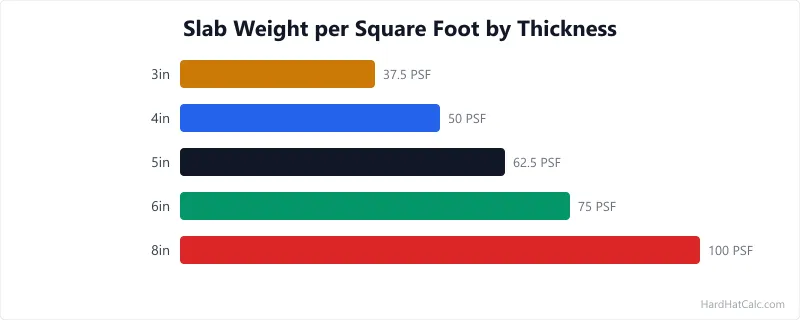
Concrete's density is both its greatest structural asset and its biggest planning constraint. At 150 pounds per cubic foot, a standard 4-inch slab adds 50 pounds to every square foot of floor area it covers, weight that every beam, column, footing, and soil layer beneath must support.
Three scenarios make slab weight a critical calculation. First, slabs on grade transfer their entire weight to the soil. Most residential soils handle a 4-inch slab without issue, but thicker slabs on poor soil can cause differential settlement and cracking. Second, elevated slabs (upper floors in concrete buildings, parking decks, mezzanines) add dead load to the structural frame. An engineer sizes every beam and column based partly on the slab weight above, so getting this number wrong cascades through the entire structural design. Third, concrete placed on existing structures (overlays, toppings, repair layers) adds weight the original design may not have anticipated. A 2-inch overlay sounds thin until you calculate that it adds 25 psf across the entire surface.
The weight calculation itself is straightforward: volume times density. The nuances come from choosing the correct density for your concrete type and accounting for reinforcement steel.
Concrete Density by Type
Not all concrete weighs the same. The aggregate type determines the bulk of the density difference, and your choice of concrete type should match the structural requirements of the application.
| Concrete Type | Density (pcf) | Common Use | Notes |
|---|---|---|---|
| Normal weight | 145–150 | Foundations, slabs, walls | Standard mix with gravel/crushed stone aggregate |
| Lightweight structural | 110–130 | Elevated slabs, toppings | Expanded shale, clay, or slate aggregate; varies by aggregate and mix |
| Lightweight insulating | 30–50 | Roof fills, insulation | Not structural — used for thermal or slope-to-drain |
| Heavyweight | 200+ | Radiation shielding | Barite or magnetite aggregate — specialised applications |
The calculator uses 150 pcf for reinforced normal-weight concrete, the figure the Caltrans, NCDOT, MnDOT, FHWA and MoDOT bridge design manuals all assign, and 115 pcf for structural lightweight, the figure NCDOT (unreinforced lightweight) and PennDOT (with reinforcement allowance) print. Lightweight runs 110 to 130 pcf depending on the aggregate: MoDOT tabulates 110, NCDOT 120 for reinforced lightweight and the Caltrans Falsework Manual 130. If your supplier quotes a unit weight, enter it in the custom density field and the calculator uses that instead of the type default.
Density is set by the mix design itself. The ratio of cement to fine and coarse aggregate, plus the water content, determines where your concrete falls in the 145–150 pcf normal-weight range. How mix proportions change concrete density and strength walks through the cement-sand-gravel ratios that pair with each application.
For slabs that need reinforcement to control cracking, you can check rebar grid spacing based on your slab dimensions and loading.
Normal-Weight vs. Lightweight Concrete
Normal-weight concrete uses standard aggregate (gravel, crushed stone, or sand) and weighs 145 to 150 pcf. It is the default choice for foundations, ground-floor slabs, driveways, and most residential work. The aggregate is cheap, widely available, and produces concrete with excellent compressive strength and durability.
Lightweight structural concrete replaces standard aggregate with expanded shale, clay, or slate. These manufactured aggregates are full of tiny air pockets that reduce density to 110 to 130 pcf, roughly 13 to 27% lighter than normal-weight depending on the aggregate and how much natural sand the mix keeps. The trade-off is cost: lightweight concrete runs 20 to 40% more per cubic yard (based on ready-mix concrete supplier pricing, March 2026) because the aggregate is manufactured rather than quarried.
Use lightweight when the supporting structure has limited load capacity. A parking garage adding a topping slab, a historic building getting a new concrete floor, or a rooftop deck where every pound counts — these are textbook lightweight applications. The weight savings often allow engineers to reduce beam and column sizes, which can offset the higher concrete cost.
Stick with normal-weight when the slab is on grade and soil bearing is adequate. There is no structural benefit to reducing slab weight when the ground is carrying the load, and normal-weight concrete is cheaper, more abrasion-resistant, and easier to source from local batch plants. For driveways and flatwork specifically, the driveway cost estimator breaks down material and labour costs at standard 4,000 PSI normal-weight.
How Slab Weight Affects Foundation Design
A ground-floor slab transfers its weight directly to the soil beneath it. Most residential soils (sand, gravel, and stiff clay) have bearing capacities between 1,500 and 4,000 psf. At 50 psf for a standard 4-inch slab, you are using less than 4% of even a modest clay soil's capacity. In most cases, the slab weight is not the concern — it is the concentrated loads from walls, columns, and equipment sitting on the slab that drive foundation sizing.
Problems arise in three situations. Thick slabs (6 to 8 inches) in industrial or commercial applications push the dead load to 75 to 100 psf, which starts to matter on softer soils. Large continuous pours create substantial total weight — a 40 by 60-foot warehouse slab at 6 inches weighs over 90,000 pounds. And filled or disturbed soil may not have reached its full bearing capacity, leading to settlement even under moderate loads.
For elevated slabs, the calculation is more consequential. Every pound of slab weight is dead load that beams and columns carry continuously for the life of the structure. A 6-inch normal-weight slab at 75 psf is a significant structural load that directly affects beam depth, column size, and footing area. Engineers run these weight calculations early in the design process because they influence every structural member below the slab.
If slab weight is part of a load path through bearing walls to the foundation, you can identify load-bearing walls and the tool accounts for concrete dead loads in its beam sizing.
Three Factors That Push Slab Weight Off-Spec
Several real-world factors affect the final weight of a concrete slab beyond the basic volume-times-density calculation. Understanding these helps you plan more accurately.
Does rebar add much weight? This tool adds 4% for reinforcement, inside the 3 to 5% that typical residential slabs carry (the state bridge manuals the density figures come from add about the same: MoDOT adds 0.005 kcf to 0.145 kcf, 3.4%). A mesh-reinforced garage slab weighs about 52 psf compared to 50 psf unreinforced — a modest increase relative to the structural benefit. Heavy reinforcement in structural elevated slabs (larger bars at closer spacing) can add 5 to 8%, but this is accounted for in the engineer's dead load calculation.
What about wet concrete versus cured? Freshly poured concrete weighs 3 to 5% more than cured concrete because of excess mix water that has not yet evaporated or been consumed by hydration. The 150 pcf figure used in structural calculations represents cured concrete. During construction, temporary shoring for elevated slabs must account for the higher wet weight. If your slab will be below grade, estimate excavation volume before pouring to budget for soil removal and grading.
Does slab thickness vary in practice? Almost always. A slab specified at 4 inches rarely pours at exactly 4 inches everywhere. Subgrade irregularities, form deflection, and screeding tolerances mean the actual thickness varies by 1/4 to 1/2 inch across the pour. For weight estimation, add 5 to 10% to account for over-pour — you will use (and pay for) more concrete than the nominal dimensions suggest. To turn those dimensions into a delivery figure, order the right volume with the built-in waste allowance and bag count.
For walls supporting a concrete slab from below, the concrete block wall cost calculator estimates the foundation wall materials and cost.
Worked Examples
Example 1
Scenario: A homeowner pours a 20 by 24-foot garage slab at 4 inches thick with normal-weight concrete and welded wire mesh reinforcement.
Calculation: Area = 20 × 24 = 480 sq ft. Volume = 480 × (4 / 12) = 160 cu ft = 160 / 27 = 5.93 cu yd. Density = 150 pcf x 1.04 (reinforced) = 156 pcf. Total weight = 160 × 156 = 24,960 lbs (12.5 tons). Weight per sq ft = (4 / 12) × 156 = 52 psf.
What this means: That 4-inch garage slab weighs nearly 25,000 pounds — about the same as five pickup trucks. This weight bears on the soil below, which must have adequate bearing capacity to prevent settlement.
Takeaway: At 52 psf, a standard garage slab creates significant dead load. If you are pouring on filled or disturbed soil, compact it thoroughly or the slab will crack as the fill settles unevenly beneath it.
Example 2
Scenario: An architect specifying a 2-inch lightweight concrete overlay on an existing 10 by 12-foot elevated deck.
Calculation: Area = 10 × 12 = 120 sq ft. Volume = 120 × (2 / 12) = 20 cu ft = 20 / 27 = 0.74 cu yd. Density = 115 pcf x 1.0 (unreinforced) = 115 pcf. Total weight = 20 × 115 = 2,300 lbs. Weight per sq ft = (2 / 12) × 115 = 19.17 psf.
What this means: Even at just 2 inches, the lightweight overlay adds 19.2 psf of dead load to the deck structure. This must be added to the existing dead and live load budget before pouring. If the supplier quotes a heavier lightweight mix (they run 110 to 130 pcf by aggregate), type that figure into the custom density field.
Takeaway: Lightweight concrete at 115 pcf cuts weight by 23% compared to normal-weight for the same thickness, but it is still substantial. Verify the existing structure can handle the additional 2,300 lbs before specifying any concrete overlay on an elevated surface.
Frequently Asked Questions
- How much does a 4-inch concrete slab weigh per square foot?
A 4-inch normal-weight concrete slab weighs approximately 50 pounds per square foot (psf). Add welded wire mesh or rebar and the weight increases to about 52 psf. Lightweight structural concrete at the same thickness weighs roughly 38 psf at 115 pcf, saving about 23% on dead load; a heavier 130 pcf lightweight mix saves only 13%. These weights assume standard cured conditions — freshly poured wet concrete weighs slightly more due to excess water that evaporates during curing. To size the rebar grid for your slab, enter the slab dimensions and bar size for a full material list.
- Does reinforced concrete weigh more than unreinforced?
Yes, but the difference is smaller than most people expect. Steel reinforcement (rebar or welded wire mesh) typically adds 3 to 5% to the slab weight. A 4-inch slab with standard #4 rebar at 12-inch spacing weighs about 52 psf versus 50 psf unreinforced. The weight increase is minimal relative to the structural benefit — reinforcement controls cracking and improves the slab's ability to span over voids or resist bending loads. Getting the correct mix proportions also matters, since a richer mix is denser than a lean fill mix.
- Why does concrete weight matter for structural planning?
Every pound of concrete is a permanent dead load on the structure below. Engineers size beams, columns, footings, and soil support based on total load, which includes the concrete's self-weight plus live loads (people, vehicles, equipment). Underestimating concrete weight leads to undersized structural members, excessive deflection, or settlement. For slabs on grade, the soil must bear the weight without settling unevenly. For elevated slabs, the supporting frame must handle the dead load continuously for the life of the structure. When the slab bears on walls, run a load-bearing check to factor concrete dead loads into the beam sizing.
- How do I calculate the weight of a concrete slab with a slope?
For a sloped slab (like a garage floor with drainage slope or a driveway), calculate the average thickness. Measure the thickness at the thin edge and thick edge, add them together, and divide by two. Use the average in your weight calculation. A garage slab that is 4 inches at the drain and 5 inches at the walls has an average of 4.5 inches. At 150 pcf, that works out to 56.25 psf — 12% heavier than a uniform 4-inch slab. If the slope requires grading, the grading-volume tool helps estimate how much soil to cut or fill before forming the slab.
More Structural calculators
Browse all structural calculators — Beam sizing, truss pricing, load calculations, wall framing, deck capacity, and foundation tools.