
Concrete Driveway Cost Calculator
Use this concrete driveway cost calculator to estimate material and labour costs. Enter size, thickness, finish type, and reinforcement for a full budget.
Last updated:
Methodology reviewed by Doc. dr. sc. Mladenka Juradin, dipl. ing. građ., PhD, Civil Engineering (FCEAG, University of Split)
Total length from street to garage or turnaround.
Single car: 10-12 ft. Two cars side-by-side: 18-24 ft.
Standard cars: 4 in. Trucks/RVs: 5-6 in. Heavy commercial: 6-8 in.
Broom is standard. Stamped and exposed aggregate add $2-$6/sq ft.
Mesh for standard driveways. Rebar for heavy loads or expansive soils.
How This Is Calculated
Area = length × width. Volume = area × (thickness / 12) / 27 × 1.10 (10% waste). Concrete cost = volume × $160/cu yd. Subbase = area × $0.75/sq ft. Reinforcement = area × rate (none $0.15, mesh $0.50, rebar $1.25). Finish premium = area × rate (broom $0, exposed $2.50, stamped $4.00). Labour = area × $4.50/sq ft (professional). Total = sum of all components.
Source: Concrete volume = length × width × thickness. Ready-mix pricing anchored to NRMCA (National Ready Mixed Concrete Association) industry data: the association-hosted Performance Benchmarking deck (October 2024) states an average 2023 selling price of $160 per cubic yard, the figure this calculator uses. Source-set correction of 2026-08-22: the former co-attribution to RS Means Heavy Construction Cost Data 2026 is withdrawn (the 2026 RS Means catalog carries no product by that name and the data is subscription-only, never opened), and the newer NRMCA survey years are members-only, so the $155-$165 band around the anchor ships unverified beyond the 2023 average. Finish cost multipliers from ACI 302.1R (Guide to Concrete Floor and Slab Construction). Reinforcement pricing from CRSI (Concrete Reinforcing Steel Institute) market reports.
7 min read
Why Driveway Quotes Vary by Thousands of Dollars
Two contractors quoting the same 480 sq ft driveway can land at $3,500 and $7,000 without either one being dishonest. The difference is almost always below the surface — literally. A driveway poured on compacted gravel over undisturbed soil needs minimal prep. A driveway replacing an old cracked slab on expansive clay soil needs demolition ($1-$3/sq ft), grading, and possibly a thicker subbase with geotextile fabric. The concrete itself is the same price in both scenarios.
This calculator separates the five cost layers — concrete, subbase, reinforcement, finish, and labour — so you can see which component drives your specific project. For most standard residential driveways, concrete and labour split the budget roughly 60/40 when you include subbase and reinforcement with materials. The finish type is the optional variable: a broom finish adds nothing to a standard pour, while stamped patterns can add $2,000+ to the same driveway.
Thickness matters more than most homeowners expect. A 4-inch slab handles passenger cars and light trucks (up to about 8,000 lbs gross vehicle weight). If you park an RV, a loaded work truck, or a boat trailer on the driveway, 5-6 inches prevents the stress cracking that sends hairline fractures across thin slabs within a few years. Use the concrete slab weight tool to check the dead load your subgrade needs to support at your chosen thickness.
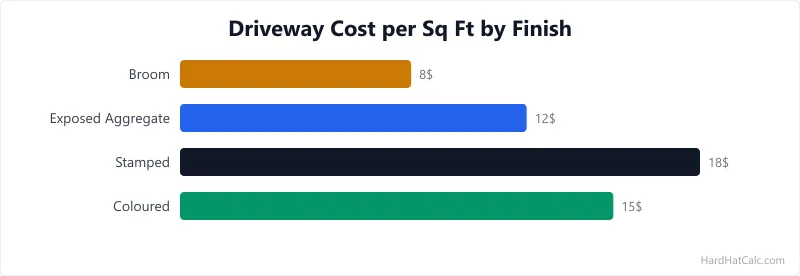
Broom Finish vs Exposed Aggregate vs Stamped Concrete
The three standard driveway finishes serve different budgets and aesthetic goals. All three use the same concrete — the difference is what happens in the 30-60 minutes between pouring and initial set.
Broom finish is the standard for residential driveways. After the concrete is screeded and floated smooth, a stiff-bristled broom is dragged across the surface to create parallel texture lines. This provides traction in rain and snow, costs nothing beyond the base pour, and is the finish most building departments expect when they say "standard concrete driveway." Every municipal sidewalk and most garage floors use broom finish.
Exposed aggregate reveals the stone within the concrete by washing away the surface paste after partial curing. The result is a pebbly, textured surface that provides excellent traction and hides minor stains. The premium ($2-$3/sq ft) covers a surface retarder chemical, pressure washing, and sealing. Exposed aggregate works well in climates with freeze-thaw cycles because the texture prevents the ponding that accelerates surface scaling.
Stamped concrete uses rubber stamps pressed into fresh concrete to replicate the look of brick, slate, flagstone, or tile. After stamping, integral colour or surface-applied stain provides realistic shading. The premium ($3-$6/sq ft) reflects the skilled labour required — stamping is time-sensitive and mistakes cannot be corrected once the concrete begins setting. Stamped driveways need resealing every 2-3 years to maintain colour and protect the stamp pattern from UV and deicing salt damage. For the concrete itself, make sure the mix proportions target 4,000 PSI — stamped surfaces crack more visibly than broom finish if the mix is under-strength. For homeowners deciding between stamped concrete and real brick paving, estimating the actual brick count and cost provides the comparison baseline.
Cost Breakdown by Component
Every driveway project stacks the same five cost layers. The table below shows typical ranges for each component at March 2026 US national averages. Your local prices vary by region, season, and concrete demand — spring and autumn are peak pouring seasons with higher labour rates in many markets.
| Component | Cost Range | Notes |
|---|---|---|
| Concrete (4,000 PSI ready-mix) | $155–$170 per cu yd | Delivery fee often included within 10-20 miles of batch plant |
| Subbase (4 in compacted gravel) | $0.65–$0.85 per sq ft | Includes delivery, spreading, and compaction |
| Wire mesh (6×6 W1.4) | $0.40–$0.60 per sq ft | Positioned mid-slab on chairs during pour |
| Rebar grid (#4 @ 18 in o.c.) | $1.00–$1.50 per sq ft | Cut, tied, and chaired on-site; better crack control |
| Forming and finishing labour | $4.00–$5.00 per sq ft | Includes form setting, pouring, screeding, finishing, curing |
| Exposed aggregate premium | $2.00–$3.00 per sq ft | Surface retarder + pressure wash + sealer |
| Stamped finish premium | $3.00–$6.00 per sq ft | Stamps, colour, release agent, sealer, skilled labour |
| Demolition (if replacing old slab) | $1.00–$3.00 per sq ft | Sawcutting, breaking, hauling — not included in calculator |
For driveways over 800 sq ft, most contractors offer volume discounts on labour because the forming-to-pouring ratio improves. A 1,200 sq ft driveway does not cost 2.5 times a 480 sq ft driveway — the forming perimeter grows slower than the area. If your project involves major excavation work, get that quoted separately before the concrete crew arrives.
Planning and Pouring a Concrete Driveway
A well-planned driveway pour avoids the two most expensive problems: a cracked slab from poor subbase prep and a surface that scales from improper finishing or curing.
Check local codes and permits. Most jurisdictions require a permit for new driveways or driveway replacements. Common requirements: minimum setback from property lines (typically 3-5 ft), maximum driveway width at the street (often 24 ft), and an approved curb cut. Some HOAs restrict stamped patterns or exposed aggregate colours. Pull the permit before ordering concrete.
Prepare the subbase. Remove topsoil and organic material to reach firm, undisturbed soil. Spread 4-6 inches of compacted gravel (crushed limestone or recycled concrete aggregate) as the subbase — estimate your gravel tonnage and cost based on the driveway area and subbase depth. Compact in 2-inch lifts with a plate compactor. The subbase distributes the load, provides drainage beneath the slab, and prevents the slab from settling into soft soil. On expansive clay soils, a 6-inch subbase with geotextile fabric separation prevents clay heave from cracking the slab.
Set forms and reinforcement. Use 2×4 or 2×6 lumber for edge forms, staked every 3-4 feet and braced plumb. Set forms to maintain a 1-2% slope away from the garage for drainage (1/4 inch per foot). Place wire mesh or rebar on chairs at mid-depth. Plan control joints every 8-12 feet in both directions — concrete cracks, and joints tell it where.
Pour and finish. Order 4,000 PSI concrete (standard driveway strength). Start at the far end and work toward the truck. Screed to form height, bull-float to close the surface, then apply the chosen finish. For broom finish, wait until bleed water disappears before brooming. For stamped, timing is critical — stamp when the concrete holds a thumbprint without sticking.
Cure for at least 7 days. Apply curing compound or cover with plastic sheeting immediately after finishing. Concrete gains most of its strength in the first week — driving on it before 7 days risks surface damage and reduces long-term durability. The concrete curing time tool adjusts cure schedules for your local temperature and humidity. Keep vehicles off for a full 28 days if temperatures are below 50°F during the cure period.
Thin Slabs, Skipped Subbase, and Deicing Salt Damage
Pouring 3-inch thickness to save money is the most common driveway failure. A 3-inch slab has roughly half the load capacity of a 4-inch slab (bending strength scales with the square of thickness). A standard sedan weighing 3,500 lbs concentrates that load on four tire patches of roughly 30 square inches each. A 3-inch slab on anything other than perfect subgrade cracks within 1-3 years under normal vehicle loading. The extra inch of concrete costs about $0.50/sq ft — a fraction of the $8-$15/sq ft cost of tearing out and replacing a failed driveway.
Pouring directly on soil without a gravel subbase invites differential settlement. Soil compresses unevenly under load — one section settles 1/4 inch while the adjacent section stays firm, and the slab cracks at the transition. A 4-inch gravel subbase bridges soft spots and distributes point loads over a wider area. It also provides a drainage layer that prevents water from pooling beneath the slab, which is the primary cause of frost heave damage in cold climates.
Using deicing salt on new concrete causes surface scaling — the top layer flakes off in thin sheets, exposing aggregate and creating a rough, pitted surface. New concrete is especially vulnerable in its first winter because it has not yet reached full carbonation depth. Wait at least one full winter before applying salt-based deicers. Use sand for traction instead. After the first year, apply a penetrating silane/siloxane sealer before each winter to protect against salt and freeze-thaw cycling.
Skipping control joints lets the slab decide where to crack — and it always picks the worst spot. Concrete shrinks as it cures, generating tensile stress that exceeds its tensile strength. Control joints are saw-cut or tooled grooves (1/4 of slab depth) that create a weak plane where cracks form invisibly inside the joint. Space them every 8-12 feet in both directions, and always cut a joint where the driveway meets the garage floor or sidewalk.
Worked Examples
Example 1
Scenario: A homeowner in the Midwest needs a standard 2-car driveway measuring 24 feet long by 20 feet wide. They choose 4-inch thickness, broom finish, wire mesh reinforcement, and hire a contractor.
Calculation: Area = 24 × 20 = 480 sq ft. Volume = 480 × (4/12) = 160 cu ft = 5.93 cu yd. Add 10% waste = 6.52 cu yd. Concrete cost = 6.52 × $160 = $1,043. Subbase (4 in gravel) = 480 × $0.75 = $360. Mesh reinforcement = 480 × $0.50 = $240. Broom finish = $0 extra. Labour = 480 × $4.50 = $2,160. Total = $1,043 + $360 + $240 + $0 + $2,160 = $3,803.
What this means: A standard 2-car driveway runs about $3,803 with professional installation — roughly $7.92 per square foot all-in. Material costs account for about 43% of the total, with labour making up the rest. This is typical for a straightforward pour on prepared ground with no demolition or grading complications.
Takeaway: At $7-$9 per square foot installed, a broom-finish concrete driveway is the benchmark against which other surfaces (asphalt, pavers, gravel) compare. The DIY version of this same project would cost about $1,643 in materials — a 57% savings if you have the skills and equipment to pour and finish 6.5 cubic yards of concrete.
Example 2
Scenario: A homeowner wants a decorative stamped concrete driveway for their front entrance: 30 feet long, 16 feet wide, 4-inch thick, with rebar reinforcement and a professional crew.
Calculation: Area = 30 × 16 = 480 sq ft. Volume = 480 × (4/12) = 160 cu ft = 5.93 cu yd. Add 10% waste = 6.52 cu yd. Concrete cost = 6.52 × $160 = $1,043. Subbase = 480 × $0.75 = $360. Rebar reinforcement = 480 × $1.25 = $600. Stamped finish premium = 480 × $4.00 = $1,920. Labour = 480 × $4.50 = $2,160. Total = $1,043 + $360 + $600 + $1,920 + $2,160 = $6,083.
What this means: The stamped finish adds $1,920 to what would otherwise be a $4,163 broom-finish project with the same rebar — a 46% premium. At $12.67 per square foot, stamped concrete still costs less than natural stone or brick pavers for the same area, while mimicking their appearance.
Takeaway: Stamped concrete is the mid-range decorative option: significantly cheaper than pavers ($15-$25/sq ft installed) but more expensive than broom finish. The finish premium is pure labour — the concrete itself costs the same. If budget is tight, pour broom-finish now and apply a decorative overlay later.
Frequently Asked Questions
- How much does a concrete driveway cost per square foot?
A standard broom-finish concrete driveway costs $6-$10 per square foot installed in March 2026, depending on thickness, reinforcement, and regional labour rates. Materials alone (concrete, gravel subbase, wire mesh) run $3-$5 per square foot without labour. Stamped or exposed aggregate finishes push the installed price to $10-$16 per square foot. These ranges reflect US national averages — urban areas with higher labour costs and regions with seasonal demand peaks can exceed $12 per square foot for standard broom finish. Get the concrete volume right first, then compare contractor bids on the labour and finish components.
- How thick should a residential concrete driveway be?
Four inches is the standard minimum for passenger vehicles weighing up to about 8,000 lbs gross vehicle weight. This covers sedans, SUVs, and half-ton pickup trucks. For heavier vehicles — loaded 3/4-ton trucks, RVs, boat trailers, or delivery trucks that idle in one spot — increase to 5 or 6 inches. The thickness increase costs relatively little ($0.50-$1.00 per square foot) but roughly doubles the load capacity because bending strength scales with the square of slab thickness. The concrete reinforcement tool helps you size rebar spacing for the thicker slab if you upgrade beyond mesh.
- Is a concrete driveway cheaper than asphalt or pavers?
Concrete falls in the middle on upfront cost but wins on lifecycle cost. Asphalt driveways cost $3-$7 per square foot installed (cheaper upfront) but require seal coating every 2-4 years ($0.50-$1.00/sq ft each time) and typically last 15-20 years before needing full replacement. Concrete driveways cost $6-$10 per square foot installed but last 25-40 years with minimal maintenance. Brick or stone pavers cost $10-$25 per square foot installed and last 25+ years but require periodic joint sand replacement and weed control. Over a 30-year period, concrete typically has the lowest total cost of ownership for any hard-surface driveway.
- Can I pour a concrete driveway myself to save money?
DIY is feasible for small pads (under 200 sq ft) but risky for full driveways. The challenge is speed: a ready-mix truck delivers 8-10 cubic yards in minutes, and that concrete begins setting immediately. A two-car driveway needs 6-7 cubic yards placed, screeded, floated, and finished within 60-90 minutes (faster in hot weather). Professional crews use 3-5 workers to hit that window. A solo DIYer or two-person team can handle a 100-200 sq ft pad poured from bagged premix over several smaller batches, but a full driveway pour from a ready-mix truck requires experienced help. The material savings (calculate your concrete cost for bagged vs ready-mix) are significant (typically 50-60%), but a botched pour means tearing out and starting over. The aggregate side of the order matters too: size construction sand quantities for the bedding layer beneath the slab.
- How long before I can drive on a new concrete driveway?
Wait a minimum of 7 days for passenger cars and 28 days for heavy vehicles. Concrete reaches roughly 70% of its design strength at 7 days and 99% at 28 days under normal curing conditions (60-80°F, moist-cured). In cold weather below 50°F, these timelines extend significantly — the curing schedule tool adjusts for your local temperature. Never drive on concrete that still shows dark, damp patches — that indicates incomplete hydration. Premature loading causes surface micro-cracking that accelerates spalling and scaling, especially when combined with deicing salt exposure in the first winter.
More Materials calculators
Browse all materials calculators — Paint coverage, roofing bundles, tile adhesive, welding time, parking lot sizing, and more.