
Sand Calculator
Sand calculator for play, masonry, construction, and fill sand. Enter length, width, and depth to estimate cubic yards, tons, bags, and material cost.
Last updated:
Length of the area to fill or cover with sand.
Width of the area. For irregular shapes, use the average width.
Sand layer thickness. Sandbox: 8-12 in. Paver base: 1 in over compacted gravel. Concrete subbase: 2-4 in. Drainage fill: 6-12 in.
Sand class drives both density and price. Play sand is kiln-dried and bagged; fill sand is the cheapest bulk option.
Bulk delivery typically costs $50-$150 flat rate within 20 miles of the supplier.
How This Is Calculated
Volume = length × width × (depth ÷ 12) ÷ 27 × 1.10 (10% overage). Tons = volume × density (1.35 play, 1.40 masonry/fill, 1.45 construction, tons/cu yd). Bags = volume in cu ft × 1.10 ÷ 0.5 cu ft per 50 lb bag (shown only under 2 cu yd). Cost = tons × price per ton (regional range by type). Delivery = $50-$150 flat rate if selected.
Source: Volume geometry from standard rectangular prism calculation (length × width × depth). Dry loose densities of 1.35 to 1.45 tons per cubic yard by sand class are this site's defaults, typical trade practice; the previous attribution to the US Geological Survey (USGS) Mineral Commodity Summaries is withdrawn as of 2026-09-02 because that publication reports production and price, not per-class bulk densities, and no supplier specification was opened. None of the four class densities moved on 2026-09-02: North Bay Materials' material-density chart groups sand with gravel, DG, rock and river cobble in one class at 2,500-2,900 lb per cu yd (1.25-1.45 tons), which brackets every shipped figure. A Wisconsin DOT research report (0092-22-05) measured lower loose dry unit weights, 83-87 pcf (about 1.12-1.17 tons per cubic yard), for subbase and backfill materials in a laboratory unit-box test; that figure describes a narrower lab sample of backfill aggregate rather than the four trade classes this page models, so it is noted here rather than treated as a producer range. The play-sand bag yield (0.5 cu ft per 50-lb bag) matches the Sakrete Natural Play Sand data sheet's own printed yield for its product. Masonry sand grading reference: ASTM C144, Standard Specification for Aggregate for Masonry Mortar. Source-set correction of 2026-08-22: the cost-range attribution to RS Means Site Work & Landscape Cost Data 2026 and aggregate supplier surveys is withdrawn (no such 2026 product; subscription-only, never opened; no survey recorded). The free channels price at the plant gate or bid, not the delivered ranges this page ships (sweep record: audits/sourcing-1-retrieval/rsmeans/). The cost ranges are unchanged and ship unverified.
8 min read
Picking the Right Sand: Play, Masonry, Construction, or Fill
The Sand Calculator asks for the sand class up front because price, density, and end-use suitability all swing on it. A 5-ton load of fill sand and a 5-ton load of kiln-dried play sand cover the same area at the same depth, but cost two to four times different and behave nothing alike under foot traffic, mortar mixers, or paver edging.
Play sand is washed, kiln-dried, and graded fine and uniform. The drying step pushes the price up: most bulk suppliers charge $25-$40 per ton compared to $10-$20 for unwashed fill, and the bagged retail product runs even higher, around $5-$7 per 50-lb bag. Play sand is the right pick for sandboxes, volleyball courts, indoor sand-art areas, and anywhere the sand needs to be dust-free and skin-safe. It is wrong for mortar (too fine, no sharp edges to bind) and wasteful under pavers (the price premium buys nothing structural). For backyard play areas where soft footing matters more than a sand-art surface, rubber or hardwood mulch over a play structure is the more common alternative: the mulch volume and refresh-cycle estimator sizes that order against the same footprint you would otherwise fill with play sand.
Masonry sand is washed and graded to a tight specification (ASTM C144 in the US, BS EN 13139 in the UK) so it produces consistent mortar workability. The grading runs slightly coarser than play sand and the particles are angular rather than rounded — that angular shape is what gives mortar its bond strength. At $20-$35 per ton bulk, it is the right pick for brick and block mortar mixes and for paver bedding sand under tight-jointed pavers. Use it whenever a mortar mix calls for "sand" without further qualification.
Construction sand (sometimes called concrete sand or sharp sand) is the coarsest and densest of the four classes — particles up to about 4 mm across, with crushed-rock fines mixed in. The density runs roughly 1.45 tons per cubic yard, slightly heavier than masonry sand. It is the standard fine aggregate for poured concrete mixes, where the angular faces lock into the cement paste and produce stronger compressive strength than smoother sand would. The "2" in a 1:2:3 ratio is the construction-sand share — how sand fits into concrete and mortar mixes walks through why the sand share changes when you move from a footing mix to a slab mix to a post-setting mix. At $15-$30 per ton it is also one of the cheaper bulk options, which makes it a popular substitute for fill sand on jobs that need a bit more compaction strength.
Fill sand is the cheapest bulk class — $10-$20 per ton — and the most variable in moisture content, fines, and grading. It is unwashed, often dredged or pit-run, and may carry organic matter, clay, or stones up to 1/4 inch. Fill sand is the right pick for non-structural backfill: filling around buried pipes, levelling a yard before topsoil, or backfilling a deep utility trench. It is wrong for mortar (organics weaken the bond), wrong for paver bedding (clay fines hold water and freeze-heave), and wrong for sandboxes (dirt content and unknown source).
Sand Densities, Bag Counts, and Coverage at a Glance
Sand is sold by weight (tons or pounds) when bulk and by volume (cubic feet or 50-lb bags) when retail. The reference table below converts between the two for the four sand classes this calculator supports, at the standard 1.10 overage factor built into bulk orders.
| Sand Type | Density (tons/cu yd) | 50-lb Bags per cu yd | Coverage at 1 in (sq ft per ton) | Coverage at 4 in (sq ft per ton) |
|---|---|---|---|---|
| Play (washed, kiln-dried) | 1.35 | ~54 | 220 | 55 |
| Masonry (washed, ASTM C144) | 1.40 | ~54 | 215 | 54 |
| Construction (coarse, sharp) | 1.45 | ~54 | 207 | 52 |
| Fill (unwashed, all-purpose) | 1.40 | ~54 | 215 | 54 |
The bag count is the same across all four because a 50-lb bag of any sand holds roughly 0.5 cu ft regardless of grading — the bag size is fixed, and the small density variations within a single class fall inside packaging tolerance. That means a cubic yard of any sand is roughly 54 retail bags, give or take 5%. Coverage drops in proportion to depth — doubling the depth halves the area one ton can cover.
No single supplier publishes a per-class sand density, so this table's figures sit inside the closest published reference range rather than matching one producer exactly. North Bay Materials' material-density chart groups sand with gravel, DG, rock, and river cobble in one combined class at 1.25-1.45 tons per cubic yard, which brackets every class shown above. The play-sand bag yield (0.5 cu ft per 50-lb bag) does match a named product directly: the Sakrete Natural Play Sand data sheet prints the same 6 sq ft x 1 in coverage per 50-lb bag.
Most homeowners over-order at bag-buying scale because they forget that a 50-lb bag covers only 0.5 cu ft. A 4×4 ft sandbox at 6 inches deep needs 8 cu ft, or 16 retail bags — easy to under-order if you eyeball the bags rather than measure.
The 10% overage built into the calculator covers two losses that almost always show up: spillage during transfer from the truck or wheelbarrow into the trench or sandbox, and settling once the sand is in place and gets walked on or rained on. For dry pickup orders where you load and unload the bags yourself, 5% overage is usually enough; for wet bulk drops that spread on uneven ground, 12-15% is realistic on the largest jobs.
Measuring, Ordering, and Spreading Sand
Translating measurements into a clean material order takes five steps. Skipping any of them tends to produce either a half-load short delivery (most common) or a quarter-yard pile of leftover sand sitting on the lawn.
Measure length and width to the inside of the contained area. For a sandbox, that is inside the timber frame. For a paver patio, inside the perimeter restraint. For a drainage trench, the trench width at the bottom — not the surface width, which is wider on a sloped trench wall. Use a tape measure rather than a rangefinder; rangefinders introduce a 0.5-1% error at construction distances.
Set the depth with the application in mind. A play sandbox uses 8-12 inches so kids can dig without hitting the bottom. Paver bedding sand sits at exactly 1 inch over the compacted gravel base — thicker bedding lets pavers tilt and rock under load. Concrete subbase sand runs 2-4 inches under the slab to break capillary moisture and bring the form to grade. Drainage fill sand fills 6-12 inches around the perforated drain pipe.
Choose the sand class before pricing. Use the comparison section above. Pricing a project around fill sand and then upgrading to masonry sand mid-job typically doubles the per-ton cost — call the supplier with the right class identified, and confirm they can deliver that class from their stock (some yards carry only one or two of the four classes).
Order bulk above 2 cubic yards, retail below. The crossover point sits where the supplier delivery fee ($50-$150) absorbs the per-ton savings. A 1-yard order at $30/ton bulk is $40 of sand against a $100 delivery fee, while 12 retail bags from a home centre cover the same volume at $60-$84 — bags win by a wide margin on small jobs. Above 2 cu yd, bulk takes over and stays cheaper through the largest residential orders.
Spread in 2-inch lifts and screed level. Sand poured in a single deep lift compacts unevenly — the bottom is denser than the top, and the surface settles weeks later as the lower layer adjusts. Spread 2 inches at a time, walk it, water it lightly to settle the fines, and screed flat with a 2×4 dragged across guide rails before adding the next lift. This is especially important for paver bedding, where a 1/4-inch high spot becomes a paver tilt that will not screw flat regardless of how the next paver is laid. The same care matters when staging sand under a poured concrete slab — bring the sand to grade before the forms go in, not after.
Common Mistakes That Push Sand Orders Off Budget
Three mistakes account for almost every sand order that misses on price or quantity, and each is preventable with a five-minute call to the supplier before you place the order.
The first is substituting fill sand for masonry sand to save money. Fill sand carries organic matter, clay, and inconsistent grading — none of which matter when you are filling a utility trench, all of which matter inside a mortar mix or under tight-jointed pavers. Mortar mixed with fill sand cures weaker, sets slower, and develops surface efflorescence as the buried clay fines wick to the surface during the first wet-dry cycle. Paver bedding made of fill sand pumps water in heavy rain and spits up the joint sand within months. The $5-$15 per ton you save against masonry sand evaporates the first time the wall or patio needs repair — and the repair cost is structural, not just cosmetic.
The second is forgetting that polymeric sand is sold by the bag, not the cubic yard. Polymeric sand goes between the joints of an installed paver patio, not under the pavers as a bedding layer. It bonds with water activation and holds the joints against weeds and ant tunnels. A 50-lb bag covers 75-100 sq ft of standard 4×8 paver joints — radically different coverage from bulk bedding sand at the same weight. The calculator on this page sizes the bedding layer; for the joint-sand line item, plan separately at one bag per 75-100 sq ft of paver area depending on joint width. Mixing the two in a single order to a bulk supplier is a common point of confusion since suppliers often stock both products under the "sand" category.
The third is ordering wet bulk sand without checking moisture. Bulk sand sold from an outdoor stockpile after a rainy week can carry 5-10% extra weight in water — and you pay by the ton, including the water. A 5-ton order at 10% moisture is really 4.5 tons of dry sand and 0.5 tons of water, and the dry coverage drops accordingly. Reputable suppliers cover stockpiles with tarps and offer dry delivery from a covered shed for an extra $10-$20 per ton; on small orders that is rarely worth it, but on jobs over 5 tons it pays for itself. Always ask the supplier whether the stockpile was covered and when it was last replenished — fresh stockpile sand is consistently drier than aged outdoor stock.
A fourth mistake worth flagging on long projects is using construction sand under pavers when masonry sand is specified. The two look almost identical to a non-specialist eye, but construction sand is too coarse for tight-jointed paver bedding — the larger particles create high spots that lift individual pavers and make the surface uneven within a few months. The calculator treats them as different classes for a reason. If your supplier ships construction when you ordered masonry, send it back rather than using it as a substitute. The same care applies inside a poured concrete footing where the spec demands construction sand, not masonry — the angular grading and density both matter for compressive strength.
Worked Examples
Example 1
Scenario: A homeowner is filling a 10-foot by 10-foot timber-framed sandbox to a 12-inch depth using kiln-dried play sand from a bulk supplier (no retail bags), with self-pickup.
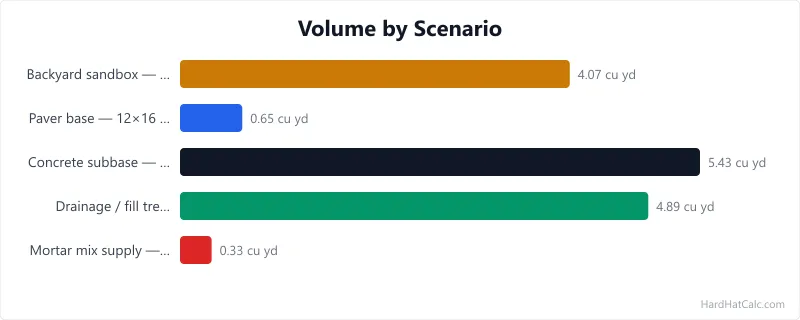
Calculation: Area = 10 × 10 = 100 sq ft. Depth in feet = 12 ÷ 12 = 1 ft. Volume = 100 × 1 = 100 cu ft = 3.70 cu yd. With 10% overage = 4.07 cu yd. Tons = 4.07 × 1.35 = 5.49 tons. Material cost = 5.49 × $25-$40 = $137-$220. Delivery = $0 (pickup). Total = $137-$220.
What this means: A standard 10×10 ft sandbox with 12 inches of play sand needs about **4 cubic yards** (5.5 tons) of bulk sand at **$137-$220** for the material. That works out to around $1.40-$2.20 per square foot of sandbox face area. Buying the same volume in 50-lb retail bags would run roughly 220 bags at $5-$7 each — about $1,100-$1,540, or 5-7× the bulk price. Bulk only stops winning when the volume drops below the 2 cubic yard threshold and delivery fees eat the savings.
Takeaway: For sandboxes over 2 cubic yards, always order bulk play sand and pick it up or take delivery from a local landscape supplier. The kiln-dried bagged retail product matters only when the sand will sit indoors or against direct skin contact with toddlers — which most outdoor sandboxes do not require.
Example 2
Scenario: A DIY paver-patio installer needs a 1-inch bedding layer of washed masonry sand under 12×16 ft of concrete pavers, ordered with bulk delivery from a regional supplier.
Calculation: Area = 12 × 16 = 192 sq ft. Depth in feet = 1 ÷ 12 = 0.0833 ft. Volume = 192 × 0.0833 = 16.0 cu ft = 0.59 cu yd. With 10% overage = 0.65 cu yd. Tons = 0.65 × 1.40 = 0.91 tons. Bags option = ⌈16.0 × 1.10 ÷ 0.5⌉ = 36 bags. Material cost = 0.91 × $20-$35 = $18-$32. Delivery = $100. Total = $118-$132.
What this means: A 12×16 ft paver patio needs only **0.65 cubic yards** (~0.9 tons) of masonry bedding sand because the 1-inch layer is so thin. The bulk-delivery total of $118-$132 is dominated by the **$100 flat delivery fee** — the sand itself is only $18-$32. At this volume, retail-bagged sand often beats bulk: 36 bags at $5-$7 each = $180-$252, but no delivery fee and faster pickup. The cross-over point is around 2 cubic yards, where bulk material cost rises enough to absorb the delivery fee.
Takeaway: For paver bedding on patios under 200 sq ft, retail-bagged masonry sand is usually the cheaper option and easier to handle than a 1-yard bulk drop. Above 200 sq ft, bulk takes over. Either way, the bedding sand sits over a properly compacted **gravel base** — never directly on bare soil ([gravel base depth and weight tool](/calculators/materials/gravel-calculator)).
Frequently Asked Questions
- How many cubic yards of sand do I need for my project?
Multiply length × width (in feet) × depth (in feet — divide inches by 12) and divide by 27 to convert cubic feet to cubic yards. A 10×10 ft area at 4 inches deep needs about 1.4 cubic yards (100 × 0.333 ÷ 27 = 1.23, rounded up with 10% overage). The calculator handles this conversion automatically, including the 10% overage factor for spillage and settling. For irregular shapes, break the area into rectangles, calculate each, and sum the totals. Order in cubic yards if your supplier sells by volume, or in tons if they sell by weight — the aggregate volume tool covers the related case of how much earth comes out before the sand goes in.
- What is the difference between play sand, masonry sand, and construction sand?
Play sand is washed and kiln-dried for retail bagging at $25-$40/ton bulk. The drying step removes dust and pathogens, making it the right pick for sandboxes and indoor uses but overpriced for structural work. Masonry sand is washed and graded to ASTM C144 at $20-$35/ton — angular particles bond well in mortar and lock together under paver edging. Construction sand is the coarsest and densest at $15-$30/ton — sharp particles up to 4 mm across, used as the fine aggregate in poured concrete mixes. The three look similar but behave differently in mortar, under pavers, and in concrete; substituting one for another almost always costs more in repairs than the per-ton savings. The mortar bag and mix tool covers the related question of how much mortar to mix once the sand class is locked in.
- How many 50-lb bags of sand are in a cubic yard?
A cubic yard of sand is about 54 fifty-pound bags, regardless of sand class. Each 50-lb bag holds roughly 0.5 cu ft of sand, and a cubic yard contains 27 cu ft — so 27 ÷ 0.5 = 54 bags. The number varies by ±5% depending on packing density and moisture, but 54 is the working figure most suppliers quote. Bagged retail sand costs $5-$7 per bag at home-centre prices, which puts a cubic yard at $270-$378 retail compared to $25-$40 bulk for the same volume of play sand — a 7-10× premium. Bags only beat bulk on jobs under 2 cubic yards, where the supplier delivery fee absorbs the volume savings. The paver-base-friendly gravel calculator covers the same crossover for crushed stone underneath.
- How deep should sand be under pavers?
Bedding sand under pavers should be exactly 1 inch deep over a compacted gravel base — never less, never more. Thicker bedding lets pavers tilt and rock under foot or vehicle traffic; thinner bedding does not absorb the small irregularities in the gravel base and produces a wavy paver surface. The 1-inch layer is screeded flat with a 2×4 across PVC pipe rails before any pavers go down. Use washed masonry sand, not coarse construction sand or unwashed fill — the grading matters for how the sand locks into the joint perimeters when the paver edge restraint is installed. Joint sand (the polymeric or fine sand that goes between paver faces after they are laid) is sized separately at one 50-lb bag per 75-100 sq ft of paver area depending on joint width.
- Why does sand price vary so much by type and supplier?
Sand price tracks four variables: processing (washed and kiln-dried play sand costs more than unwashed fill), grading specification (ASTM-graded masonry sand costs more than ungraded all-purpose), source distance (sand is heavy — every 30 miles of haul adds about $3-$5 per ton), and supplier margin (independent landscape suppliers run thinner margins than large home-centre chains). Play sand bulk runs $25-$40/ton in March 2026 US averages. Masonry sand runs $20-$35/ton. Construction sand runs $15-$30/ton. Fill sand runs $10-$20/ton. Always price-check three local suppliers before ordering — quotes for the same sand class can vary 15-25% within a single market, especially on smaller orders where some yards charge a per-yard rate and others charge by the ton. Sand from a regional pit or quarry within 30 miles is almost always cheaper than the same class shipped in from a coastal source.
More Materials calculators
Browse all materials calculators — Paint coverage, roofing bundles, tile adhesive, welding time, parking lot sizing, and more.