
Gravel Calculator
Free gravel calculator for driveways, paths, and drainage. Enter length, width, and depth to estimate cubic yards, tons, bags, and cost by gravel type.
Last updated:
Total length of the area to cover with gravel.
Width of the area. For irregular shapes, use the average width.
Gravel layer thickness. Walkways: 2-3 in. Driveways: 4-6 in. Drainage: 6-12 in.
Each type has a different density and cost. Crushed stone compacts best; pea gravel drains fastest.
Bulk delivery typically costs $50-$150 flat rate within 20 miles of the quarry. Prices and rates on this page are our own estimates as of the date shown; they change often. Enter your own figures for a current result.
How This Is Calculated
Volume = length × width × (depth ÷ 12) ÷ 27 × 1.10 (10% overage). Tons = volume × density (varies by gravel type, 1.35-1.5 tons/cu yd). Bags = volume in cu ft ÷ 0.5 cu ft per 50 lb bag (shown only under 2 cu yd). Cost = tons × price per ton (regional range). Delivery = $50-$150 flat rate if selected.
Source: Volume geometry from standard rectangular prism calculation. Loose densities of 1.35 to 1.5 tons per cubic yard by gravel type are this site's defaults, typical trade practice; the previous attribution to the US Geological Survey (USGS) Mineral Commodity Summaries is withdrawn as of 2026-09-02 because that publication reports production and price, not per-type bulk densities, and no supplier specification was opened. Value correction of 2026-09-02: decomposed granite (DG) moves from 1.6 to 1.5 tons per cubic yard. Two references bracket the loose-density figures this page ships: the Washington State DOT Design Manual (Exhibit 620-1) prints truck-measure loose unit weights of 1.43 tons per cu yd for crushed surfacing top course, 1.48 for base course and 1.55 for ballast; North Bay Materials' material-density chart groups sand, gravel, DG, rock and river cobble in one class at 2,500-2,900 lb (1.25-1.45 tons) and states gravel or rock separately at roughly 1.3-1.5 tons per cubic yard. A Wisconsin DOT research report (0092-22-05) measured loose dry unit weights of 83-87 pcf, about 1.12-1.17 tons per cubic yard, for subbase and backfill materials in a laboratory unit-box test; that figure describes a narrower lab sample of backfill aggregate rather than the trade densities this page estimates, so it is noted here rather than treated as a producer range. The bag yield (0.5 cu ft per 50-lb bag) is proportional to the Sakrete All-Purpose Gravel data sheet's own 60-lb bag yielding about 0.6 cu ft. Source-set correction of 2026-08-22: the cost-range attribution to RS Means Site Work & Landscape Cost Data 2026 and national aggregate supplier surveys is withdrawn (no such 2026 product; subscription-only, never opened; no survey recorded). The free channels (USGS average unit values, producer price lists, public bid tabulations) price at the plant gate or bid, not the delivered ranges this page ships (sweep record: audits/sourcing-1-retrieval/rsmeans/). The cost ranges are unchanged and ship unverified.
6 min read
From Measurements to Material Order
The Gravel Calculator turns three measurements — length, width, and depth — into a material order with tonnage, bag count, and cost. Here is how to measure your project and use the results.
Measure the area. Stake the corners and run a tape measure along the longest dimension for length and the shortest for width. For curved paths, measure the centreline length and average width. Irregular shapes work best when broken into rectangles — calculate each section separately and add the totals.
Set the depth. Depth depends on the application. Decorative garden paths need only 2 inches of gravel over landscape fabric. Walkways and patios perform best at 3-4 inches. Driveways handling regular vehicle traffic require 4-6 inches of compacted gravel over a prepared subgrade. Drainage trenches (calculate trench volume here) use 6-12 inches of clean stone around the drain pipe.
Pick the gravel type. Each type has a different density, which directly affects tonnage and cost. Pea gravel (small, rounded stones about ⅜ inch across) drains well and feels comfortable underfoot but shifts easily. Crushed stone (angular fragments, typically #57 size) locks together when compacted and stays put under vehicle tires. Road base — sometimes called crusher run — is a blend of crushed stone and fine particles that compacts into a near-solid surface. River rock (1-3 inch smooth stones) is decorative but poor for walking surfaces. DG (a sand-like material from weathered granite) packs hard and sheds water when compacted.
Order bulk or bags. Below about 2 cubic yards, bagged gravel from a home centre makes sense despite the higher per-unit cost — you avoid delivery fees and can transport it in a pickup truck or trailer. Above 2 cubic yards, bulk delivery from a landscape supplier or quarry costs a fraction of the bagged price per ton and arrives in a single dump-truck load.
Account for compaction and settling. The 10% overage built into this calculator covers uneven ground, spillage at the edges, and initial settling. Gravel that will be mechanically compacted (plate compactor or roller) loses 10-15% of its loose height — a 4-inch loose layer compacts to about 3.4-3.6 inches. If you need 4 inches after compaction, start with 4.5-5 inches of loose material.
Gravel Types Compared
Choosing the right gravel type saves money and avoids rework. Each type below suits different projects, and swapping one for another often causes problems within the first year.
Pea gravel costs $30-$50 per ton (March 2026, US national average) and works well for garden paths, play areas, and decorative fill between stepping stones. The round shape makes it comfortable to walk on barefoot. The downside: pea gravel migrates. Without solid edging (steel, aluminium, or pressure-treated timber) it spreads into lawns and flower beds within months. It also shifts under vehicle tires and is a poor choice for driveways. For projects that pair pea gravel with a sand layer (paver patios, sandbox bases, drainage trenches), the sand volume estimator sizes the loose-aggregate companion order. For garden paths or borders where the goal is plant-friendly organic groundcover rather than a draining stone surface, size the mulch volume by area, depth, and refresh cycle instead: mulch holds soil moisture and breaks down into the bed over time, where pea gravel does the opposite.
Crushed stone (#57 size, ¾ inch nominal) runs $25-$45 per ton and is the all-purpose choice for driveways, parking pads, and base layers under concrete driveways or patio pavers. The angular faces interlock when compacted, creating a stable surface that resists spreading. It drains well but not as fast as pea gravel because the irregular shapes leave smaller voids.
Road base (crusher run) at $18-$35 per ton is the cheapest option and the best compactor. The mix of crushed stone and fine particles binds into a hard, nearly impervious surface when wet and rolled. Road departments use it under asphalt for a reason. The fines make it poor for drainage applications — water runs off the surface rather than through it.
River rock at $50-$100 per ton is a decorative material, not a structural one. Large, smooth stones look striking around plantings, water features, and dry creek beds. They are too heavy and uneven for walkways and too smooth to compact into a stable driving surface. River rock is sold by weight, but the large stone size means more air gaps per cubic yard — it covers less area per ton than finer materials.
DG at $35-$60 per ton produces a firm, natural-looking surface that sheds water when compacted. It is popular in arid climates for patios, paths, and xeriscaped areas. In wet climates, DG turns muddy without a stabiliser binder mixed in, and repeated freeze-thaw cycles break it down. It is not suitable for driveways with regular vehicle traffic unless stabilised with a resin additive. No supplier publishes a DG-specific loose density; this page ships 1.5 tons per cubic yard, inside the range two references bracket: the Washington State DOT design manual prints loose truck-measure weights up to 1.55 tons per cubic yard for crushed ballast, and North Bay Materials groups DG with sand, gravel, rock, and river cobble in one class at 1.35 tons (a 1.25-1.45 ton printed spread, with "gravel or rock" shown separately at 1.3-1.5 tons).
Ordering, Delivery, and Spreading Gravel
Gravel is sold two ways: by the bag at home centres and by the ton (or cubic yard) from landscape suppliers and quarries. The price difference is dramatic. A 50-lb bag of pea gravel at a retail store costs $4-$7 and covers about half a cubic foot. Buying 4 cubic yards at that rate — roughly 216 bags — would cost $860-$1,510 before tax. The same 4 cubic yards delivered in bulk runs $170-$280 for the material plus $50-$150 for delivery. Bags make sense only for touch-up jobs and areas under 2 cubic yards where delivery fees eat the savings.
When ordering bulk gravel, call the supplier and give them the tonnage from this calculator. Most quarries sell by the ton, but some aggregate yards sell by the cubic yard — the density numbers in this tool let you convert between the two. A standard tandem-axle dump truck holds 12-14 tons, which covers most residential projects in a single load. Larger orders may need multiple trips at an additional delivery fee per load.
Spreading gravel by hand over a prepared surface takes roughly 1 hour per cubic yard for one person with a wheelbarrow and rake. A small skid-steer or tractor with a bucket cuts that to 10-15 minutes per cubic yard. For projects over 5 cubic yards, renting a machine for half a day ($150-$250) pays for itself in time savings.
Before spreading gravel on bare soil, lay landscape fabric to prevent the stone from sinking into the earth over years of foot traffic and rain. This step is skipped on about half of DIY gravel projects and regretted on most of them. Without fabric, you lose roughly 1 inch of gravel depth per year to soil migration — which means topping up with fresh material annually.
For a gravel driveway that sits beside a fenced property boundary, install edging along the driveway edge before filling with stone. Steel or aluminium edging (sold in 8-ft sections) stakes into the ground and keeps gravel from spilling onto the lawn or neighbouring property. Timber edging works but rots within 5-8 years unless pressure-treated.
Worked Examples
Example 1
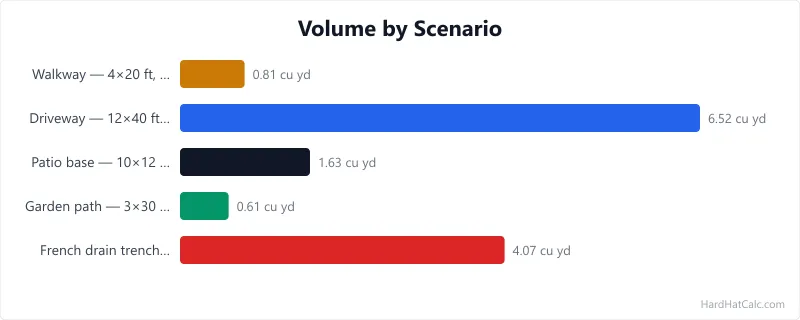
Scenario: A homeowner wants to lay a 12-foot by 40-foot gravel driveway using crushed stone at 4 inches deep, with bulk delivery included.
Calculation: Area = 12 × 40 = 480 sq ft. Depth in feet = 4 ÷ 12 = 0.333 ft. Volume = 480 × 0.333 = 160 cu ft = 5.93 cu yd. With 10% overage = 6.52 cu yd. Tons = 6.52 × 1.4 = 9.13 tons. Material cost = 9.13 × $25-$45 = $228-$411. Delivery = $100. Total = $328-$511.
What this means: A standard gravel driveway this size needs about 6.5 cubic yards — roughly three dump-truck scoops from a quarry. At 9 tons, this is a single-trip delivery for most tandem-axle dump trucks (12-14 ton capacity). The wide cost range reflects regional pricing: quarries near aggregate sources charge less than yards in metro areas that haul material long distances.
Takeaway: Crushed stone compacts tighter than pea gravel or river rock because the angular fragments lock together. For driveways, this means less stone migrates to the edges and less material disappears into the subgrade over time. A 4-inch layer over compacted earth is the minimum for passenger vehicles; trucks and trailers need 6 inches.
Example 2
Scenario: A DIY homeowner is building a 2-foot by 50-foot French drain trench backfilled with 12 inches of crushed stone.
Calculation: Area = 2 × 50 = 100 sq ft. Depth in feet = 12 ÷ 12 = 1 ft. Volume = 100 × 1 = 100 cu ft = 3.70 cu yd. With 10% overage = 4.07 cu yd. Tons = 4.07 × 1.4 = 5.70 tons. Material cost = 5.70 × $25-$45 = $143-$257. Delivery = $100. Total = $243-$357.
What this means: The French drain needs about 4 cubic yards of crushed stone — enough for a single delivery. At 5.7 tons, the material weighs about as much as a mid-size SUV. The 12-inch depth provides the drainage volume needed to handle storm runoff while surrounding the perforated drain pipe with at least 4 inches of stone on all sides.
Takeaway: Use clean, washed crushed stone (no fines) for drainage trenches. Road base and decomposed granite contain fine particles that clog drain pipe perforations and reduce water flow over time. Wrap the stone in landscape fabric to prevent soil migration into the drainage aggregate.
Frequently Asked Questions
- How deep should gravel be for a driveway?
A gravel driveway for passenger cars needs a minimum of 4 inches of compacted gravel over a firm subgrade. Trucks, SUVs, and trailers require 6 inches to prevent rutting under repeated heavy loads. The gravel layer is typically built in two lifts: a 3-4 inch base of road base (crusher run) compacted with a plate compactor, followed by a 1-2 inch top layer of crushed stone or pea gravel for the driving surface. Compaction reduces each lift by about 15%, so start with 5 inches of loose material to achieve 4 inches after compaction. If your subgrade is soft clay, adding a 6-inch layer of pit-run gravel beneath the road base prevents the stone from sinking into the soil.
- How many tons of gravel do I need per cubic yard?
One cubic yard of gravel weighs between 1.35 and 1.5 tons depending on the type. Crushed stone and pea gravel average 1.4 tons per cubic yard. Road base (crusher run) and DG are the densest on this page at about 1.5 tons per cubic yard: road base because fine particles fill the gaps between larger stones, DG because its fine, sand-like particles pack tightly. River rock is the lightest at about 1.35 tons per cubic yard because the large, smooth stones leave bigger air gaps. These figures sit inside the loose-density ranges the Washington State DOT design manual and North Bay Materials publish (1.35-1.55 tons per cubic yard across crushed surfacing, base course, and ballast). When ordering from a quarry, always order by weight (tons) rather than volume: dump trucks are weighed at a scale, so tonnage is precise, while cubic yard estimates can vary depending on how the bucket is loaded.
- Can I use gravel as a base under a concrete slab?
Yes — a 4-inch layer of compacted gravel is standard practice under concrete slabs, patios, and footings. The gravel serves three purposes: it provides a level surface for the concrete forms, it improves drainage beneath the slab to reduce hydrostatic pressure, and it breaks the capillary action that would otherwise wick moisture from the soil up into the concrete. Use road base or crushed stone, not pea gravel or river rock, because angular fragments compact into a stable, non-shifting base. Gravel also sits inside the concrete itself as the coarse aggregate — the role of gravel as the coarse aggregate in concrete covers why the same crushed stone you compact below the slab gets mixed into the slab above. A tool to spec footing widths accounts for subbase preparation when sizing footings for structural loads.
- Is pea gravel or crushed stone better for walkways?
Pea gravel is more comfortable underfoot and easier to rake smooth, but it shifts sideways under each step and requires solid edging to stay in place. Crushed stone locks together when compacted and creates a firmer walking surface that does not shift — making it the better structural choice for high-traffic paths. For a decorative garden path with light foot traffic, pea gravel over landscape fabric works well as long as you install metal or timber edging on both sides. For a main walkway to your front door that gets daily use, crushed stone compacted in two lifts gives a surface that feels almost as solid as pavement. The shed foundation guide covers gravel pad construction using similar compaction techniques.
- How much does a truckload of gravel cost?
A standard tandem-axle dump truck holds 12-14 tons of gravel, covering roughly 8-10 cubic yards. At March 2026 US national averages, a full truckload costs $216-$630 for crushed stone, $250-$700 for pea gravel, or $600-$1,400 for river rock — plus $50-$150 for delivery within 20 miles of the quarry. Delivery fees increase by roughly $5-$10 per mile beyond that radius. For smaller orders (under 5 tons), many suppliers charge a minimum delivery fee equivalent to a half-load. Picking up gravel yourself in a pickup truck is an option for small quantities — a half-ton truck can safely carry about 1,500 lbs (0.75 tons) per load, which covers roughly 0.5 cubic yards.
More Materials calculators
Browse all materials calculators — Paint coverage, roofing bundles, tile adhesive, welding time, parking lot sizing, and more.