
Fence Material Calculator
Fence material calculator for wood, vinyl, and chain-link. Enter length, height, and style for post, rail, picket, concrete, and hardware counts with cost.
Last updated:
Methodology reviewed by Doc. dr. sc. Mladenka Juradin, dipl. ing. građ., PhD, Civil Engineering (FCEAG, University of Split)
Total linear feet of fence. Include all straight runs and corners.
Most residential privacy fences are 6 ft. Check local zoning — many areas limit front yard fences to 4 ft.
Individual pickets allow custom spacing; panels are faster to install but harder to fit uneven terrain.
Distance between posts. Wood fences use 6-8 ft; chain-link allows up to 10 ft.
Each gate requires 2 extra posts (gate posts) and a gate kit or custom gate frame.
How This Is Calculated
Posts = ceil(length / spacing) + 1 + (2 × gates). Rails = (line posts - 1) × rails per bay (2 for ≤6 ft, 3 for 8 ft). Pickets = length × 2.087 (for 5.5" pickets with 0.25" gap). Concrete bags = posts × bags per post (2 for 6 ft, 3 for 8 ft fence). Cost = posts + rails + pickets/panels + concrete + fasteners + gates.
Source: Post spacing based on standard builder practice (6-8 ft on centre for wood, per manufacturer recommendations). Concrete footing volumes per ACI CODE-332-20 (Residential Code Requirements for Structural Concrete). Post hole diameter guidance from ASTM F567 (Installation of Chain-Link Fence). Material quantities based on builder framing patterns.
8 min read
Post, Rail, and Picket Quantities Explained
Every fence breaks down into the same structural elements regardless of material: posts in the ground, horizontal rails connecting them, and infill (pickets, panels, or fabric) attached to the rails. The quantities depend on fence length, height, and post spacing. Here is how each component scales.
| Component | Formula | 4 ft Fence | 6 ft Fence | 8 ft Fence |
|---|---|---|---|---|
| Posts (4×4 PT) | ceil(length/spacing) + 1 + (2 × gates) | Same for all heights | Same | Same |
| Post length | fence height + burial depth | 4 + 2 = 6 ft | 6 + 2.5 = 8.5 ft | 8 + 3 = 11 ft |
| Rails per bay | 2 for ≤6 ft, 3 for 8 ft | 2 | 2 | 3 |
| Pickets per foot | 12 / (picket width + gap) | 2.09 (5.5" + 0.25") | Same | Same |
| Concrete per post | bags by depth | 1.5 bags (18" deep) | 2 bags (24" deep) | 3 bags (36" deep) |
Post burial depth follows the one-third rule: bury one-third of the total post length. A 6-foot fence needs about 30 inches in the ground (8.5-foot post), and an 8-foot fence needs 36 inches (11-foot post). The post hole diameter should be three times the post width — a 4×4 post (actual 3.5 inches) goes in a 10-inch diameter hole. A 10-inch hole 24 inches deep holds about 0.8 cubic feet of concrete, which is roughly two 50-lb bags of dry mix.
Corner and end posts carry more force than line posts because they resist fence loads from two or three directions. Some builders use 6×6 posts at corners and gates for added rigidity. The calculator uses uniform 4×4 posts throughout, but upsizing corner posts to 6×6 adds about $8-$12 per post and noticeably improves fence stability at direction changes.
For the structural side of post sizing — how deep a post needs to be based on soil conditions, wind loads, and fence height — the fence post depth calculator provides a more detailed analysis based on your specific conditions.
Material Selection: Wood, Vinyl, Chain-Link, and Composites
Each fence material trades off between upfront cost, maintenance burden, lifespan, and appearance. The right choice depends on your budget horizon and your tolerance for periodic upkeep.
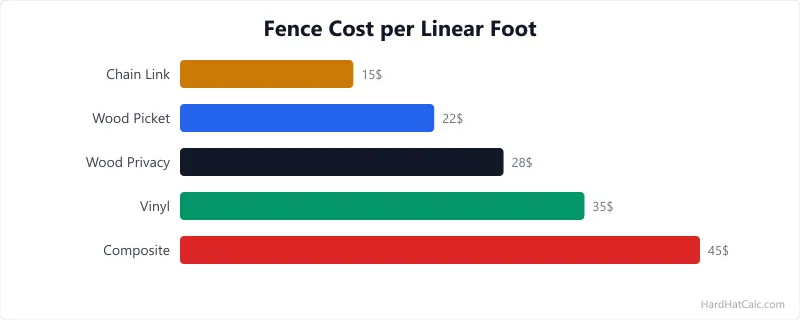
Pressure-treated wood (PT pine or fir) is the most popular residential fence material in North America. Posts are 4×4 treated to ground-contact rating (UC4A or UC4B), rails are 2×4 or 2×3 treated to above-ground rating (UC3B), and pickets are 1×6 dog-ear boards. Treated wood costs $12-$20 per linear foot in materials and lasts 15-25 years with periodic staining or sealing every 2-3 years. Without stain, untreated pine fences grey within a year and rot within 5-8 years. Cedar and redwood cost 50-100% more than treated pine but resist rot naturally and weather to an attractive silver-grey without treatment.
Vinyl (PVC) fencing arrives as a kit: posts, rails, and panels in matched sections. The material costs 30-75% more than treated wood ($20-$35 per linear foot in materials) but eliminates all maintenance. Vinyl does not rot, does not need paint or stain, and resists insect damage. The downside is limited colour options (mostly white, tan, and grey), brittleness in extreme cold (vinyl can crack if struck below 0 deg F), and difficulty repairing individual sections. A damaged vinyl panel typically requires replacing the entire panel.
Chain-link is the cheapest fence material at $5-$12 per linear foot. It does the job of defining property boundaries and containing pets without any visual privacy. Adding privacy slats ($3-$5 per linear foot) or fabric screens ($2-$4) improves privacy but reduces wind resistance. Chain-link lasts 20+ years with zero maintenance if galvanised; vinyl-coated chain-link (black or green) lasts longer and looks better for a modest premium. If you are building a fence alongside a new deck or patio, the deck materials planning guide covers lumber, hardware, and layout decisions that pair with a perimeter fence project.
How to Order and Avoid Shortages
Running out of materials during a fence build means stopping work and making another trip — or worse, waiting for a special-order delivery. Here is how experienced builders order to avoid shortages without massive over-ordering.
Measure twice, including obstacles. Walk the entire fence line with a tape measure and mark post locations with stakes or spray paint. Note trees, utility boxes, rock outcrops, and grade changes that affect post placement. A gas line that runs 2 feet inside the property line might force your fence to jog around it, adding fence length and extra posts.
Call 811 before you dig. Every US state requires utility location before excavation. Call 811 or submit an online ticket at least 3 business days before you plan to dig post holes. The locate service marks buried gas, electric, water, cable, and sewer lines with paint or flags. Hitting a gas line is dangerous; hitting a fibre optic line is expensive. This step is free and legally required in all 50 states.
Order posts and concrete with zero waste tolerance. Posts and concrete bags are cheap relative to their importance — running one post short stops the entire project. Order 2-3 extra posts and 5-10 extra bags of concrete. The unused posts work as tomato stakes and the concrete stores indefinitely in a dry location.
Order pickets with 5-10% overage. Picket counts from the calculator are theoretical minimums. In practice, you will find warped boards in the bundle (reject any with more than 1/4-inch warp per foot), break a few during cutting, and need extras at corners and gates. Ten percent overage is standard for picket fences.
Buy all materials from the same lot when possible. Wood colour and grain vary between production runs. Mixing batches creates visible colour bands in the finished fence that staining cannot fully hide. If your order is too large for a single delivery, ask the yard to pull from the same production lot.
DIY vs. Professional Installation: The Cost Split
Fence building is one of the more accessible DIY projects for homeowners with basic tool skills. The work is physically demanding but conceptually straightforward: dig holes, set posts, attach rails, hang pickets. But the economics of DIY vary depending on the fence type and your local labour market. To put a number on that split before you commit, estimate the total project cost by material, height, and DIY-or-pro install.
Wood picket (DIY-friendly): Materials run $12-$20 per linear foot. Professional installation adds $15-$30 per foot for labour, bringing the total to $27-$50 per foot installed. A homeowner with a post hole digger (rental: $40-$80/day for a two-person auger), a level, a circular saw, and a drill can build 30-50 feet per day. A 150-foot fence is a 3-4 day project for one person, or a weekend with a helper. The labour savings on a 150-foot fence: $2,250-$4,500. Before digging, run your soil type and fence height through the post burial depth calculator to confirm how deep each hole needs to be — sandy soil and high wind exposure can push posts well past the one-third rule.
Pre-built panels: Panels are faster to install than individual pickets — lift, level, attach. But the panels are heavy (60-90 lbs for a 6×8 panel) and awkward to handle alone. Two people are essential. The panel approach reduces the per-foot DIY time to about 60-80 feet per day, making a 100-foot fence a weekend project. Professional installation costs less per foot than picket fences because the labour is simpler.
Vinyl: Vinyl fence systems use routed posts and slide-in rails that require precise post spacing. A post that is 1/2 inch too close or too far from its neighbour means the rail does not seat properly. Most vinyl manufacturers void their warranty if the fence is not installed by a certified installer. If warranty matters to you, hire a pro. If you are confident in your precision, DIY vinyl saves the same $15-$30 per foot in labour.
Chain-link: Chain-link installation requires tensioning fabric, which needs specialised tools (a fence stretcher and come-along). The tension must be uniform across the entire run to avoid sagging. This is one fence type where professional installation is worth the cost for most homeowners — the tool rental ($80-$120/day) and learning curve make the DIY savings marginal on a single project. For posts that double as structural supports — holding up a pergola or shade structure at the property line, for example — sizing goes beyond basic fence post rules and into beam-and-post engineering.
Permits, Property Lines, and Neighbour Etiquette
Fence disputes are among the most common neighbourhood conflicts, and most of them are preventable with a survey, a permit, and a conversation.
A property survey ($300-$600) establishes the exact property line with legal precision. Do not rely on existing fences, visual landmarks, or "where the old fence was" to determine your property boundary. If your new fence crosses the property line even by inches, your neighbour can require you to remove it — and you absorb the full cost of removal and reinstallation on the correct line. The survey cost is insurance against a much more expensive mistake.
Most municipalities require a fence permit for fences over 4 feet tall and sometimes for any fence regardless of height. The permit process typically requires a site plan showing the fence location relative to property lines, a description of materials and height, and a fee of $25-$100. Setback requirements vary: some jurisdictions require fences to be set back 6 inches to 2 feet from the property line; others allow fences on the exact line. Front yard fences often have lower height limits (3-4 feet) than side and rear yard fences (6-8 feet).
The "good side out" convention places the finished (flat) side of the fence facing your neighbour and the rail-and-post side facing your yard. This is courtesy, not law, in most places — but a few municipalities codify it. Check your local fence ordinance before assuming. Some homeowners build a "good neighbour" or "shadowbox" fence that looks identical from both sides by alternating pickets on opposite sides of the rail.
Talk to your neighbours before building. A fence on or near the property line affects their property too. Many neighbours will agree to split the cost of a shared fence if you approach the conversation before breaking ground. Even if they decline to contribute, the conversation establishes goodwill and avoids the surprise of waking up to a fence crew they did not expect. Disputes after the fence is up cost far more to resolve — both financially and relationally — than a 15-minute conversation beforehand.
Worked Examples
Example 1
Scenario: A homeowner is building a 150-foot wood privacy fence at 6 feet tall using individual pickets on 8-foot post spacing, with one walk gate.
Calculation: Posts: ⌈150/8⌉ + 1 = 19 + 1 = 20 line posts + 2 gate posts = 22 total. Rails: (20-1) × 2 = 38 rails. Pickets: 150 × 2.087 = 313.05, rounded up to 314 pickets. Concrete: 22 × 2 = 44 bags. Fasteners: 314 × 0.25 = 78.5, rounded up to 79 lbs. Cost: posts 22 × $15 = $330, rails 38 × $8 = $304, pickets 314 × $3.25 = $1,020.50, concrete 44 × $5.50 = $242, fasteners 79 × $8 = $632, gate $75. Total = $2,604. Per foot = $17.36.
What this means: A 150-foot wood picket fence runs about $2,604 in materials — roughly $17 per linear foot. Labour (if hired) adds $15-$30 per foot, bringing the installed cost to $32-$47 per foot. The 314 pickets are the biggest material expense at $1,020.50.
Takeaway: Wood picket fences cost more in materials but less in labour compared to panel fences, because the pickets are lighter and easier for one person to handle. They also follow terrain contours (stepping or racking) better than rigid panels, making them the better choice for sloped yards.
Example 2
Scenario: A homeowner is replacing 120 feet of fencing with vinyl privacy panels at 6 feet tall, 6-foot post spacing, and 2 gates.
Calculation: Posts: ⌈120/6⌉ + 1 = 21 line posts + 4 gate posts = 25 total. Rails: 0 (built into vinyl panel system). Panels: 20 (one per bay between 21 line posts). Concrete: 25 × 2 = 50 bags. Cost: posts 25 × $32 = $800, panels 20 × $120 = $2,400, concrete 50 × $5.50 = $275, fasteners 6 × $8 = $48, gates 2 × $75 = $150. Total = $3,673. Per foot = $30.61.
What this means: Vinyl runs $30.61 per linear foot in materials alone — roughly 75% more than wood pickets. The premium buys zero maintenance: no staining, no painting, no rot, and a 20-year warranty from most manufacturers. The total of $3,673 for 120 feet is about what you would spend on a wood fence plus two rounds of staining over 10 years.
Takeaway: Vinyl makes financial sense when you factor in lifetime maintenance. A wood fence needs staining every 2-3 years ($300-$500 per treatment for 120 feet), while vinyl needs only occasional washing. Over 20 years, the vinyl and wood lifetime costs converge.
Frequently Asked Questions
- How many fence posts do I need for 100 feet of fence?
For 100 feet of fence with standard 8-foot post spacing, you need ceil(100/8) + 1 = 14 posts. Add 2 posts for each gate — so with one gate, the total is 16 posts. With 6-foot post spacing (used for vinyl and heavy-duty wood fences), you need ceil(100/6) + 1 = 18 posts plus gate posts. Always round up — posts are cheap ($12-$32 each depending on material) and running one short stops the entire project. For how deep to set each post, the post burial depth calculator factors in soil type and frost line.
- How much does it cost to build a 150-foot wood fence?
Materials for a 150-foot, 6-foot-tall wood privacy fence with pickets run $2,400-$3,200 depending on wood species and local pricing. This includes posts, rails, pickets, concrete, fasteners, and one gate. Add $15-$30 per linear foot for professional labour ($2,250-$4,500), bringing the total installed cost to $4,650-$7,700. Cedar costs 50-100% more than pressure-treated pine but lasts longer without staining. Prices as of March 2026, US national averages. If you are building a deck alongside the fence, the deck materials planning guide covers lumber, hardware, and layout decisions for the full project.
- How many bags of concrete do I need per fence post?
Two 50-lb bags of fast-setting concrete per post for a 6-foot fence (post holes 24 inches deep, 10 inches diameter). Taller 8-foot fences with 36-inch-deep holes need 3 bags per post. The dry concrete is poured directly into the hole around the post and then soaked with water — no mixing required with fast-setting products like Quikrete Fast-Setting. Each bag fills about 0.375 cubic feet, and a 10-inch × 24-inch hole around a 4×4 post has about 0.37 cubic feet of void to fill. For a deeper look at concrete mix ratios and when to use each type, the guide covers fast-setting, standard, and high-strength blends.
- Is vinyl fencing cheaper than wood in the long run?
Over a 20-year period, vinyl and wood lifetime costs are roughly equal. Vinyl costs 30-75% more upfront ($20-$35/ft materials vs. $12-$20/ft for wood) but requires zero maintenance. Wood needs staining every 2-3 years ($2-$4/ft per treatment) and may need post or rail replacement around year 10-15. A 150-foot fence over 20 years costs approximately $5,000-$8,000 in wood (materials + maintenance) versus $4,500-$6,500 in vinyl (materials only). Vinyl wins financially if your alternative is diligent maintenance; wood wins if you would skip staining anyway and accept a shorter fence life. The same lifetime-cost logic applies to deck surface materials, where composite decking follows the same upfront-vs-maintenance trade-off. For the structural posts that carry the fence, size posts for the load checks the cross-section against wind exposure.
More Materials calculators
Browse all materials calculators — Paint coverage, roofing bundles, tile adhesive, welding time, parking lot sizing, and more.