
Concrete Mix Ratios Explained
Concrete mix ratios by application — footings, slabs, driveways, and posts. What 1:2:3 means, how the water-cement ratio sets strength, and PSI by mix.
Concrete is the second most consumed material on earth after water. Globally, we pour about 14 billion cubic yards of it every year — enough to build a highway lane circling the planet 25 times. And yet most DIY builders treat concrete as a single substance, reaching for whatever pre-mixed bag sits closest to the door at the hardware store. The reality is that concrete is a recipe, and like any recipe, changing the proportions changes the result. A footing mix, a slab mix, a countertop mix, and a fence-post mix all use the same four ingredients — cement, sand, gravel (coarse aggregate), and water — but in different ratios that produce different strengths, workabilities, and curing characteristics.
This guide decodes the ratio system, explains the standard mixes for residential construction, and covers the science behind the one number that matters most: the water-cement ratio. Whether you are pouring a shed foundation, setting deck posts, or patching a driveway, understanding what goes into the mix gives you control over what comes out of it. If you would rather order a named, pre-tested mix than batch your own, the guide to concrete types and grades covers which product or designated mix to choose.
What the Numbers Actually Mean
A concrete mix ratio is written as three numbers separated by colons — for example, 1:2:3. These numbers represent the proportional volumes of the three dry ingredients.
- First number: Portland cement
- Second number: sand (fine aggregate)
- Third number: gravel or crushed stone (coarse aggregate)
A 1:2:3 mix means one part cement, two parts sand, and three parts gravel by volume. "Part" can be any unit — a shovelful, a bucket, a cubic foot. As long as you keep the proportions consistent, the resulting concrete has the same properties regardless of the batch size. This volume-based system has been the standard method for field-mixed concrete since Portland cement was first produced commercially in the 1840s. It persists today because it requires no scales — just a consistent measuring container.
The missing ingredient in the ratio notation is water. Water is specified separately, usually as a water-cement ratio (w/c) by weight. A w/c of 0.50 means half a pound of water for every pound of cement. This ratio is the single most important variable in concrete strength, and it does not appear in the simple three-number ratio — which is why understanding it separately is critical. More on that below.
Standard Mixes by Application
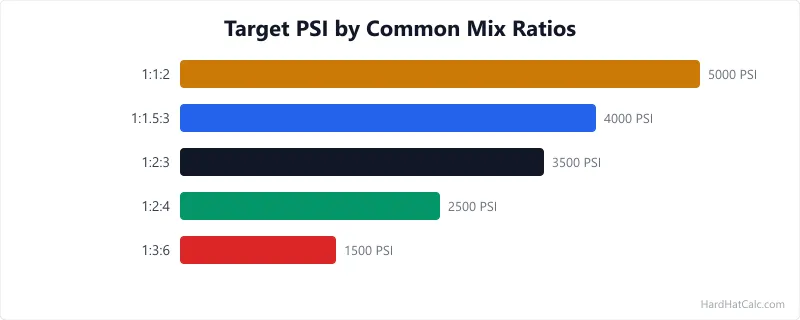
Different jobs need different concrete. A fence post does not need the same mix that supports a two-storey house foundation. The table below covers the mixes that residential builders encounter most often, with the target compressive strength each one delivers when properly mixed and cured. Compressive strength ratings below follow ACI 318 (Building Code Requirements for Structural Concrete) and ACI 211.1 (Standard Practice for Selecting Proportions for Normal, Heavyweight, and Mass Concrete) guidelines.
| Application | Mix Ratio (Cement:Sand:Gravel) | Target Strength (PSI) | w/c Ratio | Notes |
|---|---|---|---|---|
| General purpose (paths, non-structural slabs) | 1:2:4 | 2,500 | 0.55-0.60 | Adequate for sidewalks, garden paths, and light-duty slabs not subject to vehicle traffic |
| Standard structural (footings, foundations, slabs-on-grade) | 1:2:3 | 3,000-3,500 | 0.50-0.55 | The default for most residential structural work per IRC Table R402.2 |
| Driveways and garage floors | 1:1.5:2.5 | 3,500-4,000 | 0.45-0.50 | Handles vehicle loads and freeze-thaw cycling; air entrainment recommended in cold climates. Estimate full driveway costs |
| Fence posts and mailbox bases | 1:2:3 | 3,000 | 0.50-0.55 | Standard structural mix; pre-mixed 80 lb bags (Quikrete, Sakrete) are this ratio |
| High-strength (columns, retaining walls, elevated slabs) | 1:1:2 | 4,000-5,000 | 0.40-0.45 | Requires careful water control; stiffer mix is harder to work but 30-65% stronger than the standard 1:2:3 ratio |
| Lean mix / fill concrete (non-structural fill, trench backfill) | 1:3:6 | 1,500 | 0.60-0.65 | Low cement content, low cost; used for fill only, not load-bearing applications |
The IRC (International Residential Code) Section R402.2 specifies minimum 2,500 PSI concrete for footings and foundation walls in standard residential construction. Most builders use 3,000 PSI (the 1:2:3 mix) as their default because the cost difference is minimal and the additional strength provides a safety margin against poor field mixing and variable aggregate quality. These foundation footings carry the loads from everything above them — if you are pouring footings as part of a wall removal project, understanding which walls are load-bearing determines the footing size and concrete strength you need.
Ratio by volume. 1:2:4 is the most common general-purpose mix for residential work.
Total finished concrete volume needed. 27 cu ft = 1 cubic yard.
Type I/II Portland cement is standard for most residential work. Blended cements improve durability.
Ratio of wet concrete volume to total dry ingredient volume. 0.67 is standard — sand fills aggregate voids.
For estimation only. Structural work requires review by a licensed engineer. Local building codes take precedence over any calculator output.
How This Is Calculated
Parse mix ratio (e.g. 1:2:3) into cement:sand:aggregate parts. Dry volume = finished volume / yield factor (default 0.67). Component volumes = dry volume x (part / total parts). Cement bags = cement volume x 94 lb/cu ft / 94 lb per bag. Water = cement weight x W/C ratio (0.45 for rich mixes, 0.50 for lean) / 8.33 lb/gal. Total weight = sum of all component weights. Sand density ~100 lb/cu ft, aggregate ~105 lb/cu ft (site typical values). Method: the ratio-parts dry-volume model of this site (editorial); 94 lb of cement = about 1 cu ft per USDA NRCS NEH Part 645 Subpart L; water 8.33 lb/gal per TTB.
Source: The ratio-parts dry-volume method (parts of cement, sand and aggregate scaled from the finished volume by a yield factor, default 0.67) is the default estimating method of this site, typical trade practice for small batches; it closed as an editorial model on 2026-09-05 (SF20-A8 ruling 9). Legs opened: 94 lb of bulk cement = about 1 cu ft per the USDA NRCS National Engineering Handbook, Part 645, Subpart L, Concrete (March 2025); water 8.33 lb per gallon per the TTB Scientific Services density page, with NRCS (8.3 lb per gallon) and the Caltrans Concrete Technology Manual (62.4 lb per cu ft) agreeing; water-cement 0.50 as the general ceiling and 0.45 for demanding work per NRCS (CS-31) and the Caltrans chapter 3 worked example; the 1:2:3 recipe as the general-purpose mix both Quikrete and Sakrete print on their Portland cement data sheets (neither attaches a strength figure). The other six ratios, every strength label, the 0.67 yield factor and the sand 100 and aggregate 105 lb per cu ft typical densities are figures of this site with no published source opened (the Wisconsin DOT loose laboratory measure was ruled not a leg for the sand figure, which stays at 100). ACI 211.1 (the absolute-volume proportioning guide) was not opened (sold by ACI) and does not describe this shortcut; its attribution was withdrawn on 2026-09-02. PCA Design and Control of Concrete Mixtures is cited for general practice only; the PCA pages opened in SF20-A6 are silent on the yield factor.
- ACI 211.1 — Concrete Mix Proportioning (not opened; sold by ACI; the absolute-volume method, not the ratio shortcut used here)
- PCA Design and Control of Concrete Mixtures
- USDA NRCS National Engineering Handbook, Part 645 Subpart L — Concrete (94-lb sack = about 1 cu ft; water 8.3 lb/gal; w/c limits)
- TTB Scientific Services — density of water (8.33 lb/gal)
- Caltrans Concrete Technology Manual, Chapter 3 — review of concrete mix designs
- Quikrete Portland Cement technical data sheet (1:2:3 concrete mix, 94-lb bags)
- Sakrete Portland Cement Type I/II technical data sheet (1:2:3 general purpose concrete, 94-lb bags)
The Water-Cement Ratio: The Number That Controls Everything
If you take away one concept from this guide, make it this one. The water-cement ratio (w/c) is the single biggest factor determining concrete strength, durability, and permeability. Every other variable — aggregate size, mix proportions, curing method — matters less than getting the water right.
The relationship is inverse: less water means stronger concrete. A w/c of 0.40 produces roughly 5,000 PSI concrete. A w/c of 0.50 produces about 3,500 PSI. A w/c of 0.60 drops to around 2,500 PSI. The strength drops because excess water that is not consumed by the chemical hydration reaction (cement needs about 0.25 w/c for complete hydration) remains in the mix as free water. When that free water evaporates during curing, it leaves behind a network of tiny capillary voids. More voids mean weaker concrete.
This is why adding water to make the mix easier to pour — the temptation on every DIY job — directly reduces the finished strength. A wheelbarrow mix that flows like pancake batter is much easier to work than a stiff mix that holds its shape, but the soupy mix might test at 2,000 PSI where the stiff mix hits 3,500 PSI from the same dry ingredients. Denton Abrams established this relationship in 1918 at the Lewis Institute in Chicago, and it remains the foundational principle of concrete mix design over a century later.
Measuring Water in the Field
On a job site, water gets added by bucket, by hose, and sometimes by "that looks about right." This imprecision is the leading cause of weak concrete in residential work. A better approach for field mixing: measure the cement weight (each 94-lb bag of Portland cement is a known quantity) and pre-measure the water into buckets before adding it to the mixer.
For one 94-lb bag of cement at a 0.50 w/c ratio: 94 × 0.50 = 47 lbs of water. Water weighs 8.33 lbs per gallon, so 47 ÷ 8.33 = 5.6 gallons. For a 0.45 ratio (stronger, stiffer): 94 × 0.45 = 42.3 lbs = 5.1 gallons. The difference between a 3,500 PSI mix and a 4,000+ PSI mix is half a gallon of water per bag of cement. That precision matters.
One factor many beginners overlook: your sand and gravel carry moisture. Damp sand from an outdoor pile can hold 3-6% moisture by weight. On a one-bag batch using 188 lbs of sand, that is 6-11 lbs of hidden water already in the mix before you add a drop from the hose. In rainy weather, test your aggregate moisture by weighing a sample before and after oven-drying, or reduce added water by 1-2 gallons per bag and adjust based on workability. The concrete slab weight calculator helps you estimate the total volume and weight of a pour so you can scale your water measurement to the batch size.
Aggregate: The 60-75% You Rarely Think About
Cement gets all the attention, but aggregate makes up 60-75% of the concrete volume. The size, shape, and grading of the aggregate affect workability, strength, and the amount of cement paste needed to fill the voids between particles.
Coarse aggregate for residential work is typically 3/4-inch gravel or crushed stone. Larger aggregate (1 to 1.5 inches) can be used in massive pours like retaining walls and foundations, where the larger stone reduces cement demand and thermal cracking. Smaller aggregate (3/8 inch or pea gravel) is used for thin pours, countertops, and applications where the concrete must flow through tight rebar spacing. ACI 318 Section 26.4.2.1(a) limits maximum aggregate size to one-fifth the narrowest form dimension and three-quarters the minimum clear spacing between reinforcing bars.
Fine aggregate (sand) fills the gaps between the coarse aggregate pieces. Clean, sharp concrete sand with a range of particle sizes packs most efficiently. Beach sand and play sand are too fine and too uniform — they demand more water to achieve workable consistency, which weakens the finished concrete. Mason sand (finer than concrete sand) works for mortar and stucco but produces a harsher, weaker concrete when used as the primary fine aggregate.
The ideal aggregate blend follows a grading curve where particles of each size fill the voids left by the next larger size. In practice, ordering "concrete aggregate" or "3/4-inch crushed stone" and "concrete sand" from a reputable supplier gets you material that meets ASTM C33 grading requirements without needing to run a sieve analysis yourself.
Admixtures and When to Use Them
Admixtures are chemicals added to the mix in small quantities to change specific properties. They are not exotic — if you have ever used a bag of Quikrete Fast-Setting Concrete Mix, you have used an admixture (calcium chloride accelerator in that case). The four admixtures residential builders encounter most often are air entrainers, accelerators, retarders, and water reducers.
Air Entrainment
Air-entraining agents create billions of microscopic air bubbles (10-60 microns in diameter) evenly distributed through the concrete. These bubbles act as pressure relief valves during freeze-thaw cycles. When water inside the concrete freezes and expands, the air voids give the expanding ice somewhere to go instead of cracking the concrete matrix. ACI 318 Table 19.3.3.1 recommends 4-7% air content for concrete exposed to freeze-thaw conditions.
Every driveway, sidewalk, patio, and exposed foundation in a cold climate should use air-entrained concrete. Without it, surface scaling (the top layer flaking off in sheets) begins within 2-5 winters. Most ready-mix plants add air entrainment automatically for exterior pours, but verify with the dispatcher when ordering. For bag-mix jobs, liquid air-entraining agents are available for roughly $8-$12 per quart, which treats 10-15 bags of cement. Pricing as of early 2026 at major US building supply retailers.
Accelerators
Accelerators speed up the hydration reaction, reducing initial set time and increasing early strength gain. Calcium chloride is the most common and cheapest accelerator — it cuts set time from 6-8 hours to 2-4 hours and doubles the 1-day compressive strength. The standard dose is 2% of the cement weight (about 2 lbs per 94-lb bag).
The catch: calcium chloride promotes corrosion of embedded steel. Do not use it in reinforced concrete — footings with rebar, reinforced slabs, or any pour containing steel mesh. For reinforced work in cold weather, use non-chloride accelerators (more expensive but rebar-safe). ACI 318 Section 20.6 prohibits calcium chloride in prestressed concrete and strongly discourages it in any reinforced element. The concrete reinforcement calculator helps you determine rebar spacing and sizing — if your pour includes reinforcement, avoid chloride-based accelerators entirely.
Retarders
Retarders slow the hydration reaction, extending the working time before the concrete begins to set. They are essential in hot weather (above 85°F / 30°C) when concrete can begin setting within 45 minutes of mixing — before you have time to place, consolidate, and finish it. A retarder extends the window to 2-4 hours.
Sugar, in small quantities, is actually an effective concrete retarder — it is one of the oldest admixtures in construction history. But commercial retarders (lignosulfonates, hydroxycarboxylic acids) are dosed precisely and predictably. Sugar requires exact dosing: too little does nothing, too much prevents the concrete from ever setting properly. Stick with commercial products unless you enjoy expensive science experiments.
Water Reducers
Water reducers allow you to achieve the same workability (slump) with less water, which means higher strength from the same cement content. A mid-range water reducer cuts water demand by 8-15%. A high-range water reducer (superplasticiser) can cut it by 15-30%, producing flowing concrete at w/c ratios below 0.40 that would otherwise be too stiff to pour.
For residential work, water reducers are most useful in hot weather (when the temptation to add extra water is strongest) and in pumped pours (where the concrete must flow through a 4-inch hose without segregating). They cost $15-$25 per gallon and treat 4-6 cubic yards of concrete — a modest expense relative to the strength improvement.
Field Testing: How to Check Your Mix On Site
Professional concrete testing involves cylinders, curing chambers, and a compression testing machine. On a residential job, you probably do not have those. But two field tests give you useful quality information without any lab equipment.
The Slump Test
Slump measures workability — how easily the concrete flows and compacts. The test uses a standard 12-inch-tall sheet metal cone (a slump cone, available at any concrete supply house for $25-$40). Fill the cone in three layers, rod each layer 25 times with a 5/8-inch steel rod, lift the cone straight up, and measure how far the top of the concrete pile sinks (slumps) from the original 12-inch height.
Target slump values by application per ACI 211.1 Table 6.3.1:
- Footings and foundation walls: 3-4 inches
- Slabs on grade: 3-4 inches
- Reinforced walls and columns: 3-4 inches
- Pumped concrete: 4-6 inches (needs to flow through the hose)
- Mass pours (thick foundations): 2-3 inches (stiffer to reduce heat of hydration)
A slump above 6 inches (unless using a superplasticiser) usually means too much water. A slump below 2 inches means the mix is too stiff to place and consolidate properly — voids will form around the rebar and in corners. Both extremes hurt the finished product.
The Ball-in-Hand Test
For small batch jobs where a slump cone is overkill, grab a handful of the mixed concrete and squeeze it. Good concrete holds its shape without crumbling (not too dry), does not drip water between your fingers (not too wet), and leaves a thin cement paste film on your hand (enough paste to coat the aggregate). If water streams out, reduce water on the next batch. If it crumbles into pieces, add water in half-gallon increments until it holds together.
Troubleshooting Common Mix Problems
Even with the right ratio, things go wrong. These are the problems I have encountered on residential pours — including a footing pour for a garden wall extension in Northumberland that taught me every lesson on this list simultaneously.
Problem: Concrete sets too fast. Likely causes: hot weather accelerating hydration, cement that has been stored too long and partially hydrated in the bag, or accidental double-dosing of accelerator. Prevention: in hot weather, use cold mixing water (add ice to the water, not to the concrete — ice chunks create voids), dampen aggregate before mixing, and retard the mix if ambient temperature exceeds 85°F.
Problem: Concrete will not set. Likely causes: too much retarder, too much water (dilutes the cement paste below the concentration needed for hydration), or contaminated mix water (organic compounds in pond or stream water can retard setting). Fix: there is no fix once it is placed. Prevention: use clean potable water, dose retarders precisely, and keep the w/c ratio within specification.
Problem: Surface cracks within 24 hours (plastic shrinkage cracking). This happens when the concrete surface dries faster than the bleed water can replace it — common on hot, windy, or low-humidity days. The surface shrinks while the interior is still plastic, and the tension cracks the surface. Prevention: apply a curing compound or cover with plastic sheeting immediately after finishing. Mist the surface if conditions are extreme. ACI 305.1 (Hot Weather Concreting) provides detailed guidance for pours in adverse conditions.
Problem: Weak, dusty surface after curing. The surface was over-finished — steel-trowelled while bleed water was still present on the surface. Working bleed water back into the surface layer creates a weak, high-w/c-ratio skin that dusts and flakes. Prevention: wait until bleed water has fully evaporated (the surface sheen disappears) before final trowelling. On thick slabs, this can take 1-2 hours after placement.
Problem: Honeycombing (voids visible on the form face after stripping). The concrete was not adequately consolidated — air pockets remained trapped against the form. Prevention: vibrate the concrete with a pencil vibrator (internal vibrator) inserted at 12-18 inch intervals for 5-15 seconds per insertion. For forms, tap the outside of the form with a rubber mallet during placement to release trapped air. Do not over-vibrate — excessive vibration causes the heavy aggregate to sink and the cement paste to rise, creating a weak, paste-rich surface layer.
Pre-Mixed Bags vs. Site-Mixed vs. Ready-Mix Truck
The size of your pour determines which delivery method makes sense. There is no single right answer — each has a volume range where it excels and a point where it becomes impractical or uneconomical. Costs below are as of March 2026, US national averages. Regional variation of 15-25% is typical.
Pre-mixed bags (80-lb Quikrete, Sakrete, or equivalent) are the DIY default for small jobs. Each bag yields roughly 0.6 cubic feet of concrete. For a cubic yard (27 cubic feet), you need 45 bags. At $5-$7 per bag, that is $225-$315 per cubic yard — expensive compared to ready-mix, but there is no minimum order, no scheduling hassle, and no truck to worry about. Pre-mixed bags are practical for pours under 0.5 cubic yards: fence posts, small pads, mailbox bases, patch repairs.
Site-mixed from bulk materials (buying cement, sand, and gravel separately and mixing in a portable mixer or wheelbarrow) costs roughly $100-$140 per cubic yard in materials and gives you full control over the ratio. It makes sense for pours between 0.5 and 2 cubic yards — too large for bags to be cost-effective, too small for most ready-mix plants to deliver. A rented portable mixer ($50-$80 per day) handles batches of 3-6 cubic feet at a time.
Ready-mix truck delivery is the clear winner for pours above 2 cubic yards. The concrete arrives mixed to your specification, in the quantity you ordered, ready to pour. Cost: $130-$180 per cubic yard delivered, plus a short-load fee of $40-$60 per yard if you order less than the truck's minimum (typically 3-5 yards depending on the plant). A 5-yard minimum means even a 3-yard pour costs roughly the same as 5 yards. Schedule carefully: most plants charge $2-$3 per minute for truck wait time beyond the standard 5-7 minutes per yard of pour time.
Frequently Asked Questions
- What is the strongest concrete mix ratio for residential use?
The 1:1:2 ratio (one part cement, one part sand, two parts gravel) produces concrete in the 4,000-5,000 PSI range when mixed at a water-cement ratio of 0.40-0.45. This mix is used for columns, heavily loaded retaining walls, and elevated structural slabs. The trade-off is workability: the high cement content and low water ratio create a stiff, difficult-to-place mix that sets quickly. For most residential work — footings, foundation walls, slabs on grade — the 1:2:3 ratio at 3,000-3,500 PSI provides adequate strength with much better workability and lower material cost. The concrete mix ratio calculator converts these ratios into actual material quantities for your specific pour volume.
- Can I use beach sand or play sand to make concrete?
No — beach sand and play sand are poor choices for structural concrete. Beach sand contains salt (sodium chloride) that promotes corrosion of embedded steel reinforcement and can cause efflorescence (white salt deposits) on the concrete surface. Play sand is too uniformly fine-grained: it lacks the range of particle sizes that concrete sand has, which means it packs less efficiently and demands more water to achieve workable consistency. More water means a higher w/c ratio and weaker finished concrete. Always use ASTM C33-compliant concrete sand (also called sharp sand) from a concrete or aggregate supplier. If the pour includes rebar, a rebar layout tool sizes the steel before you mix.
- How much water should I add to an 80-lb bag of concrete mix?
Most 80-lb pre-mixed bags (Quikrete, Sakrete) specify approximately 3 quarts (0.75 gallons) of water per bag for a standard structural mix around 3,000-4,000 PSI. Start with slightly less water than the bag recommends — about 2.5 quarts — and mix thoroughly before deciding to add more. The exact amount depends on the moisture already present in the dry mix (bags stored in humid conditions absorb atmospheric moisture) and your desired workability. Adding the full amount listed on the bag sometimes produces a mix that is wetter than ideal, especially in cool weather when less evaporation occurs during mixing. For larger pours where bag count matters, the concrete slab weight calculator estimates total volume and weight.
- Why does my concrete crack within the first week after pouring?
Early cracking is almost always caused by rapid moisture loss from the concrete surface — a condition called plastic shrinkage cracking. The surface dries and shrinks while the interior remains wet, and the resulting tension exceeds the young concrete tensile strength. Hot weather, direct sunlight, wind, and low humidity all accelerate surface drying. Prevention requires keeping the surface moist for at least 7 days after placement: cover with plastic sheeting, apply a liquid curing compound, or mist with water several times a day. Control joints (grooved lines cut into the slab at regular intervals) give the concrete a predetermined weak point to crack along, keeping cracks hidden inside the joint rather than appearing randomly across the surface. The concrete curing time calculator estimates strength gain by day based on temperature and humidity.
- Do I need to add gravel to concrete or can I use just cement and sand?
A mix of only cement and sand (no coarse aggregate) is called mortar, not concrete. Mortar works for laying bricks, setting stone, and filling joints, but it lacks the structural strength and dimensional stability of concrete for load-bearing applications. Coarse aggregate (gravel or crushed stone) provides the skeleton of concrete — the rigid particles that resist compression. Without it, the cement-sand paste shrinks more during curing, generates more heat during hydration, and costs more per cubic foot because cement is the most expensive ingredient. For any structural pour — footings, slabs, foundations, posts — always include coarse aggregate per the mix ratios in this guide. If you need mortar specifically for brickwork, the bag count by wall area estimates bags by wall area and joint thickness.