
Fence Post Depth Calculator
Find the right fence post depth calculator result for your soil and fence height. Get burial depth, hole diameter, concrete bags, and frost line clearance.
Last updated:
Methodology reviewed by Doc. dr. sc. Mladenka Juradin, dipl. ing. građ., PhD, Civil Engineering (FCEAG, University of Split)
Height of the fence from ground to top. Standard privacy: 6 ft.
Clay holds posts well but drains poorly. Sandy soil needs deeper posts or larger concrete footings.
Depth below grade where the ground freezes. Enter 12 where it never freezes (the Florida residential code sets footings 12 inches below undisturbed ground); the Minnesota frost-depth map runs to 60 inches (5 ft 0 in) in the north. Check your local building department.
Privacy fences act as wind sails. Exposed locations need deeper posts to resist wind loads.
4×4 for standard fences. 6×6 for tall fences, gates, and heavy wind areas.
For estimation only. Structural work requires review by a licensed engineer. Local building codes take precedence over any calculator output.
How This Is Calculated
Base burial = fence height × 0.5 (one-third rule), minimum 24 inches. Soil adjustment: sandy ×1.17 (NRCS-sourced), rocky ×0.75 (NRCS-sourced). Wind adjustment: exposed ×1.25 (editorial, unverified). Frost: burial ≥ frost depth + 4 inches (the deeper of the two rules governs). Hole diameter = 3 × post width. Concrete volume = (pi/4 × hole diameter² − post width²) × depth — a round hole minus the square post section. Bags = volume / 0.375 cu ft per bag.
Source: Post embedment depth for concrete-set posts follows one-third of the total post length (this calculator computes the same ratio as half of the above-ground fence height), with a 24-inch minimum, and never above frost depth plus 4 inches. SF20-A7 retrieval (2026-09-02) found the one-third-of-total-length depth rule and the post-hole-diameter-equals-3-times-post-width rule both stated verbatim, for setting a post in concrete, by two independently owned manufacturers: the QUIKRETE Fast-Setting Concrete Mix data sheet (Product No. 1004-50: "Hole depth should be 1/3 the overall post height" and "digging the post hole about 3 times the diameter of the post") and the SAKRETE Fast Setting Concrete Mix data sheet ("depth should be 1/3 the length of the post or pole and hole should be 3 times the diameter of the pole or post width"). The QUIKRETE sheet also prints the 0.375 cu ft yield this calculator uses for the 50-lb bag count exactly ("Each 50 lb bag yields approximately 0.375 cu ft"); SAKRETE prints 0.38 cu ft for its own 50-lb bag. The 24-inch minimum is separately corroborated for a different fence type (agricultural line posts, not privacy fencing) by University of Georgia Extension Circular 774, Fences for the Farm ("Wooden line posts should be set at least 2 ft deep") and the NRCS Wisconsin Practice Standard 382 Fence specification ("Wooden line posts shall be set or driven a minimum of 24 inches below the ground line"). The frost-depth-plus-4-inches margin remains this site's own convention: no free official source located names that specific buffer for fence posts; the underlying rule, keeping footings below the local frost line, is standard footing practice on its own, but the 4-inch amount itself is not sourced. Frost depth data from NOAA/NWS frost line maps. Concrete volume calculation (hole cylinder minus post cross-section) per ACI CODE-332-20. Source-set change of 2026-08-22 (owner ruling): the sandy-soil adjustment is now x1.17, adopted from the NRCS Colorado Practice Specification 382 (Fence), which states: "All anchor and brace posts shall be set in ground at least 36 inches. In sandy or loose soil, depth of 42 inches is recommended." (42/36 = 1.17; retrieval record audits/sourcing-1-retrieval/fence2/; independently re-fetched and hash-confirmed 2026-09-02, SF20-A7). Source-set change of 2026-09-18 (SF22-HHC-F5): the rocky-ground adjustment moved from x0.85 to x0.75, adopted from three USDA NRCS state fence specifications that each print 18 inches in rocky soils against 24 inches in all other soils: the Oklahoma Practice Specification for CPS Fence (382), June 2014, Table 3 ("Wood (round posts only) 3 inches - Rocky Soils 18; Sandy 30; All Other Soils 24", repeated on the 2-inch OD steel pipe row); the North Carolina Conservation Practice Specification FENCING (382), February 2008, Table 3 (the same 18/30/24 triple on three post types); and the Texas Conservation Practice General Specification, Fence Code 382, October 2015 ("should be set 24 inches in the ground. In rocky soils a 5 1/2 foot post can be used and set 18 inches in the ground."). Those three are farm and livestock fence specifications covering line posts, they come from one publisher family (USDA NRCS state offices), and the Texas sentence does not survive into that office's March 2021 edition, so the figure ships consensus-not-confirmed rather than verified; the former x0.85 was printed by no document on record across four retrieval sessions. Agencies outside that family prescribe no depth reduction in rock at all: the Alaska fencing standard requires posts set full depth with the rock removed, and they handle rock by drilling and grouting a socket or by rock cribs. The wind (x1.25) adjustment remains this site's own editorial calibration and ships unverified: the free engineering record handles wind through a full design method (IBC Eq. 18-1), not a flat factor. The USDA NRCS Engineering Field Handbook citation for soil bearing capacities was removed 2026-09-02 (SF20-A7): this calculator does not compute a bearing-capacity value, so the citation named a document with no corresponding figure on the page. Frost-depth input range 12 to 60 in. anchored 2026-09-12 (SF22-HHC-F1 R5) to the Florida residential code footing baseline (at least 12 in. below undisturbed ground) and the Minnesota frost-depth map (5 ft 0 in. north of its line, 3 ft 6 in. south), on the value artifact value:fence-post-depth-calculator#frost-table; the former 0 to 72 in. range had no printing publisher at either end.
10 min read
The One-Third Rule and When to Go Deeper
The traditional rule for fence post depth is simple: bury one-third of the total post length. A post for a 6-foot fence needs 3 feet underground, making the total post length 9 feet. Both QUIKRETE and SAKRETE print this same one-third depth rule, plus a hole-diameter rule of 3 times the post width, in their own fast-setting concrete post-setting instructions. This rule has survived for generations because it works in average conditions — moderate soil, moderate wind, no frost concerns. The sandy-soil increase this calculator applies is drawn from a published specification (the NRCS Colorado fence standard, step 3 below). Rocky ground takes a quarter off the depth instead: three USDA NRCS state fence specifications (Oklahoma 2014, North Carolina 2008 and Texas 2015) each print 18 inches in rocky soils against 24 inches in all other soils, and this calculator applies that same ratio. Weigh that reduction before you rely on it. All three are farm and livestock fence specifications covering line posts, all three come from one publisher, and Texas dropped the sentence from its 2021 edition. Agencies outside that family print no reduction at all in rock: the Alaska fencing standard requires full-depth holes with the rock removed, and the usual alternatives are drilling and grouting a socket or building a rock crib. On a tall privacy fence or an exposed site, treat the shallower figure as a planning floor and use the wider concrete collar or the rock anchoring in step 3, or size the run with an engineer. The wind adjustment remains an editorial calibration drawn from trade practice, not a figure from a published engineering standard.
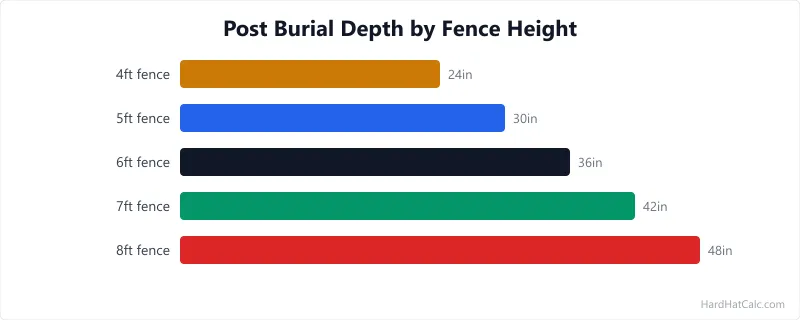
Start with the one-third rule as your baseline. Fence height × 0.5 gives the burial depth (because one-third of the total equals half the above-ground height). This produces 24 inches for a 4-foot fence, 36 inches for a 6-foot fence, and 48 inches for an 8-foot fence.
Check against the 24-inch minimum. The one-third rule is floored at 24 inches, so no fence post starts below that regardless of fence height. A 3-foot garden fence still needs 24 inches of burial to resist tipping from a leaning person or wind gust. University of Georgia Extension and a Wisconsin NRCS fence specification both set the same 24-inch minimum for wooden line posts, a related but heavier agricultural post type, not the privacy fence this calculator sizes. That floor bounds the baseline, not the finished number: the soil and wind adjustments apply after it, so a short fence in rocky ground comes out at 18 inches — which is the depth the NRCS specifications print for rocky soils.
Adjust for soil conditions. Sandy and gravelly soils provide less lateral resistance than clay or loam. Increase burial depth by about 17% in loose or sandy soils: the NRCS Colorado fence specification moves anchor and brace posts from 36 to 42 inches deep in sandy or loose soil, and this calculator applies that same ratio. Rocky soil with shallow bedrock is the opposite — you may hit rock at 18-24 inches and cannot dig deeper. In rocky ground, use a wider concrete collar (14-16 inch diameter instead of 10-12) to compensate for the shallow depth, or anchor the post bracket to the exposed rock with expansion bolts.
Adjust for wind exposure. A 6-foot privacy fence is a solid wall that catches every wind gust. In exposed locations (hilltops, open fields, coastal areas), this calculator adds 25% - an editorial allowance that ships unverified; published engineering treats fence wind loads with a full design method (IBC Eq. 18-1) rather than a flat factor. This is especially important for fences over 6 feet tall, where the wind moment arm (height × wind pressure × fence area) can generate hundreds of pounds of overturning force at the base.
Check frost depth and go deeper if needed. The bottom of the concrete footing must be at or below the local frost line to prevent frost heave. Frost heave lifts the post unevenly, racking the fence and breaking rail connections. The frost line runs from the Florida footing baseline of 12 inches, where the ground never freezes, to 60 inches (5 ft 0 in) in northern Minnesota. This calculator adds 4 inches of clearance below the frost line; the requirement to clear the frost line is standard footing practice, but that specific 4-inch buffer is this site's own convention, since no free published source states a fence-post frost margin. This is our own estimate; no published source backs these figures. Check your results against your product data or a licensed professional before acting.
Frost Depth by Region
Frost depth determines the minimum post hole depth in regions where the ground freezes. Posts set above the frost line will heave — shifting upward as ice lenses form in the soil, then failing to settle back to the original position when the ground thaws. After a few freeze-thaw cycles, a shallow post can heave 2-4 inches, visibly tilting the fence.
| Region | Approximate Frost Depth | Notes |
|---|---|---|
| Southern US (FL, LA, TX coast) | 12 in (footing baseline) | Rarely freezes; the Florida residential code sets footings 12 in below undisturbed ground, so enter 12 |
| Mid-Atlantic (VA, NC, TN) | 12-18 in | Mild freeze-thaw |
| Upper South / Lower Midwest (KY, MO, KS) | 18-24 in | Standard frost penetration |
| Northern Midwest (OH, IN, IL) | 24-36 in | Building code typically requires 36" footings |
| Upper Midwest (MN, WI, ND) | 42-60 in | Per the Minnesota DLI frost-depth map, 3 ft 6 in. south of its line and 5 ft 0 in. north of it |
| Northern New England (ME, VT, NH) | 48-60 in | Among the deepest in the contiguous US |
| Mountain West (MT, WY, CO high elevations) | 36-60 in | Varies dramatically with elevation |
These are approximate ranges. Your local building department has the official frost depth for your jurisdiction — it is the same depth required for building footings and deck piers. Cited to IRC R403.1.4.1 and Table R301.2(1). The code text itself is not freely available to link; confirm the figure against the current edition or your local building department before acting. Use that number, not the regional average. Microclimates (north-facing slopes, shaded areas, areas with poor drainage) can have deeper frost than the regional norm. For structural posts supporting decks or porches rather than fences, a deck post footing tool handles the full engineering calculation.
Concrete, Gravel, or Foam: Post Setting Methods Compared
How you set the post in the hole matters almost as much as how deep the hole is. Three methods dominate residential fence construction, each with trade-offs in strength, cost, and ease of removal.
Concrete is the standard post-setting method and the strongest option for permanent fences. Fast-setting concrete (Quikrete Fast-Setting, Sakrete Fast-Setting) is poured dry into the hole around the post and then soaked with water. It sets in 20-40 minutes — fast enough to plumb and brace the post before it locks in place. Regular concrete mix (mixed with water in a wheelbarrow) is cheaper per bag but takes 24-48 hours to cure, meaning every post must be braced until the concrete hardens. Either way, the concrete collar grips the post and distributes lateral loads into the surrounding soil. If you are mixing concrete on site rather than using pre-blended fast-set, the concrete mix recipes for footings and posts covers the cement-sand-gravel ratios that produce a post-setting mix versus a heavier slab mix.
Gravel (compacted crushed stone or pea gravel) is a viable alternative for fences in well-drained soils. Pour 4-6 inches of gravel into the bottom of the hole for drainage, set the post, and backfill with gravel in 6-inch lifts, tamping each lift with a steel rod or 2×4. The advantage of gravel is drainage: water runs through gravel rather than pooling around the post base, which reduces rot on wood posts. The disadvantage is lower lateral strength — a gravel-set post can shift under sustained wind pressure more easily than a concrete-set post. Gravel works well for short fences (4 feet and under) and decorative fences that do not face high wind loads.
Expanding foam (Sika PostFix, Fast 2K) is a two-part polyurethane that expands to fill the post hole in minutes. One bag replaces two 50-lb bags of concrete, weighs 3 lbs instead of 100, and sets in 3 minutes. The foam bonds to the post and the surrounding soil, creating a rigid collar similar to concrete. Foam costs more per post ($10-$15 vs. $7-$11 for concrete) but saves enormous labour on large projects — carrying 100 foam packs (300 lbs) instead of 200 concrete bags (10,000 lbs) makes a measurable difference on a 50-post fence. Prices and rates on this page are our own estimates as of the date shown; they change often. Enter your own figures for a current result. The long-term durability data for foam is limited because the products have been on the market for only about 15 years, but early results are positive.
Post Materials: PT Wood, Cedar, Steel, and Concrete
The post material determines how long the fence lasts, because the post is the component in contact with soil moisture and the first part to fail. To weigh those materials against their installed price, price the whole fence by material before settling on a species.
Pressure-treated (PT) pine or fir is the most common fence post material. Modern PT wood uses MCA (micronised copper azole) or ACQ (alkaline copper quaternary) preservatives that resist rot and insect damage in ground contact. Posts rated UC4A (general ground contact) last 15-20 years in most soils; posts rated UC4B (heavy-duty ground contact in severe conditions) last 20-30 years. The treatment does not penetrate to the core of the post — cutting the post exposes untreated wood, which must be brushed with end-cut preservative (copper naphthenate, about $10 per quart).
Cedar posts resist rot naturally through oils in the heartwood (the darker inner wood). Cedar heartwood in ground contact lasts 15-25 years without any chemical treatment. The sapwood (lighter outer ring) rots as fast as untreated pine, so specify heartwood posts or accept that the outer layer will degrade first. Cedar costs 50-100% more than PT pine and is harder to find in many regions.
Steel posts (galvanised or powder-coated steel pipe or channel) outlast any wood post in ground contact — 30-50 years minimum. They are standard for chain-link fences and increasingly used as structural cores inside wood-clad fences. A steel post with a wood sleeve gives the appearance of a wood fence with the longevity of steel. The downsides are cost ($20-$40 per post vs. $12-$18 for PT wood) and the need for welding or bolt connections for rail attachment. When steel fence posts also serve as structural supports for pergolas or overhead beams, post sizing shifts from fence-grade to structural-grade calculations based on the carried load.
Concrete posts are indestructible in the ground but heavy, expensive, and difficult to handle. A 6-foot concrete fence post weighs 100-200 lbs depending on cross-section. Concrete posts are common in the UK and Europe (where they pair with concrete gravel boards and wood or concrete panels) but rare in North American residential fencing.
Gate Posts: Why They Need Special Treatment
Gate posts experience forces that no other fence post faces. Every gate opening and closing applies a lateral pull at the hinge point and a vertical sag load that increases as the gate ages and hardware loosens. Gate posts are the first posts in a fence to fail, and their failure cascades into the adjacent fence sections.
The standard approach for gate posts is to upsize them from 4×4 to 6×6 (or from steel pipe to heavier-gauge steel) and to set them deeper than line posts — add 6-12 inches of additional burial depth. The concrete footing should also be wider: a 14-16 inch diameter hole instead of 10-12 inches. This wider footing provides more bearing area against the soil and resists the rotational forces from the gate better than a narrow footing.
Heavy-duty hinges reduce gate post stress by spreading the load across a wider bearing area. Standard strap hinges allow the gate to sag as the wood shrinks and the hinge holes enlarge. Self-closing spring hinges (about $15-$25 per pair) maintain gate alignment and add a positive closing force that keeps the gate from slamming in the wind. For wide gates (over 4 feet), use three hinges instead of two to distribute the weight.
Anti-sag kits (a diagonal cable with a turnbuckle across the gate frame) counteract the natural tendency of a heavy gate to droop at the latch side. Install the cable from the top of the hinge side to the bottom of the latch side, then tighten the turnbuckle to lift the latch end. Check and re-tension the cable annually — wood gates shrink and expand with moisture changes, and the turnbuckle needs periodic adjustment. For the full material list beyond just posts, the fence material calculator estimates everything from rails and pickets to concrete and fasteners.
Worked Examples
Example 1
Scenario: A homeowner in Minneapolis (frost line 42 inches) is installing a 6-foot privacy fence in loam soil with moderate wind exposure using 4×4 posts.
Calculation: Base burial = 6 × 0.5 × 12 = 36 inches. Soil multiplier (loam) = 1.0 → 36 inches. Wind multiplier (moderate) = 1.0 → 36 inches. Frost minimum = 42 + 4 = 46 inches. Final burial = max(36, 46) = 46 inches. Total post = 6 + 46/12 = 9.83 ft → buy 10-ft posts. Hole diameter = 3.5 × 3 = 11 inches. Concrete volume = (pi/4 × 11² - 3.5²) × 46 / 1728 = 2.2 cu ft (round hole minus the square post section). Bags = 2.2 / 0.375 = 5.9 bags per post.
What this means: The 42-inch frost line in Minneapolis forces the post depth to 46 inches — well beyond the structural minimum of 36 inches. This means buying 10-foot posts for a 6-foot fence, with nearly 4 feet underground. Nearly six bags of concrete per post is heavy material: a 20-post fence needs about 118 bags weighing 5,900 lbs total.
Takeaway: In cold climates, the frost line — not the fence height — drives post depth. Posts set above the frost line will heave as the ground freezes and thaws, tilting the fence and eventually breaking the rails. The extra depth and concrete is non-negotiable in freeze-thaw regions.
Example 2
Scenario: A homeowner in a coastal Florida town (frost depth entered at the Florida 12-inch footing baseline, sandy soil, exposed wind) is building a 6-foot privacy fence with 4×4 posts.
Calculation: Base burial = 6 × 0.5 × 12 = 36 inches. Soil multiplier (sand) = 1.17 → 42.1 inches. Wind multiplier (exposed) = 1.25 → 52.65, rounded up to 53 inches. Frost minimum = 12 + 4 = 16 inches (not controlling). Final burial = 53 inches (about 4.4 ft). Total post = 6 + 53/12 = 10.42 ft → buy 12-ft posts. Hole diameter = 11 inches. Concrete volume = 2.54 cu ft → 6.8 bags per post.
What this means: Sandy soil and coastal wind exposure push the burial depth to 53 inches — deeper than the frost-driven Minneapolis example despite having no frost at all. The loose sand provides poor lateral support, and coastal winds can exceed 80 mph during storms. A 6-foot privacy fence in exposed conditions acts as a sail with 48 sq ft of wind area per 8-foot bay.
Takeaway: Sandy coastal sites are among the hardest fence environments. Consider 6×6 posts (more lateral resistance), chain-link (less wind surface), or shadow-box fencing (alternating pickets that allow wind through) to reduce wind loads. A solid privacy fence in an exposed coastal location takes a beating during storm season.
Frequently Asked Questions
- How deep should a fence post be for a 6-foot fence?
A 6-foot fence post should be buried at least 36 inches (3 feet) deep in average soil with moderate wind. This follows the one-third rule: bury one-third of the total post length underground. The total post length is 9 feet (6 above + 3 below). In cold climates, the frost line may require deeper burial — 42-54 inches in the northern US. Sandy soils need about 17% deeper posts than clay or loam (NRCS-sourced). Buy 10-foot posts for a 6-foot fence to allow for full burial depth plus a couple inches of trimming. Once you know the depth, the fence material calculator builds the full materials list including posts, rails, pickets, and hardware.
- How much concrete goes in each fence post hole?
A standard fence post in a 10-inch diameter hole buried 30-36 inches deep needs 2 bags of 50-lb fast-setting concrete. Deeper holes (42-48 inches for cold climates) need 3-4 bags. Wider holes for gate posts (14-16 inch diameter) use 4-5 bags at the same depth. Each 50-lb bag of fast-setting concrete yields approximately 0.375 cubic feet when mixed. Pour the dry mix into the hole around the post, then add water — no wheelbarrow mixing required. To estimate the total excavation volume across all post holes, multiply per-hole volume by the number of posts on your fence line.
- Do fence posts need to be below the frost line?
Yes, in regions where the ground freezes. The bottom of the concrete footing should be at or below the local frost line depth to prevent frost heave. Frost heave occurs when water in the soil freezes and expands, pushing the post upward. Over multiple freeze-thaw cycles, the post rises unevenly, tilting the fence and breaking rail connections. In Minneapolis (42-inch frost line), a 6-foot fence post needs to be buried at least 46 inches — deeper than the structural minimum of 36 inches. In warm climates with no frost, burial depth is purely structural. The same frost-line rules apply to concrete pier footings for decks and porches.
- Can I use gravel instead of concrete for fence posts?
Yes, gravel (compacted crushed stone) works for short fences (4 feet and under), decorative fences, and temporary fences in well-drained soils. Pour 4-6 inches of gravel at the bottom for drainage, set the post plumb, and backfill with gravel in 6-inch lifts, tamping each layer firmly. Gravel drains better than concrete (reducing post rot) but provides less lateral resistance. For privacy fences over 4 feet that catch significant wind, concrete is the safer choice — the added strength prevents the post from shifting during storms. If you are setting posts for a structure that carries overhead load, the post size calculator handles the structural engineering side.
More Materials calculators
Browse all materials calculators — Paint coverage, roofing bundles, tile adhesive, welding time, parking lot sizing, and more.