
Brick Calculator
Brick calculator for modular, queen, standard, and UK metric brick across running, stack, Flemish, and English bonds. Estimates count, mortar, and cost.
Last updated:
Methodology reviewed by Doc. dr. sc. Mladenka Juradin, dipl. ing. građ., PhD, Civil Engineering (FCEAG, University of Split)
Total face area of the brick wall (height × length, minus door and window openings).
Pick how you measured the wall. The calculator converts internally.
Brick face dimensions drive the bricks-per-area count. Confirm with your supplier before ordering.
Flemish bond adds about one-third more bricks and English bond about one-half more (BIA Technical Notes 10 Table 6) because header courses raise the count per linear foot.
Thicker joints use fewer bricks per square foot but more mortar. UK metric brick is sized for 10 mm joints.
Double-wythe walls double both brick and mortar quantities. Most exterior brick veneer is single-wythe.
Bricks lost to cuts, breakage, and colour-blending returns. Use 5% for clean rectangular walls, 10% for walls with many openings.
How This Is Calculated
Bricks/sq ft (native joint: modular 6.75, standard 6.55, queen 5.50, UK metric 5.5) × (native joint ÷ actual joint) × bond multiplier (running 1.0, stack 1.0, Flemish 1.333, English 1.5) × wythe multiplier (single 1.0, double 2.0) × wall area × (1 + waste/100) → ceil → bricks. Mortar volume = bricks × joint length per brick × joint thickness × joint depth × 0.5, ÷ 1728 cu in/cu ft, × 1.15 waste. Bags = ceil(volume ÷ 0.6 cu ft). Cost = bricks × unit price + bags × $11.
Source: Bricks per square foot from Brick Industry Association Technical Notes 10, Table 4 "Quantity Estimates for Brick Masonry" (US modular and non-modular formats): 675 modular, 655 standard and 550 queen brick per 100 sq ft at a 3/8 in. joint, applied here as 6.75, 6.55 and 5.50 per square foot. Value correction of 2026-09-02: this page previously applied 7.0, 6.75 and 6.0, which over-ordered by 3 to 9 percent; the table was read from the published PDF on gobrick.com and the figures now match the document the page cites. UK metric brick coverage is computed from the 215 × 102.5 × 65 mm brick at a 10 mm joint, giving a 225 × 75 mm working face and about 59 bricks/m² or 5.5 per square foot; that figure is the site's own arithmetic and is not in TN 10. Bond pattern correction factors are from TN 10 Table 6 "Estimate Correction Factors for Bond Patterns": English bond (full headers every second course) adds one-half to the running-bond count (1.5x) and Flemish bond (alternate full headers and stretchers every course) adds one-third (1.333x). Value correction of 2026-09-02: this page previously applied 1.5x to both bonds; the Flemish row of Table 6 was re-read from the PDF text layer and the multiplier now follows it. Mortar volume per brick uses the same shared-joint geometry as the site mortar calculator. Source-set correction of 2026-08-12, two withdrawals. The BS EN 771-1 attribution for the UK metric brick dimensions is withdrawn: BSI states that the standard specifies no sizes, so it cannot be the source of a 215 × 102.5 × 65 mm working size. The arithmetic from that size to 59 bricks/m² stands on its own and is unchanged; the dimensions themselves are the long-standing UK format and now ship unattributed. Second, the cost data attribution to "RS Means Masonry Cost Data 2026" and to Brick Development Association supplier surveys is withdrawn because neither publication exists. The unit prices are unchanged and ship unverified.
8 min read
Modular, Queen, US Standard, or UK Metric — Picking a Brick Format First
The Brick Calculator asks for the brick format up front because count differences between formats run past 20% on the same wall. A 200 sq ft veneer needs 1,418 modular bricks but only 1,155 queen bricks at the same waste factor — buying the wrong size sends you back to the supplier mid-project.
Modular brick (US, 3⅝ × 2¼ × 7⅝ in) is the default for residential brick veneer in North America. The face dimensions yield 6.75 bricks per square foot at a ⅜-inch joint (675 per 100 sq ft in BIA Technical Notes 10, Table 4). Most local distributors stock modular in the widest colour and texture range, so it is usually the cheapest option per brick. If you have not been told otherwise by your architect or supplier, default to modular.
Queen brick (US, 3⅝ × 2¾ × 7⅝ in) has the same length and depth as modular but a taller face (2¾ instead of 2¼ inches). The taller face means you lay fewer bricks per course — 5.5 per square foot (550 per 100 sq ft in TN 10). Queen brick covers a wall faster but costs more per brick because demand is lower. It is a good pick when labour is the dominant cost and brick price is secondary.
US standard brick (3⅝ × 2¼ × 8 in) is slightly longer than modular and yields 6.55 bricks per square foot (655 per 100 sq ft in TN 10). Standard is the historic baseline brick in the eastern US and is still common in restoration work where matching the original brick size matters more than count efficiency.
UK metric brick (215 × 102.5 × 65 mm) is the standard British clay brick format. BS EN 771-1 covers clay masonry units but specifies no sizes, so the format is trade convention rather than a dimension set by that standard. The working size at a 10 mm joint is 225 × 75 mm on the face, yielding about 59 bricks per square metre or 5.5 per square foot. UK metric is incompatible with US courses and joints — never substitute UK metric for US modular on a single wall, even when colours match. The course heights are different and the wall will refuse to line up at corners. For thermal performance of UK metric assemblies, the thermal mass and U-value tool handles the assembly-level calculation once the brick format is locked in.
Bond Patterns and What They Cost in Brick Count
The bond pattern is the second-largest variable in brick count after format. The four common bonds split into two groups: stretcher-only bonds (running, stack) that use the base brick count, and header-bonded patterns (Flemish, English) that raise the count by one-third to one-half.
Running bond is the default for residential veneer. Each course is offset from the one below by half a brick, creating the familiar staggered pattern. Running bond is the strongest stretcher-only bond because the offsets distribute load across two adjacent bricks below. It uses the base brick count for whichever format you pick.
Stack bond aligns vertical joints from course to course, creating a grid pattern. It uses the same brick count as running bond but is structurally weaker — vertical load travels straight down through the joint columns instead of distributing across bricks. Stack bond is fine for non-load-bearing veneer over a structural backing wall but is not recommended for self-supporting walls without horizontal joint reinforcement (typically wire ladder reinforcement every other course).
Flemish bond alternates header (short face out) and stretcher (long face out) bricks within each course. It pairs strongly with double-wythe construction because the headers tie the two wythes together. Flemish bond uses about 1.33× the brick count of running bond: BIA Technical Notes 10 Table 6 adds one-third to the stretcher count because every other unit in each course is a header showing its short face. The visual signature — alternating square and rectangular faces — is common on traditional UK boundary walls and Georgian-era US brickwork.
English bond alternates entire courses: one course of all stretchers, the next all headers. It ties wythes together in solid walls and uses about 1.5× the brick count of running bond — Table 6 adds one-half, more than Flemish because every second course is all headers. English bond walls have superior weather resistance because the header courses interlock more deeply — they were standard for UK garden boundary walls and exposed retaining walls before reinforced cavity walls displaced them. If your wall sits on a poured concrete footing, confirm the footing width handles the full thickness of a double-wythe English-bond wall (typically 9–10 inches for two wythes plus collar joint).
Bricks Per Square Foot at Common Joint Thicknesses
Joint thickness has a directly proportional effect on brick count: thinner joints fit more bricks per square foot, thicker joints fit fewer. The reference table below shows bricks per square foot at the four joint sizes the calculator supports.
| Brick Format | ¼ in (6 mm) | ⅜ in (9.5 mm, US) | 10 mm (UK) | ½ in (13 mm) |
|---|---|---|---|---|
| Modular (US, 3⅝ × 2¼ × 7⅝ in) | 10.13 | 6.75 | 6.42 | 5.06 |
| Queen (US, 3⅝ × 2¾ × 7⅝ in) | 8.25 | 5.50 | 5.23 | 4.13 |
| US standard (3⅝ × 2¼ × 8 in) | 9.82 | 6.55 | 6.23 | 4.91 |
| UK metric (215 × 102.5 × 65 mm) | 8.67 | 5.78 | 5.50 | 4.33 |
Read down the column matching your joint thickness, then across to your brick format. The intersection is the bricks-per-square-foot factor before any bond or wythe multiplier. For a 200 sq ft modular wall at a ⅜-inch joint, that is 200 × 6.75 = 1,350 bricks before waste and bond adjustments. The ⅜-inch column is the BIA Technical Notes 10 Table 4 figure for each US format; the other columns are this calculator's proportional scaling from that native joint, a site convention. TN 10 itself prints one count per modular size at both ⅜ and ½ inch, because modular brick is manufactured to suit its joint.
The biggest mistake homeowners make with this table is assuming the joint can be adjusted without supplier coordination. Most brick is dimensioned for a specific joint thickness — modular brick is sized for ⅜ inch, UK metric for 10 mm. Forcing a wider joint creates inconsistent course heights; forcing a tighter joint risks brick-to-brick contact where chips and cracks travel between units. If you want a non-standard joint for aesthetic reasons, talk to the supplier and the mason before ordering.
Waste factors stack on top of these numbers. A clean rectangular wall with no openings can run 5% waste; a wall with multiple windows, decorative cuts, or a curved face needs 8–10%. Order at the upper end if your design includes cuts — small fragmentary leftovers cannot be reused on the next course because the cut faces are not weather-rated.
Measuring, Ordering, and Laying Brick
Avoid the two failure modes that account for most over- and under-orders: measuring net wall area incorrectly, and forgetting that bond pattern multiplies the count.
Measure gross wall area first. Multiply wall length by wall height. For a wall with a sloped top (a gable or a stepped boundary), break it into rectangles and triangles, then sum the areas. Use a tape measure, not a rangefinder — most rangefinders introduce a 0.5–1% error at construction distances which compounds across a multi-hundred-square-foot wall.
Subtract every opening over 4 sq ft. Doors, windows, vents, and let-in fixtures all cut bricks out of the face area. Smaller penetrations (single-brick vents, electrical boxes) can be ignored — the cuts and partial bricks needed to frame them roughly equal the bricks the opening removes.
Pick the bond pattern before ordering. Decide running, stack, Flemish, or English at the start. Switching from running to Flemish mid-project requires ordering about a third more bricks (half more for English), and supplier turnaround on matching brick can run 4–6 weeks for non-standard colours. Most homeowners default to running bond and only deviate when matching an existing wall or following an architectural drawing.
Add waste before ordering, not after. Use 5% on clean rectangular walls and 10% on walls with multiple openings or curves. Round up to the nearest pallet — bricks are sold by the pallet (typically 500–600 modular per pallet), not by the exact piece. A leftover 60 bricks beats a 60-brick shortfall mid-pour.
Lay a dry course first. Set bricks on the foundation without mortar to confirm the spacing works. Adjust joint thickness within the typical range (⅜ to ½ inch) to avoid cutting end bricks where the wall meets a corner. Cut bricks weaken corners and concentrate weather penetration at the most exposed point of the wall.
Pour mortar in batches and tool joints before they set. Mix what you can lay in 30–45 minutes; longer mixing times let the mortar stiffen on the trowel and bond poorly to the next course. Tool concave joints when the mortar is "thumbprint firm" — it holds a thumbprint without sticking. The site mortar bag and site-mix tool handles the corresponding mortar quantity question if you want to cross-check the bag count this calculator produces.
Common Mistakes That Push Brick Orders Over Budget
Most over- and under-orders trace to four mistakes that show up across both DIY and contracted brick projects.
The first is forgetting the wythe multiplier on solid walls. Single-wythe walls are one brick thick — typical for veneer over a wood-framed structural wall. Double-wythe (or "double-skin") walls are two bricks thick with a collar joint or void between them, common on UK boundary walls and load-bearing residential walls before cavity construction became standard. Doubling the wythe doubles the brick count. The error usually appears when a homeowner sees a "100 sq ft wall" and orders for face area without realising the wall is two bricks deep.
The second is mismatching bond pattern to bricks ordered. Flemish and English bonds need extra header bricks. If your supplier ships pure stretcher units (the standard pallet), you do not have enough headers for a Flemish or English face — and headers cannot be cut from stretcher units cleanly because the cut face is not weather-rated. Specify "header pieces required" when ordering Flemish or English; expect a 10–15% premium because headers are produced in lower volume.
The third is ignoring the joint thickness lock-in for UK metric brick. UK metric brick is dimensioned for a 10 mm joint, not a ⅜-inch (9.5 mm) joint. The 0.5 mm difference compounds across courses — a wall designed for 10 mm joints but laid at 9.5 mm is 5 mm short on every course. Across 30 courses (about 7 ft of wall height) that is 150 mm — almost 6 inches of vertical mismatch at corners. Always lay UK metric to its native joint.
The fourth is storing brick on bare ground in winter. Brick absorbs water; water freezes; freeze-thaw cycles spall the brick face before it ever reaches the wall. Always store brick on pallets covered with breathable tarps. The same rule applies to mortar bags — wet bags clump and produce inconsistent mix proportions, which weakens joints and risks the entire wall failing inspection. If your project includes a gravel base or yard staging area, order an extra ton of crushed gravel for brick pallet staging away from the foundation.
Worked Examples
Example 1
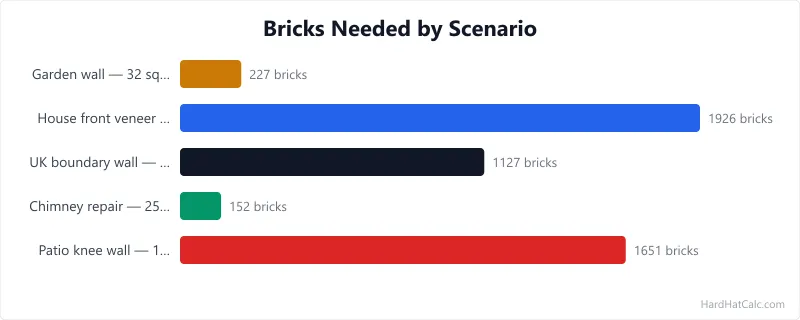
Scenario: A homeowner is laying a 200 sq ft brick veneer wall on the front of a US house using modular brick (3⅝ × 2¼ × 7⅝ in), running bond, ⅜-inch mortar joints, and a 5% waste factor.
Calculation: Bricks per sq ft = 6.75 (modular at ⅜-inch joint, BIA TN 10 Table 4). Bond multiplier = 1.0 (running). Wythe multiplier = 1.0 (single-wythe). Bricks needed = ⌈200 × 6.75 × 1.0 × 1.0 × 1.05⌉ = 1,418. Mortar volume = 1,418 × 14.875 × 0.375 × 3.625 × 0.5 = 14,337 cu in = 8.3 cu ft, × 1.15 waste = 9.5 cu ft. Bags = ⌈9.5 ÷ 0.6⌉ = 16. Brick cost = 1,418 × $0.50 = $709. Mortar cost = 16 × $11 = $176. Total material cost = $885.
What this means: A 200 sq ft modular brick veneer needs **1,418 bricks** and **16 bags of premix mortar**, for about **$885 in materials**. Brick is roughly 80% of the material budget; mortar fills out the rest. Add labour and the wall costs $5–$10 per sq ft installed depending on your region and crew size.
Takeaway: For a typical front-of-house veneer wall, modular brick at running bond is the budget benchmark. Switching to Flemish bond would push the count to 1,890 bricks (+33%) for the same wall area — the bond pattern decision moves a single-storey veneer by about $236 in brick alone ($945 vs $709).
Example 2
Scenario: A homeowner in Northumberland is rebuilding a 6 m² UK garden boundary wall in metric brick (215 × 102.5 × 65 mm), English bond, double-wythe, with 10 mm joints and 5% waste.
Calculation: Wall area = 6 × 10.7639 = 65 sq ft. Bricks per sq ft = 5.5 (UK metric at 10 mm). Bond multiplier = 1.5 (English). Wythe multiplier = 2.0 (double-wythe). Bricks = ⌈65 × 5.5 × 1.5 × 2.0 × 1.05⌉ = 1,127. Mortar volume = 1,127 × 16.54 × 0.394 × 4.04 × 0.5 = 14,839 cu in = 8.6 cu ft, × 1.15 waste = 9.9 cu ft. Bags = ⌈9.9 ÷ 0.6⌉ = 17. Brick cost = 1,127 × $0.55 = $620. Mortar cost = 17 × $11 = $187. Total material cost = $807 (≈ £640 at March 2026 rates).
What this means: A 6 m² double-wythe English-bond UK garden wall needs **1,127 metric bricks** and **17 bags of mortar**, costing about **$807 (≈ £640)**. The English bond and double-wythe combination triples the brick count over a simple single-wythe running-bond wall of the same face area — header courses use roughly 2× bricks per linear foot, and double-wythe doubles the wall thickness.
Takeaway: UK garden walls in traditional English bond cost more in brick but produce a stronger, weather-resistant wall that holds up against UK rain and frost cycles. If budget is the only driver, a single-wythe stretcher-bond wall would need 376 bricks for the same 6 m² — about 33% of the bond-and-thickness upgrade.
Frequently Asked Questions
- How many bricks do I need per square foot of wall?
It depends on the brick format and joint thickness. US modular brick at ⅜-inch joints uses 6.75 bricks per square foot. Queen brick uses 5.5, US standard uses 6.55, and UK metric brick uses 5.5 per square foot at its native 10 mm joint. Multiply the per-square-foot count by your wall area, then by the bond pattern multiplier (1.0 for running or stack, 1.333 for Flemish, 1.5 for English), then add 5–10% for waste. The Brick Industry Association publishes the US counts in Technical Notes 10, Table 4 (675, 655 and 550 per 100 sq ft) and the bond factors in Table 6. The brick-mortar volume tool covers the corresponding question of how much mortar these bricks consume.
- What is the difference between US modular and UK metric brick?
Modular brick (US) measures 3⅝ × 2¼ × 7⅝ inches, so the face shows a 7⅝-inch length and a 2¼-inch height. UK metric brick measures 215 × 102.5 × 65 mm, so the face shows a 215 mm length and a 65 mm height. The two formats use different joint thicknesses (⅜ inch vs 10 mm), different course heights, and different counts per area. They cannot be substituted on the same wall — a wall designed for one format will not line up at corners or openings if you switch to the other. Match the brick format to the existing wall on repair projects, and pick before ordering on new builds. The thermal mass and R-value tool handles the assembly-level performance once the format is locked.
- Does bond pattern change brick quantity?
Yes. Flemish bond uses about one-third more bricks and English bond about one-half more than running bond for the same wall area. Both bonds lay some bricks with the short face exposed: Flemish alternates a header and a stretcher within every course, English alternates whole courses of headers and stretchers. BIA Technical Notes 10 Table 6 gives the correction factors as +1/3 for Flemish and +1/2 for English over a stretcher-only running or stack bond. The aesthetic and structural payoff is real — header bonds tie multi-wythe walls together — but the brick budget needs to reflect it before ordering. The block wall cost calculator shows the equivalent comparison for CMU walls where bond patterns also drive material counts.
- How much waste should I order beyond the calculated count?
Use 5% waste on clean rectangular walls and 10% on walls with multiple openings or cuts. Waste covers bricks broken in transit, bricks cut to fit corners and openings, bricks rejected for colour mismatch (kiln runs vary slightly), and the small over-order needed to round up to the nearest pallet. Brick is sold by the pallet — typically 500–600 modular bricks per pallet — so the practical minimum order rounds the calculated count up. A 600-brick over-order on a 1,500-brick wall is normal and gives you a small reserve for future repairs without re-firing a custom batch later. The concrete curing time tool covers the related question of when masonry can be loaded after the supporting footing has been poured.
- Why do brick prices vary so much between brick types and regions?
Brick price tracks four variables: clay composition (red vs buff vs blended colours), kiln process (machine-made vs hand-moulded), regional shipping distance (brick is heavy — every 100 miles adds $30–$50/pallet), and brick density. Modular red brick from a regional kiln typically runs $0.45–$0.55 per brick in March 2026 US averages. Hand-moulded or blended-colour brick runs $0.75–$1.20 per brick. UK metric brick imported into the US runs $0.55–$0.85 because of shipping and lower stocking volume. Always price-check three local distributors before ordering — quotes for the same brick can vary 15–20% within a single market. Brick from a local kiln is almost always cheaper than the same colour shipped from out of state.
More Materials calculators
Browse all materials calculators — Paint coverage, roofing bundles, tile adhesive, welding time, parking lot sizing, and more.