
Retaining Wall Block Calculator
Free retaining wall block calculator for segmental walls. Enter length and height for block count, courses, base gravel, drainage, and total cost.
Last updated:
Methodology reviewed by Doc. dr. sc. Mladenka Juradin, dipl. ing. građ., PhD, Civil Engineering (FCEAG, University of Split)
Total visible height. Walls over 4 ft typically require engineering.
Horizontal face dimension. Standard: 12 inches.
Vertical face dimension. Common: 4 or 6 inches.
Front-to-back depth. 8 inches for small walls, 12 for taller.
Price per unit from your supplier.
For estimation only. Structural work requires review by a licensed engineer. Local building codes take precedence over any calculator output.
How This Is Calculated
Blocks per course = ceil(wall length in inches / block face length). Courses = ceil(wall height / block face height). Total blocks = blocks per course × courses × 1.10 waste factor. Base gravel = wall length (ft) × 2 ft wide × 0.5 ft deep / 27 cu ft per cu yd. Drainage gravel = wall length (ft) × 1 ft wide × wall height (ft) / 27. Total cost = blocks + gravel ($40/cu yd) + drain pipe ($1/ft) + filter fabric ($0.30/sq ft) + cap adhesive ($5/tube per 20 ft).
Source: Block count calculations based on standard segmental retaining wall unit dimensions per CMHA (formerly NCMA) TEK 2-4B (Segmental Retaining Walls). Drainage and base design per the CMHA Design Manual for Segmental Retaining Walls, 3rd Edition.
6 min read
What Actually Goes Into a Retaining Wall
The blocks themselves are the most visible part of a retaining wall, but they are not the most important. Behind every well-built retaining wall sits a carefully layered system of drainage gravel, filter fabric, and a perforated drain pipe — and that hidden infrastructure determines whether the wall lasts 30 years or leans over in three.
Most homeowners budget for blocks and forget everything else. On a typical 3-foot-high wall, the blocks account for 60–75% of total material cost. The remaining 25–40% goes to drainage gravel, base gravel, filter fabric, a perforated drain pipe, and cap adhesive. That does not sound like much in percentage terms, but on a 40-foot wall it can add $300–$600 to the bill — money that must be spent or the wall fails. Prices and rates on this page are our own estimates as of the date shown; they change often. Enter your own figures for a current result.
The drainage system is not optional. Soil behind a retaining wall absorbs rainfall and irrigation water. Without a path to drain, that water builds hydrostatic pressure against the wall face. A 4-foot wall with saturated soil behind it can experience over 1,000 pounds of lateral pressure per linear foot. No amount of block weight holds against that kind of force without drainage relief. For walls that also serve as foundation elements, applying a vapor barrier on the soil side prevents moisture migration through the block cores.
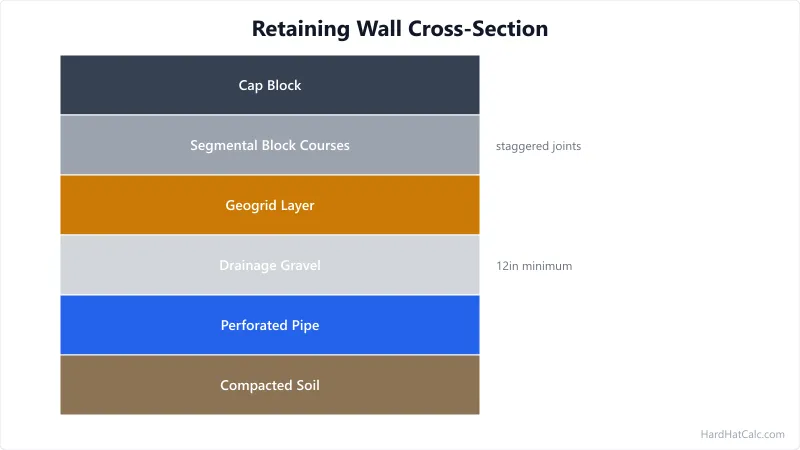
Building a Retaining Wall: Step by Step
Call 811 before digging. Underground utility lines (gas, electric, water, cable) can cause serious injury or death if struck during excavation. This free service marks buried utilities within 48–72 hours.
Excavate the trench. Dig 6 inches deeper than the first course and at least 24 inches wider than the block depth. The trench must extend behind the wall to accommodate drainage gravel. Compact the subsoil at the bottom of the trench with a plate compactor before adding any gravel.
Lay and compact the base gravel. Spread 6 inches of compacted crushed stone (3/4-inch minus) in the trench. Compact in 2-inch lifts. This base distributes the wall’s weight evenly and prevents settling. A level, well-compacted base is the single most important step — every imperfection here amplifies through the entire wall.
Set the first course level. Place the first row of blocks on the compacted base. Check level after every 3–4 blocks. Shim with gravel if needed. The first course must be within 1/8 inch of level over its full length — there is no correcting a crooked base course once higher courses are stacked.
Stack courses with setback. Each course steps back approximately 3/4 inch from the course below it (the built-in lip on most SRW blocks handles this automatically). The setback tilts the wall face into the hillside, which uses gravity to resist the soil pressure pushing outward.
Backfill with drainage gravel. After every 2–3 courses, backfill behind the blocks with clean 3/4-inch crushed stone. The gravel zone should be at least 12 inches wide behind the blocks, extending from the base to within 6 inches of the top.
Install the perforated drain pipe. Place 4-inch perforated corrugated pipe at the base of the wall, holes facing down, on top of the base gravel. Wrap the pipe in filter fabric to prevent soil from clogging the perforations. Route the pipe to daylight at a low point or connect it to a storm drain.
Adhesive-set the cap course. Apply construction adhesive to the top of the final course and press the cap blocks into place. Cap blocks prevent water from entering the wall core and give the wall a finished appearance. The adhesive prevents foot traffic or mower contact from dislodging the cap row.
Block Types and Pricing
| Block Type | Face Size | Depth | Typical Cost (March 2026) | Best For |
|---|---|---|---|---|
| Standard gravity | 12″ × 4″ | 8″ | $3–$6 | Garden walls under 3 ft |
| Standard segmental | 12″ × 4″ | 12″ | $5–$8 | Retaining walls 3–4 ft |
| Large format | 16″ × 6″ | 12″ | $7–$12 | Taller walls, fewer courses |
| Decorative split-face | 12″ × 4″ | 8″ | $6–$10 | Visible landscape walls |
Prices as of March 2026, US national averages from landscape supply and masonry retailers. Regional variation of 15–25% is common. Prices do not include delivery, which typically adds $50–$150 per pallet.
For larger retaining structures using concrete blocks with mortar, the concrete block wall cost calculator estimates the full material list including mortar and rebar. Those figures price the block route; to see how a finished wall stacks up against poured concrete, timber, gabion, and natural stone on a cost-per-square-foot basis, the breakdown of what a retaining wall costs by type sets out the full range before you commit to a material.
Drainage: The Most Important Thing You Cannot See
Water is the enemy of retaining walls. Soil behind the wall absorbs rainfall, creating hydrostatic pressure that pushes the wall outward. Without drainage, a 4-foot wall can experience thousands of pounds of lateral pressure per linear foot after a heavy rain.
The three-part drainage system — gravel backfill, filter fabric, and perforated pipe — collects water behind the wall and channels it to daylight or a storm drain. Cut any one of these three components and the wall’s lifespan drops dramatically.
Gravel backfill creates a free-draining zone immediately behind the blocks. Water that seeps through the soil hits the gravel layer and drops to the base rather than pressing against the wall face. The gravel must be clean, angular crushed stone — not round river rock, which does not interlock and shifts under pressure.
Filter fabric separates the drainage gravel from the native soil. Without it, fine soil particles migrate into the gravel over time, eventually clogging the drainage path. Landscape fabric works for the first year or two; woven geotextile fabric rated for drainage applications lasts the life of the wall.
The perforated drain pipe collects water at the lowest point behind the wall and carries it to a discharge point. The pipe must slope at least 1/8 inch per foot toward the outlet. Wrapping the pipe in filter fabric prevents soil intrusion into the perforations.
If your retaining wall needs reinforced concrete footings rather than a gravel base, you can plan rebar layout for the footing.
Height Limits and When You Need an Engineer
Most jurisdictions limit unengineered segmental retaining walls to 4 feet (48 inches) of exposed height. Some allow up to 6 feet if the wall uses geogrid reinforcement — sheets of polymer mesh that extend back into the retained soil and anchor the wall to the earth behind it.
Above these thresholds, a licensed engineer must design the wall, specify geogrid lengths and spacing, and often stamp drawings for permit. Engineered walls often require reinforced concrete footings where rebar splicing requirements must follow ACI standards. Those footings also pull in a specific mix design for filling and grouting block cores — typically a 3,000 PSI footing mix with a controlled water-cement ratio to handle lateral earth pressure without shrinkage cracking. The engineering adds $500–$1,500 to the project but is mandatory and protects you legally. A failed retaining wall that was built without required engineering approval shifts all liability to the property owner.
Surcharge loads reduce the maximum unengineered height. A surcharge is any load above and behind the wall: a driveway, a structure, a steep slope, or even heavy landscaping equipment parked near the edge. If a car parks within 3 feet of the wall top, treat it as a loaded wall regardless of height. The lateral force from a 4,000-pound vehicle adds the equivalent of 2–3 feet of additional soil pressure.
Terracing is the common workaround for tall grade changes without engineering. Instead of one 6-foot wall, build two 3-foot walls with a 3–4-foot-wide terrace between them. Each wall stays under the engineering threshold, and the terrace provides planting space. The total material cost is higher (two walls, two drainage systems), but you avoid engineering fees and the construction is straightforward.
If your retaining wall includes support columns or piers, size the pier diameter for those point loads.
Worked Examples
Example 1
Scenario: A homeowner building a 30-foot garden retaining wall, 3 feet (36 inches) high, with standard 12" × 4" blocks at $5 each.
Calculation: Blocks per course = ⌈360 / 12⌉ = 30. Number of courses = ⌈36 / 4⌉ = 9. Base blocks = 30 × 9 = 270, plus 10% waste = 297 blocks. Base gravel = 30 × 2 × 0.5 / 27 = 1.11 cu yd. Drainage gravel = 30 × 1 × 3 / 27 = 3.33 cu yd. Block cost = 297 × $5 = $1,485. Gravel = 4.44 × $40 = $177.60. Drain pipe = $30. Fabric = $27. Adhesive = $10. Total ≈ $1,730.
What this means: Nearly 300 blocks for a 30-foot wall at 3 feet high — the block count climbs quickly with height because you add an entire course (30 blocks) for every 4 inches of height. Each added course costs another $150 in blocks alone.
Takeaway: Drainage gravel is the hidden material cost — at 3.33 cubic yards behind this wall, it costs three times the base gravel and more than twice the drain pipe and fabric combined. Skimping on drainage is the number one cause of retaining wall failure.
Example 2
Scenario: A contractor pricing a 40-foot retaining wall at 4 feet high using heavier 16" × 6" blocks at $8 each.
Calculation: Blocks per course = ⌈480 / 16⌉ = 30. Number of courses = ⌈48 / 6⌉ = 8. Base blocks = 30 × 8 = 240, plus 10% waste = 264 blocks. Base gravel = 40 × 2 × 0.5 / 27 = 1.48 cu yd. Drainage gravel = 40 × 1 × 4 / 27 = 5.93 cu yd. Block cost = 264 × $8 = $2,112. Gravel = 7.41 × $40 = $296.40. Drain pipe = $40. Fabric = $48. Adhesive = $10. Total ≈ $2,506.
What this means: The larger blocks cost more per unit but require fewer courses (8 vs 12 if using 4-inch blocks for the same height), reducing courses from 12 to 8 and cutting labour time by about a third. At $2,500 for materials, add $2,000–$4,000 for professional installation of a 40-foot, 4-foot-high wall.
Takeaway: At 4 feet high, this wall is at the threshold where most jurisdictions require engineering. Check your local code — many limit unengineered segmental walls to 4 feet (48 inches). Going even one course higher typically triggers an engineered design that adds $500–$1,500 to the project.
Frequently Asked Questions
- How many retaining wall blocks do I need per linear foot?
For standard 12-inch × 4-inch blocks, you need 1 block per linear foot per course. A 3-foot (36-inch) wall has 9 courses, so you need 9 blocks per linear foot plus 10% for cuts and waste — roughly 10 blocks per linear foot. Larger 16-inch × 6-inch blocks drop this to about 5 blocks per linear foot at the same height. Always round up and add a waste factor, especially for walls with curves or corners that require more cutting. For mortared CMU block walls with rebar reinforcement, the concrete block wall cost calculator handles the full material list including mortar and grout. Engineered walls with poured concrete elements should also check lateral concrete pressure on formwork before pouring.
- How high can a retaining wall be without engineering?
Most US jurisdictions follow the IRC, which limits unengineered segmental retaining walls to 4 feet (48 inches) of exposed height. Some local codes set the limit at 3 feet. Walls with surcharge loads (driveways, buildings, or slopes above) may require engineering regardless of height. Above the local limit, a geotechnical or structural engineer must design the wall including geogrid reinforcement, drainage, and footings. Check your local building department before starting — code limits vary by jurisdiction. If engineering is required and the design calls for a poured concrete footing, spec pier footings for any support columns.
- What kind of gravel goes behind a retaining wall?
Use clean, angular crushed stone, typically 3/4-inch minus (also called drainage gravel or #57 stone). Avoid round river rock — angular stone interlocks and drains better. The gravel serves two purposes: it drains water away from the wall face and provides a granular mass behind the blocks that reduces lateral earth pressure. Never use soil, sand, or pea gravel as retaining wall backfill — they hold water or shift too easily under lateral load. If the wall location requires digging out existing soil first, the soil-removal volume tool estimates how much material you need to remove.
- Do retaining wall blocks need mortar?
No. Segmental retaining wall blocks are designed for dry-stack construction — they interlock through gravity, weight, and a setback that leans each course into the hillside. The only adhesive is construction adhesive applied to the cap course to prevent wind or foot traffic from displacing the top blocks. Mortar-set retaining walls use a different block type (standard CMU) and a completely different construction method with rebar-reinforced cores and structural footings. For a full rundown on mortar types and estimating quantities, use the mortar tool when planning a mortared wall instead.
- How much does a block retaining wall cost per linear foot?
Material cost ranges from $10–$35 per linear foot for a 2-foot wall to $40–$120 per linear foot for a 4-foot wall, depending on block type and height. These figures include blocks, drainage gravel, base gravel, drain pipe, filter fabric, and cap adhesive — as of March 2026, US national averages. Professional installation adds $15–$30 per square foot of wall face (this figure ships unverified: its RS Means attribution was withdrawn on 2026-08-22 and no industry source publishes an installed rate), making total installed cost for a 4-foot wall roughly $80–$200 per linear foot including materials and labour. If the wall also serves as a fence boundary, factor in the additional fencing materials on top of the block wall structure.
More Structural calculators
Browse all structural calculators — Beam sizing, truss pricing, load calculations, wall framing, deck capacity, and foundation tools.