
Rebar Lap Splice Calculator
Free rebar lap splice calculator per ACI 318. Enter bar size #3-#10, concrete PSI, coating, and splice class for the required overlap length in inches.
Last updated:
Methodology reviewed by Doc. dr. sc. Mladenka Juradin, dipl. ing. građ., PhD, Civil Engineering (FCEAG, University of Split)
Bar number equals eighths of an inch in diameter. #5 = 5/8" diameter.
Compressive strength of concrete. 3,000 PSI is residential minimum; 4,000 PSI is standard for foundations.
Epoxy-coated bars need longer splices because the coating reduces bond with concrete.
Class B applies when more than half the bars are spliced at the same cross-section. Most field splices are Class B.
Standard means cover is at least one bar diameter and clear spacing between bars is at least twice the diameter.
For estimation only. Structural work requires review by a licensed engineer. Local building codes take precedence over any calculator output.
How This Is Calculated
Development length ld = (fy × ψt × ψe) / (D × λ × √f'c) × db × confinement factor, where D is the ACI simplified-method size-class divisor: 25 for bars #6 and smaller, 20 for #7 and larger (the bar-size effect lives in the divisor — no separate ψs). Lap splice length = ld × splice class multiplier (Class A: 1.0, Class B: 1.3), rounded up to the nearest inch. fy = 60,000 PSI (Grade 60 rebar). ψt = 1.0 (bottom bars), ψe = 1.0 (uncoated) or 1.5 (epoxy, conservative), λ = 1.0 (normal-weight concrete). Confinement factor 1.5 for tight cover/spacing. Bar diameters per ASTM A615 (#9 = 1.128 in, #10 = 1.270 in). Minimum development length and lap splice: 12 inches.
Source: Development length per ACI 318-19 Table 25.4.2.3 (simplified method: divisor 25 for #6 and smaller, 20 for #7 and larger). Lap splice classes per ACI 318-19 Table 25.5.2.1. Bar diameters per ASTM A615/A615M. Output values reconciled July 2026 against the ATC/SEAOC Class B lap splice design aid (Grade 60, normal-weight, uncoated bottom bars). Re-checked September 2026 against three free published tables: Dayton Superior Rebar Splicing Handbook Table 1.11 prints the same eight Class B lap lengths at 3,000 and 4,000 PSI for uncoated bottom bars, and both the WSDOT Bridge Design Manual Appendix 5.1-A7 and TxDOT Standard Specification Item 440 Table 6 apply the same 1.5 multiplier to epoxy-coated bars.
5 min read
The Formula Behind Rebar Lap Splices
The rebar lap splice calculator works out how much two reinforcing bars must overlap inside concrete to transfer the full tensile force from one bar to the next. Every time a bar run exceeds the stock length (typically 20 feet), or where two pours meet, the steel must be lapped — and the overlap distance depends on the bar size, concrete strength, coating, and how many bars share the same splice point. Each bar number maps to a fixed diameter, which is the starting point for the overlap; the reference chart of rebar diameters and weights lists every designation from #3 to #18.
The underlying formula comes from ACI 318-19 (the American Concrete Institute's Building Code Requirements for Structural Concrete), sections 25.4 and 25.5. It first calculates the development length — the embedment needed for concrete to grip a single bar tightly enough to resist its full yield strength. The lap splice length then multiplies that development length by a class factor: 1.0 for Class A splices (where half or fewer bars overlap at one location) and 1.3 for Class B splices (where more than half do).
The calculation uses several modification factors that account for real conditions. Epoxy-coated bars (the green ones used in corrosive environments) bond less effectively with concrete, so they need a 50% longer development length. Smaller bars (#6 and under) develop faster relative to their diameter, which the ACI simplified method captures with a gentler size-class divisor (25 instead of the 20 used for #7 and larger). Cover and clear spacing matter too — bars with generous cover and wide spacing transfer force more efficiently than bars crammed together with minimal cover. The concrete strength f'c sits inside the √f'c term in the formula, which is why a 4,000 PSI mix produces shorter splices than a 3,000 PSI mix at the same bar size — how concrete strength is set by the mix proportions covers the cement-and-water ratio behind that compressive strength rating.
When figuring how much rebar to order, add the lap splice length to every joint. On a 60-foot foundation wall using 20-foot bars, each horizontal run needs two splices. That is two extra 31-inch overlaps per bar — just over 5 extra feet of steel per line. A rebar grid sizing tool can help you size the overall steel order once you know the splice lengths, and a pad-volume sizing tool determines the dimensions that drive your bar layout.
Real-World Splice Length Reference
This table shows calculated lap splice lengths for common rebar sizes in 4,000 PSI normal-weight concrete, uncoated bars, Class B splices, with standard cover conditions. These are the most frequent field conditions.
| Bar Size | Diameter (in) | Development Length (in) | Class B Lap Splice (in) | Class B Lap Splice (ft) |
|---|---|---|---|---|
| #3 | 0.375 | 14.23 | 19 | 1.58 |
| #4 | 0.500 | 18.97 | 25 | 2.08 |
| #5 | 0.625 | 23.72 | 31 | 2.58 |
| #6 | 0.750 | 28.46 | 37 | 3.08 |
| #7 | 0.875 | 41.50 | 54 | 4.50 |
| #8 | 1.000 | 47.43 | 62 | 5.17 |
| #9 | 1.128 | 53.51 | 70 | 5.83 |
| #10 | 1.270 | 60.24 | 79 | 6.58 |
Note the jump between #6 and #7 — the ACI simplified method switches its size-class divisor from 25 to 20 at that boundary, which increases the development length by a quarter in one step. Epoxy-coated bars add 50% to these figures, and "other" cover conditions (tighter spacing or less cover) add another 50%. The concrete mix ratio calculator can verify your target strength if you are batching on site rather than ordering ready-mix.
Every row above was checked in September 2026 against Dayton Superior's published ACI 318 lap splice table, which prints the same eight Class B figures for 4,000 PSI uncoated bottom bars in normal-weight concrete, and the same eight again at 3,000 PSI. Highway work is a different matter: state transportation agencies set a floor of their own on top of the code calculation, so a splice that satisfies ACI 318 can still be short on a bridge or culvert. The Washington State DOT bridge manual sets a 24-inch minimum tension lap for every bar size, and the Texas DOT reinforcing specification tabulates a 16-inch minimum lap for #3 bar rising to 8 ft 11 in for #10. On state-funded structures, use the agency table rather than this one.
For projects where rebar sits in contact with earth or moisture — retaining walls, below-grade walls, marine structures — consider epoxy coating. The longer splices cost extra steel, but the corrosion protection extends the service life of the structure by decades. The below-grade barrier tool covers the exterior barrier side of below-grade protection.
What to Watch For on Site
Why does splice class matter so much? Splice class reflects how much of the cross-section is relying on the splice to carry load. When every bar in a wall or footing overlaps at the same horizontal line (Class B), the concrete at that section must transfer twice the force — from the ending bar and into the continuing bar simultaneously. The 1.3 multiplier accounts for this stress concentration. Staggering splices so that no more than half the bars overlap at any one section drops you to Class A, which means shorter overlaps and less waste.
What happens if the lap splice is too short? A short splice fails by pulling apart under tension. The bar slips out of the concrete rather than yielding, and the failure is sudden — there is no warning deflection or gradual cracking. This is why ACI 318 sets minimum development lengths conservatively and why inspectors measure splice lengths during rebar inspection. On a retaining wall, a failed splice could lead to structural collapse under soil pressure.
Can I use mechanical couplers instead of lap splices? Yes, and they are increasingly common on commercial jobs. Mechanical couplers (threaded or swaged connections) join two bars end-to-end without any overlap. They save steel, reduce congestion in tight areas, and can be tested to full bar strength. The trade-off is cost — roughly $40–$60 each for a #5 mechanical coupler (retail, 2026) against roughly $2 of extra rebar for a lap splice; installed bid prices run far higher. Prices and rates on this page are our own estimates as of the date shown; they change often. Enter your own figures for a current result. Couplers make sense when bar congestion is a problem or when splicing is physically difficult, such as in heavily reinforced columns.
Worked Examples
Example 1
Scenario: A contractor is forming a 60-foot-long foundation wall with #5 rebar running horizontally. The concrete mix is 4,000 PSI, the bars are uncoated, and more than 50% of the bars are spliced at the same cross-section (Class B). Cover exceeds one bar diameter and clear spacing exceeds twice the bar diameter.
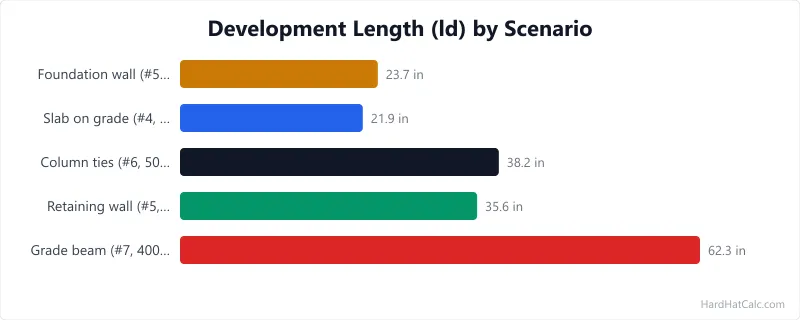
Calculation: Bar diameter db = 0.625 in. fy = 60,000 PSI. f'c = 4,000 PSI. ψt = 1.0 (bottom bars), ψe = 1.0 (uncoated). Size-class divisor = 25 (#6 and smaller). Confinement factor = 1.0 (standard cover). λ = 1.0 (normal-weight concrete). ld = (60,000 × 1.0 × 1.0) / (25 × 1.0 × √4,000) × 0.625 = (60,000) / (25 × 63.246) × 0.625 = (60,000 / 1,581.14) × 0.625 = 37.95 × 0.625 = 23.72 in. Class B multiplier = 1.3. Lap splice = 23.72 × 1.3 = 30.84 in → rounded up to 31 in. ACI 318 minimum 12 in met.
What this means: Each horizontal bar overlap in this foundation wall must be at least 31 inches. With standard 20-foot rebar lengths in a 60-foot wall, each horizontal run needs two splices — three bars lapped together at the joints.
Takeaway: For #5 uncoated bar in 4,000 PSI concrete, plan on 31 inches of overlap per Class B splice. Mark splice locations on the forms before placing steel so the crew keeps overlaps consistent.
Example 2
Scenario: A homeowner is reinforcing a 16 × 24 ft slab on grade with #4 rebar at 12-inch spacing. The concrete is 3,000 PSI, bars are uncoated, and fewer than 50% of bars are spliced at any one location (Class A). Standard cover conditions apply.
Calculation: Bar diameter db = 0.500 in. fy = 60,000 PSI. f'c = 3,000 PSI. ψt = 1.0, ψe = 1.0. Size-class divisor = 25 (#6 and smaller). Confinement factor = 1.0, λ = 1.0. ld = (60,000 × 1.0 × 1.0) / (25 × 1.0 × √3,000) × 0.500 = (60,000) / (25 × 54.772) × 0.500 = (60,000 / 1,369.31) × 0.500 = 43.82 × 0.500 = 21.91 in. Class A multiplier = 1.0. Lap splice = 21.91 × 1.0 = 21.91 in → rounded up to 22 in. ACI 318 minimum 12 in met.
What this means: Each splice in this slab needs at least 22 inches of overlap. Since the slab is 24 feet in one direction, any bars running that way need at least one splice if using 20-foot stock lengths — budget 22 inches of extra bar per splice location.
Takeaway: Class A splices in light-duty slabs are shorter than many contractors assume. Stagger splice locations so no more than half the bars overlap at the same point along the slab.
Frequently Asked Questions
- How long should a rebar lap splice be for #5 bar?
In 4,000 PSI concrete with standard cover and uncoated bars, a Class B lap splice for #5 rebar is 31 inches (about 2 feet 7 inches). Class A drops to 24 inches. These figures assume normal-weight concrete and bottom bar placement. Epoxy-coated #5 bar needs a 47-inch Class B splice — 50% longer — because the coating reduces the bond between the bar and the surrounding concrete. Always round up to the nearest inch and verify against your project engineer's splice schedule before cutting steel.
- What is the difference between Class A and Class B rebar splices?
Class A applies when no more than half the bars in a cross-section are spliced at the same location, and the actual steel area provided is at least twice what the design requires. Class B covers everything else — which in practice means most field conditions, since contractors often find it simpler to splice all bars at one construction joint rather than staggering them. Class B multiplies the development length by 1.3, adding roughly 30% more overlap. Staggering splices to qualify for Class A saves steel but takes more planning during layout.
- Does epoxy-coated rebar need a longer lap splice?
Yes. Epoxy-coated rebar (the green bars) requires a 50% longer development length compared to uncoated black bar. The epoxy layer creates a smoother surface that bonds less effectively with the cement paste in the concrete. For a #5 bar in 4,000 PSI concrete, the Class B splice jumps from 31 inches (uncoated) to 47 inches (epoxy-coated). Despite the longer splices and higher cost, epoxy coating is worth it for any concrete exposed to de-icing salts, seawater, or prolonged moisture. The concrete curing time calculator can help you plan the cure schedule — proper curing also improves the concrete-to-rebar bond.
- Where should rebar lap splices be located in a beam or wall?
Place splices away from points of maximum stress. In a simply supported beam, the highest tension is at mid-span, so splices belong in the outer thirds of the span. In walls, avoid splicing directly at the base where bending moment peaks under lateral load. ACI 318-19 §25.5.1 also requires that splices be staggered — if you must splice multiple bars, offset them so no more than half overlap at the same point along the member. Poor splice placement is one of the most common rebar inspection failures on residential foundations.
- What is the minimum rebar lap splice length per ACI 318?
ACI 318-19 sets an absolute minimum lap splice of 12 inches, regardless of the development length calculation. In practice, this minimum only governs for very small bars (#3) in high-strength concrete. For the bar sizes and concrete strengths used in most residential and commercial work (#4 through #8, 3,000–5,000 PSI), the calculated splice length always exceeds 12 inches. The 12-inch floor exists as a safety net to ensure that even in the best conditions, there is always a meaningful overlap transferring load between bars. Highway agencies are stricter than the building code here: WSDOT sets a flat 24-inch minimum tension lap, and TxDOT starts at 16 inches for #3 bar, so check the governing agency table before cutting steel on public work.
More Structural calculators
Browse all structural calculators — Beam sizing, truss pricing, load calculations, wall framing, deck capacity, and foundation tools.