
Underlayment Calculator
Underlayment calculator for laminate, LVP, hardwood, and tile. Enter floor area and subfloor type for roll or sheet count, seam tape, and moisture barrier.
Last updated:
Total floor area to be covered with underlayment.
Each flooring type requires a specific underlayment for best performance.
Concrete subfloors need moisture protection. Wood subfloors need sound and cushion.
Concrete subfloors and below-grade rooms need a separate moisture barrier or integrated underlayment.
Square feet one roll or sheet covers, printed on your product's packaging. Sizes vary widely by product: AcoustiCORK's cork sheet covers 6 sq ft and FloorMuffler's contractor-size foam roll covers 600 sq ft. Defaults to the size a maker prints for the flooring type selected above (100 sq ft foam, 200 sq ft cork, 54 sq ft crack-isolation membrane) — check your box and change it if it differs.
How This Is Calculated
Product selected by flooring-type × subfloor-type matrix. Units = floor area × 1.05 overage ÷ coverage per unit (an editable input; defaults to 100 sq ft foam, 200 sq ft cork, 15 sq ft cement board, 54 sq ft crack-isolation membrane, or 32 sq ft plywood by product — enter your own package size if it differs). Seam tape = floor area ÷ 25 linear feet ÷ 180 ft per roll. Cost = units × product cost + tape rolls × $8.
Source: Foam roll coverage (100 sq ft) is confirmed by two makers: MP Global QuietWalk and FloorMuffler LVT UltraSeal each print a 100 sq ft standard roll (FloorMuffler also sells a 600 sq ft contractor roll). Cork roll coverage (200 sq ft) is the AcoustiCORK T51 packaging (48 in x 50 ft x 2mm); AcoustiCORK also sells a 6 sq ft sheet (S130) — both are one manufacturer's sizes, not a cross-maker consensus, so coverage per roll or sheet is an editable input defaulting to 200 sq ft for cork. Crack-isolation membrane coverage (54 sq ft) is the Schluter DITRA 5M packaging, inside an opened 10 to 323 sq ft spread across three makers (Custom EasyMat 40/120/300/400 sq ft, LATICRETE Strata_Mat 10/150/323 sq ft, Schluter DITRA 54/150/323 sq ft); also editable, defaulting to 54 sq ft. Cement board (15 sq ft, a 3x5 ft sheet) and plywood/hardboard (32 sq ft, a 4x8 ft sheet) are definitional sheet sizes carried over from the USG Durock and James Hardie HardieBacker installation guides; those two were not re-opened this pass. Coverage figures read 2026-09-02 (SF20-A7, Q-A6-11).
7 min read
Choosing Underlayment by Flooring Type
The Underlayment Calculator matches your flooring type and subfloor condition to the right underlayment product. Picking the wrong one causes noise, moisture damage, or voided flooring warranties. Follow this decision path.
Laminate flooring: Use foam underlayment rolls. Standard foam (2–3 mm thick) provides cushion and minor sound dampening. Over concrete subfloors, choose foam with an integrated polyethylene moisture barrier film — this is a single product that serves both functions. Most laminate manufacturers require underlayment and will void the warranty without it. Do not double up layers — two layers of foam create too much cushion, causing the click-lock joints to separate under foot traffic.
Luxury vinyl plank (LVP): Use thin foam (1–1.5 mm). LVP is already resilient and does not need the cushion that laminate requires. Thick underlayment under LVP makes the floor feel spongy and can cause plank edges to telegraph through the surface. Some LVP products come with pre-attached underlayment — adding a second layer voids the warranty. Check the box before buying separate underlayment.
Engineered hardwood: Cork underlayment provides the best combination of sound absorption, cushion, and thermal insulation. Cork ships both ways — AcoustiCORK's T51 roll covers 200 sq ft and its S130 sheet covers 6 sq ft — so enter the coverage printed on your own product rather than assuming a size. Cork costs more than foam but delivers higher STC and IIC ratings, which matter for upper floors in multi-storey homes. Foam rolls work as a budget alternative.
Ceramic or porcelain tile over plywood: Cement board underlayment is required. Tile cannot be set directly on plywood — the flex causes thinset bond failure and grout cracking. Cement board (¼-inch or 7/16-inch thick) provides the rigid, moisture-stable surface tile needs. Screw cement board to the subfloor every 8 inches with cement board screws, tape the seams with alkali-resistant mesh tape, and thin-set the tape joints.
Tile over concrete: A crack isolation membrane replaces cement board. Concrete slabs can develop hairline cracks from settling or curing shrinkage — these cracks telegraph through tile and grout without an isolation layer. Roll-on or sheet membranes decouple the tile from the slab, absorbing crack movement up to 1/8 inch.
Sheet vinyl over plywood: Use ¼-inch plywood or hardboard underlayment. Sheet vinyl conforms to every imperfection in the subfloor — seams, screw heads, grain texture — and telegraphs them through the surface. The smooth hardboard layer creates a flat, uniform substrate. Nail or staple every 4 inches along edges and 6 inches in the field.
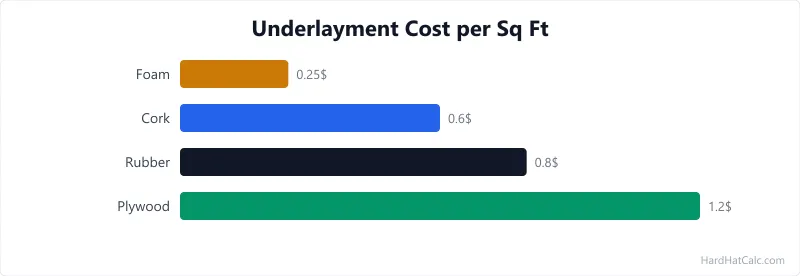
How Subfloor Condition Affects Underlayment Performance
Underlayment compensates for subfloor imperfections, but it cannot fix fundamental structural problems. Before laying any underlayment, check three things: flatness, moisture, and structural soundness.
Flatness matters because floating floors (laminate, LVP, engineered hardwood) amplify any bump or dip in the subfloor. Industry standard is 3/16 inch of variation over a 10-foot span. Use a straightedge to check — lay it across the floor and look for gaps. High spots get ground down with a floor sander or concrete grinder. Low spots get filled with floor-levelling compound. Foam underlayment absorbs minor imperfections (1/16 inch or less) but cannot bridge a ½-inch dip.
Moisture is the silent floor killer. Concrete slabs emit water vapour continuously, even years after pouring. This moisture migrates upward through the slab and into any floor material that is not protected. Over plywood subfloors, moisture comes from below (crawl space humidity, basement dampness) and from above (spills, pet accidents). For concrete slabs, perform an ASTM F1869 calcium chloride test or ASTM F2170 relative humidity probe test before installing any floor system. If emissions exceed the flooring manufacturer's limit (typically 3 lbs/1000 sq ft/24 hrs for laminate), apply a vapor barrier before the underlayment.
Structural soundness means the subfloor does not bounce, creak, or flex excessively under foot traffic. A plywood subfloor over joists should meet L/360 deflection limits for tile and L/180 for resilient flooring. If the floor bounces when you walk across it, the joists may be undersized, overspanned, or both — adding underlayment on top of a bouncing subfloor does not fix the underlying problem. The floor joist size calculator can help verify whether the existing joists support the intended floor system.
Underlayment Coverage and Cost Reference
The table below shows underlayment product types, coverage per unit, and approximate costs as of March 2026 (US national averages). All figures assume 5% overage for seams and wall-edge trim. Coverage is the calculator's editable default — enter the figure printed on your own product's packaging if it differs.
| Product | Packaging | Coverage | Cost / Unit | Best For |
|---|---|---|---|---|
| Standard foam roll (2-3 mm) | Roll | 100 sq ft | $20–$30 | Laminate, LVP over wood subfloor |
| Foam + moisture barrier | Roll | 100 sq ft | $28–$38 | Laminate, LVP over concrete |
| Cork (6 mm) | Roll or sheet | 200 sq ft (roll) / 6 sq ft (sheet) | $18–$28 | Engineered hardwood, sound reduction |
| Cement board (¼") | 3×5 ft sheet | 15 sq ft | $10–$14 | Tile over plywood |
| Crack isolation membrane | Roll | 54 sq ft | $30–$45 | Tile over concrete |
| Hardboard (¼") | 4×8 ft sheet | 32 sq ft | $14–$22 | Sheet vinyl over plywood |
Seam tape adds $6–$10 per roll (180 linear feet). Most rooms under 300 sq ft need only 1 roll of tape. Larger rooms or rooms with many seams (L-shaped layouts, closets) may need 2 rolls.
For tile underlayment (cement board), you also need cement board screws ($8–$12 per box of 200) and alkali-resistant mesh tape ($8–$12 per roll of 150 ft). Standard drywall tape and screws are not suitable — they corrode and fail in the alkaline environment of thinset mortar.
Sound Ratings: When Underlayment Choice Matters Most
In single-storey homes over crawl spaces, sound performance is a minor consideration — the floor assembly is not transmitting noise to occupied space below. In multi-storey homes, apartments, and condominiums, underlayment sound ratings directly affect livability and may be code-required.
Two ratings define floor sound performance. STC (Sound Transmission Class) measures airborne sound (voices, music, TV) passing through the assembly. IIC (Impact Insulation Class) measures impact sound (footsteps, dropped objects, chair legs) transmitted through the structure. Most building codes require STC 50 and IIC 50 for floor-ceiling assemblies between dwelling units.
Standard foam (2-3 mm) provides STC 58–65 and IIC 58–65 over most subfloors. It meets code minimums for most residential construction and costs the least. Adequate for ground-floor and single-storey applications where impact noise transmission is not a concern.
Premium foam (5-6 mm) improves to STC 65–72 and IIC 65–72. The thicker profile absorbs more impact energy, noticeably reducing the footstep sound transmitted to the floor below. Use premium foam in upper floors of multi-storey homes and anywhere noise reduction matters.
Cork (6 mm) delivers the highest ratings of the common underlayment types: STC 65–73 and IIC 68–76. Cork's cellular structure absorbs both airborne and impact sound more effectively per millimetre than foam. The trade-off is cost — cork underlayment runs 40–60% more than standard foam per square foot. For condominiums with strict HOA sound requirements or upper-floor bedrooms over living spaces, cork often pays for itself in neighbour relations.
Cement board and hardboard provide no meaningful sound improvement — they are rigid and transmit impact noise freely. If you need sound reduction under tile, specify a rubber or cork anti-fracture membrane instead of cement board alone. Some products (e.g., Schluter DITRA-SOUND) combine crack isolation with IIC improvement.
If your drywall installation includes ceiling work below the floor in question, adding resilient channel to the ceiling joists provides another 8–12 points of IIC improvement on top of whatever the underlayment contributes.
Installation Mistakes That Void Warranties
Underlayment installation seems simple — roll it out, tape the seams, lay the floor. But several common mistakes void flooring warranties and create problems that are expensive to fix after the flooring is installed.
Overlapping seams instead of butting them. Foam and cork underlayment seams should butt edge-to-edge, not overlap. Overlapping creates a ridge that telegraphs through floating floors as a visible line. Tape the butt seam with the manufacturer's specified tape to prevent the edges from separating.
Skipping the moisture test on concrete. Most flooring warranties require a documented moisture test (ASTM F1869 or F2170) on concrete subfloors. If the flooring fails due to moisture and you cannot produce test results, the warranty claim is denied. The test kit costs $20–$30 and takes 24–72 hours. Cheap insurance.
Using the wrong underlayment thickness. More is not better. Laminate click-lock joints are engineered for a specific deflection range. Too-thick underlayment causes the joints to flex excessively, creating gaps and squeaks. Too-thin underlayment provides inadequate sound and cushion. Follow the flooring manufacturer's specification — it is printed on the box or in the installation guide.
Running underlayment up walls. Underlayment should stop at the wall edge. Running it up the wall creates a ramp that lifts the first row of flooring and prevents the baseboard from sitting flat. Cut the underlayment flush with the wall line, leaving the recommended expansion gap (typically ¼ to ⅜ inch) between the flooring and the wall.
Nailing through underlayment. Foam and cork underlayment should never have nails or staples driven through it. The underlayment must float freely to absorb floor movement. Cement board and hardboard underlayment are different — they must be mechanically fastened to the subfloor to prevent movement.
Worked Examples
Example 1
Scenario: A homeowner is installing laminate flooring in a 500 sq ft basement over a concrete slab. Moisture barrier is needed because the slab is at grade.
Calculation: Product: foam roll with integrated moisture barrier. Coverage: 100 sq ft/roll. Cost: $25 + $8 moisture upgrade = $33/roll. Adjusted area: 500 × 1.05 = 525 sq ft. Rolls = ⌈525 ÷ 100⌉ = 6 rolls. Tape: 500 ÷ 25 = 20 lf → ⌈20 ÷ 180⌉ = 1 roll. Cost = 6 × $33 + 1 × $8 = $206.
What this means: The basement needs 6 rolls of moisture-barrier foam underlayment and 1 roll of seam tape at roughly $206. The moisture barrier prevents concrete slab moisture from wicking up through the laminate, which causes warping and mould growth.
Takeaway: Never skip the moisture barrier over concrete. Even slabs that feel dry emit enough vapour to damage floating floors within 6–12 months. An ASTM F1869 calcium chloride moisture test costs under $30 and tells you exactly how much vapour the slab emits.
Example 2
Scenario: A contractor is prepping a 60 sq ft bathroom floor for tile installation over a plywood subfloor.
Calculation: Product: cement board sheets (3×5 ft, 15 sq ft each). Cost: $12/sheet. Adjusted area: 60 × 1.05 = 63 sq ft. Sheets = ⌈63 ÷ 15⌉ = 5 sheets. Tape: 60 ÷ 25 = 2.4 lf → 1 roll (alkali-resistant mesh tape for cement board). Cost = 5 × $12 + 1 × $8 = $68.
What this means: Five cement board sheets and one roll of mesh tape at $68 provides the rigid, moisture-resistant substrate that tile requires over plywood. The cement board adds 7/16 inch of floor height — check that the transition to adjacent rooms is acceptable before installing.
Takeaway: Tile over bare plywood fails. Plywood flexes under load and swells with moisture, cracking thinset and grout within months. Cement board bridges the gap between a flexible wood subfloor and the rigid tile surface, absorbing flex without cracking. Confirm the [floor joist size](/calculators/structural/floor-joist-size-calculator) supports the added weight of cement board plus tile.
Frequently Asked Questions
- What type of underlayment do I need for laminate flooring?
Laminate flooring requires foam underlayment, typically 2–3 mm thick. Over plywood or OSB subfloors, standard foam provides adequate cushion and sound dampening. Over concrete subfloors, use foam with an integrated polyethylene moisture barrier to prevent slab moisture from reaching the laminate. Check your laminate manufacturer's installation guide — some specify maximum underlayment thickness, and exceeding it voids the warranty. If your laminate has pre-attached underlayment padding, do not add a second layer. For concrete slabs, the vapor barrier calculator estimates poly sheeting and tape if you need a separate moisture barrier.
- Can I install flooring underlayment over concrete?
Yes, but you must address moisture first. Concrete slabs emit water vapour continuously, and this moisture damages laminate, LVP, and hardwood flooring from below. Use underlayment with an integrated moisture barrier, or install a separate 6-mil polyethylene vapour barrier beneath standard underlayment. Before installation, test the slab moisture level using ASTM F1869 (calcium chloride) or ASTM F2170 (relative humidity probe). Most flooring manufacturers require moisture emissions below 3 lbs/1000 sq ft/24 hrs. Confirm the slab weight and thickness before adding flooring loads, especially on upper-storey or elevated slabs.
- Do I need underlayment if my subfloor is plywood?
Yes, for floating floors (laminate, LVP, engineered hardwood). Underlayment cushions the floating floor against the subfloor, reduces sound transmission, and absorbs minor subfloor imperfections. For glue-down flooring, underlayment is not needed — the adhesive bonds directly to the subfloor. For tile, the underlayment is cement board, which is screwed to the plywood to create a rigid, moisture-stable substrate for thinset and tile.
- How much overlap should underlayment seams have?
Underlayment seams should not overlap — they should butt edge-to-edge and be sealed with tape. Overlapping creates a ridge under floating floors that shows through the surface as a visible line and can prevent click-lock joints from engaging properly. Use the tape specified by the underlayment manufacturer (usually a polyethylene seam tape). The only exception is the moisture barrier film: if using a separate poly sheet under the underlayment, overlap those seams by 6–8 inches and tape them to create a continuous moisture seal. Verify the floor joist sizing before installing underlayment — bouncy joists cause flooring failures that no underlayment can prevent.
More Materials calculators
Browse all materials calculators — Paint coverage, roofing bundles, tile adhesive, welding time, parking lot sizing, and more.