
Thinset Calculator
Free thinset calculator for modified and unmodified mortar. Enter tile area, bag coverage, and product type for bag count, weight, and cost estimates.
Last updated:
Total area to be tiled, excluding areas like tub basins or pre-tiled sections.
Modified for most jobs. Unmodified over uncoupling membranes. LHT for tiles over 15×15.
Back-buttering adds 15-20% more thinset but improves bond coverage for large tiles.
Pick your notch from the coverage table below by tile size, then enter that notch's default — or your own product's printed number — here. Defaults to 87.5 sq ft (1/4" square notch, the median of nine makers' printed figures per 50-lb bag). A preset below sets this automatically for its notch and tile class.
How This Is Calculated
Base coverage is the Bag Coverage input, an editable field that defaults to this site's per-notch figure (87.5 sq ft per 50-lb bag at 1/4" square, 40 at 1/2" square, 92.5 at 3/16" V, 60 at 3/8" square: the makers' printed medians) but reads your own product's printed coverage if you enter it. LHT mortar: no coverage adjustment (one LHT bag covers what one traditional bag covers, per Merkrete and Custom). Back-buttering multiplier: ×0.83 (this site's own allowance). Waste factor: ×0.9. Bags = area ÷ adjusted coverage, rounded up. Cost = bags × cost per bag.
Source: Per-notch Bag Coverage defaults are the makers' printed medians per 50-lb bag, set 2026-09-12 (SF22-HHC-F1 E5, seat-ruled 2026-09-07) from the data sheets opened and hashed on relays HHPK9354 and LQRM7238 (40-lb bags scaled by 1.25). 1/4" square 87.5: the median of nine maker tables, ARDEX X 77 137.5, TEC Fast Set Ultimate 120.6, HENRY 527 95, Custom MultiSet / FlexBond / VersaBond 90, LATICRETE 253 Gold 87.5, MAPEI Ultraflex 2 82.5, Bostik Tile-Mate / PM 75, Merkrete 710 70, Schluter SET / ALL-SET 65 (its DITRA column); the figure was 75 (the low end of three makers) from 2026-09-02 and 50 before that. 1/2" square 40: the median of five prints, ARDEX 68.75, TEC 60 (its own equivalence, "the coverage for a 3/8 inch slant notch is similar for material calculations"), Merkrete 40, Schluter 35, Bostik 32.5; the figure was 65 (ARDEX alone) from 2026-09-02 and 25 before that. 3/16" V-notch 92.5: Bostik 85-100 at 3/16 x 5/32 in., the one maker printing a V-notch row (was 95, a site convention). 3/8" square 60: TEC is the one maker printing that notch (60-68 per 40-lb bag, 80 per 50 lb) and its line runs 38 percent above the nine-maker 1/4" median, so the default is TEC's row scaled to the nine-maker level (58), which the 1/b geometry from the 1/4" median (58.3) and TEC's 1/2"-notch equivalence (60) both match; a derived figure, not a median (was 30, a site convention). Every maker table on record orders coverage the same way, largest notch least coverage, and so does this table now (the former 1/2" default sat above the former 3/8" default). LHT mortar: no coverage adjustment; Merkrete 820 DUSTLESS Merlite ("30-lb bag provides same coverage as a typical 50-lb bag") and Custom ProLite TDS-114 ("A 30 lb bag covers the same area as a 50 lb bag of traditional mortar") both print a one-bag-for-one-bag equivalence, so the former x0.85 (removed 2026-09-12) had charged large-tile jobs about 18 percent more than the makers' own figures, on top of the back-butter allowance. The back-butter x0.83 and the 10 percent waste factor are this site's own allowances: the makers print the contact coverage back-buttering achieves (LATICRETE TDS 196: 75 to 80 percent; MAPEI: 50 to 60 percent against a 95 percent requirement), a different quantity from material consumption, and no reviewed sheet prints a waste figure. Enter your own product's printed coverage in the Bag Coverage field to override any default. Tile-size-to-notch pairings follow LATICRETE TDS 196 and MAPEI's own trowel-size guidance (an 18 x 18 in. tile takes a 1/2 in. square or 3/4 in. loop notch; tiles over 15 in. take a 1/2 in. square); the TCNA Handbook itself was not opened. Cost per bag is this site's own estimate; two distributor listings opened print $14.66 (Custom MultiSet, stonetooling.com) and $17.99 (MAPEI Kerabond T, tiletoolshq.com) per 50-lb bag.
8 min read
Modified vs. Unmodified Thinset: The Critical Decision
The choice between modified and unmodified thinset is not about quality — both produce strong bonds when used correctly. The decision comes down to what you are tiling over, and getting it wrong leads to bond failure.
Modified thinset contains polymer additives (latex or acrylic) mixed into the dry powder. These polymers improve flexibility, adhesion to smooth surfaces, and water resistance. Modified thinset is the right choice for: plywood substrates that flex under load, exterior installations that cycle through freeze-thaw, large-format tiles that need stronger initial grab, and any surface where the thinset bonds to porous material on at least one side. The polymers cure by air-drying — moisture escapes through the porous substrate or through the grout joints, allowing the polymer to coalesce and harden.
Unmodified thinset is pure portland cement and sand with no polymer additives. It cures through hydration (a chemical reaction with water), not by drying. This makes it the required choice over uncoupling membranes (Schluter DITRA, Strata_MAT, NobleSeal CIS) and waterproof membranes (RedGard, Hydroban). These membranes are non-porous — they trap moisture against the thinset. Modified thinset cannot cure properly in this sealed environment because the polymers need to dry. Unmodified thinset cures fine because hydration does not need air.
Large and Heavy Tile mortar is a specialty category for tiles larger than 15×15 inches or thicker than ½ inch. LHT mortars have higher polymer content and non-sag additives that prevent large tiles from sliding on vertical surfaces before the thinset sets. ANSI A118.15 defines the performance standard for LHT mortars. They cost roughly 60-70% more per bag than standard modified thinset but they provide the sag resistance and extended open time that large-format work requires. This calculator no longer trims coverage for LHT mortar: Merkrete (820 DUSTLESS Merlite) and Custom (ProLite) both print that one LHT bag covers what one traditional 50-lb bag covers, so the ×0.85 this page applied until 2026-09-12 is gone. Large tiles still take more mortar, but that comes through back-buttering (the Back-Butter input), which ANSI A108.5 calls for on large-format tile; charging it twice had over-ordered LHT jobs by about 18%.
The three-family adhesive tool covers all three adhesive families (thinset, mastic, and epoxy). This calculator focuses specifically on thinset mortar and adds trowel-level detail that the broader tool does not.
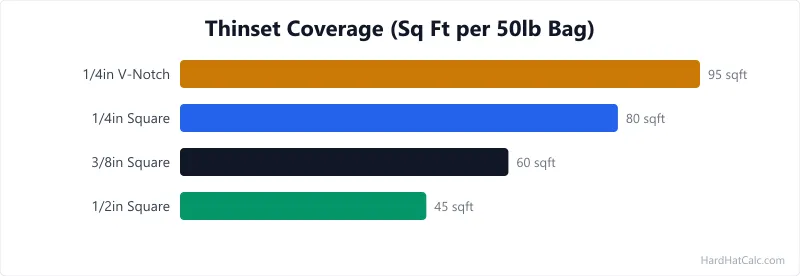
Coverage by Trowel Notch Depth
Trowel notch size directly controls how much thinset transfers to the substrate. Deeper notches leave more adhesive, which means fewer square feet per bag. This calculator has no trowel-notch dropdown — match your tile size to a row in the table below, then enter that row's coverage (or your own bag's printed number) into the Bag Coverage field. The table shows this calculator's own output at the default coverage rate for each notch and a 10% waste factor, using 50-lb bags as the standard unit.
| Trowel Size | Tile Size Range | Coverage (sq ft/bag) | Bed Thickness | Back-Butter? |
|---|---|---|---|---|
| 3/16" V-notch | Up to 6×6 in | 83.3–92.5 (Bostik, one print) | ~3/32" | No |
| 1/4" square | 8×8 to 12×12 in | 78.8–87.5 (median of nine makers) | ~3/16" | Optional |
| 3/8" square | 13×13 to 18×18 in | 54–60 (derived from TEC's one print) | ~1/4" | Recommended |
| 1/2" square | Over 18×18 in | 36–40 (median of five makers) | ~5/16" | Required |
The four defaults moved on 2026-09-12 to the medians of the makers' own printed coverage per 50-lb bag (40-lb bags scaled by 1.25), and the table now runs the way every maker's table runs: the deeper the notch, the fewer square feet per bag (until 2026-09-12 the 1/2" row covered more than the 3/8" row, which no trowel can do). For a 1/4" square notch nine data sheets print, from highest to lowest, ARDEX X 77 137.5, TEC Fast Set Ultimate 120.6, HENRY 527 95, Custom MultiSet, FlexBond and VersaBond 90, LATICRETE 253 Gold 87.5, MAPEI Ultraflex 2 82.5, Bostik Tile-Mate 75, Merkrete 710 70 and Schluter SET 65; the median, 87.5, is the default. For a 1/2" square notch five print a figure: ARDEX 68.75, TEC 60 (its own note that a 1/2" notch takes the coverage of its 3/8" slant notch for material calculations), Merkrete 40, Schluter 35 and Bostik 32.5; the median, 40, is the default. Only Bostik prints a 3/16" V-notch row (85-100; the default takes its midpoint, 92.5), and only TEC prints a 3/8" square row (60-68 per 40-lb bag, 80 per 50 lb, on a product line that runs 38% above the nine-maker median at 1/4"); the 3/8" default, 60, is that row scaled to the nine-maker level, which is also where the notch geometry (coverage falls with notch depth) and TEC's own 1/2"-notch equivalence land. Those two rows rest on one maker each, so enter your own bag's printed figure whenever you have it. The four presets below fill in the Bag Coverage field for a typical job at each notch; pick the one closest to your tile size, or type the number printed on your own bag directly.
These figures drop by about 20% when back-buttering (the calculator applies ×0.83, this site's own allowance; the makers print the contact coverage back-buttering achieves, not a material figure), which applies a thin skim coat to the tile back before setting it into the troweled bed. Back-buttering is not just extra adhesive — it fills the texture on the back of the tile (most porcelain and ceramic tiles have a waffle or grid pattern), eliminating air pockets that become hollow spots.
Coverage also decreases on rough or porous substrates. Concrete slabs, especially those with a broom finish, can absorb 10–15% of the thinset into the surface texture. Cement board has a consistent texture that tracks close to manufacturer stated rates. Plywood substrates should always have a crack isolation membrane, and the membrane itself has very little absorption.
The numbers above assume a single waste factor of 10%. If you are new to tiling, budget 15–20% waste — mixing errors, re-troweling dried areas, and uneven application all consume extra material.
Mixing and Applying Thinset for Maximum Bond
Thinset mixing is where most DIY tile jobs go wrong. The cement chemistry is unforgiving — too much water and the bond fails. Too little water and the thinset does not spread. Follow these steps for a reliable result.
Measure water precisely. Most 50-lb bags call for 5–5.5 quarts of clean, cool water. Pour the water into the bucket first, then add the powder gradually while mixing. Adding water to powder creates dry pockets that are nearly impossible to mix out.
Mix with a paddle mixer on a drill at low speed. Hand-mixing with a margin trowel works for small batches but leaves clumps in larger mixes. Use a ½-inch drill with a mixing paddle at 150–300 RPM. High speed introduces air bubbles into the mix, which weaken the bond.
Slake for 5–10 minutes. After initial mixing, let the thinset rest. Slaking allows the polymers in modified thinset to fully activate and the cement particles to hydrate evenly. Then remix briefly — 30 seconds — without adding more water. The mix should be smooth and hold ridges from the trowel without slumping.
Trowel at a consistent 45-degree angle. Flatten the thinset onto the substrate with the flat side of the trowel (skim coat), then comb through it with the notched side at 45 degrees. Steeper angles leave more adhesive; shallower angles leave less. Inconsistent angles create high and low spots that show through the finished tile.
Set tiles within the open time. Open time is the window between troweling and setting — typically 15–20 minutes for modified thinset, 20–30 minutes for unmodified. If the thinset has skinned over (a dry film on the surface), scrape it off and re-trowel. Pressing a tile into skinned thinset creates a weak mechanical bond that fails under thermal cycling.
Pull a tile after the first few and check coverage. The back of the tile should show 85% adhesive contact for dry areas, 95% for wet areas (showers, pools). If coverage is low, increase your trowel notch size or back-butter the tiles. This five-second check on your first row prevents 200 square feet of hollow tiles.
Substrate Compatibility and Common Failures
Thinset bonds to the substrate through a combination of mechanical interlock (the cement keys into the substrate texture) and chemical adhesion (the cement paste grips the surface). Both mechanisms require a clean, sound substrate. Dust, paint, curing compounds, and sealers all block adhesion and cause delamination.
Cement board is the ideal substrate for thinset. The alkaline surface chemistry matches the thinset cement, and the surface texture provides excellent mechanical interlock. Pre-score cement board before applying thinset — a scored surface has up to 40% more bonding area than a smooth one.
Plywood is acceptable for floor tile in dry areas if it meets minimum thickness (3/4-inch exterior grade) and stiffness (L/360 deflection limit). Thinset bonds to plywood but the bond is weaker than to cement board because wood fibres swell and contract with humidity, stressing the bond line. A crack isolation membrane between the plywood and thinset absorbs this movement. Without it, grout joints crack within the first heating season as the plywood shrinks.
Concrete is the most variable substrate. New concrete must cure for at least 28 days before tiling. The surface must be free of curing compounds, paint, and laitance (the weak surface layer that forms during finishing). Grinding or shot-blasting exposes fresh cement paste for thinset to bond to. Moisture testing is required before tiling — ASTM F1869 calcium chloride test or ASTM F2170 relative humidity probe. Concrete with more than 75% RH or 3 lbs/1000 sq ft/24hr moisture emission requires a moisture mitigation system before tiling.
Over waterproofing membranes, use unmodified thinset. The membrane prevents air from reaching the thinset from below, so modified thinset (which needs air to cure the polymer component) remains soft and uncured beneath the tile. This is the single most common cause of tile delamination in shower and wet-area installations.
Storage, Shelf Life, and Jobsite Realities
Thinset powder has a shelf life of about 12 months if the bag stays sealed and stored off the floor in a dry location. Once a bag absorbs moisture from the air, the cement pre-hydrates and loses bonding strength. A bag that feels lumpy or hard has already started to set inside the packaging — do not use it.
Mixed thinset has a pot life of 2–3 hours under moderate conditions (65–80°F). In hot weather above 90°F, pot life drops to 60–90 minutes. Do not add water to remix thinset that has started to stiffen — re-tempering breaks the cement bonds that have already formed, resulting in a weaker final cure. Mix only what you can use within the pot life window.
Weight matters for transport and for floor loading. Each 50-lb bag yields roughly 0.5 cubic feet of mixed thinset. A 200 sq ft kitchen floor with 3/8-inch notch troweling needs about 9 bags — 450 lbs of dry powder before adding water. For second-floor installations, confirm the floor joist size can handle the combined weight of substrate, thinset, tile, and furniture.
For projects that also need joint filler, the grout calculator estimates sanded or unsanded grout bags from the same tile dimensions. Thinset and grout are complementary purchases — order them together to save a delivery trip.
Worked Examples
Example 1
Scenario: A homeowner is tiling a 200 sq ft kitchen floor with 18×18-inch porcelain tiles using modified thinset. The installer plans to back-butter each tile for full coverage.
Calculation: Base coverage at 3/8" square notch = 60 sq ft/bag (the 2026-09-12 default). Modified type: no adjustment. Back-buttering: ×0.83 → 49.8 sq ft/bag. Waste factor: ×0.9 → 44.8 sq ft/bag. Bags = ⌈200 ÷ 44.8⌉ = 5 bags. Weight = 5 × 50 = 250 lbs. Cost = 5 × $18 = $90.
What this means: The kitchen floor requires 5 bags of modified thinset (250 lbs total) at roughly $90. Back-buttering added 1 extra bag compared to substrate-only application (4 bags at 54 sq ft), but it ensures the 95% coverage that prevents hollow spots under large tiles.
Takeaway: Large-format tiles on floors need back-buttering. The extra material cost is trivial compared to pulling up and resetting cracked tiles caused by adhesive voids.
Example 2
Scenario: A tile setter is installing subway tile (4×16) on 90 sq ft of shower walls over a Schluter DITRA membrane. The membrane manufacturer requires unmodified thinset.
Calculation: Base coverage at 3/16" V-notch = 92.5 sq ft/bag (Bostik's printed 85-100, the 2026-09-12 default). Unmodified type: no adjustment. No back-buttering needed for small tiles. Waste factor: ×0.9 → 83.3 sq ft/bag. Bags = ⌈90 ÷ 83.3⌉ = 2 bags. Weight = 2 × 50 = 100 lbs. Cost = 2 × $12 = $24.
What this means: The shower walls need only 2 bags of unmodified thinset at $24. Small tiles with a V-notch trowel stretch each bag much further than larger tiles do.
Takeaway: Uncoupling membranes like DITRA require unmodified thinset because modified thinset needs air exposure to cure — the non-porous membrane traps moisture and prevents proper curing. Using modified thinset over DITRA is one of the most common and most expensive tile installation mistakes.
Frequently Asked Questions
- When should I use modified vs unmodified thinset?
Use modified thinset for most applications: plywood substrates, exterior tile, large-format tiles, and any surface where air can reach the thinset from at least one side. Use unmodified thinset exclusively over non-porous membranes like Schluter DITRA, Laticrete Strata_MAT, and liquid-applied waterproofing membranes (RedGard, Hydroban, AquaDefense). The polymer in modified thinset needs air to cure — a sealed membrane traps moisture and prevents curing, leaving the thinset soft and unbonded beneath the tile. For membrane sizing, the membrane rolls and primer tool estimates rolls and primer for shower and foundation applications.
- How thick should thinset be under tile?
The ideal thinset bed is 3/32 to 5/16 inch thick after the tile is pressed in, depending on tile size and trowel notch. ANSI A108.5 allows a maximum bond coat thickness of 3/4 inch. Going thicker than the trowel notch allows invites shrinkage cracks as the excess moisture evaporates. If you need to build up height to meet adjacent floor levels, use a self-levelling underlayment first, then tile over it with the correct trowel notch — do not use thinset as a levelling compound. The underlayment calculator estimates self-levelling and sheet underlayment quantities by floor area.
- Can I use thinset to level an uneven floor?
No. Thinset is designed to bond tile to a substrate, not to fill low spots. Applying thinset thicker than 3/4 inch causes shrinkage cracking as the excess water evaporates. For floors that are out of level, use a self-levelling compound (SLC) rated for the depth you need — most SLCs pour from 1/8 inch to 1 inch thick. Let the SLC cure fully (typically 24 hours) before applying thinset and tile over it. The SLC-vs-trowel guide covers when SLC is needed versus simply adjusting trowel technique.
- How long can mixed thinset sit before it goes bad?
Mixed thinset has a pot life of 2–3 hours at moderate temperatures (65–80°F). Above 90°F, pot life drops to 60–90 minutes. Once the thinset starts to stiffen in the bucket, discard it — adding water to loosen it (re-tempering) breaks the cement bonds that have already formed and produces a weak final cure. Mix only enough thinset for 30–45 minutes of work at a time, and you will waste less material and maintain consistent bond quality. After setting tile, estimate your grout bags while waiting for the thinset to cure overnight.
More Materials calculators
Browse all materials calculators — Paint coverage, roofing bundles, tile adhesive, welding time, parking lot sizing, and more.