
Tile Adhesive Types Guide
Tile adhesive types compared: thinset, mastic, and epoxy. Modified vs unmodified, substrate matching, trowel notch, cost, and common failure modes.
You are standing in the tile aisle at the building supply store. There are four shelves of adhesive products. The bags say "modified thinset," "unmodified thinset," "premium large-format mortar," and "pre-mixed mastic." The prices range from $10 to $65. The back-of-bag instructions are identical boilerplate. And you have no idea which one your project needs.
This is the single most common question in tile installation, and the wrong answer has consequences: tiles that delaminate six months after installation, grout joints that crack within the first heating season, shower walls that develop mould behind tiles that appear perfectly set. The adhesive is invisible once the tile goes down, which makes it the easiest component to get wrong and the most expensive to fix.
This guide covers the three adhesive families (thinset, mastic, and epoxy), explains the critical modified vs unmodified decision, matches adhesives to substrates, and documents the failure modes that result from the wrong choice.
Total surface area including walls or floors.
Larger tiles need deeper trowel notches and more adhesive per sq ft.
Thin-set for most floors; mastic for dry wall tile; epoxy for wet/commercial.
Rough substrates absorb more adhesive. Concrete may need a primer coat.
How This Is Calculated
Coverage rate (sq ft per unit) from a table by adhesive type and tile size. Thin-set per 50-lb bag: small 75, medium 55 (makers' printed low ends), large 50, extra-large 37.5 (derived by notch scaling from the small-tile anchor). Mastic per 3.5-gal bucket: small 105, medium 52, large 33, extra-large 27.5. Epoxy: 0.75 × the thin-set figure (unverified). Plywood substrate: ×0.9. Concrete substrate: ×0.85. Bags needed = area ÷ adjusted coverage rate, rounded up. Cost = bags × cost per unit.
Source: Coverage figures per unit by adhesive type and tile-size class, set on 2026-09-05 (SF20-A8 ruling 11) and corrected on 2026-09-12 (SF22-HHC-F1 E8, seat-ruled 2026-09-07) from manufacturer data sheets opened and hashed on relays HHPK9354 and LQRM7238. Thin-set (sq ft per 50-lb bag): at a 1/4 x 1/4 in. square notch Custom VersaBond TDS-119 prints 85 to 95, LATICRETE 253 Gold DS-296 80 to 95, MAPEI Ultraflex 2 (current TDS, 2026-05-19) 75 to 90, TEC Superflex 90 to 100, Bostik Tile-Mate 70 to 80 and ARDEX X 5 85 to 90 per 40-lb bag; at 1/4 x 3/8 in. Custom prints 60 to 67, LATICRETE 60 to 70 and MAPEI 55 to 65. The small default 75 and medium default 55 are MAPEI's low ends at those two notches (the medium figure was 65 until 2026-09-12; the former 50 and 40 of early 2026 over-ordered by 1.5 to 2 times). No reviewed sheet prints a 3/8 or 1/2 in. square row for these products at 50 lb, so the large 50 and extra-large 37.5 are derived by notch scaling from the 1/4 in. anchor (coverage falls with notch depth: 75 x 0.25 / 0.375 = 50, 75 x 0.25 / 0.5 = 37.5); they are this site's derived figures, not printed ones (they were 30 and 25 until 2026-09-12, site conventions that ordered the 1/2 in. class above the 3/8 in. class). Mastic (sq ft per 3.5-gal bucket): Custom AcrylPro TDS-127 prints 40 to 60 sq ft per gallon at a 3/16 x 5/32 in. V-notch for tile up to 6 in., 15 to 25 at 1/4 x 1/4 in. for tile up to 12 in. and 10 to 14 at 1/4 x 3/8 in. for tile up to 15 in.; LATICRETE 15 Premium Mastic DS-286 50 to 60 at a 1/8 in. V-notch, 30 at 3/16 in. V, 20 at 1/4 in. square; MAPEI Type 1 50 to 70 per gallon at a 1/8 in. notch and 25 to 35 at 1/4 in. square; ARDEX D 16 prints 105 sq ft per 3.5-gal pail at a 1/4 in. square notch, the small-class figure on the engine's own bucket basis. The small 105 and medium 52 per bucket (30 and 15 per gallon) sit at the printed low ends; large 33 and extra-large 27.5 stay inside Custom 10 to 14 per gallon as a site convention. Epoxy: 0.75 x the thin-set figure, unverified; two epoxy sheets opened since print coverage per their own unit sizes (Custom EBM-Lite TDS-154, 50 to 55 sq ft per 1.9-gallon unit at 1/4 in. square; LATICRETE LATAPOXY 300, 30 to 35 sq ft per #2 unit at 1/4 in. square), which this calculator's generic unit does not match, so the multiplier stays labelled unverified. The plywood 0.9 and concrete 0.85 multipliers are site allowances (no reviewed sheet prints a substrate-dependent coverage adjustment). Cost per unit is this site's own estimate; distributor listings opened print $14.52 for a 50-lb bag of VersaBond (stonetooling.com), $54.93 and $73.95 for 3.5-gal buckets of LATICRETE 15 and Bostik mastic (masterwholesale.com) and $183.73 for a 1.9-gal EBM-Lite epoxy unit (stonetooling.com). The TCNA Handbook is cited for practice, not for these figures.
- TCNA Handbook for Ceramic, Glass, and Stone Tile Installation
- Custom Building Products — VersaBond thin-set TDS-119 (coverage per 50-lb bag by notch)
- LATICRETE 253 Gold data sheet DS-296 (coverage per 50-lb bag by notch)
- MAPEI Ultraflex 2 product data (coverage per 50-lb bag by notch; distributor-hosted copy)
- Custom Building Products — AcrylPro mastic TDS-127 (coverage per gallon by notch and tile size)
The Three Adhesive Families
Every tile adhesive falls into one of three categories. Each has a specific chemistry, a specific use case, and specific limitations. Using the wrong family leads to predictable failure.
Thinset Mortar (Cement-Based)
Thinset is a dry powder containing portland cement, sand, and (in modified versions) polymer additives. You mix it with water on site and apply it with a notched trowel. Thinset is the workhorse of the tile industry — it bonds to nearly every substrate, works on floors and walls, handles wet and dry areas, and accommodates tile sizes from 1×1-inch mosaics to 48×48-inch slabs. About 85% of all residential tile installations in the US use thinset mortar.
Thinset cures through a combination of cement hydration (a chemical reaction with water) and, in modified versions, polymer coalescence (the latex or acrylic additives dry and form a flexible film). Cure time is 24 hours minimum before grouting, 48 hours before heavy traffic. Full cure takes 28 days, same as concrete.
Cost: $10-$22 per 50-lb bag (March 2026 US averages). One bag covers 40-95 sq ft depending on tile size and trowel notch depth. Use the thinset calculator to estimate bags for your specific project.
Mastic (Pre-Mixed Latex Adhesive)
Mastic is a ready-to-use adhesive sold in buckets. It requires no mixing — open the lid, scoop, and trowel. Mastic is a latex-based paste that cures by evaporation (the water in the paste escapes through the grout joints and porous substrate). It has strong initial grab, which makes it popular for wall tile because the tiles stick immediately without sliding.
Mastic has strict limitations: it is not rated for floors (it stays slightly flexible and compresses under sustained weight), not rated for wet areas (it re-emulsifies — reverts to paste — when exposed to sustained moisture), and not rated for large or heavy tiles (the initial grab is not strong enough to hold tiles above 8×8 inches on vertical surfaces without temporary support).
Where mastic works well: dry interior wall tile — backsplashes, fireplace surrounds, accent walls, and wainscoting. If the area will never see standing water or sustained humidity, and the tiles are 8×8 inches or smaller, mastic saves mixing time and produces a perfectly adequate bond. Cost: $25-$40 per 3.5-gallon bucket, covering 50-70 sq ft.
Epoxy Adhesive (Two-Part Resin)
Epoxy tile adhesive is a two-part system: resin and hardener mixed together before application. The resulting bond is the strongest of the three families — waterproof, chemical-resistant, and capable of bonding to difficult substrates (metal, glass, existing tile, epoxy-coated concrete). Epoxy is the standard for commercial kitchens, hospitals, food processing plants, swimming pools, and any application where chemical exposure, extreme hygiene, or moisture immersion is expected.
Epoxy costs 3-5× more per square foot than thinset. Working time is short — 20-30 minutes before it begins to set. Mixing ratios must be precise (the chemical reaction depends on the correct proportion of resin to hardener). Cleanup requires solvents, not water. And mistakes are essentially permanent once the epoxy cures — removing epoxy-set tile usually destroys the substrate.
Cost: $50-$80 per unit, covering 15-25 sq ft. Reserve epoxy for applications where its specific properties are required. For most residential tile work, thinset provides adequate bond strength at a fraction of the cost.
Modified vs. Unmodified Thinset: The Critical Decision
Within the thinset category, the choice between modified and unmodified is the decision that causes the most installation failures. Both produce strong bonds when used correctly. Both fail when used in the wrong context. The difference is chemistry.
Modified thinset contains polymer additives (latex or acrylic) blended into the dry powder at the factory. These polymers improve flexibility (the cured thinset bends slightly without cracking), adhesion to smooth surfaces (the polymer creates a mechanical bond in addition to the cement bond), and water resistance (the polymer film blocks moisture penetration). Modified thinset cures through two parallel mechanisms: cement hydration (which needs water) and polymer coalescence (which needs air — the polymer film forms as the water evaporates).
Unmodified thinset is pure portland cement and sand with no polymer additives. It cures exclusively through cement hydration — a chemical reaction that occurs even underwater. It does not need air exposure to cure.
The practical implication: modified thinset must have at least one air-permeable surface to cure properly. If modified thinset is sandwiched between two non-porous surfaces — such as a porcelain tile (non-porous) set over a waterproof membrane (non-porous) — the polymer component cannot dry. The cement hydrates normally, but the polymer remains soft and uncured. The bond appears set but is weaker than it should be. Under thermal cycling (hot-cold, wet-dry), the bond eventually fails and the tile pops off.
When to Use Modified Thinset
- Tile over plywood substrates (the plywood is porous enough to let the polymer dry)
- Tile over cement board (porous)
- Large-format tiles (15×15 and larger) where extra adhesion and flex are needed
- Exterior tile installations subject to freeze-thaw cycles
- Any substrate where at least one side of the thinset is porous
When to Use Unmodified Thinset
- Tile over uncoupling membranes (Schluter DITRA, Strata_MAT, NobleSeal CIS)
- Tile over liquid-applied waterproofing (RedGard, Hydroban, AquaDefense)
- Any installation where the thinset is trapped between two non-porous surfaces
The membrane manufacturers specify unmodified thinset explicitly in their installation instructions. Using modified thinset over DITRA is the most common and most expensive tile installation mistake — the tiles appear set, pass the initial inspection, and fail 6-18 months later when the uncured polymer breaks down under moisture cycling. The fix requires tearing out the entire tile field and starting over.
Substrate Matching Guide
The substrate — the surface you are tiling over — determines both the adhesive type and the preparation required. Mismatching adhesive to substrate is the second most common cause of tile failure after the modified/unmodified error.
Cement board (HardieBacker, Durock, Permabase) is the ideal tile substrate. Use modified thinset for most applications, unmodified if a waterproofing membrane is applied between the cement board and the thinset. No primer needed. Score the surface for better mechanical bond.
Plywood (3/4-inch exterior grade) is acceptable for floor tile in dry areas. Apply modified thinset. Install a crack isolation membrane (Ditra, Noble CIS, or liquid-applied) between the plywood and thinset if the floor structure has any flex. Plywood moves with humidity changes — the membrane absorbs this movement and prevents it from cracking the tile/grout assembly. Confirm the underlayment and subfloor assembly meets L/360 deflection limits for tile.
Concrete slabs require surface preparation. New concrete must cure at least 28 days before tiling. Old concrete must be free of paint, curing compounds, adhesive residue, and laitance. Grind or shot-blast the surface to expose fresh cement paste. Moisture-test with ASTM F1869 or F2170 before installing any floor system. Use modified thinset on bare concrete; use unmodified thinset if a waterproofing or crack isolation membrane is applied first.
Existing tile can be tiled over if the existing tile is well-bonded (no hollow spots when tapped), level, and clean. Lightly sand the glaze to improve mechanical bond. Use modified thinset or epoxy — unmodified thinset does not bond well to glazed surfaces because the non-porous glaze prevents cement interlock. This application is one of the few residential cases where epoxy adhesive is worth the cost premium.
Drywall (greenboard) is acceptable for light wall tile in dry areas only — backsplashes, fireplace surrounds. Use mastic or modified thinset. If you are tiling a newly built wall, the drywall estimating process should account for the areas that will be tiled versus painted so you buy the right board type for each zone. Never use drywall as a tile substrate in wet areas (showers, tub surrounds) regardless of the adhesive — drywall absorbs moisture through any gap in the grout and disintegrates behind the tile. Wet areas require cement board or a waterproof-rated substrate.
Common Failure Modes and How to Avoid Them
Tile adhesive failures fall into three categories: bond failure (tiles delaminate from the substrate), cohesive failure (the adhesive layer itself cracks), and substrate failure (the surface beneath the adhesive gives way).
Hollow tiles are the most common bond failure. They sound hollow when tapped because the adhesive does not fully contact the tile back. Causes: insufficient trowel notch size (too small leaves too little adhesive), failure to back-butter large tiles, skinned-over thinset (applied the tile after the thinset surface had dried), or insufficient trowel pressure. Prevention: use the correct trowel size for the tile, back-butter tiles 13×13 and larger, and set tiles within the open time (15-20 minutes for modified thinset). Pull the first tile you set and check the back — 85% coverage for dry areas, 95% for wet areas.
Tiles popping off shower walls is almost always a modified-over-membrane error. The polymer in modified thinset never fully cured because the non-porous membrane and non-porous tile trapped the moisture. Fix: tear out tile and thinset, clean the membrane surface, reinstall with unmodified thinset. Prevention: read the membrane manufacturer's instructions before buying thinset. The waterproofing membrane calculator can help size the membrane for your shower project.
Cracked grout lines within the first year usually indicate substrate movement, not grout failure. The substrate is flexing under load, and the rigid thinset/tile assembly cannot absorb the movement. Causes: plywood subfloor without crack isolation membrane, undersized joists that deflect under foot traffic, or concrete slab with active cracks. Prevention: install an uncoupling or crack isolation membrane over any substrate that moves, and verify the structural floor meets L/360 deflection limits for tile.
Mastic re-emulsification occurs when mastic-set tile is exposed to sustained moisture. The mastic softens and the tiles slide off the wall. This happens most often in showers where mastic was used instead of thinset, and in backsplashes directly behind sinks where constant splashing saturates the adhesive through the grout joints. Prevention: use thinset in any area that gets wet — even areas that seem dry can accumulate enough humidity to soften mastic over time.
Cost Comparison
Material cost per square foot of tile installed, based on March 2026 US national averages. Labour cost is not included — professional tile installation runs $5-$15 per sq ft regardless of adhesive type.
| Adhesive Type | Cost per Unit | Coverage (sq ft) | Cost per sq ft | Best For |
|---|---|---|---|---|
| Unmodified thinset | $10-$15 / 50-lb bag | 40-95 | $0.15-$0.30 | Over membranes |
| Modified thinset | $15-$22 / 50-lb bag | 40-95 | $0.20-$0.45 | Most applications |
| LHT mortar | $25-$35 / 50-lb bag | 25-50 | $0.60-$1.20 | Large/heavy tile |
| Mastic | $25-$40 / 3.5-gal bucket | 50-70 | $0.40-$0.70 | Dry wall tile |
| Epoxy | $50-$80 / unit | 15-25 | $2.50-$4.50 | Chemical/wet areas |
For most residential projects, modified thinset at $0.20-$0.45 per sq ft is the right choice. Adhesive cost is typically 3-5% of total tile project cost (including tile, grout, substrate preparation, and labour). Spending an extra $50-$100 on the correct adhesive is trivial compared to the $2,000-$5,000 cost of tearing out and redoing a failed installation. For walls where tile is overkill — utility rooms, garages, or accent walls that just need a clean finish — understanding paint coverage rates helps you compare the cost of painting versus tiling the same surface.
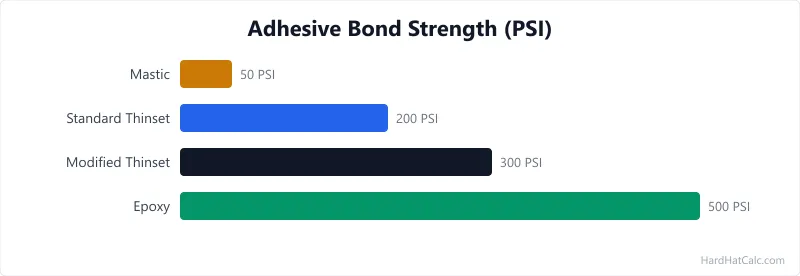
Frequently Asked Questions
- Can I use mastic in a shower or wet area?
No. Mastic re-emulsifies (reverts to paste) when exposed to sustained moisture. Showers, tub surrounds, steam rooms, and any area with direct water contact require thinset mortar or epoxy adhesive. Even backsplashes directly behind sinks should use thinset because constant splashing can saturate mastic through the grout joints over time. This is the single most common adhesive mistake in DIY bathroom remodels, and the fix requires complete tear-out and reinstallation. The thinset calculator estimates bag counts for wet-area installations based on tile size and trowel notch.
- Which thinset should I use over Schluter DITRA?
Unmodified thinset. Schluter specifies this explicitly in their installation instructions because DITRA is a non-porous polypropylene membrane. Modified thinset cannot cure properly when trapped between the non-porous membrane and non-porous tile — the polymer additives need air exposure to coalesce, and DITRA blocks that exposure from below. The cement portion hydrates normally, but the polymer stays soft, creating a bond that feels set but lacks the full tensile strength of a properly cured joint. Failure typically appears 6-18 months after installation. If the shower also needs a waterproofing membrane, size the membrane before choosing the adhesive system.
- How do I know if my tile adhesive has cured properly?
Thinset mortar is firm to the touch after 24 hours and reaches functional strength within 48-72 hours. You can test adhesion by tapping installed tiles — a solid thud indicates good contact, while a hollow sound suggests the adhesive did not fully bond. For a definitive check, pull up one tile (before grouting) and inspect the back: 85% adhesive coverage is the minimum for dry-area floors, 95% for wet areas like showers. If coverage is low, increase your trowel notch size, back-butter the tiles, or work within a shorter open time to prevent the thinset from skinning over. After the adhesive cures, the grout calculator estimates the grout quantity by tile size and joint width.
- Is epoxy adhesive worth the extra cost for residential tile?
For most residential applications, no. Modified thinset provides adequate bond strength for floors, walls, showers, and exterior tile at 5-10x less cost per square foot. Epoxy is justified in specific situations: tiling over existing glazed tile (where thinset cannot achieve mechanical bond), commercial kitchens or food service areas requiring chemical resistance, pool and spa surrounds subject to constant water immersion, and healthcare settings requiring antimicrobial properties. For a standard bathroom or kitchen renovation, thinset is the right product and epoxy is an unnecessary expense. The bag-and-cost comparison tool compares bag counts and costs across adhesive types for your project area.
- What happens if I use the wrong trowel notch size?
Too small a trowel notch leaves insufficient adhesive under the tile, creating hollow spots that crack under load and fail to bond properly. Too large a notch wastes adhesive and can cause it to squeeze up through narrow grout joints when the tile is pressed in. Match trowel notch to tile size: 3/16-inch V-notch for tiles up to 6x6 inches, 1/4-inch square for 8x8 to 12x12, 3/8-inch square for 13x13 to 18x18, and 1/2-inch square for tiles over 18x18 inches. These sizes are industry standards from the Tile Council of North America (TCNA). For ceiling tile installations, the ceiling tile layout calculator handles grid spacing and border tile sizing.