
Ceiling Tile Layout Calculator
Drop ceiling tile layout calculator: enter room size and 2x2 or 2x4 tile for tile count, main runners, cross tees, wall angle, and hanger wire with cost.
Last updated:
The longer dimension of the room. Main runners run parallel to this direction.
The shorter dimension. Cross tees span this direction between main runners.
2x2 tiles use more cross tees but look better in small rooms. 2x4 tiles are faster to install in large spaces.
Order 5-10% extra tiles for cuts, damage during installation, and future replacements.
How This Is Calculated
Tiles = ceil(rows × columns × waste factor). Main runners: spaced 4 ft on centre across width, running full room length. Cross tees (4 ft): at 4 ft intervals between main runners. Cross tees (2 ft): at midpoints for 2×2 grids. Wall angle = room perimeter. Hanger wires: every 4 ft on each main runner per ASTM C636.
Source: Grid layout calculations per Armstrong Ceiling Solutions installation instructions for suspended ceilings. Grid spacing and hanger wire requirements per ASTM C636 (Installation of Metal Ceiling Suspension Systems). Tile quantities include border tile calculation method from USG Ceilings Design Guide.
7 min read
Grid Layout Basics: How Suspended Ceiling Systems Work
A suspended ceiling (drop ceiling) hangs a metal grid from the structural ceiling above, with lightweight acoustic tiles resting in the grid openings. The system provides finished appearance, acoustic control, and easy access to wiring, plumbing, and ductwork hidden in the plenum space above. Here is how the components fit together.
Wall angle (L-shaped molding) mounts to the perimeter walls at the desired ceiling height. It supports the grid edges and gives a clean transition from wall to ceiling. Standard wall angle is 7/8-inch face, 12-foot sections, installed with screws or powder-actuated pins every 24 inches.
Main runners (T-shaped bars) span the room parallel to the longest wall, supported by hanger wires from the structure above. Standard main runners come in 12-foot sections that interlock end to end. They are spaced 4 feet apart (measured centre to centre), with the first runner 2 feet from the wall to create equal border tiles on both sides.
Cross tees snap into slots on the main runners, connecting adjacent runners at regular intervals. Four-foot cross tees create the primary grid openings. For a 2×2 tile layout, additional 2-foot cross tees snap into the midpoints of the 4-foot tees, subdividing each 2×4 opening into two 2×2 openings.
Hanger wires (typically 12-gauge galvanised) connect the main runners to the structural ceiling. ASTM C636 specifies maximum 4-foot spacing along each runner, with the first hanger no more than 2 feet from the wall. Each wire wraps around the runner flange and attaches to a screw eye, lag bolt, or shot pin in the structure above.
Tiles drop into the grid openings. Full tiles sit on the flanges of the grid members. Border tiles (partial tiles along the walls) are cut to fit and rest on the wall angle on one side and the grid flange on the other. In basement finishing projects, the hanger wires attach to the floor joists above — if you are also planning the framing for new partition walls below that floor system, install the wall top plates before running the ceiling grid so the wall angle sits on a finished surface.
Choosing Between 2×2 and 2×4 Tile Grids
The two standard grid sizes — 2 ft × 2 ft and 2 ft × 4 ft — serve different spaces, budgets, and aesthetic preferences. Your choice affects material cost, installation speed, and the visual impression of the finished ceiling.
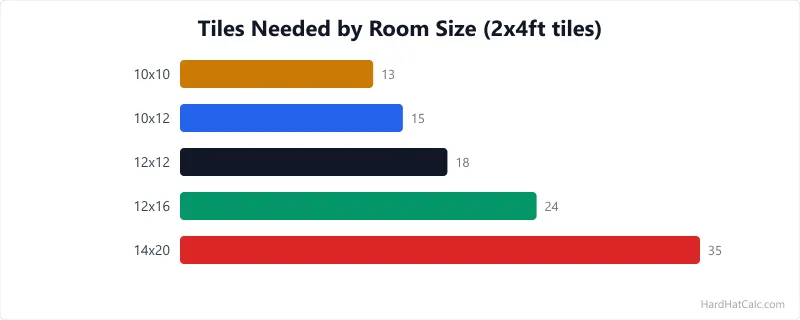
Two-by-four tiles install faster because each tile covers twice the area. A 20×16 ft room needs 40 tiles in a 2×4 layout versus 80 tiles in a 2×2 layout. Fewer tiles means less handling time, fewer cuts, and a simpler grid with no 2-foot cross tees. For large commercial spaces — offices, retail, warehouses — 2×4 is the default choice because installation speed drives labour cost.
Two-by-two tiles look better in smaller rooms and residential basements. The smaller grid creates a more refined pattern with shorter sight lines between grid members. The grid itself becomes a more balanced visual element rather than a series of long rectangular panels. For rooms under 300 sq ft, the aesthetic difference is worth the extra material and labour. If the basement walls still need finishing alongside the ceiling, the drywall estimating guide covers sheet layout, waste factors, and finishing materials, while the boards-screws-and-tape tool estimates board, screws, and tape for the walls below your new grid.
Acoustic performance depends on the tile product, not the tile size. Both 2×2 and 2×4 tiles are available with the same NRC (Noise Reduction Coefficient) and CAC (Ceiling Attenuation Class) ratings. Standard mineral fibre tiles (Armstrong Cortega, USG Radar) have NRC ratings of 0.50-0.70, meaning they absorb 50-70% of sound energy that hits them. Premium acoustic tiles reach NRC 0.90+ but cost $4-$8 per tile instead of $1.50-$3.00.
Fire ratings are another tile-level property. Most standard suspended ceiling tiles carry a Class A fire rating (flame spread index ≤25, smoke developed index ≤50) per ASTM E84. The grid itself is non-combustible steel. This combination gives suspended ceilings a fire performance advantage over drywall in some applications — a burning tile falls out of the grid and activates sprinklers, while a drywall ceiling holds heat against the structure above.
Material Costs and Common Mistakes
The cost breakdown for a suspended ceiling project shows that tiles are the largest single expense, but grid components and hardware add up quickly. Prices as of March 2026, US national averages from Home Depot, Lowe's, and commercial ceiling distributors.
| Component | Unit | Price Range | Notes |
|---|---|---|---|
| Standard mineral fibre tiles (2×2) | per tile | $1.50-$3.00 | Armstrong Cortega, USG Radar tier |
| Standard mineral fibre tiles (2×4) | per tile | $2.50-$5.00 | Same product, larger size |
| Premium acoustic tiles (2×2) | per tile | $4.00-$8.00 | NRC 0.85+, sagging-resistant |
| Main runners (12 ft section) | each | $4.00-$5.50 | Heavy-duty or standard |
| 4 ft cross tees | each | $1.00-$1.50 | Snap-in, match runner brand |
| 2 ft cross tees | each | $0.75-$1.00 | Only needed for 2×2 grid |
| Wall angle (10 ft section) | each | $2.50-$4.00 | 7/8" or 15/16" face width |
| Hanger wire (12 ga, pre-cut 6 ft) | each | $0.40-$0.60 | Or buy 100 ft coil and cut |
| Screw eyes or lag bolts | each | $0.15-$0.25 | Into wood joists |
Common installation mistakes that this calculator helps you avoid: underestimating border tile waste (border cuts produce offcuts too small to use elsewhere), forgetting 2-foot cross tees when ordering for a 2×2 grid, and running main runners the wrong direction (always parallel to the long wall to minimise the number of runners and hanger points). The wall angle quantity is simply the room perimeter — people forget to account for closet alcoves, soffits, and column wraps that add perimeter length. For ceiling painting as an alternative to tiles, you can estimate ceiling paint for drywall and plaster ceilings.
Border Tile Strategy: Centering vs. Starting Full
How you handle border tiles — the partial tiles along the walls — affects both the look and the installation difficulty. Two approaches dominate, and the right choice depends on your priorities.
Centered layout (industry standard): Divide the room so that border tiles on opposite walls are equal in width. If a 20-foot room uses 2-foot tiles, you get 10 full tiles and no borders. But a 21-foot room gets 9 full tiles (18 feet) with 1.5-foot border tiles on each side. This looks balanced and professional because both sides of the room have matching tile widths.
Full-tile start (quick method): Start with full tiles against one wall and put the cut tile on the opposite wall. This is faster — you only cut tiles on two walls instead of four — but the asymmetry is visible. A 1.5-foot border tile on one side and a full 2-foot tile on the other creates an off-centre look that bothers detail-oriented occupants.
The centred approach matters most when the border tiles would be very narrow. A 3-inch border strip along one wall looks like a mistake. With centring, that same 3-inch leftover becomes a 15-inch border on each side (full tile minus 3 inches, split between two sides), which reads as an intentional design element. The minimum recommended border width is 6 inches — narrower borders are difficult to cut cleanly, hard to support on the wall angle, and visually distracting. If centering would produce borders under 6 inches, shift the layout by one tile to create wider borders.
Rooms with multiple soffits, bulkheads, or alcoves complicate the centring calculation. In these cases, centre the grid on the largest open area and accept asymmetric borders in the smaller recesses. Nobody notices a 4-inch border tile inside a closet, but they notice one in the middle of a conference room.
Plenum Space, Clearance, and Code Requirements
The space above a suspended ceiling (the plenum) is where HVAC ducts, electrical wiring, plumbing, and fire suppression lines run. Building codes regulate what goes in the plenum and how the ceiling interacts with fire protection systems.
Minimum clearance between the structural ceiling and the grid depends on what is in the plenum. A bare-minimum installation with nothing above the tiles needs 3 inches — just enough to angle tiles into the grid. But most basements and commercial spaces have obstructions that require 6-12 inches of clearance. HVAC ducts and recessed light cans typically need 8-10 inches. Fire sprinkler heads must extend below the grid, and their deflectors need specific clearances per NFPA 13 — check with your fire protection contractor before setting the grid height.
Basement installations have a common conflict with floor drain plumbing. Drain lines from the floor above slope at 1/4 inch per foot, and a long run across a basement ceiling may drop 3-4 inches over its length. Mapping the lowest obstruction across the entire ceiling before committing to a grid height prevents the painful discovery that one pipe is 2 inches too low after you have already installed 80% of the grid. Once the grid is up, you will likely want to finish the joints on the surrounding drywall walls before moving furniture in — compound dust and ceiling tile installation do not mix well.
Seismic bracing applies in earthquake zones. ASTM E580 covers seismic design requirements for suspended ceilings over 1,000 sq ft or in buildings with an importance factor (hospitals, schools, emergency services). Compression struts and lateral bracing wires connect the grid to the structure at specific intervals to prevent the ceiling from swaying and dropping tiles during ground motion. If your project requires seismic bracing, factor an additional $0.50-$1.50 per sq ft for materials and labour.
Plenum-rated wiring is required for electrical cables that run above the tiles without conduit. Standard NM-B (Romex) is not plenum-rated. Use CMP-rated cable or run standard wire through EMT conduit. This code requirement (NEC Article 300.22) exists because the plenum acts as an air return path in many HVAC systems, and burning cable jacket would spread toxic smoke throughout the building.
Worked Examples
Example 1
Scenario: A homeowner is finishing a basement rec room measuring 24 ft × 16 ft and wants a 2×2 suspended ceiling tile layout with 10% spare tiles.
Calculation: Full rows across 16 ft width: floor(16/2) = 8 rows. Border width: (16 - 8×2)/2 = 0, no border tiles across width. Full columns along 24 ft: floor(24/2) = 12 columns. Border length: 0. Full tiles = 8 × 12 = 96. Border tiles = 0. Total with 10% waste = ⌈96 × 1.10⌉ = 106 tiles. Main runners: ⌈16/4⌉ = 4 runners × 24 ft = 96 lin ft. 4ft cross tees: (⌈24/4⌉+1) × 5 gaps = 7 × 5 = 35. 2ft cross tees: ⌈24/4⌉ × 5 = 6 × 5 = 30. Wall angle: 2×(24+16) = 80 lin ft. Hanger wires: (⌈24/4⌉+1) × 4 = 7 × 4 = 28.
What this means: This room divides evenly into 2-foot tiles with no border cuts needed — a best-case scenario that minimises waste. The 106-tile order (96 needed + 10 spares) provides replacements for future stains or damage without a colour-matching problem.
Takeaway: Rooms with dimensions divisible by the tile size avoid border tile cuts entirely. When planning a basement finish, adjust partition wall locations by a few inches if possible to hit even multiples of 2 feet — it saves cutting time and reduces waste.
Example 2
Scenario: A commercial tenant is installing 2×4 ceiling tiles in a 30 ft × 20 ft conference room with 5% spare factor.
Calculation: Full rows across 20 ft width: floor(20/2) = 10 rows, no border. Full columns along 30 ft: floor(30/4) = 7 full columns. Border length: (30 - 7×4)/2 = (30-28)/2 = 1 ft borders on each end. Total columns = 7 + 2 = 9. Full tiles = 10 × 7 = 70. Border tiles = (10 × 9) - 70 = 20. Base tiles = 90. With 5% waste = ⌈90 × 1.05⌉ = 95 tiles. Main runners: ⌈20/4⌉ = 5 × 30 ft = 150 lin ft. Wall angle: 2×(30+20) = 100 lin ft.
What this means: The 30-foot length does not divide evenly by 4 (the tile length), creating 1-foot border tiles on each end. Twenty border tiles need cutting — a trim saw or sharp utility knife handles this, but it adds 30-45 minutes to the installation. The 95 tiles at roughly $2.25 each run about $214 for tiles alone.
Takeaway: For 2×4 tiles, border tiles occur whenever the room length is not a multiple of 4 feet. Centering the layout puts equal-width borders on each end, which looks more balanced than pushing full tiles to one wall and a narrow strip to the other.
Frequently Asked Questions
- How many ceiling tiles do I need for a 20×16 foot room?
A 20×16 ft room needs 80 tiles in a 2×2 layout (20/2 × 16/2 = 80) or 40 tiles in a 2×4 layout (20/4 × 16/2 = 40), assuming the room dimensions divide evenly by the tile size. Add 5-10% for waste and spares — 88 tiles for 2×2 or 44 tiles for 2×4. If the room dimensions do not divide evenly, border tiles increase the count because each partial tile at the walls uses a full tile that gets cut down, and the offcut is often too small to use elsewhere. If you prefer a painted drywall ceiling instead, run ceiling coverage to estimate gallons by room size.
- What is the minimum drop for a suspended ceiling?
The absolute minimum clearance above the grid is about 3 inches, which allows tiles to be angled up and into the grid openings. However, most installations need 4-6 inches minimum for grid components and basic access. If the plenum contains ductwork, plumbing, electrical, or recessed lighting, plan for 8-12 inches of clearance below the lowest obstruction. Measure the lowest point across the entire ceiling area — a single pipe or duct that hangs 2 inches lower than the rest determines the maximum grid height for the whole room. For basements, the wall soundproofing calculator can help select acoustic tiles that improve noise isolation between floors.
- Do I need 2-foot cross tees for a 2×4 tile layout?
No. A 2×4 tile layout uses only 4-foot cross tees, which create 2 ft × 4 ft openings that match the tile size. Two-foot cross tees are only needed for a 2×2 layout, where they snap into the midpoint of each 4-foot cross tee to subdivide the 2×4 opening into two 2×2 openings. Ordering the wrong cross tees is a common mistake — make sure your grid components match your chosen tile size before the material arrives on site. If you are also finishing the walls, the board-and-fastener estimator estimates boards and fasteners for the room below the grid.
- How far apart should hanger wires be for a suspended ceiling?
ASTM C636 requires hanger wires no more than 4 feet apart along each main runner, with the first wire no more than 2 feet from the end wall. This spacing distributes the ceiling weight evenly and prevents the grid from sagging. Each wire must be plumb (vertical) and wrapped tightly around the main runner flange with at least three full turns. Standard 12-gauge galvanised wire supports approximately 75 pounds, which is more than sufficient for typical grid loads of 1-2 pounds per square foot. Make sure the floor joists above are solid enough to hold the screw eyes that anchor each wire.
- Can I install a drop ceiling in a room with 7-foot ceilings?
You can, but it may not meet building code. Most residential codes (IRC) require a minimum 7-foot finished ceiling height in habitable rooms and 6 feet 8 inches in bathrooms and hallways. A drop ceiling in a 7-foot room would reduce the finished height to 6 feet 6 inches to 6 feet 9 inches depending on plenum needs, which falls below the habitable-room minimum. Check your local code before proceeding. Non-habitable spaces like utility rooms and storage areas often have lower or no minimum height requirements. You can check R-value targets to determine whether adding insulation above the grid is needed for your climate zone.
More Materials calculators
Browse all materials calculators — Paint coverage, roofing bundles, tile adhesive, welding time, parking lot sizing, and more.