
Drywall Estimating Guide
How to estimate drywall sheet by sheet — measuring method, 4x8 vs 4x12 layout, joint compound, tape and screw quantities, and waste factors by room type.
I ordered 30 sheets of drywall for a bedroom renovation in our Northumberland house. The delivery driver stacked them against the garage wall, I signed the ticket, and he drove off. Two days later, with the ceiling hung and three walls covered, I was eight sheets short. That meant a second delivery, a second delivery fee, and two wasted days waiting for the truck. The measuring was not wrong — the layout was. I had treated drywall estimation like a simple area calculation (wall area divided by sheet area) and ignored the cuts, the waste, and the way sheets actually fit around windows and doors.
This guide walks through the method that prevents that mistake. It covers measuring room by room, planning sheet layouts to minimise waste, calculating finishing materials (joint compound, tape, screws), and spotting the errors that trip up first-time drywallers. The drywall sheet calculator embedded below handles the arithmetic, but understanding the logic behind the numbers is what keeps you from ordering short — or overspending on sheets you will never use.
Sum of all wall lengths in the room. A 15×12 ft room has 54 ft of perimeter.
Floor to ceiling height. Standard residential is 8 ft; newer homes may be 9 or 10 ft.
Select "Walls + Ceiling" to include ceiling sheets in the count.
Length × width of the ceiling. Only used when ceiling is included above.
4×12 sheets reduce joints on long walls but are heavy (about 77 lbs for 1/2" regular).
Each standard door deducts ~21 sq ft; each window ~15 sq ft. The calculator uses an average of 18 sq ft per opening.
Standard rectangular rooms: 10%. Rooms with many corners, soffits, or angles: 15-20%.
How This Is Calculated
Gross wall area = perimeter × height. Net area = gross wall area - (openings × 18 sq ft) + ceiling area. Sheets = ceil(net area × waste factor / sheet area). Screws = 1/sq ft walls + 1.25/sq ft ceiling. Tape = 0.4 lin ft per sq ft. Joint compound = 0.14 lbs per sq ft, which is 140 lbs per 1,000 sq ft of board — the top of the coverage band National Gypsum prints for its ProForm All Purpose ready mix. Pails = compound lbs / 62, rounded up.
Source: Drywall coverage and fastener spacing per GA-216 (Gypsum Association Application and Finishing of Gypsum Panel Products). Finish levels per GA-214 (Recommended Levels of Gypsum Board Finish). Screw spacing: 12 inches on ceilings, 16 inches on walls per GA-216. Joint compound quantity comes from the makers' own printed coverage rather than a standard: National Gypsum prints 123-140 lbs per 1,000 sq ft of board for ProForm All Purpose ready mix, USG prints about 10 gallons per 1,000 sq ft at a 12-15 lb/gal density, and Georgia-Pacific prints two 61-lb pails per 1,000 sq ft; this calculator uses the top of National Gypsum's band. Sheet weights are Georgia-Pacific's printed nominal 1.6 lbs per square foot for 1/2-inch board. The tape rate is this site's own estimating convention.
Measuring a Room for Drywall: The Right Way
Drywall estimation starts with measuring every surface that gets covered. Walls and ceilings are separate calculations because they use different sheet orientations and have different waste characteristics. Grab a tape measure and a notepad — or your phone — and work around the room methodically.
Walls
Measure the length of each wall at the base, in feet and inches. Measure the ceiling height once (it should be consistent, but check two corners and use the taller measurement if they differ). For each wall, the gross area is length multiplied by height. A 14-foot wall in a room with 8-foot ceilings has a gross area of 112 square feet.
Do not subtract windows and doors yet. Record the gross area for every wall first, then note the openings separately. A standard interior door opening measures about 21 square feet (3 ft wide by 7 ft tall). A standard window measures about 12-15 square feet. You will subtract these later, but the subtraction is not as straightforward as it seems — more on that in the layout section below.
Ceilings
Measure the room length and width at the ceiling level. In older houses, walls are not always plumb, so the ceiling dimensions can differ from floor dimensions by an inch or two. Use the ceiling measurement. The ceiling area is length times width: a 12 × 14 foot room has a 168 square foot ceiling. Ceilings typically use 4 × 12 foot sheets to minimise joints, though 4 × 8 sheets work in smaller rooms or when you are working alone and cannot handle the weight of a 12-footer overhead.
Recording Openings and Obstructions
For each wall, note the number and size of doors, windows, electrical panels, and any other features that drywall must fit around. A large picture window takes a full sheet width out of the wall, while a small bathroom window only removes a portion of one sheet. The key distinction: you still need the full sheet to cut around the opening. The offcut may or may not be usable elsewhere. This is where area-only calculations fail — they assume every scrap of cutaway material disappears, when in reality you bought that sheet and used only part of it.
Sheet Layout Strategy: Why Area Alone Gets It Wrong
Drywall sheets come in standard sizes. The most common residential sizes are 4 × 8 feet (32 sq ft) and 4 × 12 feet (48 sq ft). The width is always 4 feet. The length varies: 8, 10, 12, and sometimes 14 feet. Choosing the right length for each surface reduces both waste and the number of joints you need to finish.
The reason a simple area calculation fails is that drywall sheets have constraints that raw area ignores.
- Sheets must span stud bays. Every edge of a drywall sheet must land on a stud or on blocking. You cannot end a sheet in the middle of a 16-inch stud bay — the edge will crack or sag. This means you sometimes use a wider sheet than the remaining wall space requires, just to reach the next stud.
- Horizontal joints should be staggered. If you hang sheets horizontally (the standard practice for walls), the vertical end joints on one row should not line up with the joints on the row above. Staggering prevents cracks that develop along continuous joint lines. This staggering sometimes forces you to start a row with a partial sheet, which generates waste.
- Openings consume more than their area. A window centred on a wall interrupts one or two sheets. You cut the opening out, but the leftover pieces above and below the window are often too small or too oddly shaped to use elsewhere. The sheet is consumed; only part of its area covers the wall.
The practical result: a room that measures 400 sq ft of wall area does not need 400 ÷ 32 = 12.5 sheets. It typically needs 14-16 sheets because of cuts, staggering, and opening waste.
Hanging Horizontal vs. Vertical
On walls with 8-foot ceilings, hanging sheets horizontally (the 4-foot dimension runs vertically, the 8- or 12-foot dimension runs along the wall) is standard practice. Two horizontal rows of 4-foot-wide sheets cover the full 8-foot height with one horizontal seam at the 4-foot line. That seam falls at roughly waist height, which is easier to tape and finish than a vertical seam.
On walls taller than 8 feet — 9-foot and 10-foot ceilings are increasingly common in new construction — you may need a third row. A 9-foot ceiling gets two 4-foot rows plus a 1-foot strip at the top or bottom. A 10-foot ceiling gets two 4-foot rows plus a 2-foot strip. Those narrow strips generate waste from the sheets they are cut from, adding to the total count.
Vertical hanging (the 8-foot length runs floor to ceiling) makes sense on commercial projects and on walls shorter than 4 feet, like knee walls in attic conversions. It avoids horizontal seams entirely on 8-foot walls but creates more vertical seams and uses more tape and compound to finish.
Finishing Materials: Joint Compound, Tape, and Screws
Drywall sheets are only half the material order. Finishing those sheets requires joint compound (mud), tape, and screws — and underestimating any of these stalls the project just as effectively as running out of sheets.
Joint Compound
Joint compound covers the taped joints, the screw heads, and the inside corners. It goes on in three coats: a bedding coat (embeds the tape), a fill coat (builds up the joint flush with the surface), and a finish coat (feathers the edges smooth). Each coat uses progressively less material as the joint narrows, but three coats across every joint adds up fast.
The standard estimating rule: one gallon of pre-mixed joint compound covers about 100 square feet of wall area (not joint length — total wall area, because compound also covers screw heads and corner beads spread across the entire surface). That 100 is the cautious end of the printed range. USG's Sheetrock all-purpose sheet works out to 100 square feet per gallon and National Gypsum's ProForm chart to 111. The pail on the shelf holds 4.5 gallons, whatever the trade calls it, so one pail covers 450-500 square feet. For a 12 × 14 foot room with 8-foot ceilings (roughly 400 sq ft of wall plus 168 sq ft of ceiling = 568 sq ft total), that is 568 ÷ 500 = 1.14 pails at best and 568 ÷ 450 = 1.26 at worst, so buy two. The joint compound calculator factors in your specific joint lengths, corner types, and finish level to refine that estimate.
Tape
Paper tape comes in 500-foot rolls. Mesh tape comes in 300-foot rolls (it is thicker and not recommended for inside corners — paper tape folds cleanly into corners, mesh does not). To estimate tape quantity, measure the total length of all joints: every seam where two sheets meet, plus every inside corner (wall-to-wall and wall-to-ceiling). A typical 12 × 14 foot room has roughly 120-160 linear feet of joints. One 500-foot roll of paper tape handles most single rooms with material to spare.
Screws
Drywall screws go into every stud behind every sheet. The spacing is 12 inches OC along the edges of each sheet and 16 inches OC in the field (the centre area of the sheet). For 4 × 8 sheets on 16-inch stud spacing, that works out to about 32 screws per sheet on walls and 40 per sheet on ceilings (ceilings use tighter field spacing — 12 inches OC — because gravity pulls the sheet away from the framing). A box of 1,000 screws handles roughly 30 sheets. For most rooms, one box is enough.
Use #6 coarse-thread drywall screws for wood framing and #6 fine-thread screws for steel studs. Length: 1-1/4 inch for single-layer 1/2-inch drywall on wood, 1-5/8 inch for 5/8-inch Type X (fire-rated) board. The screw tip should penetrate the stud at least 5/8 inch per ASTM C1002 and manufacturer installation guidelines.
Waste Factors by Room Type
Every room generates waste differently. A rectangular room with no windows has minimal waste — sheets fit wall-to-wall with only end cuts. A bathroom with a window, a door, a shower niche, and plumbing cutouts generates waste from every sheet that touches an obstruction.
| Room Type | Recommended Waste Factor | Why |
|---|---|---|
| Rectangular room, no windows | 10% | Minimal cuts — only end pieces and staggering waste |
| Standard bedroom (1 door, 1-2 windows) | 12-15% | Window and door cutouts generate partial sheets |
| Kitchen or living room (multiple openings, soffits) | 15-18% | Cabinets, soffits, and pass-throughs create irregular cuts |
| Bathroom | 15-20% | Small walls, many cutouts for plumbing and fixtures |
| Room with arches, angles, or cathedral ceiling | 20-25% | Angled cuts waste large portions of each sheet |
| Hallway or stairwell | 12-15% | Narrow walls use partial sheet widths, offcuts often unusable |
These factors apply to the sheet count, not the area. If the area math says you need 15 sheets and the waste factor is 15%, order 18 sheets (15 × 1.15, rounded up). Always round up — you cannot buy half a sheet.
A Room-by-Room Walkthrough
Theory is useful. Running through an actual room makes it stick. Here is a step-by-step estimate for a standard 12 × 14 foot bedroom with 8-foot ceilings, one door (3 × 7 ft), and two windows (3 × 4 ft each).
Step 1 — Ceiling. The ceiling measures 12 × 14 = 168 sq ft. Using 4 × 12 sheets laid lengthwise across the 14-foot dimension (two sheets span 12 feet of the 14-foot length, with a 2-foot cut from a third sheet filling the gap): you need 3.5 sheet-widths across the 12-foot span (12 ÷ 4 = 3 rows). Each row takes one full 12-footer plus one 2-foot piece. That is 3 full sheets plus 3 partial sheets — but those partials come from cutting a full sheet, so you need 3 sheets for the full lengths and 1 sheet to supply the three 2-foot fill pieces. Ceiling total: 4 sheets of 4 × 12.
Step 2 — Walls. The perimeter is 2(12 + 14) = 52 linear feet. At 8-foot ceiling height, gross wall area = 52 × 8 = 416 sq ft. Using 4 × 8 sheets hung horizontally (two rows per wall), you need enough sheets to cover 52 linear feet of wall in each row. That is 52 ÷ 8 = 6.5 sheets per row, rounded to 7 sheets per row. Two rows = 14 sheets. Now account for the door (21 sq ft) and two windows (24 sq ft total). The door and windows do not eliminate whole sheets — they create cutouts within sheets. From experience, a door typically saves you one sheet in the lower row; two small windows might save you half a sheet between them. Adjusted wall count: about 12-13 sheets of 4 × 8.
Step 3 — Add waste. This is a standard bedroom, so 12% waste factor. Ceiling: 4 × 1.12 = 4.5, round to 5 sheets. Walls: 13 × 1.12 = 14.6, round to 15 sheets. Total: 5 ceiling sheets (4 × 12) and 15 wall sheets (4 × 8). That is 20 sheets total for a room that measures 584 sq ft of surface area. Pure area math would predict 584 ÷ 32 = 18.25 sheets. The layout method adds two sheets — which is exactly the kind of gap that leaves you phoning for a second delivery.
Step 4 — Finishing materials. For 584 sq ft of surface: two 4.5-gallon pails of pre-mixed joint compound (584 ÷ 450-500 sq ft per pail works out to 1.2-1.3), one roll of paper tape, and one box (1,000 count) of 1-1/4-inch drywall screws. If you are using setting-type (hot mud) compound for the first coat — which hardens faster and shrinks less — buy one bag of 20-minute or 45-minute compound in addition to the pre-mixed for the finish coats.
Common Drywall Estimation Mistakes
After drywalling multiple rooms during our house renovation — and making most of these mistakes at least once — here are the errors that cost time and money.
Treating area as sheet count. This is the fundamental error. Dividing total area by 32 sq ft per sheet ignores layout constraints, stud alignment, and opening waste. It consistently underestimates by 10-20%. Always lay out sheets on paper (or mentally walk each wall) before ordering.
Forgetting the ceiling. Ceiling drywall often gets left off the initial order because people think about "the walls." A 12 × 14 ceiling adds 4-5 sheets to the order. On larger rooms or open-plan spaces, the ceiling can require more sheets than any single wall.
Using the wrong sheet size. Buying 4 × 8 sheets for a room that could use 4 × 12 creates extra vertical joints — each one requires taping, three coats of compound, and sanding. Fewer joints means less finishing time and a smoother result. Use the longest sheet that you can physically handle and manoeuvre into the room. For ceilings, 4 × 12 sheets are standard in professional work; for DIY, 4 × 8 is often more practical unless you have a drywall lift or a helper.
Ignoring fire-rated requirements. Garages attached to living spaces, furnace rooms, and walls between units in multi-family buildings require 5/8-inch Type X drywall per IRC Section R302.6 (garage-to-dwelling separation). Type X is heavier, more expensive, and uses longer screws. If you order standard 1/2-inch for a garage ceiling that code requires Type X, you are buying that drywall twice. Check your local building code requirements before ordering.
Skipping corner bead. Every outside corner (where two walls meet at a convex angle) needs corner bead — a metal or vinyl strip that creates a straight edge for finishing. Count every outside corner in the project. Paper-faced corner bead is easier to finish than metal bead and resists denting, but both require compound to cover. A 10-foot stick of corner bead costs $3-$6 and is easy to forget when ordering the big-ticket items. This pricing is typical as of early 2026 at major US building supply retailers; check your local supplier.
DIY vs. Professional: Cost Comparison
Hanging and finishing drywall is labour-intensive work. The materials are relatively cheap — the labour is where the money goes. Here is how the costs break down for that same 12 × 14 bedroom example. Source-set correction of 2026-08-22: the attribution to RS Means residential data and major retailer pricing is withdrawn (no such current RS Means product naming, subscription-only, never opened; no retailer capture recorded). Three of the six lines below now carry September 2026 prices, read off named US retailer listings opened on 18 September 2026: the 4 × 8 sheets, the 4 × 12 sheets, and the joint compound. The other three lines (paper tape, screws, corner bead) are still March 2026 figures with no capture behind them, and they ship unverified. Regional variation of 15-25% is normal.
DIY Material Costs
- 15 sheets of 1/2-inch 4 × 8 drywall at $10-$18 each: $150-$270 (September 2026)
- 5 sheets of 1/2-inch 4 × 12 drywall at $16-$26 each: $80-$130 (September 2026)
- 2 pails pre-mixed joint compound at $25-$27 each: $50-$54 (September 2026)
- 1 roll paper tape: $4-$6 (March 2026, unverified)
- 1 box drywall screws (1,000 ct): $15-$22 (March 2026, unverified)
- Corner bead and miscellaneous: $15-$25 (March 2026, unverified)
Total DIY material cost: $314-$507. Add $50-$100 for tool rental (drywall lift for the ceiling, T-square, and sanding pole) if you do not own them. The band widened rather than shifted: the September listings for sheets run from budget lightweight stock to regular board at a New England yard, and that spread is real rather than a hedge.
Professional Installed Cost
A drywall contractor charges $1.50-$3.00 per square foot for hang, tape, and finish (Level 4 finish — smooth enough for flat paint). For 584 sq ft of surface, that is $876-$1,752. The contractor supplies materials, handles delivery, and completes the work in 2-3 days for a single room. Your DIY timeline for the same room, assuming moderate experience: 4-6 days including drying time between compound coats.
The cost gap between DIY and professional narrows on larger projects. A whole-house drywall job (2,000+ sq ft of surface) benefits from the contractor's speed, equipment, and bulk pricing. A single room is where DIY savings are largest — you avoid the contractor's minimum job charge, which often starts at $1,500-$2,000 regardless of room size.
If your drywall project is part of a larger renovation that includes structural changes — removing walls, adding headers, reframing — make sure the framing is complete and inspected before hanging drywall. The wall framing calculator helps you verify stud counts, plate lengths, and header sizing so the framing behind the drywall is correct before you cover it up.
Four Ordering Rules That Avoid a Second Delivery Fee
Drywall delivery to a residential job site costs $75-$150 depending on distance and quantity. That fee applies whether you order 20 sheets or 100. Ordering accurately the first time saves a second delivery fee and — more importantly — saves the days lost waiting for it.
Order by the room, not by the project. Calculate each room independently with its own waste factor, then sum the totals. This catches rooms with unusual waste characteristics (bathrooms, hallways) that a whole-house average would smooth over.
Buy 2-3 extra sheets beyond your calculated total. At $10-$18 per sheet, the insurance is cheap. Damaged sheets (they crack during handling more often than you expect), mis-cuts, and hidden obstructions behind old plaster all consume extra material. Unopened sheets in good condition can be returned to most building supply stores within 30-90 days.
Match sheet thickness to the application. Standard residential walls and ceilings use 1/2-inch drywall. Fire-rated assemblies use 5/8-inch Type X. Curved walls use 1/4-inch flexible drywall (two layers laminated on the curve). Moisture-resistant (green board) or mould-resistant (purple board) drywall goes behind tile in bathrooms but is not required for painted bathroom walls above the shower line — standard drywall with good ventilation and a quality primer works fine per the Gypsum Association's GA-600 Application Guide.
Check the sheets on delivery. Drywall is heavy and fragile. Sheets cracked in transit are common, especially on the bottom of the stack. Refuse damaged sheets before the driver leaves — replacement later means waiting for another delivery window.
Frequently Asked Questions
- How many sheets of drywall do I need for a 10×10 room?
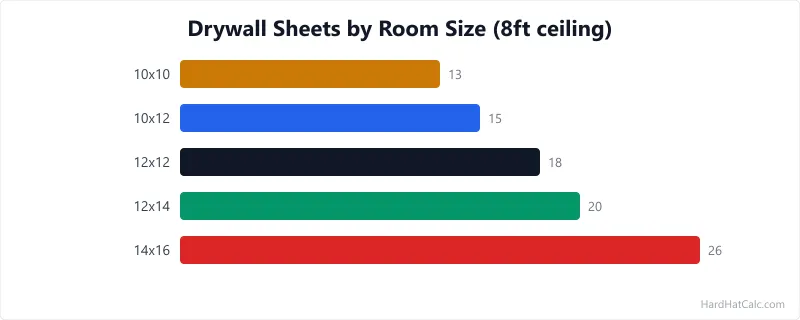
A 10×10 ft room with 8-foot ceilings needs roughly 13-14 sheets of 4×8 drywall. The walls have 320 sq ft of gross area (40 ft perimeter × 8 ft height), which takes about 10 sheets hung horizontally. The ceiling adds 100 sq ft, requiring 3-4 sheets of 4×8 (or 2-3 sheets of 4×12). After a 12% waste factor for a standard room with one door and one window, the total lands at 13-14 sheets. Pure area math would suggest 13 sheets (420 ÷ 32), but layout waste and staggering requirements push the practical count slightly higher. The room-dimension sheet count tool automates this math for any room dimensions.
- What is the difference between drywall mud and joint compound?
They are the same product — "mud" is the trade slang for joint compound. There are two main types: pre-mixed (comes ready to use in buckets) and setting-type or "hot mud" (a powder you mix with water that hardens via chemical reaction rather than drying). Pre-mixed is easier for beginners because it stays workable longer, but it shrinks as it dries and needs 24 hours between coats. Setting-type compound hardens in 20, 45, or 90 minutes regardless of humidity, shrinks less, and allows you to apply multiple coats in a single day — but it sets hard and is much more difficult to sand if you make mistakes. The joint compound calculator estimates bucket quantities based on your joint lengths and finish level.
- When are 4×12 drywall sheets worth the extra handling?
Use 4×12 sheets wherever you can handle them. Longer sheets mean fewer vertical joints, which means less taping, less sanding, and a smoother finished wall. On a 14-foot wall, a single 4×12 sheet plus a 2-foot piece covers the entire length with one joint instead of two joints from two 4×8 sheets. The trade-off is weight and manoeuvrability: a 4×12 half-inch sheet weighs about 77 pounds against about 51 pounds for a 4×8, on Georgia-Pacific's printed nominal of 1.6 pounds per square foot for half-inch regular board. For ceilings, a drywall lift makes 12-foot sheets manageable for one person. For walls, two people can handle 12-footers comfortably in most rooms. Before hanging drywall, confirm stud spacing and layout with the stud spacing and plate-run tool — fastener schedules depend on stud placement.
- How many gallons of joint compound should I budget for a drywall job?
Budget one gallon of pre-mixed joint compound for every 3 to 3.5 sheets of 4×8 drywall. National Gypsum's ProForm chart prints 9.0 gallons, or 123-140 lbs, per 1,000 sq ft of board. USG's Sheetrock all-purpose sheet prints about 10 gallons per 1,000 sq ft. Neither document states a coat count against that figure; both print one whole-job coverage rate covering taping and finishing together, so read it as the job, not as a coat. Watch the container units, because the makers do not line up: USG prints a 4.5-gallon pail and no weight for it, while National Gypsum and Georgia-Pacific print 61.7 lbs on their large pail and no gallon figure. No maker document states both. On the gallon side, 4.5 gallons at 100-111 sq ft per gallon covers about 450-500 sq ft, or 14-15 sheets, including tape bedding, screw heads, and inside corners. Our joint compound calculator plans heavier on purpose at 4.9 lbs per sheet, our own figure set above the makers' printed band, so it will tell you a 62-lb pail stretches to 12-13 sheets rather than 14-15. A Level 5 finish skims compound over the whole surface, not just the joints. Our calculator plans 10.5 lbs per sheet for that, again a site convention with no published maker figure behind it. Once the walls are finished, the paint coverage guide explains how surface texture affects primer and topcoat quantities.
- Which bathroom walls need green board or purple board?
Green board and purple board belong on bathroom walls and ceilings outside the wet zone, never behind shower or tub tile. The residential code is explicit: water-resistant gypsum backing board shall not be used where there will be direct exposure to water (IRC R702.3.7.1). Its table of backers for wall tile in tub and shower areas (Table R702.4.2) lists four materials. Those are glass mat gypsum backing panel (ASTM C1178), fibre-reinforced gypsum panels (C1278), fibre-cement backer board (C1288), and fibre mat-reinforced cementitious backer units (C1325). Ordinary water-resistant gypsum backing board is not one of them. So behind tile in a shower or tub surround, use cement board or another listed backer. Keep the moisture- or mould-resistant gypsum for the rest of the room; the code permits it on ceilings. National Gypsum prints the same rule for its own products: water-resistant gypsum board cannot be used in the wet area per code. Outside that zone, its moisture-resistant paper and glass mat products both work. Ventilation does more against mould than the board choice does. Fit a fan rated at least 50 CFM and leave it running during and after each shower. For the layer on top, the substrate and adhesive pairings guide explains why drywall never works as a tile base in a wet area.