
Paint Coverage Rates Guide
Real paint coverage rates by surface type, paint formula, and roller nap — how primer changes the math and what a gallon actually covers versus the label.
Every gallon of paint carries a label that says something like "covers 350-400 sq ft." That number is a laboratory measurement on a perfectly smooth, primed, sealed test panel applied with a precisely calibrated roller at exactly the right film thickness. Your living room wall — with its texture, porosity, patches, and colour-hiding challenges — is not that test panel. Real-world coverage rates fall 15-40% below the label claim depending on the surface condition, paint quality, application method, and the colour transition you are making.
This guide provides actual coverage rates measured in field conditions, not manufacturer marketing. The numbers come from contractor experience, manufacturer technical data sheets (not marketing brochures), and testing by organisations like the Painting and Decorating Contractors of America. Use these rates to buy the right quantity on the first trip to the paint store — not one gallon too many and not one gallon too few.
Coverage Rates by Surface Type
The single biggest variable in paint coverage is what you are painting. A smooth, primed drywall surface absorbs almost no paint and lets you spread each gallon across its maximum area. A rough, porous, or textured surface drinks paint and cuts your coverage dramatically.
| Surface | Primer Coverage | Topcoat Coverage (1st coat) | Topcoat Coverage (2nd coat) |
|---|---|---|---|
| Smooth drywall (primed) | 350-400 sq ft/gal | 350-400 sq ft/gal | 400-450 sq ft/gal |
| Textured drywall (orange peel) | 250-300 sq ft/gal | 250-300 sq ft/gal | 300-350 sq ft/gal |
| Heavy knockdown texture | 200-250 sq ft/gal | 200-250 sq ft/gal | 250-300 sq ft/gal |
| Bare wood (sanded smooth) | 300-350 sq ft/gal | 300-350 sq ft/gal | 350-400 sq ft/gal |
| Rough-sawn wood / cedar | 200-250 sq ft/gal | 200-275 sq ft/gal | 275-325 sq ft/gal |
| Concrete block (CMU) | 150-200 sq ft/gal | 200-250 sq ft/gal | 250-300 sq ft/gal |
| Brick | 150-200 sq ft/gal | 175-225 sq ft/gal | 225-275 sq ft/gal |
| Stucco | 150-225 sq ft/gal | 175-250 sq ft/gal | 250-300 sq ft/gal |
| Metal (clean, primed) | 400-450 sq ft/gal | 350-400 sq ft/gal | 400-450 sq ft/gal |
| Previously painted (good condition) | N/A (spot prime only) | 350-400 sq ft/gal | 400-450 sq ft/gal |
| Ceiling (smooth, flat paint) | 350-400 sq ft/gal | 300-350 sq ft/gal | 350-400 sq ft/gal |
The second coat always covers more area than the first because the first coat seals the surface porosity. Plan to buy enough paint for the first coat rate, and the leftover from the second coat becomes your touch-up reserve.
For ceiling paint quantities specifically — where flat paint, overhead application, and splatter are all factors — the calculator below handles the math for you.
Wall-to-wall interior length.
Wall-to-wall interior width.
Flat latex is standard. Use primer first on stained ceilings. Textured for popcorn-style.
Most ceilings need 2 coats for even coverage. New drywall may need primer + 2 coats.
How This Is Calculated
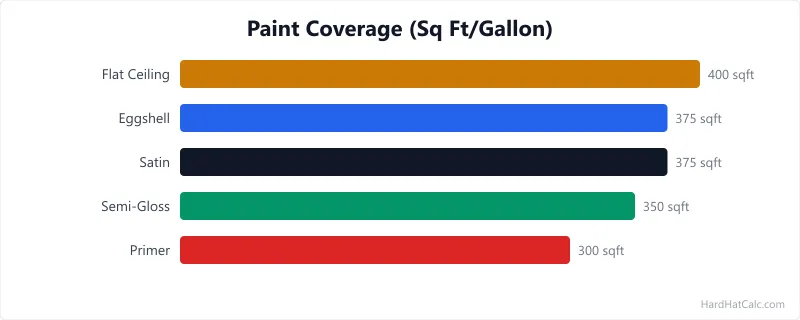
Ceiling area = length × width. Total coverage = area × coats. Gallons = total coverage ÷ coverage per gallon. Coverage rates: flat latex 375 sq ft/gal (a working figure inside the 250–400 sq ft/gal ranges manufacturers print), primer 325 sq ft/gal and textured 175 sq ft/gal (site conventions). Cost = gallons (rounded up) × cost per gallon.
Source: Flat ceiling paint coverage: the calculator applies 375 sq ft per gallon, a working figure inside the ranges the manufacturers print for their own ceiling paints, each opened on the manufacturer's own host on 2026-09-02: Behr Premium Plus Interior Ceiling Flat Paint & Primer 250–400 sq ft per gallon (product page and printable data sheet); Valspar Signature Ceiling Paint + Primer 300–400 sq ft per gallon on its product page and "approximately 400 sq ft per gallon" on its product data sheet; Glidden Interior Latex Ceiling Paint 37 m² (400 sq ft) per 3.78 L on its Canadian technical data sheet; PPG Interior Latex Ceiling Paint up to 400 sq ft per gallon; PPG's Glidden Professional Ceiling Paint GPL-0000 200–300 sq ft per gallon. Correction of 2026-09-02: this page previously stated a 350–400 range and attributed it to those manufacturers; the ranges they print are wider and differ from each other, as listed. Primer (325 sq ft per gallon) and textured ceiling paint (175 sq ft per gallon) are this site's working conventions: none of the four manufacturers publishes a ceiling-specific primer rate or a textured-ceiling-paint rate (their general primers print 400 sq ft per gallon and their texture products are sold by can or box coverage). Cost figures from US national retail averages, March 2026.
Five Factors That Kill Your Coverage Rate
Paint coverage drops below the label claim for specific, predictable reasons. Knowing them helps you estimate accurately and avoid running out mid-wall.
1. Surface Porosity
Porous surfaces absorb paint into their structure rather than letting it sit on top and spread. Bare drywall, new plaster, raw wood, concrete block, and brick are all porous. The first coat on bare drywall loses 10-15% of its volume to absorption. On concrete block, that loss jumps to 30-40% — the rough, open-pored surface sucks paint into every void. This is why primer exists: a coat of primer seals the porosity so the topcoat can spread at its full rated coverage. Skipping primer on a porous surface does not save money — it wastes the more expensive topcoat by using it as de facto primer.
2. Surface Texture
Texture increases the actual surface area beyond the flat measurement. A smooth wall that measures 10 × 10 feet (100 sq ft flat) has roughly 100 sq ft of paintable surface. The same wall with knockdown texture has 115-130 sq ft of actual surface area because the peaks and valleys add micro-area that the roller must cover. Heavy stucco exterior can have 140-160 sq ft of actual surface per 100 sq ft of measured wall. Your roller does not know about square feet — it sees surface area, and textured surfaces have more of it.
3. Colour Transition
Painting light over dark (or dark over light) demands more coats for complete hide. Going from a standard beige to white typically takes 2 coats with a quality paint. Going from dark navy to white may take 3-4 coats — or a tinted primer followed by 2 topcoats. Each extra coat consumes a full round of paint at the coverage rate. The solution is a primer tinted to roughly 50% of the topcoat colour, which provides a neutral mid-tone base that the topcoat can hide in two passes.
4. Application Method
Roller, brush, and spray each have different transfer efficiencies — the percentage of paint that actually ends up on the wall versus wasted on the tool, in the air, or on drop cloths.
- Roller: 90-95% transfer efficiency. The most material-efficient method for walls and ceilings. Use a 3/8-inch nap for smooth surfaces, 1/2-inch for eggshell or light texture, and 3/4-inch for heavy texture.
- Brush: 85-90% transfer efficiency. Less efficient than a roller because the bristles retain more paint. Best for cutting in edges and trim, not for covering large areas.
- Airless spray: 50-70% transfer efficiency. Overspray wastes 30-50% of the paint into the air, on masking, and on drop cloths. Spray coverage rates should be calculated at 60-70% of the label rate. Spraying makes sense for speed on large exterior jobs and for a smooth finish on cabinets and trim, but it is the most wasteful method per gallon.
- HVLP spray: 65-80% transfer efficiency. Better than airless but still wastes 20-35%. Used primarily for fine finish work on cabinets and furniture.
5. Paint Quality and Formulation
Premium paints contain more solids (pigment and resin) per gallon and less water or solvent. Higher solids content means better hiding power per coat and more coverage per gallon. A budget paint at $25 per gallon with 35% solids by volume covers less area and hides less colour than a premium paint at $55 per gallon with 50% solids. The cost per square foot of covered surface is often comparable between the two — you just buy fewer gallons of the premium product. Benjamin Moore, Sherwin-Williams, and PPG all publish solids content on their technical data sheets (not the marketing label — look for the TDS on the manufacturer website).
Picking the Right Primer for the Surface
Primer is a purpose-built first coat designed to seal, bond, and provide a uniform base for the topcoat. Using topcoat as its own primer (the "just add another coat" approach) works in only one scenario: repainting a previously painted surface in good condition with a similar colour. Every other situation benefits from dedicated primer.
New drywall needs PVA (polyvinyl acetate) primer — a cheap, fast-drying primer that seals the paper face and joint compound so they absorb paint uniformly. Without PVA primer, the joint compound areas absorb differently than the paper areas, creating visible "flashing" where the sheen differs across the wall. PVA primer costs $10-$15 per gallon and covers 350-400 sq ft. It is the cheapest insurance against flashing on new construction.
Stain-blocking primer (shellac-based like Zinsser BIN or water-based like Zinsser 123) seals water stains, smoke damage, tannin bleed from cedar and redwood, and odours from pet urine. No amount of topcoat hides these problems — the stain migrates through latex paint and reappears within days. One coat of stain-blocking primer permanently seals the stain before the topcoat goes on. For cabinet painting projects where primer selection is critical, the cabinet paint calculator includes primer quantities and product recommendations.
Bonding primer (Stix by Insl-x, Zinsser 123 Plus) adheres to glossy, slick, or non-porous surfaces that regular primer cannot grip — tile, laminate, glossy painted surfaces, and factory-finished cabinets. Without bonding primer, topcoat applied over these surfaces peels within weeks to months because the paint film has no mechanical or chemical bond to the substrate.
Roller Nap Selection: The Coverage Multiplier Nobody Talks About
The nap thickness of your roller cover directly affects how much paint the roller picks up, how much it deposits per pass, and how the finish looks. Choosing the wrong nap for your surface wastes paint and produces a poor finish.
| Nap Thickness | Best For | Coverage Impact | Finish Quality |
|---|---|---|---|
| 3/16" (foam or microfiber) | Smooth doors, cabinets, trim | +5-10% vs standard | Ultra-smooth, minimal stipple |
| 3/8" | Smooth drywall, primed surfaces | Baseline (label rate) | Smooth with light stipple |
| 1/2" | Eggshell texture, light orange peel | -5-10% vs standard | Moderate stipple |
| 3/4" | Medium texture, stucco, concrete | -15-20% vs standard | Heavy stipple, gets into texture |
| 1" - 1-1/4" | Heavy stucco, rough concrete block, brick | -25-35% vs standard | Fills deep texture, heavy stipple |
A thick-nap roller on a smooth wall wastes paint (heavy stipple deposits too much material) and looks bad (orange peel effect on what should be a smooth finish). A thin-nap roller on a textured wall misses the valleys and requires extra passes, which slows the job without saving paint. Match the nap to the texture, and the coverage rate will land close to the table values at the top of this guide.
How to Measure a Room for Paint
Measuring for paint follows a straightforward process. The most common mistake is not deducting windows and doors — or deducting too much and running short.
Measure each wall length and multiply by the ceiling height to get the gross wall area. A 12 × 14 foot room with 8-foot ceilings has a perimeter of 52 feet and gross wall area of 416 sq ft. Deduct approximately 21 sq ft per standard door and 15 sq ft per average window. Two doors and two windows deduct 72 sq ft, leaving 344 sq ft of net paintable wall area.
For the ceiling, multiply length by width: 12 × 14 = 168 sq ft. Ceiling paint (flat sheen) typically covers 300-350 sq ft per gallon on a smooth surface because overhead application is less efficient — gravity works against you, the roller drips, and you cannot see thin spots as easily.
Divide the net wall area by the coverage rate for your surface type and paint quality. For 344 sq ft of smooth primed drywall at 375 sq ft per gallon, you need 0.92 gallons — round up to 1 gallon for the first coat. The second coat at 425 sq ft per gallon uses 0.81 gallons. Total: 2 gallons for the walls. Add 1 gallon for the ceiling if painting it. The house painting cost calculator handles multi-room estimates with cost breakdowns for entire home projects.
Commercial vs. Consumer Paint: Is the Price Premium Justified?
Professional-grade paints (Benjamin Moore Regal, Sherwin-Williams Duration, PPG Timeless) cost $45-$70 per gallon. Consumer-grade paints from the same manufacturers cost $25-$40 per gallon. The price difference buys three things that directly affect coverage rates and the number of coats required.
First, higher pigment loading. Premium paints contain more titanium dioxide (the primary white pigment) and higher-quality coloured pigments. More pigment means better one-coat hide on colour transitions and fewer coats needed on new surfaces. A premium paint that covers in one coat on a repainting job effectively doubles its coverage rate compared to a budget paint that needs two coats.
Second, higher resin content. Resin is the binder that holds pigment to the surface and determines the durability of the dried film. Higher resin content produces a tougher, more washable surface that lasts longer between repaints. In high-traffic areas (hallways, kitchens, kids' rooms), the longer repaint cycle of a premium paint saves money over the life of the surface even if it costs more per gallon upfront.
Third, better rheology. Rheology is the flow behaviour of the paint — how it rolls on, levels out, and resists dripping. Premium paints are formulated to flow smoothly, self-level to minimise roller marks, and resist spattering during application. This means less mess, less waste, and a better-looking finish with less effort. The labour savings (your time on a DIY project, or the painter's rate on a professional job) often exceed the paint cost difference.
The bottom line: premium paint costs 40-80% more per gallon but often covers in fewer coats, spreads further per coat, and lasts longer before the next repaint. On a per-year, per-square-foot basis, premium paint is frequently the cheaper option.
Frequently Asked Questions
- How much paint do I need for a 12×12 room?
A 12×12 ft room with 8-foot ceilings has 384 sq ft of gross wall area. Deduct about 36 sq ft for a door and window, leaving 348 sq ft of paintable wall. At 375 sq ft per gallon (smooth primed drywall, quality paint), you need 1 gallon per coat — so 2 gallons for two coats on the walls. Add 1 gallon if painting the ceiling (144 sq ft at 325 sq ft per gallon for flat ceiling paint). Total: 2-3 gallons depending on whether you include the ceiling. Buy an extra quart for touch-ups. The house painting cost calculator automates this room-by-room for an entire home.
- Does primer affect paint coverage rates?
Yes — primer dramatically improves topcoat coverage by sealing surface porosity. On bare drywall without primer, the first coat of topcoat gets absorbed into the paper and joint compound, reducing coverage by 15-25% and creating uneven sheen (flashing). On primed drywall, the topcoat sits on a sealed, uniform surface and reaches its full rated coverage. On porous surfaces like concrete block or rough wood, primer can double the topcoat coverage rate by eliminating absorption losses. The cost of a $12 gallon of PVA primer saves $25-$50 in topcoat that would otherwise be wasted as de facto primer. For cabinet repainting where primer adhesion is critical, the cabinet paint calculator accounts for the extra prep and coat requirements.
- Why does spray painting use more paint than rolling?
Airless spray guns atomise paint into fine particles, and 30-50% of those particles miss the target surface — they become overspray that lands on masking tape, drop cloths, adjacent surfaces, and the air itself. A gallon of paint that covers 375 sq ft with a roller covers only 225-265 sq ft with an airless sprayer. HVLP (high volume low pressure) sprayers are more efficient at 65-80% transfer, but still waste more than a roller. Spraying is chosen for speed and finish quality (smooth, factory-like appearance) rather than material efficiency. When spraying exterior surfaces, the siding material calculator helps estimate both the siding and the paint required for the full wall area.
- How many coats of paint do I need to cover dark walls?
Going from a dark colour (navy, charcoal, deep red) to a light colour (white, cream, pale grey) typically requires a tinted primer plus 2 topcoats — effectively 3 coats total. Without tinted primer, you may need 3-4 topcoats to fully hide the dark base colour, which uses more expensive topcoat paint and takes significantly longer. Ask the paint store to tint the primer to roughly 50% of your topcoat colour — this grey or mid-tone base gives the topcoat the best chance of hiding in two coats. Going dark over light is easier: most quality dark paints cover in 2 coats without special primer. A ceiling paint quantity tool estimates flat-white ceiling paint separately, which typically covers well in a single coat over existing white.
- What is the best roller nap for interior walls?
For smooth drywall (the most common residential surface), use a 3/8-inch nap roller cover. It picks up enough paint for efficient coverage without depositing excess that creates heavy stipple or runs. For lightly textured walls (orange peel or eggshell), use 1/2-inch nap. For heavy knockdown texture, use 3/4-inch nap to reach into the valleys. Using too thick a nap on smooth walls wastes paint and creates an unwanted textured finish. Using too thin a nap on textured walls requires multiple passes to fill the low spots, which wastes time without saving paint. If the drywall is new, the drywall estimating guide explains finish levels and their impact on paint adhesion.