
House Painting Cost Calculator
House painting cost calculator comparing DIY and pro rates by wall area, room count, paint grade, and coat count for a realistic interior painting budget.
Last updated:
Combined wall area for all rooms. Subtract windows and doors for accuracy.
Set to 0 if ceilings are not being painted.
Higher-quality paint covers better and lasts longer.
Two coats is standard. One coat works for same-colour touch-ups only.
Each room needs its own set of tape, drop cloths, and prep supplies.
How This Is Calculated
Paint gallons = ceil((wall area + ceiling area) x coats / coverage rate). Primer gallons = ceil(total area / 350). Paint cost = paint gallons x price per gallon. Supplies = rooms x $35. Labour = total area x $2.50/sq ft (professional only). Total = paint cost + primer cost + supplies + labour.
Source: Paint coverage rates per Sherwin-Williams and Benjamin Moore product specifications (350-400 sq ft per gallon for flat, 350-400 for semi-gloss). Value correction of 2026-08-12: semi-gloss previously showed 300-350. Sherwin-Williams states 350-400 sq ft per gallon at 4 mils wet on its own semi-gloss product data sheets, including SuperPaint Interior Latex Semi-Gloss (101.30B, A88 series), Emerald Interior Latex Semi-Gloss (101.08SGA, K38 series) and Duration Home Interior Latex Semi-Gloss (101.69B, A98 series), so the sheen penalty this page previously applied is not what the manufacturer publishes. The professional labour rate of $2.00 to $3.00 per square foot ($2.50 applied) is this site's default estimate for March 2026, typical trade practice; the previous attribution to BLS Occupational Employment and Wage Statistics (SOC 47-2141) and HomeAdvisor is withdrawn as of 2026-09-02 because BLS publishes painters' hourly wages, not per-square-foot rates, and the HomeAdvisor figure was never opened.
7 min read
DIY vs Professional: Where Painting Money Goes
Most online painting estimates give you a single number and call it done. Then you get three contractor quotes ranging from $1,800 to $4,500 for the same job, and that single number stops looking useful. Prices and rates on this page are our own estimates as of the date shown; they change often. Enter your own figures for a current result. The House Painting Cost Calculator breaks your project into its actual components — paint, primer, supplies, and labour — so you can see where money goes and where you have choices.
The gap between DIY and professional costs is wider in painting than almost any other home project. Materials for a typical 3-bedroom interior run $400–$800 regardless of who holds the roller. Labour adds $2.00–$3.00 per square foot on top of that (March 2026, this site's default estimate; the Bureau of Labor Statistics publishes painters' hourly wages, not per-square-foot rates). A 1,500 sq ft wall area job that costs $600 in materials jumps to $4,000+ with a professional crew. That difference is not because painters overcharge — it is because prep work, cutting in around trim, and clean edges take real skill and time.
Paint quality also shifts the equation. Economy paint at $25–$35 per gallon covers fewer square feet per coat and fades faster than a premium product at $50–$75 per gallon. Spending $200 more on better paint can eliminate the need for a third coat, saving $150 in material and several hours of labour. The calculator lets you toggle quality tiers and see how that trade-off plays out for your wall area.
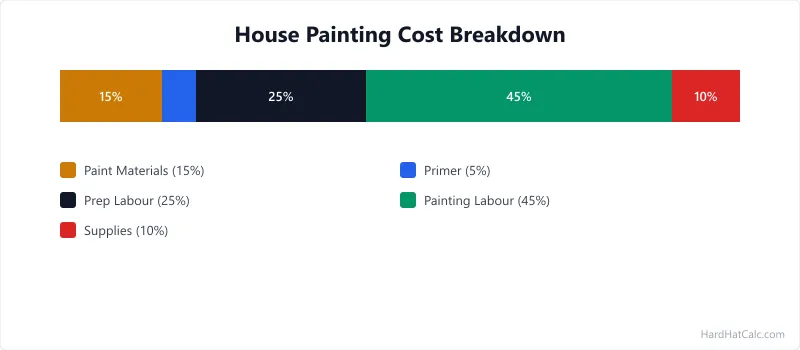
What Affects Your Paint Budget
Wall area is the primary cost driver (the square-footage measuring guide shows how to total it across walls and ceilings), but room count runs a close second for a reason most estimators ignore: prep time and supplies reset with every room. Each room needs fresh tape around trim, its own drop cloth arrangement, and edge-cutting along a new set of corners and window frames. A single 800 sq ft open-plan space costs 25-35% less to paint than four separate 200 sq ft rooms with the same total area, because prep time and supplies reset with each room.
Surface condition matters more than surface area for prep costs. Walls with peeling paint, water stains, or patched drywall need sanding, priming, and sometimes skim-coating before the first colour coat goes on. A room with clean, previously-painted walls in good condition might need only a light sand and one primer coat. A room with smoke damage or bare plaster could need three rounds of prep before paint touches the surface.
Ceiling height changes the labour equation more than the material equation. An 8-foot ceiling puts all wall area within easy roller reach. A 10-foot ceiling means extension poles and slower progress. A vaulted ceiling over 12 feet requires scaffolding or lifts, which can add $200–$500 per room in equipment rental (March 2026 US averages). If you are working with high ceilings, you can size ceiling paint needs with dedicated ceiling coverage estimates. For new construction or major remodels, estimate the wall framing gives you the total wall area before painting begins.
Paint Coverage by Quality Tier
The cost difference between paint tiers is not just about the price tag on the can. Coverage rate, durability, and touch-up ease all change with quality. The table below compares the three tiers this calculator uses. All prices reflect March 2026 US national averages from Sherwin-Williams and Benjamin Moore published pricing.
| Factor | Economy ($25–35/gal) | Standard ($35–50/gal) | Premium ($50–75/gal) |
|---|---|---|---|
| Coverage per gallon | 300–350 sq ft | 350–400 sq ft | 375–425 sq ft |
| Typical sheen | Flat | Eggshell / Satin | Satin / Semi-gloss |
| Coats for full coverage | 2–3 | 2 | 1–2 |
| Durability | 3–5 years | 5–8 years | 8–12 years |
| Washability | Low | Moderate | High |
| Best use | Spare rooms, rentals | Living areas, bedrooms | Kitchens, bathrooms, trim |
Premium paints contain more resin and pigment per gallon, which is why they cover more area and resist scrubbing. In kitchens and bathrooms where walls face moisture and grease, premium semi-gloss pays for itself by surviving cleaning that would damage economy flat paint. For low-traffic spare bedrooms, economy flat does the job at half the price.
Pricing a 3-Bedroom Interior and a Kitchen Refresh
Two real-world scenarios show how the calculator produces its estimates and where costs concentrate in each case.
Scenario 1: 3-Bedroom Home Interior, Professional Labour
Measure the surfaces. Walls total 1,500 sq ft across 6 rooms (3 bedrooms, living room, hallway, dining area). Ceilings add another 600 sq ft. Total paintable area: 2,100 sq ft.
Calculate paint gallons. Standard paint covers 375 sq ft per gallon. Two coats over 2,100 sq ft: (2,100 × 2) / 375 = 11.2, rounded up to 12 gallons.
Calculate primer. One primer coat at 350 sq ft per gallon: 2,100 / 350 = 6 gallons.
Add up material costs. Paint: 12 gal x $42 = $504. Primer: 6 gal x $30 = $180. Supplies: 6 rooms x $35 = $210. Materials subtotal: $894.
Add professional labour. 2,100 sq ft x $2.50/sq ft = $5,250. Total project cost: $894 + $5,250 = $6,144.
The labour component is 85% of total cost here. That ratio is typical for professional interior painting and explains why the DIY savings on this project would be over $5,000.
Scenario 2: Kitchen and Bathroom DIY Refresh
Measure the surfaces. Kitchen and bathroom walls total 450 sq ft. No ceilings being painted. Two rooms.
Calculate paint gallons. Premium paint at 400 sq ft per gallon, two coats: (450 × 2) / 400 = 2.25, rounded up to 3 gallons.
Calculate primer. One coat: 450 / 350 = 1.29, rounded up to 2 gallons.
Add up costs. Paint: 3 gal x $62 = $186. Primer: 2 gal x $30 = $60. Supplies: 2 rooms x $35 = $70. Total: $316.
Premium paint makes sense here because kitchens and bathrooms need moisture resistance and washability. The total stays under $350 because the wall area is small and there is no labour charge. When mixing specialty coatings for these spaces, the paint ratio calculator handles multi-component products like epoxy and two-part primers.
Lead Safety, Skipped Primer, and Wrong Sheen Choices
Painting a pre-1978 home without lead-safe practices is a serious legal and health risk. For homes built before 1978: Federal law (EPA RRP Rule) requires lead-safe work practices when disturbing paint in pre-1978 housing. Hire an EPA-certified renovator or get trained before proceeding. Sanding, scraping, or heat-stripping old paint can release lead dust that is hazardous to children and adults. The EPA Renovation, Repair, and Painting (RRP) Rule applies to any paid work on pre-1978 homes, and DIYers should follow the same precautions — wet-scraping, HEPA vacuuming, and plastic sheeting containment — even though the RRP Rule does not legally require certification for owner-occupants doing their own work. Testing kits ($10–$30 at hardware stores) confirm whether existing paint contains lead before you start any prep work.
Skipping primer to save money is the most common false economy in residential painting. Primer costs $25–$35 per gallon and one coat covers bare patches, stains, and colour transitions that would otherwise bleed through two or three coats of topcoat paint. Without primer, dark colours underneath can require three topcoats instead of two — using more paint than the primer would have cost in the first place. Always prime over new drywall, patched areas, and drastic colour changes. For a deeper look at how coverage rates shift between primer, flat, and specialty coatings, the paint coverage rates guide breaks down the numbers by surface type.
Buying paint by room count instead of wall area leads to either waste or mid-project store runs. A "3-bedroom house" could have 1,200 sq ft of wall area or 2,400 sq ft depending on room dimensions and ceiling height. Measure walls or use this calculator to get a gallon count based on actual square footage. Buy one extra gallon beyond the calculated amount for touch-ups and keep it sealed for future repairs.
Ignoring surface prep turns a 2-day DIY project into a 5-day disaster. Peeling paint needs scraping and sanding. Nail holes need filling and sanding smooth. Trim edges need painter's tape applied carefully on clean, dry surfaces. Rushing past these steps shows in the finish — brush marks over bumps, tape lines bleeding through to trim, and patchy spots where old colours show through new ones.
Choosing the wrong sheen for the room creates maintenance problems. Flat paint hides wall imperfections but marks and stains easily — fine for ceilings and low-traffic rooms. Semi-gloss resists moisture and cleans well, making it the right choice for kitchens, bathrooms, and trim. Putting flat paint in a kitchen means scrubbing grease off a surface that cannot handle scrubbing. For cabinet refinishing specifically, the cabinet paint calculator covers the unique material and prep requirements of painted cabinetry.
Underestimating ventilation needs affects both health and finish quality. Paint releases VOC (Volatile Organic Compounds) as it dries. Low-VOC paints reduce but do not eliminate fumes. Work with windows open and fans running during application and for 24–48 hours after. In winter, when opening windows is impractical, schedule painting in small batches with fans exhausting fumes through a single cracked window rather than painting the whole house closed up.
Worked Examples
Example 1
Scenario: A homeowner painting a 3-bedroom house interior: 1,500 sq ft of walls plus 600 sq ft of ceilings across 6 rooms. Standard-quality paint, two coats, with a professional painting crew.
Calculation: Total area = 1,500 + 600 = 2,100 sq ft. Paint gallons = ⌈(2,100 × 2⌉ / 375) = 12 gallons. Primer = ⌈2,100 / 350⌉ = 6 gallons. Paint cost = 12 x $42 = $504. Primer cost = 6 x $30 = $180. Supplies = 6 rooms x $35 = $210. Labour = 2,100 x $2.50 = $5,250. Total = $504 + $180 + $210 + $5,250 = $6,144.
What this means: $6,144 is a mid-range estimate for professional interior painting of a 3-bedroom home in March 2026 (US national averages). Labour accounts for 85% of the total, which is typical for professional painting. The material cost alone would be $894 for a DIY approach.
Takeaway: Professional labour dominates house painting costs. If your budget is tight but your time is flexible, DIY painting saves over 80% on a project this size — the skill barrier for rolling walls is lower than most construction trades.
Example 2
Scenario: A DIY homeowner refreshing the kitchen and bathroom with premium paint: 450 sq ft of walls, no ceilings, two coats, 2 rooms.
Calculation: Total area = 450 + 0 = 450 sq ft. Paint gallons = ⌈(450 × 2⌉ / 400) = 3 gallons. Primer = ⌈450 / 350⌉ = 2 gallons. Paint cost = 3 x $62 = $186. Primer cost = 2 x $30 = $60. Supplies = 2 rooms x $35 = $70. Labour = $0 (DIY). Total = $186 + $60 + $70 = $316.
What this means: $316 for a kitchen and bathroom refresh is well within weekend-project territory. Premium paint is the right call here — moisture resistance and washability matter more in these rooms than anywhere else in the house.
Takeaway: Small-area projects with premium paint cost less than most people expect. Three gallons of top-tier paint plus supplies comes in under $350 and delivers a finish that holds up to daily kitchen and bathroom use for 8–12 years.
Frequently Asked Questions
- How much does it cost to paint the interior of a 1,500 square foot house?
A 1,500 sq ft house typically has 1,200–1,800 sq ft of paintable wall area depending on room layout, window count, and ceiling height. DIY materials (paint, primer, supplies) run $500–$900 for two coats of standard-quality paint as of March 2026, based on US national averages from Sherwin-Williams and Benjamin Moore pricing. Hiring a professional crew adds $2.00–$3.00 per square foot of wall area in labour, bringing the total to $3,500–$6,500. The wide range reflects differences in paint quality and coverage rates, surface condition (heavy prep work costs more), and regional labour rates.
- How many gallons of paint do I need for a 12x12 room?
A 12x12 room with 8-foot ceilings has roughly 384 sq ft of wall area (4 walls x 12 ft x 8 ft) before subtracting windows and doors. At standard paint coverage of 375 sq ft per gallon, two coats require about 2.05 gallons — so buy 3 gallons to cover the second coat fully and have touch-up paint left over. Subtract about 20 sq ft per window and 20 sq ft per standard door to get a tighter estimate. If painting the ceiling too, add 144 sq ft (12 × 12) and use the ceiling paint estimator for a separate gallon count.
- Is it cheaper to paint a house yourself or hire a professional?
DIY painting saves 70–85% of the total cost because labour is the largest expense in any painting project. For a 3-bedroom home with 1,500 sq ft of walls, materials run $500–$900 while professional labour adds $3,000–$5,000 on top. The trade-off is time: a professional crew of 2–3 painters finishes a whole-house interior in 2–4 days. A solo DIY painter working evenings and weekends typically needs 2–3 weeks for the same job. Where professionals earn their fee is in prep quality and clean edges — cutting in around trim, straight ceiling lines, and smooth finishes require practice that shows in the result. If your walls need patching and taping before paint, add that prep time to the DIY estimate.
- What is the best paint sheen for interior walls?
Eggshell and satin are the most versatile sheens for interior walls in living rooms, bedrooms, and hallways. Eggshell has a soft, low-gloss finish that hides minor wall imperfections while still allowing gentle cleaning. Satin adds slightly more sheen and wipes clean more easily, making it a better fit for homes with children or pets. Semi-gloss belongs on trim, doors, and high-moisture rooms like kitchens and bathrooms where frequent scrubbing is expected — including painted cabinets that need a durable, washable finish. Flat (matte) paint works well on ceilings and low-traffic formal rooms but marks too easily for everyday living spaces.
More Materials calculators
Browse all materials calculators — Paint coverage, roofing bundles, tile adhesive, welding time, parking lot sizing, and more.