
Paint Ratio Calculator
Mixing two-part coatings? Use this paint ratio calculator to get exact hardener and reducer amounts for 4:1, 3:1, and 4:1:1 epoxy and urethane systems.
Last updated:
Each coating type has a typical mix ratio. Pot life is entered separately below — it varies by product, not just by type.
Volume of the base component. 1 quart = 32 oz, 1 gallon = 128 oz.
The first number is base parts, the second is hardener. 4:1 = 4 parts base to 1 part hardener.
Percentage of total mix to add as reducer. 0% for no reducer.
No two products match on this figure, so there is no default — read the pot life printed on your own product's TDS and enter it in minutes (convert hours: 2 hr = 120 min). Verified examples below run from 45 min to 72 hr (4,320 min).
How This Is Calculated
Hardener volume = base volume / ratio. Subtotal = base + hardener. Reducer = subtotal x (reducer % / 100). Total = subtotal + reducer. Pot life is read straight from the Pot Life field you enter (an empty field shows a message asking for the figure, never a number), printed on your product's TDS. Cost = (base x $/oz) + (hardener x $/oz) + (reducer x $0.60/oz).
Source: The mixing arithmetic (hardener from ratio, reducer from percentage, totals) is identity math on the inputs you enter. Standard mix ratios (4:1, 2:1, etc.) per SSPC (Society for Protective Coatings) coating application guidelines are a selectable convention, not a per-product spec. Pot life is entered from your own product's TDS (Technical Data Sheet). Source-set correction of 2026-09-02: this page previously shipped a fixed pot-life figure per coating type, attributed generically to PPG, Sherwin-Williams and Axalta TDS. Verification found every one of five TDS opened at those three makers disagreed with the shipped figure for its category (examples below), so the per-type figure is withdrawn and pot life is now a required field.
7 min read
Five Steps to a Correct 2K Mix
Mix a two-part epoxy at the wrong ratio and you don't get weak paint — you get an expensive puddle that won't cure, can't be wiped off easily, and wastes both the product and your prep time. Getting the ratio right is the single most important step in any 2K coating application.
These five steps apply to every two-component product, whether you are spraying automotive clear coat or rolling industrial floor epoxy.
Read the TDS for your specific product. Ratios vary even within product lines — a manufacturer's 2K primer may be 4:1 while their 2K clear is 2:1. The TDS also specifies whether the ratio is by volume or by weight. Most automotive products use volume ratios. Some industrial coatings specify weight ratios, which require a scale instead of a measuring cup.
Measure the base component first. Pour your base paint into a calibrated mixing cup to the desired volume mark. Graduated mixing cups with ratio lines printed on the side are available from paint suppliers for $2-$5 and eliminate guesswork. Prices and rates on this page are our own estimates as of the date shown; they change often. Enter your own figures for a current result. For the volumes in this calculator, 1 pint = 16 oz, 1 quart = 32 oz, 1 gallon = 128 oz.
Add hardener to the correct ratio mark. Pour the hardener (also called activator or catalyst depending on the manufacturer) into the same cup until it reaches the ratio line. For a 4:1 product, the hardener line is at 1/4 of the base volume above the base level.
Stir thoroughly for a minimum of 2 minutes. Incomplete mixing is the most common cause of soft spots, fisheyes, and uneven cure. Stir from the bottom up, scraping the sides of the cup. The mixed product should be a uniform colour with no streaks or swirls of unmixed hardener.
Add reducer last if specified, then stir again. Reducer (also called thinner) adjusts viscosity for spray application. The TDS specifies a reducer range — staying within that range prevents finish defects. Too little reducer produces dry spray and orange peel. Too much dilutes the film build and causes runs.
Ratio Notation: 4:1, 1:1, and Volume vs Weight
Understanding mix ratio notation prevents costly mistakes, especially when switching between product lines or working with European coatings that use different conventions.
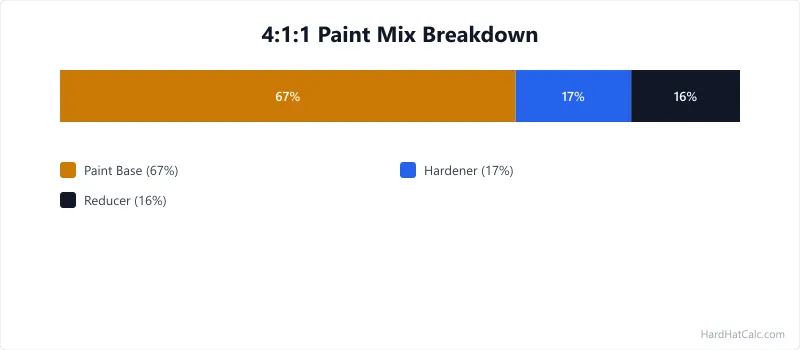
A ratio written as 4:1 means 4 parts base to 1 part hardener by volume. Pour 32 oz of base, add 8 oz of hardener, and your catalysed mix is 40 oz before reducer. Some manufacturers express this same ratio as 4:1:1 when reducer is included — 4 parts base, 1 part hardener, 1 part reducer. The third number is not a second hardener; it is the reducer addition expressed as a ratio rather than a percentage.
A 1:1 ratio (common for epoxies) means equal parts base and hardener. This is where mistakes happen most often — the volume doubles, so a gallon of base becomes two gallons of mixed product. Ordering a gallon of epoxy without realising you also need a gallon of hardener is a common first-timer error that delays the job.
European and some marine coatings express ratios by weight, not volume. A product labelled "100:50 by weight" is a 2:1 ratio by weight, but because hardeners are often denser than the base, the volume ratio may be closer to 2.5:1. Always check whether the TDS specifies volume or weight — mixing a weight-ratio product by volume throws off the chemistry.
The distinction between catalysed and reducible coatings matters for waste planning. Catalysed products (all 2K coatings) undergo an irreversible chemical reaction — once hardener is added, the clock starts and the product will gel whether you use it or not. Reducible products (lacquers, some single-stage enamels) only contain solvent that evaporates, so leftover material can be sealed and used later. For single-component ceiling and wall paints where mixing ratios are not a concern, spec the ceiling paint by room size and paint type.
Mix Ratios, Reducer Ranges, and Pot-Life Examples by Coating Type
The table below summarises typical mix ratios and reducer ranges for the five most common two-component coating families. These are general conventions, not manufacturer specifications; your own product's TDS overrides any general reference.
| Product Type | Typical Ratio | Reducer Range | Primary Application |
|---|---|---|---|
| 2K Clear Coat | 4:1 | 0-15% | Automotive refinish, show finish |
| Epoxy | 1:1 | 0-10% | Industrial primer, floor coating |
| Urethane Single-Stage | 4:1:1 | 15-30% | Auto/fleet single-coat colour |
| 2K Primer | 3:1 or 4:1 | 0-10% | Body shop primer-surfacer |
| Polyurethane | 2:1 | 10-20% | Marine, aerospace, high-gloss |
Prices as of March 2026, US national averages for professional-grade products: base coatings $0.80-$3.00/oz depending on type, hardeners $1.00-$3.50/oz, reducers $0.40-$0.80/oz. Automotive clear coat and urethane single-stage sit at the high end. Industrial epoxy and 2K primers are more affordable per ounce but used in larger volumes.
Pot life does not fit a per-type row. These six figures, read from the technical data sheets of three manufacturers, are examples — not defaults, and not averages:
| Product | Coating Type | Printed Pot Life |
|---|---|---|
| Axalta Cromax LE3004S | 2K primer surfacer | 45 min at shop temperature |
| PPG DP4000 | 2K primer | 60 min at 20°C |
| PPG DPLF, DP402LF catalyst | Epoxy primer | 8 hr (480 min) at 70°F |
| PPG DPLF, DP401LF catalyst | Epoxy primer | 72 hr (4,320 min) at 70°F |
| Sherwin-Williams Sunfire PRO SUS | Urethane single-stage | 2 hr (120 min) at 75°F |
| PPG D8115/D8117 | Matt clearcoat | 1-2 hr (60-120 min) at 20°C |
Those six figures span two orders of magnitude inside just three brands: Axalta's 45-minute primer surfacer and PPG's DP401LF-catalysed epoxy differ by a factor of 96. A single "typical" number per coating type would be wrong for most of the products in that type, which is why pot life is a field you fill in rather than a result the calculator assumes. Read your own TDS, measured from the moment hardener contacts the base, and enter that figure above. Every 15 deg F increase above the temperature your TDS tested at roughly halves the pot life it printed — Axalta's 45-minute primer surfacer could gel in 20-25 minutes in a shop running 20 deg F hotter than the TDS benchmark. Plan batch sizes around that window, not the total project volume.
Temperature, Reducer, and Pot Life Compared
Temperature, reducer choice, and batch size interact in ways that trip up even experienced painters. Understanding the relationships between these three variables prevents wasted product and poor film quality.
Hot weather (above 85 deg F) accelerates the crosslinking reaction in every 2K product. Pot life drops, viscosity rises faster, and the material can gel in the gun or hose if you pause too long between passes. The countermeasures: switch to a slow-evaporating reducer (often labelled "warm weather" or "slow" by the manufacturer), increase reducer percentage by 5-10% within the TDS range, and mix smaller batches. Spraying in the morning when temperatures are lower buys an extra 15-30 minutes of pot life on most products. For single-component paints where coverage rate matters more than pot life, the paint coverage rates guide compares square-foot yields across product types.
Cold weather (below 60 deg F) slows the reaction but creates different problems. The material stays liquid longer (which seems like an advantage) but the solvents also evaporate more slowly, leading to runs, sags, and trapped solvent that causes blistering days later. The countermeasures: switch to a fast-evaporating reducer, decrease reducer percentage, and allow longer flash times between coats. Some epoxies will not cure at all below 50 deg F — check the TDS for minimum application temperature.
Reducer speed selection is the painter's primary tool for adapting to conditions. Most manufacturers offer fast, medium, and slow reducers for each product line. Fast reducers flash off quickly — good for cold weather, small parts, and avoiding runs on vertical surfaces. Slow reducers keep the film wet longer — good for hot weather, large panels, and achieving better flow-out and gloss. Medium is the all-purpose choice for 65-80 deg F shop conditions. For full house painting cost estimates covering both interior and exterior work, see the materials calculators hub for upcoming tools.
Common Mixing Mistakes and Fixes
What happens with too much hardener?
Excess hardener accelerates the crosslinking reaction beyond the designed rate. The coating cures too quickly, becomes brittle, and may crack or lose adhesion within weeks. You will also notice shorter working time — the material thickens in the cup faster than expected, and orange peel gets worse as viscosity rises. Most 2K products tolerate up to 10% excess hardener without visible defects, but going 20% or more over creates problems you cannot fix with technique. If you have already over-catalysed a batch, the only option is to spray it immediately before it gels. You cannot add more base to dilute the hardener once mixed — the reaction has already started.
What about too little hardener?
Under-catalysed coatings never fully cure. The surface may dry to the touch but remains soft underneath — fingernail scratches will dent it, and solvents will dissolve it. In clear coats, under-catalysation causes a hazy, milky appearance and poor scratch resistance. The only fix is to strip the coating and start over. There is no way to add hardener after the fact.
Can you mix products from different manufacturers?
This is one of the fastest ways to ruin a paint job. Even within the same chemistry family (e.g. two different brands of 2K clear), the resin formulations, hardener chemistry, and solvent systems differ. Cross-mixing can cause adhesion failure, chemical incompatibility (gelling, separation, or non-cure), and VOC compliance issues. Always use the same manufacturer's base, hardener, and reducer as a matched system. For other multi-component construction products like tile adhesive and mortar, the coverage-and-product tool handles coverage rate and product selection.
Worked Examples
Example 1
Scenario: An auto body shop is mixing 1 quart (32 oz) of 2K clear coat at a 4:1 ratio with 10% reducer for a full panel respray.
Calculation: Hardener = 32 / 4 = 8 oz. Subtotal = 32 + 8 = 40 oz. Reducer = 40 × 0.10 = 4 oz. Total mixed volume = 40 + 4 = 44 oz. Pot life from the product's TDS: 90 minutes, inside the 60-120 minute range PPG prints for its D8115/D8117 matt clearcoat system. Cost: 32 x $2.50 + 8 x $3.00 + 4 x $0.60 = $80.00 + $24.00 + $2.40 = $106.40 (prices as of March 2026, US national averages for professional-grade product).
What this means: The 44 oz of mixed clear coat covers roughly 60-80 sq ft at recommended film build — enough for a full car panel or two smaller panels. The $106 material cost is competitive for mid-range professional product.
Takeaway: Pot life starts the moment you add hardener. Mix only what you can spray inside the window your TDS prints — this shop's 90-minute clear splits a quart into two half-quart batches to avoid waste, since a different clear coat on the same job could give the crew half that time or double it.
Example 2
Scenario: A maintenance crew is mixing 1 gallon (128 oz) of epoxy primer at a 1:1 ratio with 5% reducer for a structural steel floor coating.
Calculation: Hardener = 128 / 1 = 128 oz. Subtotal = 128 + 128 = 256 oz. Reducer = 256 × 0.05 = 12.8 oz. Total mixed volume = 256 + 12.8 = 268.8 oz (2.1 gallons). Pot life from the product's TDS: 8 hours (480 minutes) for PPG's DPLF epoxy primer catalysed with DP402LF (the same primer catalysed with DP401LF instead runs 72 hours). Cost: 128 x $1.20 + 128 x $1.50 + 12.8 x $0.60 = $153.60 + $192.00 + $7.68 = $353.28 (prices as of March 2026, US national averages for industrial-grade product).
What this means: A 1:1 epoxy doubles your volume — you get 2.1 gallons of sprayable material from each gallon of base. The 8-hour pot life on the DP402LF catalyst gives far more working time than a same-shift 2K clear or primer, so plan the batch size around the floor area, not the clock.
Takeaway: Epoxy primer pot life swings by catalyst, not just by brand — PPG's own DPLF line runs from 8 hours with DP402LF to 72 hours with DP401LF, a nine-fold spread inside one product. Read which catalyst your TDS names before you plan a batch, and check its temperature de-rating separately if the shop runs hot.
Frequently Asked Questions
- What happens if you add too much hardener to two-part paint?
Excess hardener accelerates the crosslinking reaction beyond the intended rate, producing a coating that cures too quickly and becomes brittle. The film may crack, lose adhesion, or develop orange peel because you cannot get it on the surface fast enough. Most 2K products tolerate up to 10% excess hardener without visible problems, but going 20% or more over creates noticeable defects. If you have over-catalysed a batch, the only fix is to spray it immediately before it gels — you cannot add more base to dilute the hardener once mixed. For single-component paints where ratio is not an issue, the house painting cost estimator handles coverage and material budgets.
- How do you measure paint mixing ratios accurately?
Use a calibrated mixing cup with ratio marks printed on the side (available from paint suppliers for $2-$5). Pour the base to the first mark, then add hardener to the next mark for your ratio. For small batches, graduated syringes or kitchen measuring cups work. Digital scales are more accurate for large batches but require the weight-based ratio from the TDS, which differs from the volume ratio. Always pour base first, add hardener second — this lets you verify the base volume before committing the hardener. The epoxy-adhesive mixing guide covers similar multi-component mixing for epoxy adhesives in tiling applications. When prepping newly framed walls for paint, the stud-and-plate quantities tool tells you how much wall area to budget paint for first.
- Can I adjust reducer percentage based on temperature?
Yes, and you should. In hot weather (above 85 deg F), increase reducer percentage by 5-10% and switch to a slow-evaporating reducer to extend your working time. In cold weather (below 60 deg F), decrease reducer or switch to a fast-evaporating formula to ensure the film dries before it sags. The TDS specifies a reducer range (e.g. 10-25%) — stay within that range. Going below dries too fast and creates dry spray; going above dilutes the film build and may cause runs. For cabinet refinishing projects where temperature control is easier, the cabinet paint calculator estimates quantities by door count and finish method.
- How long is the pot life of a mixed two-part coating?
It depends entirely on the product — pot life is not consistent even within one coating type. Checking technical data sheets from three manufacturers found a 45-minute pot life for Axalta's Cromax LE3004S 2K primer surfacer at one end and 72 hours for PPG's DPLF epoxy primer on its DP401LF catalyst at the other, a 96-fold spread. Temperature shifts that further: pot life roughly halves for every 15 deg F increase above the temperature the TDS was tested at. Once the material starts to thicken, it is past usable pot life even if it is still liquid — the crosslinking has progressed too far for proper film formation. Epoxy tile adhesive follows similar pot-life rules, with 20-30 minutes of working time at room temperature.
More Materials calculators
Browse all materials calculators — Paint coverage, roofing bundles, tile adhesive, welding time, parking lot sizing, and more.