
Siding Material Calculator
Siding material calculator for vinyl, fiber cement, wood, and engineered wood. Enter wall area minus openings for squares, starter strip, and trim.
Last updated:
Total area of all exterior walls. Calculate: perimeter × wall height. Include gable ends.
Sum of all window and door openings. Typical home: 15-20% of wall area.
Material affects cost, waste factor, and trim requirements.
Count every outside corner on the building, including bay windows and bump-outs.
Sets how many 10-ft corner posts each corner needs, and the J-channel run at the soffit line. Over 10 ft, each corner takes a second post.
How This Is Calculated
Net area = wall area - openings. Total area = net area × waste factor. Squares = total area / 100. Starter strip = building perimeter. J-channel = perimeter + (openings × 15 lin ft). Corner posts = outside corners × ceil(wall height ÷ 10 ft), because posts and corner trim boards are stocked in 10-ft lengths. Cost = siding squares + starter + J-channel + corner posts. Trim and corner rates are set per material, not blended — see the accessory table.
Source: The take-off (net area, squares, starter strip = perimeter, J-channel at 15 lin ft per opening, one 10-ft corner post per outside corner for every 10 ft of wall height) is this site's estimating convention. One "square" of siding covers 100 sq ft. The vinyl waste factor (10%) follows the VSI Vinyl Siding Installation Manual, which instructs: "Add a factor of 10 percent to all material estimates to allow for waste." Source-set correction of 2026-08-22: the former attribution of all four waste factors to RS Means Residential Construction Cost Data 2026 is withdrawn — the 2026 RS Means catalog carries no product by that name (its annuals are "Costs Book" titles) and the underlying cost data is subscription-only and was never opened. The fiber cement (12%), wood clapboard (15%) and engineered wood (12%) factors are this site's typical allowances, not manufacturer values: the 2026-08-22 sweep (record: audits/sourcing-1-retrieval/rsmeans/) and a 2026-09-02 read of James Hardie's installation hub, planning blogs and product catalogue, LP Corp's SmartSide coverage chart (which states that its tables do not account for waste factors and leaves the factor to the purchaser) and the Cedar Shake and Shingle Bureau and Real Cedar (WRCLA) pages found no published waste percentage. Attribution correction of 2026-09-02: the previous reference to James Hardie installation instructions for the coverage method is withdrawn (never opened for a figure). Trim and accessory quantities per manufacturer specification.
9 min read
Vinyl vs. Fiber Cement vs. Wood vs. Engineered: The Trade-Offs
Each siding material targets a different point on the cost-durability-appearance spectrum. No single material wins in every category, so the right choice depends on your budget, climate, and how much maintenance you are willing to do.
Vinyl siding dominates the market by volume — roughly 30% of all US homes have vinyl siding — because it is cheap, easy to install, and maintenance-free. The material costs $1.25-$2.17 per sq ft against September 2026 retailer listings. Prices and rates on this page are our own estimates as of the date shown; they change often. Enter your own figures for a current result. Installed, vinyl runs $2.50-$5.00 per sq ft including labour, and every labour and installed-cost figure on this page is a March 2026 estimate that the September 2026 refresh left alone, because no retailer or manufacturer publishes a siding labour rate. It never needs painting, resists moisture and insects, and comes in dozens of colours. The drawbacks are visual quality (vinyl looks like plastic because it is plastic), limited repairability (a damaged section often requires replacing the entire course), and vulnerability to extreme heat (vinyl warps above 160 deg F, which can happen on dark-coloured siding in direct sun against a south-facing wall).
Fiber cement (James Hardie, Allura, CertainTeed) is the premium choice for homes where appearance matters. It looks like real wood clapboard, resists fire (non-combustible), resists rot and termites, and holds paint for 15-20 years between repaints. The material costs $2.00-$2.38 per sq ft and installs at $6.00-$12.00 per sq ft. The downside is weight and brittleness — fiber cement planks weigh 2.5 lbs per linear foot for 8-1/4-inch exposure, and they crack if dropped or bent. Cutting produces silica dust that requires a respirator and dust control.
Wood clapboard (cedar, redwood, pine) is the traditional American siding material. Real wood has an authenticity that no manufactured product replicates — the grain, texture, and way it weathers are unique to each board. Cedar and redwood resist rot naturally and weather to silver-grey without treatment. Pine must be painted or stained and needs re-coating every 3-5 years. Grade drives the material price further than species does: select tight-knot (STK) western red cedar bevel runs $5.00-$8.30 per sq ft, while utility-grade knotty cedar of the same profile runs $1.48-$1.70. Tight-knot describes knots that are sound and held fast in the board, not loose enough to fall out and leave a hole. STK is the grade class both suppliers behind that $5.00-$8.30 band sell. This calculator prices STK at $6.50 per sq ft; buy utility grade instead and the siding line on the same wall falls to about $1.60 per sq ft, with the accessory lines unchanged. Installed cost runs $8.00-$15.00 per sq ft. Wood siding lasts 40-60 years with proper maintenance — potentially the longest lifespan of any option.
Engineered wood (LP SmartSide) offers wood aesthetics at a lower cost than solid wood, with better dimensional stability and rot resistance. It is made from wood strands bonded with resin and treated with zinc borate for termite and fungal resistance. Material cost: $1.50-$2.05 per sq ft. Installed: $4.00-$8.00 per sq ft. The 50-year substrate warranty is strong, but the product must be painted (it has no natural weather resistance) and the bottom edges must be kept above grade to prevent moisture wicking.
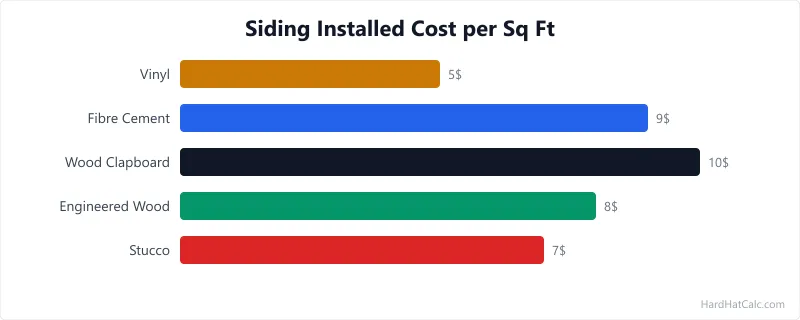
Siding Pricing and Accessory Breakdown
A complete siding job requires more than just the siding panels. Accessories (starter strips, J-channel, corner posts, undersill trim, soffit, and fascia) add 15-30% to the material cost. Material prices as of September 2026, read from independent lumber yards and building-supply retailers across the US. The labour row is the exception: it stays at its March 2026 figures because no primary source publishes a siding labour rate, so it was not re-priced.
| Component | Vinyl | Fiber Cement | Wood | Engineered |
|---|---|---|---|---|
| Siding per sq ft | $1.25-$2.17 | $2.00-$2.38 | $5.00-$8.30 (select tight-knot) | $1.50-$2.05 |
| Starter strip per lin ft | $0.60-$1.60 | $0.60-$1.60 | N/A (first course) | $0.60-$1.60 |
| J-channel / trim per lin ft | $0.56-$0.72 | $2.50-$2.75 | $1.00 (March 2026, not re-priced) | $1.25-$1.30 |
| Outside corner | $22-$27 per 10-ft post | $50-$55 per 10-ft corner | $30 per 10-ft corner (March 2026, not re-priced) | $25 per 10-ft corner |
| Drip cap (over windows) | $0.45-$1.25/lin ft | $0.45-$1.25/lin ft | $0.45-$1.25/lin ft | $0.45-$1.25/lin ft |
| Housewrap per sq ft | $0.14-$0.23 | $0.14-$0.23 | $0.14-$0.23 | $0.14-$0.23 |
| Labour per sq ft (March 2026, not re-priced) | $1.50-$3.00 | $3.00-$5.00 | $4.00-$7.00 | $2.50-$4.50 |
Three rows in that table need a word. Each material now carries its own trim and corner rate instead of one blended non-vinyl figure: vinyl is anchored on two J-channel listings, fiber cement on three HardieTrim listings, and engineered wood on a single LP 440 trim listing. One publisher is the thinnest evidence on the page, so read the engineered column that way. The fiber cement, wood and engineered corner figures buy two 10-foot trim boards butted at the corner rather than a pre-made post, because no retailer opened in September 2026 printed a readable per-piece price for a full-height non-vinyl corner post; a corner taller than 10 feet takes a second pair, and the tool charges for it. The wood trim and wood corner cells are where the September sweep came back empty. No cedar or pine 1x4 trim board with a printed price turned up, so those two rates stay at their March 2026 values and say so. The drip cap and housewrap rows do not vary by siding type at all: the same aluminium or galvanized stock and the same 9-by-100-foot Tyvek roll go behind every one of the four materials.
Housewrap (Tyvek, Typar, or equivalent weather-resistive barrier) is required under all siding types by code (IRC R703.2) but is often installed before the siding contractor arrives. If not, add $0.14-$0.23 per sq ft for material and $0.25-$0.50 per sq ft for labour on the same un-refreshed March 2026 basis as the labour row. Housewrap must lap correctly (upper courses over lower, like shingles) and be integrated with window and door flashing to create a continuous drainage plane behind the siding. Moisture control behind siding pairs with a vapor barrier in the wall cavity — especially in cold climates where interior humidity can condense against cold sheathing.
Measuring Exterior Walls: Gables, Bump-Outs, and Dormers
Exterior wall area is harder to measure accurately than interior walls because of gable ends, dormers, bay windows, and multi-level roof transitions. A systematic approach prevents both over-ordering (expensive) and under-ordering (project-stopping).
Start with the rectangular portions. Each exterior wall is width × height. Walk the perimeter and measure each wall segment, including garage faces, bump-outs, and setbacks. Multiply each segment by its height and sum the results. Most estimators use the average wall height for simplicity — a 9-foot first floor and a 9-foot second floor with a 1-foot band board gives 19 feet of average wall height for a two-storey home.
Gable ends are triangles. The area of a gable is 1/2 × base × peak height. A 30-foot-wide gable with a 6/12 pitch has a peak height of 7.5 feet (30/2 × 6/12) and an area of 1/2 × 30 × 7.5 = 112.5 sq ft. Most homes have two gable ends. This area is often forgotten in estimates, leading to a shortage of 200+ sq ft of siding on a typical gable-roofed house.
Dormers add small wall sections on the roof. Each dormer has a face wall and two cheek walls. Measure each surface and add to the total. A typical dormer adds 30-60 sq ft of siding area.
Window and door openings reduce the siding area. Measure each opening (width × height) or use the standard deductions: interior doors = 21 sq ft, windows = 12-20 sq ft depending on size, sliding glass doors = 40-50 sq ft, garage doors = 128-160 sq ft. The total opening area on a typical home runs 15-20% of the gross wall area. If your openings exceed 20%, your house has a lot of glass — double-check the measurements because overestimating openings leads to under-ordering siding.
Installation Sequence and Common Failure Points
Siding installation follows a bottom-to-top sequence regardless of material type. Each course overlaps the one below, creating a shingle-like drainage plane that sheds water outward.
Install housewrap and flash all penetrations. The weather-resistive barrier goes on first. Flash window and door openings with self-adhesive flashing tape. The flashing sequence matters: sill first, then jamb sides, then head. This order ensures water flows over each lap rather than behind it.
Install starter strip at the bottom of the wall. The starter strip provides the angled surface that locks the first course of siding at the correct angle. Without it, the first course hangs flat against the wall and looks different from every course above.
Install corner posts and J-channel. These pieces frame the siding field. Corner posts go on before the siding so each course can butt into them. Posts and corner trim boards are stocked in 10-foot lengths, so a wall taller than 10 feet takes two pieces per corner, stacked with the upper one lapping over the lower so water runs outside the joint. This tool counts them that way: an 18-foot corner is two posts, not one. J-channel goes around windows, doors, and the soffit line to receive the cut ends of siding.
Install siding courses from bottom to top. Each course locks into the one below and nails at the top. Vinyl siding nails must not be driven tight — leave 1/32 inch between the nail head and the siding flange to allow thermal expansion. Fiber cement and wood are nailed tight because they do not expand as much. Stagger the end joints between courses by at least 24 inches (vinyl) or 16 inches (fiber cement) so that no two adjacent courses have joints in the same location.
Final course and soffit trim. The top course is cut to width, locked into the undersill trim, and capped. Soffit and fascia installation completes the exterior envelope. Soffit vents must provide adequate attic ventilation — typically 1 sq ft of net free area per 150 sq ft of attic floor area.
When Re-Siding Makes More Sense Than Repair
Patching damaged siding is cheaper than full replacement, but there are situations where the economics favour starting fresh. Understanding when to repair and when to replace saves money long-term.
Repair makes sense when the damage is localised — a few cracked planks, faded sections on one wall, impact damage from a fallen branch. Vinyl siding is the easiest to patch because individual courses can be unlocked, removed, and replaced without disturbing adjacent courses. The challenge is colour matching: vinyl fades with UV exposure, so new pieces never match old ones exactly. Replace the entire wall face rather than patching mid-wall to avoid visible colour differences.
Full re-siding is the better choice when the underlying housewrap or sheathing is compromised. If removing a damaged siding panel reveals rotted OSB, water-stained sheathing, or missing housewrap, the water problem extends beyond the siding itself. Re-siding the entire building lets you inspect and repair the sheathing, install fresh housewrap with proper flashing, and add exterior continuous insulation (R-5 to R-10 foam board) that dramatically improves energy performance. Use the insulation R-value tool to check what thickness of foam board your climate zone requires before ordering materials.
The cost tipping point is roughly 30% — if more than 30% of the siding needs replacement, the labour savings of doing the full house at once typically outweigh the material savings of patching. A full re-side also provides a uniform appearance that patching cannot achieve, especially if the existing siding has faded or weathered unevenly over time. For the structural side of exterior wall projects, a stud and plate estimator sizes the lumber if any framing repairs are needed behind the siding.
Worked Examples
Example 1
Scenario: A homeowner is re-siding a 1,500 sq ft ranch house (1,200 sq ft exterior wall area after gable ends) with vinyl siding. Window and door openings total 180 sq ft. The house has 4 outside corners and 9-foot walls.
Calculation: Net area = 1,200 - 180 = 1,020 sq ft. With 10% vinyl waste = 1,020 × 1.10 = 1,122 sq ft = 11.22 squares. Starter strip = ⌈1,200/9⌉ = 134 lin ft. J-channel = 134 + (10 openings × 15) = 284 lin ft. Corner posts = 4. Cost: siding 11.22 × $160 = $1,795, starter 134 × $1.20 = $161, J-channel 284 × $0.65 = $185, corners 4 × $24 = $96. Total = $2,237. Per sq ft = $2.19.
What this means: Vinyl siding for a modest ranch house runs $2,237 in materials, still the cheapest of the four materials on an identical house. The 11.22 squares translate to roughly 6 boxes of double-4 vinyl siding (each box covers about 2 squares). Add $1,500-$3,000 for labour if hiring an installer, a March 2026 estimate the September 2026 price refresh did not re-price.
Takeaway: Vinyl siding is the budget champion at $1.60 per square foot for materials, but it has the shortest lifespan (20-30 years) and the least visual appeal. It warps in extreme heat, fades in UV, and cannot be painted (the vinyl expands too much for paint adhesion). For curb appeal, fiber cement or real wood costs more upfront but looks dramatically better.
Example 2
Scenario: A homeowner is replacing the siding on a two-storey colonial (2,400 sq ft wall area, 400 sq ft of openings, 6 corners, 18-foot walls) with James Hardie fiber cement.
Calculation: Net area = 2,400 - 400 = 2,000 sq ft. With 12% waste = 2,000 × 1.12 = 2,240 sq ft = 22.4 squares. Starter strip = ⌈2,400/18⌉ = 134 lin ft. J-channel = 134 + (23 openings × 15) = 479 lin ft. Corner posts = 6 corners × ⌈18/10⌉ = 12, because the posts come in 10-ft lengths and an 18-ft corner takes two of them. Cost: siding 22.4 × $205 = $4,592, starter 134 × $1.20 = $161, trim 479 × $2.60 = $1,245, corner posts 12 × $52 = $624. Total = $6,622. Per sq ft = $3.31.
What this means: Fiber cement for a two-storey home runs $6,622 in materials. Switch this same colonial to vinyl and the tool returns $4,280, so fiber cement costs about 1.5 times as much on an identical house. The material is heavier (a 12-foot HardiePlank board weighs about 22 lbs vs. 4 lbs for vinyl), so installation labour is also higher. Total installed cost: $12,000-$18,000 including labour, a March 2026 estimate the September 2026 price refresh did not re-price.
Takeaway: Fiber cement is the sweet spot between vinyl (cheap but short-lived) and wood (beautiful but high-maintenance). It resists rot, fire, and insects; holds paint for 15+ years; and adds genuine curb appeal. James Hardie offers a 30-year product warranty when installed to their specifications, making the long-term cost competitive with vinyl when maintenance is factored in.
Frequently Asked Questions
- How many squares of siding do I need for a 1,500 sq ft house?
A 1,500 sq ft house (referring to living area) typically has 1,200-1,800 sq ft of exterior wall area depending on the number of storeys and the building footprint. After subtracting window and door openings (typically 15-20% of wall area), the net siding area runs 1,000-1,500 sq ft, or 10-15 squares. Add 10-15% for waste: 11-17 squares. Get an exact count by measuring each wall segment, adding gable ends, and subtracting actual opening dimensions. For the window and door openings you are deducting, that calculator gives the framed dimensions.
- How much does it cost to re-side a house with fiber cement?
Fiber cement siding (James Hardie HardiePlank) costs $6.00-$12.00 per sq ft fully installed, including material, labour, and accessories. For a typical 2,000 sq ft net siding area (after openings), the total project cost is $12,000-$24,000. Material alone runs $2.00-$2.38 per sq ft ($4,000-$4,760) against September 2026 retailer listings. Add $2,000-$4,000 for paint if the pre-primed boards need a topcoat. The installed, labour and paint figures here are March 2026 estimates that were not re-priced, and all of them vary by region and contractor. If repainting existing siding is cheaper, the house painting cost estimator breaks down paint, primer, and labour for a full exterior.
- Can you install new siding over old siding?
Yes, in some cases. Vinyl siding can be installed over existing wood or vinyl siding if the wall surface is flat and the existing material is in sound condition. However, this approach hides any underlying moisture damage, prevents inspection of the sheathing and housewrap, and adds thickness that complicates window and door trim details. Most siding manufacturers and building codes allow overlay installation, but many contractors and inspectors prefer tear-off because it allows a fresh start with proper housewrap and flashing. The labour savings of overlay ($1-$2/sq ft) are modest compared to the peace of mind of knowing what is behind the siding. While the wall is open, consider adding insulation to meet current code before the new siding goes on.
- What is the cheapest siding material for a house?
Vinyl siding is the least expensive option at $1.25-$2.17 per sq ft for materials as of September 2026, and $2.50-$5.00 per sq ft installed on the page's un-refreshed March 2026 labour basis. A complete vinyl re-side of a 1,500 sq ft net wall area costs $3,750-$7,500 installed on that same basis. Engineered wood (LP SmartSide) is the next cheapest at $1.50-$2.05 per sq ft for materials. Both require no ongoing staining or painting (vinyl never needs paint; engineered wood comes factory-primed). The cheapest long-term option depends on how long you plan to stay — vinyl lasts 20-30 years while fiber cement and engineered wood last 30-50 years. The retrofitting cost calculator can estimate the full envelope upgrade if you combine siding with insulation and air sealing.
More Materials calculators
Browse all materials calculators — Paint coverage, roofing bundles, tile adhesive, welding time, parking lot sizing, and more.