
Floor Joist Size Calculator
Free floor joist size calculator for 2x6 through 2x12 lumber. Enter span, spacing, and wood species to get the minimum depth from AWC and NDS span tables.
Last updated:
Methodology reviewed by Doc. dr. sc. Mladenka Juradin, dipl. ing. građ., PhD, Civil Engineering (FCEAG, University of Split)
Distance between bearing walls or beams, measured inside face to inside face.
Standard residential spacing is 16" OC. Tile floors often use 12" OC.
Grade No. 2 is the standard structural grade for residential framing.
IRC requires 40 PSF for habitable rooms, 30 PSF for sleeping rooms (some jurisdictions).
Weight of the floor assembly itself. Light: 10 PSF. Tile floor: 15-20 PSF.
For estimation only. Structural work requires review by a licensed engineer. Local building codes take precedence over any calculator output.
How This Is Calculated
Minimum joist size looked up from AWC Span Tables for Joists and Rafters 2024 (No. 2 grade, L/360) by species, spacing (12"/16"/19.2"/24" table columns — no scaling factors), and load bracket (total ≤40 psf uses the 30+10 table, ≤50 the 40+10 table, above that the 50+10 table). Spans exceeding the 2x12 column return an engineered-joist referral instead of a size. Deflection limit = span (in) / 360 for live load. Joist count per 10 ft = ceil((120 / spacing) + 1). Board feet = (2 x nominal depth / 12) x span x count.
Source: Maximum spans from AWC Span Tables for Joists and Rafters, 2024 edition (Tables F-1/F-2/F-3), with No. 2 grade design values per the AWC Design Values for Joists and Rafters 2024 supplement. The 40+10 psf cells at 12"/16"/24" match IRC 2021 Table R502.3.1(2). Deflection limits per IRC 2021 Section R301.7 — L/360 for live load. Values verified July 2026.
6 min read
The Bounce Test: When Your Floor Feels Like a Trampoline
Jump in the middle of a bedroom and bounce. If the floor feels springy or dishes noticeably, the joists are either too small for the span or spaced too far apart. That bounce is deflection — the temporary bending of the joist under load — and while a little flex is normal in wood framing, too much causes cracked tile, squeaky subfloor seams, and an unsettling "trampoline" feeling underfoot. When a joist has gone past normal flex into a permanent dip, the job shifts from sizing to repair, and working out why a floor joist is sagging comes before any sistering or added support.
Building codes limit floor deflection to L/360 for live load and L/240 for total load. L/360 means the maximum sag at midspan cannot exceed 1/360th of the span. For a 14-foot span, that is just under half an inch (0.47 inches). Exceed that, and the floor passes the bounce test in the worst way.
The floor joist size calculator above determines the minimum joist depth — 2x6 through 2x12 — that meets both the strength and deflection requirements for your span, spacing, species, and loading. It draws from the same AWC span tables that building officials use when reviewing framing plans.
Joist selection is not something to eyeball or guess. A 2x8 that clears a 12-foot span in Douglas fir at 16" OC becomes inadequate at 14 feet — just two feet more. The difference between a solid floor and a bouncy one is often a single size step, and the cost difference between 2x8 and 2x10 lumber for a typical room is under $100.
Selecting Joists: A Practical Sequence
Picking the right joist involves five decisions that build on each other. Skip one and the others fall apart.
Measure the clear span. This is the distance between the inside faces of the bearing walls or beams that support the joist ends. Do not include the bearing length — that is separate. If the span exceeds the maximum for the largest solid-sawn lumber size (about 21 feet for 2x12 Douglas fir at 12-inch spacing — southern pine tops out sooner), you need either a mid-span beam to break the span into two shorter sections or engineered I-joists.
Choose the joist spacing. Standard residential framing uses 16 inches on centre. Tile floors and heavy dead loads benefit from 12" OC, which lengthens allowable spans by roughly 15% and stiffens the floor between joists. 19.2" and 24" spacings are used with engineered I-joists and some subfloor panel layouts, but 24" OC with solid-sawn lumber cuts allowable spans by 15-20% compared to 16" OC.
Identify your wood species. Douglas Fir posts the longest floor spans of the common species, with SPF and hem-fir close behind; southern pine — since SPIB's 2013 design-value revision — trails in the larger joist sizes. Use whatever is locally available and affordable, but know the species before looking up span tables because the numbers differ meaningfully.
Calculate total load. Add live load (40 PSF for habitable rooms per IRC, 30 PSF for attic sleeping rooms in some jurisdictions) to dead load (weight of the floor assembly — subfloor, finished floor, and ceiling below). Standard light construction is 10 PSF dead. Tile floors add 10-15 PSF. A room with a heavy stone hearth may need a localised joist doubling.
Look up the minimum joist size. Enter your span, spacing, species, and total load into the calculator above. The result is the smallest joist that satisfies both the bending strength requirement and the deflection limit. If you are between sizes, always go to the next larger — the cost difference is small and the next size up adds 1-2 feet of span capacity. With the size chosen, a board-foot tally for the joist run converts the joist count into a lumber order you can price.
Solid Sawn Lumber vs Engineered I-Joists
Solid sawn joists (2x6 through 2x12) and engineered wood I-joists both frame floors, but they suit different situations.
Solid sawn lumber is the traditional choice for residential floors. It is available at every lumber yard, easy to cut and nail, and understood by every framing crew. The drawbacks appear at longer spans: solid-sawn 2x12 joists max out at about 18 to 21 feet depending on species and spacing (and only 16'-6" in southern pine at 16" OC), they can twist, bow, and crown if not properly selected, and their depth, 11.25 inches actual for a 2x12 rather than a full foot, may conflict with tight floor-to-floor heights.
Engineered I-joists use an OSB web between two LVL or sawn-lumber flanges. They span up to 30+ feet without mid-span support, resist twisting and crowning because the engineered web is dimensionally stable, and come in consistent depths (9.5", 11.875", 14", 16"). The trade-off is higher material cost (roughly 20-40% more than solid sawn for equivalent spans) and special requirements for end bearing, web stiffeners, and hole placement for plumbing and HVAC runs.
For most residential rooms with spans under 16 feet, solid sawn 2x10 or 2x12 joists are cost-effective and straightforward. Above 16 feet, or when you need a shallower floor assembly without a mid-span beam, I-joists become the practical choice. The exterior-deck joist sizer covers exterior deck joist sizing, where pressure-treated lumber and outdoor-rated species replace interior framing grades.
Maximum Span Reference by Joist Size
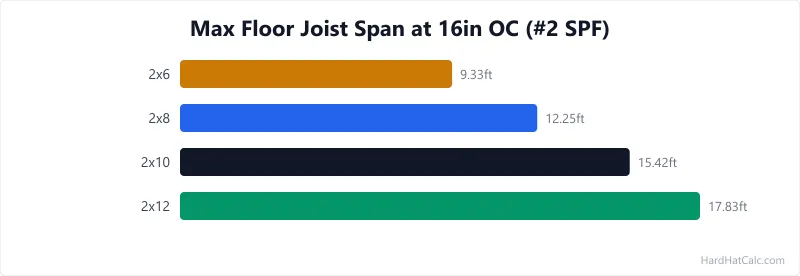
The table below shows approximate maximum spans for the four common joist sizes at 16" OC spacing with 50 PSF total load (40 live + 10 dead). These are No. 2 grade values — the standard structural grade.
| Joist Size | Actual Depth | SYP No. 2 | DF No. 2 | SPF No. 2 | Hem-Fir No. 2 |
|---|---|---|---|---|---|
| 2x6 | 5.5" | 9'-4" | 9'-9" | 9'-4" | 9'-1" |
| 2x8 | 7.25" | 11'-10" | 12'-9" | 12'-3" | 12'-0" |
| 2x10 | 9.25" | 14'-0" | 15'-7" | 15'-5" | 15'-2" |
| 2x12 | 11.25" | 16'-6" | 18'-1" | 17'-10" | 17'-7" |
Values from AWC Span Tables for Joists and Rafters, 2024 edition, matching IRC 2021 Table R502.3.1(2). Note that Douglas fir — not southern pine — now posts the longest floor spans: SPIB's 2013 revision of southern pine design values pulled its 2x10 and 2x12 columns well below the western species.
Notice the pattern: each step up in joist size adds roughly 2 to 3 feet of span capacity. A 2x10 spans about 20% farther than a 2x8 in the same species. This is because bending stiffness increases with the cube of the depth — doubling depth increases stiffness eightfold.
For staircase openings that interrupt the joist layout, the staircase dimension calculator sizes the opening, headers, and trimmers needed to frame around the stair.
Dead Load Estimates by Floor Type
Dead load is the weight the joists carry permanently — the floor assembly itself, not the people and furniture on top. Getting the dead load wrong changes the joist size.
Standard wood-frame floor (carpet or vinyl). Subfloor (3/4" plywood at 2.3 PSF) + finished floor (carpet and pad at 1.5 PSF or vinyl at 0.5 PSF) + ceiling below (1/2" drywall at 2.2 PSF). Total: 5-6 PSF. Use 10 PSF as the conservative standard, which includes allowance for mechanical runs and insulation.
Tile or stone floor. Add mortar bed (5-7 PSF for 1/2" setting bed), cement backer board (3 PSF), and tile (2-6 PSF depending on material). Total dead load: 15-25 PSF. Thick natural stone (marble, granite) can push dead load above 25 PSF for heavy slabs.
Engineered hardwood or laminate. These float on a thin foam underlayer and weigh 2-3 PSF. Dead load is essentially the same as the standard 10 PSF figure. The underlayment calculator estimates the foam or cork pad quantities for these flooring types.
Concrete topping (gypcrete for sound isolation). A 1.5-inch pour of gypcrete adds 12-13 PSF. Combined with standard subfloor and ceiling, total dead load reaches 20-25 PSF — equivalent to a tile floor. Multi-family buildings often use gypcrete for sound separation between units, and the added weight frequently bumps the joist size up one step.
Worked Examples
Example 1
Scenario: A homeowner is framing a bedroom floor with a 14-foot clear span using Southern Yellow Pine (SYP) No. 2 joists at 16 inches on centre. Live load is 40 PSF (residential code requirement) and dead load is 10 PSF (light construction).
Calculation: Total load = 40 + 10 = 50 PSF. Per AWC span tables for SYP No. 2 at 16" OC and 40+10 loading: 2x8 spans up to 11'-10", 2x10 spans up to 14'-0", 2x12 spans up to 16'-6". At a 14-foot span, a 2x10 is the minimum size that meets both strength and deflection limits — and it lands exactly on the table maximum.
What this means: A 2x10 SYP joist at 16" OC reaches a 14-foot bedroom span with zero margin — 14'-0" is the table limit, so the span must be measured precisely to the bearing faces. The 2x8 falls more than 2 feet short. If the real span runs even an inch past 14 feet, step up to 2x12 or tighten spacing to 12" OC (16'-2" allowable).
Takeaway: For spans over roughly 12 feet at standard 16" OC spacing, most species require 2x10 joists — and southern pine 2x10 tops out at exactly 14 feet. Beyond that, 2x12, tighter spacing, or engineered I-joists become necessary.
Example 2
Scenario: A bathroom renovation requires a 10-foot span with Douglas Fir joists at 12 inches on centre. The tile floor adds significant dead load — 20 PSF for tile, mortar bed, and cement board over the standard 10 PSF.
Calculation: Total load = 40 + 20 = 60 PSF, which the calculator serves from the 50+10 table (a conservative stand-in with a stricter deflection basis). For DF No. 2 at 12" OC: 2x6 spans up to 9'-10", 2x8 spans up to 13'-1", 2x10 spans up to 16'-5". At a 10-foot span, a 2x8 is the minimum. The deflection check matters most for tile because tile and grout crack when the substrate flexes: L/360 for 40 PSF live load across 10 ft = 0.33 inches max. A 2x8 DF at 12" OC deflects approximately 0.12 inches under that live load — well within limit.
What this means: A 2x8 Douglas Fir joist at 12" OC is sufficient for a 10-foot tile bathroom floor. The tighter 12" spacing compensates for the heavy dead load. Tile floors are unforgiving of deflection — cracked grout lines are the first sign of undersized joists.
Takeaway: Tile floors need stiffer framing than carpet or vinyl because tile and grout crack when the substrate deflects. Use 12" OC spacing or upsize by one joist depth compared to standard bedroom framing.
Frequently Asked Questions
- What size floor joists do I need for a 14-foot span?
For a 14-foot span at standard 16" on-centre spacing with 40 PSF live load and 10 PSF dead load, a 2x10 joist No. 2 grade clears the span in all four common species — Douglas fir at 15'-7", SPF at 15'-5", hem-fir at 15'-2", and southern pine at exactly 14'-0", the table limit with zero margin. If your species is southern pine and the measured span runs past 14 feet, step up to 2x12 or tighten to 12" OC. Always check the AWC span tables for your specific species and grade, because the difference between species can shift the answer by one size step. If the joists bear on a centre wall, that wall is load-bearing and cannot be removed without a replacement beam.
- Can I use 2x8 joists for a 16-foot span?
No. At 16" OC spacing, a 2x8 in the strongest common species (Douglas Fir No. 2) maxes out at 12'-9" for residential floor loads (40 psf live + 10 psf dead). A 16-foot span requires 2x12 joists at 16" OC — or 2x10 at 12" OC in Douglas fir or SPF. Even at 12" OC spacing, a 2x8 only reaches about 14 feet. Forcing a 2x8 across a 16-foot span produces a floor that exceeds the L/360 deflection limit, resulting in a bouncy floor that cracks tile and causes squeaks at subfloor seams. If you cannot reduce the span, run a beam deflection check to see exactly how much the joist flexes at the candidate sizes.
- Does floor joist spacing affect the required size?
Yes — spacing has a direct effect. Closer spacing means each joist carries less tributary load, which allows smaller sizes or longer spans. Moving from 16" OC to 12" OC adds roughly 15% to the maximum span. Moving from 16" to 24" OC cuts the maximum span by about 18%. For tile floors, the tighter spacing also reduces deflection between joists, which prevents grout cracking. Most residential floors use 16" OC as the standard balance between material cost and structural performance. The stud-wall planner uses the same spacing conventions, so the layout typically aligns between floors and walls.
- When should I use engineered I-joists instead of solid lumber?
Consider engineered I-joists when spans exceed 16-18 feet, when you need consistent depth without crowning or twisting, or when the floor assembly depth is constrained and you cannot use a deeper solid-sawn member. I-joists span up to 30+ feet without mid-span support and resist the warping problems common in long solid-sawn joists. They cost 20-40% more than solid lumber per joist, but eliminate the need for a mid-span beam (and its footings), which often makes the total system cost comparable. For outdoor decks with different species requirements, the outdoor joist span tool covers pressure-treated lumber and deck-specific loading.
More Structural calculators
Browse all structural calculators — Beam sizing, truss pricing, load calculations, wall framing, deck capacity, and foundation tools.