
Staircase Dimension Calculator
Free staircase dimension calculator: enter floor-to-floor height for rise, run, tread count, stringer length, and headroom per IRC R311.7 limits.
Last updated:
Vertical distance from finished floor to finished floor above.
Horizontal depth of each tread. IRC minimum is 10 inches.
Target riser height. IRC maximum is 7-3/4 inches.
For estimation only. Structural work requires review by a licensed engineer. Local building codes take precedence over any calculator output.
How This Is Calculated
Number of risers = round(total rise / preferred riser height). Actual riser height = total rise / number of risers. Number of treads = risers - 1. Total run = treads x tread depth. Stringer length = sqrt(total rise² + total run²). Minimum headroom = 80 inches (IRC R311.7.2).
Source: Stair geometry calculations per IRC 2021 Section R311.7 (Stairways). Maximum riser height 7-3/4 inches (R311.7.5.1), minimum tread depth 10 inches (R311.7.5.2), minimum headroom 6 ft 8 in (R311.7.2). Stringer length by Pythagorean theorem.
5 min read
The Two Numbers Every Stair Builder Memorises
Building code boils staircase geometry down to two critical measurements: a maximum riser height of 7-3/4 inches and a minimum tread depth of 10 inches. Get those two numbers right, and the rest of the geometry follows by arithmetic.
Measure the total rise. This is the vertical distance from finished floor to finished floor, including subfloor, underlayment, and finish materials on both levels. Missing a 3/4-inch layer of hardwood throws off every riser height in the flight.
Divide by your preferred riser height. Round the result to the nearest whole number — that gives you the number of risers. A target of 7.5 inches works well for most residential stairs.
Re-divide to find the actual riser height. Take the total rise and divide by the number of risers you just calculated. This is the exact height you will cut each riser to. It will rarely be a round number.
Count the treads. Treads always equal risers minus one, because the upper floor acts as the final stepping surface.
Multiply treads by tread depth for total run. This horizontal distance tells you how much floor space the staircase consumes.
Calculate stringer length with the Pythagorean theorem. The stringer is the hypotenuse of a right triangle formed by the total rise and total run. This measurement determines the lumber length you need.
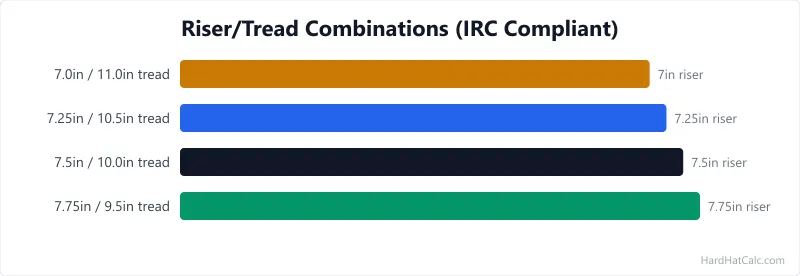
Uneven Risers Trip People — Code Limits the Variance
Humans calibrate their gait to the first two or three steps. If one riser is 7 inches and another is 7.75 inches, the brain does not adjust fast enough and you stumble. This is not just uncomfortable — it is the leading cause of stair-related falls in residential buildings.
IRC R311.7.5.1 limits the maximum variation between any two risers in the same flight to 3/8 inch. That tolerance sounds generous, but in practice, even 1/4-inch variation is noticeable underfoot. This is why you divide the total rise evenly across all risers rather than choosing a round riser height and letting the last step absorb the remainder. A "make-up step" that is noticeably shorter or taller than its neighbours violates code and creates a trip hazard.
The same principle applies to treads. Every tread in a flight must be the same depth, with a maximum 3/8-inch variance between any two treads. Consistency in both dimensions produces a staircase that feels predictable and safe.
If your staircase lands against a framed wall, you can lay out the stud spacing around the stairwell opening.
IRC Code Requirements at a Glance
The table below summarises the key dimensional requirements from IRC 2021 Section R311.7. Your local jurisdiction may adopt amendments — always verify with your building department before cutting lumber.
| Dimension | IRC 2021 Requirement | Typical Comfort Range |
|---|---|---|
| Maximum riser height | 7-3/4" (197 mm) | 7"–7.5" for comfort |
| Minimum tread depth | 10" (254 mm) | 10"–11.5" for comfort |
| Minimum stair width | 36" (914 mm) | 36"–42" |
| Minimum headroom | 6'8" (2,032 mm) | 7'+ for comfort |
| Maximum riser variance | 3/8" between any two risers | Under 1/8" with careful cutting |
| Handrail height | 34"–38" (864–965 mm) | 36" standard |
| Handrail required | Stairs with 4+ risers (R311.7.8.1) | All interior stairs |
| Guards (guardrails) | Required on open sides with >30" total rise (R312.1) | Min. 36" high from nosing |
| Baluster spacing | 4" sphere cannot pass through (R312.1.3) | 3.5" typical spacing |
IRC R312 requires guards (guardrails) on open sides of stairs with a total rise of more than 30 inches. Guard height must be at least 36 inches measured from the stair nosing. Balusters must be spaced so a 4-inch sphere cannot pass between them (IRC R312.1.3).
These requirements apply to residential interior stairs. Exterior stairs, spiral stairs, and commercial stairs follow different code sections with different dimensional limits.
Comfort vs. Code: Optimising Your Stairs
Code sets minimums, not ideals. A 10-inch tread meets IRC requirements but feels cramped to anyone with feet larger than size 10. An 11-inch or 11.5-inch tread is noticeably more comfortable and only adds a few inches to the total run per tread. Similarly, a 7-inch riser feels better underfoot than a 7.75-inch maximum — the shorter rise creates a less steep angle that is easier on knees, especially for anyone carrying loads up and down.
The classic comfort formula for stairs is riser height plus tread depth equals 17 to 18 inches (Blondel's rule, a widely used stair design formula). A 7.5-inch riser with a 10-inch tread gives 17.5 inches — right in the sweet spot. A 7-inch riser with an 11-inch tread gives 18 inches — slightly more generous and very comfortable for daily use.
Stair angle matters too. Most comfortable residential stairs fall between 30 and 35 degrees from horizontal per architectural best practice guidelines. Steeper than 37 degrees and the stair starts to feel like a ladder. Shallower than 28 degrees and each step feels awkwardly long. The angle is determined entirely by your riser height and tread depth — adjusting either one changes the slope of the entire flight. For deck stairs specifically, the stringer-treads-and-hardware guide covers stringer stock, treads, and hardware alongside the rest of the build.
For door clearance at the top or bottom of the staircase, the door swing clearance calculator checks whether the door arc conflicts with the landing.
Open Risers vs. Closed Risers
Open risers — stairs with no vertical board between treads — create an airy, modern look that lets light pass through the flight. They are popular for deck stairs, contemporary interiors, and open-plan living spaces. Closed risers use a vertical board (the riser) to enclose each step, creating a traditional appearance and a solid visual barrier.
Code treats them differently. IRC R311.7.5.3 requires that a 4-inch sphere cannot pass through the opening in any stair. For open risers, this means the gap between consecutive treads cannot exceed roughly 4 inches. With a 7.5-inch riser height and standard 1-inch tread overhang (nosing), the clear gap is about 6.5 inches — too large for code. To pass, open-riser stairs typically use thicker treads, angled risers, or a horizontal bar between treads to reduce the opening below 4 inches.
Closed risers meet the 4-inch sphere requirement automatically and are simpler to build. Material cost is nearly identical — a 1x8 riser board costs a few dollars per step. The real difference is aesthetic, not structural.
One practical consideration: closed risers block dust and debris from falling through the stair. In a basement or utility staircase, that matters more than it does in a showpiece foyer stair. Open risers also make the underside of the stair visible, so the framing and stringer cuts need to be cleaner than they would behind a closed riser.
If the stairwell opening cuts through a load-bearing wall, you will need a header beam — screen the wall for load-bearing to estimate the beam size required.
Worked Examples
Example 1
Scenario: A homeowner needs stairs from a standard 8-ft ceiling basement (100 inches total rise, accounting for 8 inches of floor structure above the ceiling) with 10-inch treads and a preferred riser height of 7.5 inches.
Calculation: Risers = round(100 / 7.5) = 13. Actual riser height = 100 / 13 = 7.69 inches. Treads = 13 - 1 = 12. Total run = 12 × 10 = 120 inches (10 ft). Stringer length = √(100² + 120²) = √(10,000 + 14,400) = √(24,400) = 156.2 inches (13 ft 0 in).
What this means: Thirteen risers at 7.69 inches each fits within the 7-3/4-inch IRC maximum, but just barely. The 10-foot horizontal run means the staircase needs a clear floor area of at least 3 feet wide by 10 feet long.
Takeaway: A standard 8-ft basement stair eats 30+ square feet of floor space. If that is tight, increasing tread depth to 11 inches only adds 12 inches to the total run but makes each step noticeably more comfortable.
Example 2
Scenario: A deck builder needs exterior stairs from a 48-inch high deck to ground level, using 11-inch treads and a preferred riser height of 7.0 inches.
Calculation: Risers = round(48 / 7.0) = 7. Actual riser height = 48 / 7 = 6.86 inches. Treads = 7 - 1 = 6. Total run = 6 × 11 = 66 inches (5 ft 6 in). Stringer length = √(48² + 66²) = √(2,304 + 4,356) = √(6,660) = 81.6 inches (6 ft 10 in).
What this means: Seven risers at 6.86 inches each is well within code. The 5.5-foot run means the bottom of the stairs lands about 5.5 feet from the deck edge — plan the landing pad accordingly.
Takeaway: Deck stairs with 4 or more risers require at least one handrail per IRC R311.7.8 — this 7-riser flight definitely needs one. At under 7 feet, the stringer can be cut from a single 2x12 with minimal waste.
Frequently Asked Questions
- What is the maximum riser height allowed by building code?
IRC 2021 Section R311.7.5.1 sets the maximum riser height at 7-3/4 inches (197 mm) for residential stairs. Some jurisdictions adopt amendments — Oregon, for example, allows 8 inches for existing buildings. OSHA uses a different standard for commercial stairs (7 inches max per 1910.25). Always check your local building code, as amendments vary by state and sometimes by county.
- How do I calculate the number of steps for a 9-foot ceiling?
A 9-foot ceiling with standard floor framing (1-inch subfloor + 0.75-inch finish floor + 9.25-inch joist depth) gives roughly 109 to 112 inches of total rise. Divide by your target riser height: 110 / 7.5 = 14.67, round to 15 risers. That gives 15 risers at 7.33 inches each and 14 treads. At 10-inch tread depth, the stair runs 140 inches (11 feet 8 inches) horizontally. For a 9-foot ceiling, plan for 14 to 15 risers. The floor joist size calculator helps determine joist depth, which factors into the total rise measurement.
- What is the minimum headroom clearance for residential stairs?
IRC 2021 Section R311.7.2 requires a minimum of 6 feet 8 inches (80 inches or 2,032 mm) measured vertically from the tread nosing to the nearest overhead obstruction at any point along the stair. This means the stairwell opening in the floor above must be long enough to maintain 80 inches of clearance as you walk down. In practice, the opening is typically the same length as the total horizontal run of the stair minus 2 to 3 treads. If the stairwell opening cuts through a load-bearing wall, a header beam must bridge the opening and carry the interrupted loads.
- Can I build stairs with different riser heights on the same flight?
Code says no. IRC R311.7.5.1 limits the maximum height difference between any two risers in the same flight to 3/8 inch. This exists because uneven risers cause trips and falls — humans unconsciously calibrate their stride to the first few steps. The way to meet this is to divide the total rise evenly and cut all risers to the same calculated height. A 1/8-inch tolerance per cut is realistic with a good circular saw and careful layout. For deck stairs, the deck stair material walkthrough covers stair stringers, treads, and hardware alongside the rest of the build.
- How long does a staircase stringer need to be?
Stringer length is the diagonal distance from the top floor to the bottom landing, calculated with the Pythagorean theorem: sqrt(total rise squared + total run squared). For a standard 8-foot ceiling basement stair (98-inch rise, 120-inch run), the stringer is about 155 inches (12 feet 11 inches). Standard stair stringers are cut from 2x12 lumber. A 14-foot 2x12 handles most residential stairs up to 10-foot ceilings. For longer runs, your lumber yard stocks 16-foot and 20-foot 2x12s. If a door frame sits at the top or bottom of the staircase, check the door frame size calculator to confirm the rough opening dimensions before framing the landing.
More Structural calculators
Browse all structural calculators — Beam sizing, truss pricing, load calculations, wall framing, deck capacity, and foundation tools.