
Door Frame Size Calculator
Need jamb width and rough opening dimensions? This door frame size calculator handles prehung and site-built frames from wall thickness and door size.
Last updated:
How This Is Calculated
Rough opening width = door width + 2" (interior prehung) or + 2.5" (exterior, or site-built). Rough opening height = door height + 2" (interior prehung) or + 2.5" (exterior, or site-built). Jamb width = actual wall thickness (framing + finish surfaces). Jamb material (linear ft) = (2 × door height + door width) ÷ 12 × 1.1 waste factor. Trim per side = 2 × (door height ÷ 12) + (door width + 2 × trim width) ÷ 12. Total trim = trim per side × 2 sides × 1.1 waste factor. Trim pieces = 6 (3 per side × 2 sides).
Source: Rough opening rules are framing conventions drawn from door manufacturer installation guides rather than a standard. Interior prehung: + 2 in. wide and + 2 in. high, per Masonite, Installation Instructions for Interior Prehung Doors, stud rough opening allowances table (26 x 82 through 38 x 82 in. for 24 to 36 in. wide, 80 in. tall units; opened 2026-09-03, applied 2026-09-05 under the SF20-A8 ruling, which moved the interior prehung height from + 2.5 in.). Exterior: + 2.5 in. wide and + 2.5 in. high, per the published Masonite common exterior rough openings (38.5 in. wide and 82.5 in. high for a 36 x 80 in. door; the width moved from + 2 in. on 2026-09-05 under the SF21 seat ruling A10-1, on a fresh capture of the same page); JELD-WEN specifies a minimum of 3/4 in. over the door in each direction; Therma-Tru sizes rough openings from the unit dimension. Site-built: + 2.5 in. wide and + 2.5 in. high, a site convention (no manufacturer publishes site-built jamb instructions). The guide for your own unit governs. Standard prehung jamb widths of 4-9/16, 5-1/4 and 6-9/16 in. per Masonite and Woodgrain. Attribution corrections: 2026-09-02, the ANSI/BHMA A156.115 citation withdrawn (that standard covers hardware preparation, not rough-opening clearances); 2026-09-05, the IRC Section R311.2 table caption withdrawn (egress-door clear-opening minimums, not a rough-opening table). Jamb width calculations based on actual wall thickness (drywall + framing). Trim dimensions per AWI (Architectural Woodwork Institute) recommendations.
- AWI (Architectural Woodwork Institute) Quality Standards
- Masonite — how to measure for exterior doors (common rough openings)
- Masonite — installation instructions for interior prehung doors (stud rough opening allowances table)
- Masonite — how to measure for interior doors (common side jamb widths)
- Woodgrain — interior door training guide (jamb widths, unit-to-rough-opening rule)
9 min read
Why Nominal Door Sizes Mislead on Frame Dimensions
The Door Frame Size Calculator figures out the rough opening dimensions, jamb width, and trim quantities you need for a specific door and wall combination. Nominal door sizes printed on the label rarely match the actual frame dimensions required to install them — a "30-inch door" needs a 32-inch rough opening, and the jamb stock must match your wall thickness down to the eighth of an inch.
This mismatch between what the label says and what the framing needs trips up even experienced renovators. A prehung door unit from a home centre comes with jambs sized for a standard 2x4 wall with drywall on both sides (4-1/2" total). Hang that same unit in an older home with lath-and-plaster walls (5-3/8" thick) and the jamb falls short of the wall surface by nearly an inch. The result is either a visible gap between the jamb edge and the casing, or a jamb extension piece that never quite matches.
Enter your door dimensions, wall type, frame style, and preferred trim profile above. The calculator returns the exact rough opening size your framing crew needs, the jamb width that matches your wall, the total linear footage of jamb stock and casing, and the number of trim pieces to order. All figures include a 10% waste allowance for mitre cuts, fitting adjustments, and the piece that splits when you nail too close to the end.
Door Frame Anatomy and Standard Dimensions
A door frame has four main components: the two side jambs, the head jamb across the top, the threshold or sill at the bottom, and the casing (trim) that covers the joint between the jamb and the wall surface on both sides of the wall.
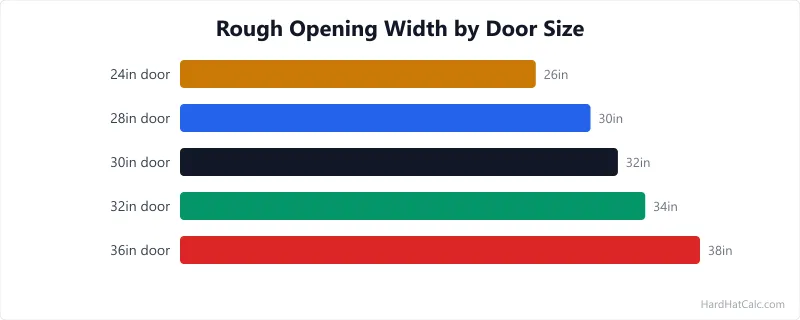
The rough opening (RO) is the hole framed in the wall studs before the door frame is installed. It must be larger than the door itself to allow room for the frame, shims, and levelling adjustments. The rules this calculator uses come from manufacturer installation guides, not a standard. Interior prehung units: 2 inches wider and 2 inches taller than the door slab (the Masonite interior prehung installation table prints a 32 × 82 inch opening for a 30 × 80 inch door, and the same + 2 inches across every size from 24 to 36 inches). Exterior units: 2.5 inches wider and 2.5 inches taller (Masonite lists 38.5 × 82.5 inches as its common rough opening for a 36 × 80 inch exterior door). Site-built jambs: 2.5 inches wider and 2.5 inches taller, a site convention for hand-fitted frames that no manufacturer publishes. JELD-WEN specifies at least 3/4 inch over the door in each direction. Check the guide for your unit before framing.
| Door Size (nominal) | RO Width (interior prehung) | RO Width (exterior or site-built) | RO Height (interior prehung) | RO Height (exterior or site-built) | Standard Jamb Width (2x4 + drywall) |
|---|---|---|---|---|---|
| 24" × 80" | 26" | 26.5" | 82" | 82.5" | 4-1/2" |
| 28" × 80" | 30" | 30.5" | 82" | 82.5" | 4-1/2" |
| 30" × 80" | 32" | 32.5" | 82" | 82.5" | 4-1/2" |
| 32" × 80" | 34" | 34.5" | 82" | 82.5" | 4-1/2" |
| 36" × 80" | 38" | 38.5" | 82" | 82.5" | 4-1/2" |
| 36" × 96" | 38" | 38.5" | 98" | 98.5" | 4-1/2" |
The interior prehung columns follow Masonite's interior prehung installation table (26 × 82 through 38 × 82 inches for 80-inch doors); the exterior figures follow its exterior page (38.5 × 82.5 inches for a 36 × 80 door). The site-built figures share the exterior columns and, with the 96-inch interior row, extend those rules as a site convention. For doors taller than 80 inches (the 84- and 96-inch heights this calculator offers) the +2-inch interior prehung height allowance is our extension, because Masonite's table prints 80-in. doors. This is our own estimate; no published source backs these figures. Check your results against your product data or a licensed professional before acting. IRC Section R311.2, which this caption used to cite, sets egress-door clear-opening minimums and is not a rough-opening table, so it is no longer cited for these rows. Exterior doors and ADA-accessible entries default to 36 inches wide — the 32-inch minimum clear opening required by ADA standards demands at least a 34-inch slab, but 36-inch doors are the industry standard because they leave a comfortable margin after subtracting the door stop and hinge projection.
Prehung vs. Site-Built: Which Frame Approach Fits Your Project
The choice between a prehung door and a site-built jamb determines how much work happens at the jobsite and how forgiving the installation is of imperfect walls.
Prehung doors arrive from the factory with the door slab already hung on hinges inside a three-sided frame. The strike plate is mortised, the door stop is applied, and the hinge mortises are cut. Installation means sliding the unit into the rough opening, shimming it plumb and level, and nailing through the jambs into the framing. A competent carpenter hangs a prehung interior door in 30–45 minutes. Prehung units dominate new construction because speed matters when a house has 15–25 doors to hang.
The limitation is wall thickness. Prehung jambs come in standard widths: 4-9/16" for 2x4 walls with drywall, 6-9/16" for 2x6 walls with drywall. If your wall does not match those dimensions — plaster walls, double-layer drywall, or any non-standard assembly — the prehung jamb will be too narrow or too wide. Some manufacturers sell adjustable split-jamb prehung units that telescope to fit a range of wall thicknesses, but these cost 20–40% more and feel less solid than a single-piece jamb.
Site-built jambs are constructed on-site from flat jamb stock — typically 3/4" thick clear pine, finger-jointed pine, or MDF boards ripped to the exact wall thickness. The carpenter builds the frame, mortises for the hinges, and hangs the door slab into the assembled jamb. This takes 2–3 hours for a skilled trim carpenter (longer for someone less experienced) but produces a frame that matches any wall thickness precisely.
Site-built jambs are the right choice for older homes where wall thickness varies, for custom door sizes, and for situations where the rough opening is already framed and a standard prehung unit does not fit. When renovating a stone cottage or a Victorian home with plaster walls, a site-built approach is usually the only practical option. The extra shimming allowance (0.5" wider RO requirement) accounts for the less predictable fit of hand-built frames.
If your project involves framing new walls for door openings, you can work out stud counts for the wall and size the rough opening, header, and king/trimmer stud layout before you order jamb material.
Measuring Walls and Sizing Jambs: Step by Step
Getting the right frame dimensions requires measuring what you have before ordering what you need. These steps apply to both replacement doors in existing walls and new doors in freshly framed openings.
Measure the wall thickness at the door location. Press a flat stick or combination square through the doorway and measure from the face of one wall surface to the face of the other. Do this at three points along the opening — top, middle, and bottom. Walls are rarely perfectly consistent, especially in older homes. Use the widest measurement as your jamb width. A 2x4 stud is actually 3-1/2" wide; add 1/2" drywall on each side and you get 4-1/2". But plaster-over-lath walls can be 4-7/8" to 5-3/8" or more, and these widths do not match any stock prehung jamb.
Measure or verify the rough opening. For replacement doors, measure the existing RO after removing the old frame and trim. Width is measured at three heights; height is measured at both sides. If the existing RO is within 1/4" of the required dimensions, you can proceed with shimming. If it is more than 1/2" off in any direction, reframe the opening or choose a different door size.
Select your door size based on the RO, not the other way around. In renovation work, the existing framing dictates the door size. If your RO is 32" wide, that fits a 30" prehung door (needs 32" RO) — not a 32" door (needs 34" RO). Trying to force a larger door into an undersized opening leads to shaving jambs, removing shim space, and a door that binds in the frame.
Order jamb stock at or slightly wider than your wall measurement. Jamb material can be planed down to fit, but it cannot be stretched wider. If your wall measures 5-1/4", order 5-3/8" jamb stock and plane the 1/8" excess flush with the wall surface. It is far easier to remove a thin strip of wood than to shim out a narrow jamb with extension strips.
Calculate trim from door height, not RO height. Casing runs from the floor to the top of the head casing on both sides, plus the head piece across the top. The head casing width equals the door width plus twice the casing width (to cover the mitre returns). Plan for a minimum 3/16" reveal (the small setback between the casing edge and the jamb face) — this reveal is standard trim carpentry practice and hides minor jamb irregularities.
Trim Width, Non-Standard Walls, and When to Call a Pro
Trim style affects more than appearance — it changes material quantities, mitre difficulty, and how forgiving the installation is of wall irregularities.
What trim width works best for a beginner? The 2-1/4" Colonial profile is the most forgiving. Its narrow width means mitre joints are smaller (less visible when slightly off), it flexes more easily against uneven walls, and it requires less material per opening. Wide Craftsman profiles (3-1/4" to 3-1/2") look striking but demand tighter mitre work and dead-flat walls — any bow in the wall surface telegraphs through wide flat casing as a visible gap between the back of the trim and the wall.
How do I handle non-standard wall thicknesses? If your wall falls between standard jamb widths, you have three options. First, rip custom jamb stock from wider boards — a table saw set to the exact wall thickness produces a perfect-fit jamb. Second, use a split-jamb prehung unit that adjusts across a range (typically 4-1/2" to 5-1/2" or 6-1/4" to 6-3/4"). Third, install a standard prehung frame and add a jamb extension strip on one side to make up the difference. The extension strip is the least elegant solution and often shows a visible seam line, especially under paint.
Does trim style affect clearance for the door swing? Not directly, but wide casing can interfere with furniture placement near the door. A 3-1/2" Craftsman casing adds 7 inches to the visual footprint of the doorway (3-1/2" on each side). If the door is at the end of a hallway or near a corner, that extra width can make the wall space between the casing and the corner too narrow for a light switch or thermostat. Plan your door swing clearance alongside the frame dimensions — the two decisions are linked.
When should I call in a professional? Site-built jambs in plaster walls, load-bearing walls where the rough opening needs widening, and any exterior door replacement involving threshold waterproofing are all cases where a trim carpenter or general contractor saves time and prevents water intrusion or structural problems. Interior prehung doors in standard drywall walls are a reasonable DIY project — the manufacturers design them to be installer-friendly.
For doorways at the top or bottom of a staircase, IRC Section R311.7 imposes specific landing size requirements. The staircase dimension calculator checks those landing dimensions against code before you commit to a door size and swing direction.
Worked Examples
Example 1
Scenario: A homeowner is replacing an interior bedroom door. The new door is a 30" × 80" prehung unit going into a standard 2x4 wall with 1/2" drywall on both sides (4.5" total wall thickness). They plan to use 2-1/4" Colonial casing.
Calculation: Rough opening width = 30 + 2 = 32". Rough opening height = 80 + 2 = 82" (interior prehung: the allowance Masonite prints in its interior prehung installation table). Jamb width = 4.5" (matches wall thickness). Jamb material = (80 × 2 + 30) ÷ 12 × 1.1 = 190 ÷ 12 × 1.1 = 15.83 × 1.1 = 17.4 linear ft. Trim per side = 2 × (80 ÷ 12) + (30 + 2 × 2.25) ÷ 12 = 13.33 + 2.88 = 16.21 ft. Total trim = 16.21 × 2 × 1.1 = 35.7 linear ft. Trim pieces = 6.
What this means: The rough opening needs to be 32" wide by 82" tall. A prehung frame comes with jambs already attached to the door slab, so the 17.4 feet of jamb material is built into the unit. The 35.7 feet of trim breaks into 6 pieces of casing — three per side of the wall. Standard 7-foot moulding lengths cover each piece with minimal waste.
Takeaway: For prehung doors, verify the existing rough opening before ordering. If the old RO is undersized, widening it in a non-load-bearing wall is straightforward — in a load-bearing wall, you need a properly sized header above the opening.
Example 2
Scenario: A contractor is building a site-built jamb for a 32" × 80" door in an older home with lath-and-plaster walls. The plaster walls measure 5-3/8" thick. The homeowner wants 3-1/2" Wide Craftsman trim.
Calculation: Rough opening width = 32 + 2.5 = 34.5" (site-built needs extra shimming room). Rough opening height = 80 + 2.5 = 82.5" (site-built: the extra half inch of height is a site convention, not a published figure). Jamb width = 5.375" (matching the plaster wall thickness). Jamb material = (80 × 2 + 32) ÷ 12 × 1.1 = 192 ÷ 12 × 1.1 = 16 × 1.1 = 17.6 linear ft. Trim per side = 2 × (80 ÷ 12) + (32 + 2 × 3.5) ÷ 12 = 13.33 + 3.25 = 16.58 ft. Total trim = 16.58 × 2 × 1.1 = 36.5 linear ft. Trim pieces = 6.
What this means: The 5-3/8" jamb width is non-standard — you will not find prehung frames at this width in a home centre. The contractor needs to rip jamb stock from 1× lumber (typically 3/4" thick 1×6 boards ripped to 5-3/8") or order finger-jointed jamb material from a millwork supplier. The wider Craftsman casing adds about half a foot to the total trim requirement compared to Colonial casing (36.5 vs 36 linear ft).
Takeaway: Older homes with plaster walls almost always need custom-width jambs. Measure the actual wall thickness at the doorway — not at a different spot, because plaster thickness varies across a wall. A 1/8" error in jamb width leaves a visible gap or an edge that protrudes past the wall surface.
Frequently Asked Questions
- What is the rough opening size for a 30-inch interior door?
A 30-inch prehung interior door requires a rough opening of 32 inches wide by 82 inches tall, the allowance Masonite prints in its interior prehung installation table (a 32 × 82 inch opening for a 30 × 80 inch door). The extra 2 inches of width provides 1 inch of shimming space on each side of the frame, and the 2 inches of height covers the head jamb and the shimming clearance above it. If you are building a site-built jamb instead of using a prehung unit, add an extra half inch to the width (32.5 inches) and to the height (82.5 inches) because hand-fitted frames need more adjustment room; that half inch is a site convention rather than a published figure. Always verify these dimensions against the specific manufacturer instructions, because some prehung units require slightly different RO sizes. For framing the rough opening itself, the door header size calculator determines the beam needed above the opening.
- How do I measure wall thickness for a replacement door frame?
Push a flat stick, combination square, or rigid ruler through the doorway opening (with the old trim removed) and measure from the face of the finished wall surface on one side to the face on the other side. Take this measurement at three points: near the top, at the middle, and near the bottom of the opening. Use the widest measurement as your jamb width — ordering jamb stock slightly wider is easy to plane down, but a jamb that is too narrow leaves a gap. Standard 2x4 walls with drywall measure 4-1/2 inches, but plaster-over-lath walls commonly run 5 to 5-3/8 inches, and walls with tile backer board or double-layer drywall can exceed 5 inches. If you are adding drywall to one side of the wall, that extra half-inch changes your jamb width.
- What jamb width do I need for a 2x6 exterior wall?
A 2x6 stud wall with 1/2-inch drywall on the interior side and 1/2-inch sheathing on the exterior side measures approximately 6-1/2 inches. If the exterior finish includes siding and a rain screen gap, the total wall thickness can reach 7 inches or more. Standard prehung exterior door units come with 6-9/16 inch jambs, which covers the basic 2x6 plus drywall plus sheathing assembly. For thicker assemblies, you need either a wider stock prehung frame (some manufacturers offer 7-1/4 inch jambs) or a jamb extension strip nailed to the interior edge of the standard jamb to bridge the gap. The stud-and-plate quantities tool lays out 2x4 and 2x6 stud walls so you can confirm the exact depth before ordering.
- Can I install a prehung door in a plaster wall without replacing the jambs?
You can, but it requires a workaround because standard prehung jambs are sized for drywall walls (4-9/16 inches), and plaster-over-lath walls typically measure 5 to 5-3/8 inches. The most common approach is to install the prehung unit and add a jamb extension strip to the side that falls short. This strip — a thin piece of matching wood glued and pinned to the edge of the existing jamb — bridges the gap between the factory jamb and the wall surface. The casing then covers the seam. A cleaner but more labour-intensive approach is to remove the factory jambs from the prehung unit, rip new jamb stock to match your wall thickness, and rehang the door slab on the custom jambs. After installation, check that the door swing clearance works with your furniture layout.
More Materials calculators
Browse all materials calculators — Paint coverage, roofing bundles, tile adhesive, welding time, parking lot sizing, and more.