
Door Header Size Calculator
Free door header size calculator per IRC 2021 Table R602.7(1). Enter opening width, stories, snow load, and building width for header size and jack studs.
Last updated:
Methodology reviewed by Doc. dr. sc. Mladenka Juradin, dipl. ing. građ., PhD, Civil Engineering (FCEAG, University of Split)
Clear width of the door or window opening, measured between king studs.
Number of stories the header supports. IRC Table R602.7 covers up to 2 stories.
Ground snow load for your region. Check IRC Table R301.2(1) or your local building department.
Measured perpendicular to the ridge — the header span tables depend on it directly. If unsure, keep 36 ft (the conservative column). Between columns the code permits interpolation; this tool uses the next-wider column.
Built-up headers are most common; a single 4x of the same depth is an accepted alternative. LVL is engineered lumber sized from manufacturer tables, not this prescriptive table.
For estimation only. Structural work requires review by a licensed engineer. Local building codes take precedence over any calculator output.
How This Is Calculated
Header size determined by IRC Table R602.7 prescriptive lookup: input = opening width, stories supported, and ground snow load. Jack studs: 1 per side for openings up to 4 ft, 2 for 5-10 ft, 3 for 11-12 ft. Header weight estimated from lumber density (~0.37 lb/ft per nominal inch of depth for sawn softwood) or LVL density (~9.8 lb/ft for 3.5" x 9.25"). Cost estimates: sawn lumber $1.50-$3.00/ft/in, built-up $2.00-$4.00/ft/in, LVL $4.00-$7.00/ft/in (March 2026 US averages).
Source: Prescriptive header spans and jack-stud counts from IRC 2021 Table R602.7(1) (Girder Spans and Header Spans for Exterior Bearing Walls) — double-ply No. 2 grade DF-L/hem-fir/southern pine/SPF, keyed to ground snow load (30/50/70 psf) and building width (12/24/36 ft), interpolation taken to the next-stricter column. Openings beyond the 2-2x12 column are referred to engineered design. Cells verified July 2026 against the published 2021 IRC table text and county reproductions of the 30-psf block, and re-verified September 2026 cell-for-cell against UpCodes (2021) and the 2021 Seattle Residential Code Chapter 6 (2018 and 2021 editions identical; no 2019-cycle change).
6 min read
What Goes Above the Hole in a Load-Bearing Wall
Every time a framer cuts a door or window opening into a load-bearing wall, the structure above that opening needs a bridge. That bridge is the header — a horizontal beam that picks up the load from above and routes it down through jack studs on each side to the sole plate and foundation below.
The door header size calculator determines the required header dimensions for standard residential openings based on IRC Table R602.7 prescriptive requirements. Enter the opening width, the number of stories the header supports, the ground snow load for your region, the building width (the code table's own axis: wider buildings put more roof on every header), and the header material type. The tool returns the code table's double-ply header size, its jack stud count, approximate weight, and a material cost estimate, or an engineered-header referral when the opening is beyond the sawn-lumber table.
Headers are one of the most frequently mis-sized elements in residential framing. Too small and the header deflects — causing drywall cracks above the door and doors that stick in their frames. Too large wastes material and reduces insulation space in exterior walls. The IRC prescriptive tables exist precisely to prevent both problems without requiring an engineering calculation for every opening in the house. If the wall carrying the header is load-bearing, first check the total load on the wall to confirm whether prescriptive sizing or an engineered header is needed.
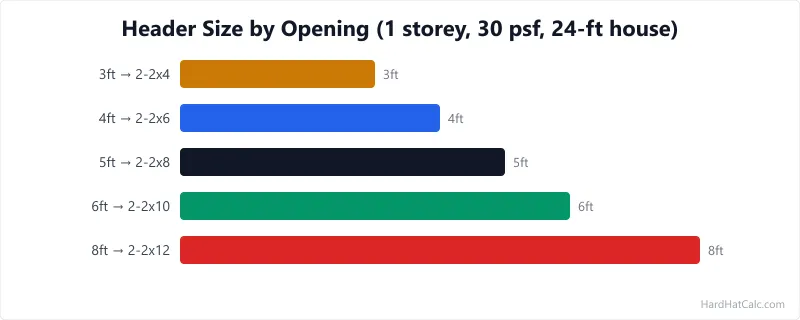
IRC Table R602.7(1) Header Spans
The real code table is keyed to the maximum SPAN each header size can carry — organised by ground snow load and building width, not by opening width. The rows below are the double-ply spans of IRC 2021 Table R602.7(1) for a header supporting roof and ceiling (single storey), in feet-inches, with the required jack studs (NJ) per end.
| Header | 30 psf, 12 ft wide | 30 psf, 24 ft | 30 psf, 36 ft | 50 psf, 12 ft | 50 psf, 24 ft | 50 psf, 36 ft |
|---|---|---|---|---|---|---|
| 2-2x4 | 4'-0" (1) | 3'-1" (1) | 2'-7" (1) | 3'-5" (1) | 2'-7" (1) | 2'-2" (1) |
| 2-2x6 | 6'-0" (1) | 4'-7" (1) | 3'-10" (1) | 5'-1" (1) | 3'-11" (1) | 3'-3" (2) |
| 2-2x8 | 7'-7" (1) | 5'-9" (1) | 4'-10" (2) | 6'-5" (1) | 5'-0" (2) | 4'-2" (2) |
| 2-2x10 | 9'-0" (1) | 6'-10" (2) | 5'-9" (2) | 7'-8" (2) | 5'-11" (2) | 4'-11" (2) |
| 2-2x12 | 10'-7" (2) | 8'-1" (2) | 6'-10" (2) | 9'-0" (2) | 6'-11" (2) | 5'-10" (2) |
With a floor above (the two-storey condition), every span shrinks — a 2-2x12 in a 24-foot-wide house drops from 8'-1" to 6'-8". Note what the table means for wide openings: a 10- or 12-foot opening exceeds the 2-2x12 span in every column except a narrow single-storey building, so those openings take an engineered header (LVL sized from the manufacturer's tables, or steel), designed for the actual loads.
All sizes are doubled members (two 2x pieces with a 1/2-inch plywood or OSB spacer to match the 3.5-inch wall width). Single solid 4x members of the same depth are an acceptable alternative per IRC Section R602.7.2. Where the table shows one jack stud, the code permits an approved framing anchor instead.
How to Frame a Door Header Step by Step
Lay out the rough opening. Mark the king stud locations on the sole plate. The rough opening width equals the door width plus the two jack stud thicknesses (1.5 inches each for 2x lumber) plus 1/2 inch for shim space on each side. A 36-inch door needs a 38.5 to 39-inch rough opening.
Install king studs. These are full-height studs running from sole plate to top plate on each side of the opening. They carry the header load and anchor the jack studs. Nail them with three 16d nails at the top plate and toenail at the sole plate.
Cut and assemble the header. For built-up headers, sandwich a 1/2-inch plywood strip between two 2x members. The plywood brings the total width to 3.5 inches, matching the 2x4 wall depth. Apply construction adhesive to both faces and nail with 16d nails at 16 inches on centre, staggered top and bottom.
Set jack studs and header. Cut jack studs to the rough opening height minus the header depth. Nail each jack stud to its king stud with 10d nails at 12 inches on centre. Lift the header into position on top of the jack studs and nail through the king studs into the header ends with at least five 16d nails per side.
Add cripple studs above. If the header does not fill the full space to the top plate, install short cripple studs at 16-inch on-centre spacing between the header top and the top plate. These transfer top-plate loads to the header and provide a nailing surface for drywall.
Solid Lumber vs Built-Up vs LVL Headers
Three header types dominate residential construction, each with distinct trade-offs.
Solid sawn lumber (4x) uses a single piece of dimensional lumber — a 4x8, 4x10, or 4x12. The 3.5-inch actual width fills a 2x4 wall cavity exactly. Solid headers are simple to install and available at any lumberyard. The downside: sawn lumber has natural defects (knots, grain deviation, checks) that reduce its actual capacity below the published grade values. Quality varies from board to board, and it is hard to find straight, defect-free 4x material in longer lengths.
A built-up header pairs two 2x members with a plywood spacer. Because the framer selects the better of the two boards for the tension face (bottom), built-up headers are more reliable than solid lumber in practice. The spacer also creates an insulation cavity — a 2x10 built-up header with 1/2-inch plywood leaves a 1-inch gap that can be filled with rigid foam, reducing thermal bridging. Built-up headers are the default choice for production framing because the materials are lighter to handle individually and always in stock.
LVL headers use engineered lumber manufactured from thin wood veneers laminated under heat and pressure. LVL has no knots, consistent properties, and published design values 30 to 50% higher than equivalent sawn lumber. For openings over 8 feet, LVL is often the only wood option that works without increasing the header depth beyond what fits in a standard wall. The penalty: LVL costs two to three times more per foot than dimensional lumber and must be special-ordered at many yards. For a quick comparison of window and door sizing options, pair this calculator with rough-opening data from the window and door sizing tool.
Common Header Mistakes and How to Avoid Them
Even experienced framers make header errors that lead to callbacks. The following problems appear repeatedly on job sites and in home inspections.
Is a header required in every wall opening? Not always. Non-load-bearing partition walls do not require structural headers. A flat 2x4 laid on edge across the top of the opening (a "flat header") is sufficient to support the drywall and casing. Installing a structural header in a partition wall wastes material and labour. Check the framing plans — if the wall is marked "NLB" (non-load-bearing), skip the structural header.
What happens if the header is undersized? The header deflects under load, causing diagonal drywall cracks above the door corners — the classic "picture frame" crack pattern. Doors and windows bind in their frames, becoming difficult to open or close. In severe cases, the header can sag visibly, requiring removal and replacement with a correctly sized member. Fixing an undersized header after the house is drywalled and trimmed costs $1,500 to $4,000 depending on access and finish repair.
Can I use a single 2x instead of a doubled header? IRC Table R602.7 requires doubled members or a single 4x member. A single 2x does not provide adequate bending capacity for structural headers. The only exception is IRC Section R602.7.4, which permits single 2x4 flat headers for openings up to 4 feet wide in single-storey buildings with limited roof loads — a narrow exception that applies mainly to closet doors and small windows.
Do I need a header in an exterior wall above a garage door? Garage door openings in exterior walls always require headers because exterior walls are load-bearing. Garage door headers are typically the largest in the house — an 8-foot single door needs a 2-2x12 at typical building widths (only a narrow 12-foot-wide bay gets away with 2-2x10), and a 16-foot double door exceeds prescriptive table limits, requiring an engineered beam. Spec the W-shape if your garage opening exceeds 12 feet.
Worked Examples
Example 1
Scenario: A framer needs a header for a 6-foot-wide double entry door in a two-storey, 24-foot-wide home with 30 psf ground snow load. The wall is load-bearing with standard 2x4 framing.
Calculation: Opening width = 6 ft, stories above = 2 (roof, ceiling and one centre-bearing floor), snow = 30 psf, building width = 24 ft. Per IRC 2021 Table R602.7(1): 2-2x10 spans only 5'-8" in that column, so the required header is 2-2x12 (6'-8" allowable). Built-up header = two 2x12s with 1/2-inch plywood spacer. Header depth = 11.25 in (actual). Jack studs = 2 per side (the NJ column of the governing cell). Header weight = 0.37 lb/ft-in × 12 × 6 ft × 2 plies + 5% spacer allowance = approximately 56 lbs. Estimated material cost = approximately $99 in this tool's cost model.
What this means: With a full storey above, a 6-foot opening in a 24-foot-wide house needs a doubled 2x12 — one size deeper than most framers guess, because the header carries half the floor above as well as the roof. The two jack studs on each side transfer the header load down to the sole plate and foundation.
Takeaway: Building width drives header sizing as strongly as opening width: this same door in a 12-foot-wide structure needs only a 2-2x8 (6'-1" allowable). Budget about $99 in materials for the 2-2x12, and expect an experienced framer to cut and assemble it in about 30 minutes.
Example 2
Scenario: A contractor frames a 5-foot picture window in a single-storey, 36-foot-wide ranch in a 50 psf ground snow region, using a built-up header.
Calculation: Opening width = 5 ft, stories above = 1 (roof and ceiling), snow = 50 psf, building width = 36 ft. Per IRC 2021 Table R602.7(1): 2-2x10 spans only 4'-11" in that column, so the required header is 2-2x12 (5'-10" allowable). Header depth = 11.25 in (actual). Jack studs = 2 per side. Header weight = 0.37 × 12 × 5 × 2 plies + 5% = approximately 47 lbs. Estimated material cost = approximately $69.
What this means: A modest 5-foot window in a wide house at heavy snow needs the largest sawn header in the table. The same opening in a 12-foot-wide structure needs only a 2-2x6 (5'-1" allowable) — the wider the building, the more roof each foot of header carries.
Takeaway: Never size a header from the opening width alone. The code table's columns are building width and snow load, and they move the answer by two full sizes on the same opening. When the table runs out — anything past the 2-2x12 column — the next step is an engineered LVL from the manufacturer's span tables or a steel beam, not a bigger guess.
Frequently Asked Questions
- What size header do I need for a 6-foot door opening?
A 6-foot door opening in a load-bearing wall needs — at 30 psf ground snow, per IRC 2021 Table R602.7(1) — a doubled 2x10 in a 24-foot-wide house or a doubled 2x12 in a 36-foot-wide house for a single storey, and a doubled 2x12 (24-ft width) with a floor above; at 36-ft width with a floor above, 6 feet is beyond the sawn table entirely (2-2x12 tops out at 5'-8") and takes an engineered header. The doubled members are separated by a 1/2-inch plywood spacer to match the 3.5-inch width of a 2x4 wall, and the governing table cell also prescribes the jack studs per side. For the full wall framing material list including king studs and cripples around the opening, pair this result with the wall framing tool.
- Do non-load-bearing walls need headers above doors?
Non-load-bearing partition walls do not require structural headers. A flat 2x4 spanning the top of the opening is sufficient to support drywall and door casing. However, you must verify whether the wall is load-bearing before making this decision — an undersized header in a load-bearing wall risks structural failure. If floor joists or roof trusses bear on the wall from above, it is load-bearing and requires a full structural header per IRC Table R602.7. When in doubt, treat the wall as load-bearing or have a contractor verify the framing before proceeding. The guide on identifying load-bearing walls walks through the visual clues step by step.
- How many jack studs do I need for a door header?
The IRC prescribes jack studs per header size and load, in the NJ column of Table R602.7(1) — one per side for lightly loaded small headers, two for most residential cells, and three where a 2-2x12 works hard (70 psf snow at 36-foot width, and some floor-above cells). Where the table calls for just one, an approved framing anchor may substitute (table footnote). Jack studs transfer the full header load to the sole plate and foundation. They must be continuous from the sole plate to the underside of the header — spliced or pieced-together jack studs are not permitted. Each jack stud is face-nailed to its adjacent king stud with 10d nails at 12 inches on centre. Before sizing the header, determine the total load the wall carries to confirm whether prescriptive sizing or an engineered design is needed.
- When should I use an LVL header instead of dimensional lumber?
LVL (Laminated Veneer Lumber) headers make sense in three situations: openings wider than 8 feet where dimensional lumber deflects excessively, heavy-load scenarios with two stories and high snow loads where the prescriptive table pushes to 2x12 maximums, and exterior walls where the narrower LVL profile leaves room for insulation behind the header. LVL design values are 30 to 50 percent higher than equivalent-depth sawn lumber, which sometimes allows a shallower header that preserves headroom. The trade-off is cost — LVL runs two to three times the price of standard framing lumber per linear foot. If the opening exceeds 12 feet, prescriptive tables no longer apply and you may need a steel beam designed by an engineer.
More Structural calculators
Browse all structural calculators — Beam sizing, truss pricing, load calculations, wall framing, deck capacity, and foundation tools.