
Door Swing Clearance Calculator
Door swing clearance calculator for hinged, pocket, barn, and bifold doors. Enter door width and angle for swing arc, clearance depth, and ADA compliance.
Last updated:
Standard interior: 28–32 in. Exterior/ADA: 36 in. Double: 60–72 in.
Interior doors: 1-3/8 in. Exterior: 1-3/4 in. Commercial: 1-3/4 to 2-1/4 in.
Standard swing: 90°. Full open against wall: 170–180°.
Pocket and barn doors save swing space but have hardware requirements.
How This Is Calculated
Standard hinged: clearance depth = door width × sin(angle). Clearance width = door width × (1 − cos(angle)) + thickness. Arc area = (angle/360) × π × door width². Pocket: depth = thickness only, no arc. Barn: depth = thickness + 1.5" standoff, slide space = 2× door width. Bifold: depth = half door width + thickness. ADA pass: clear opening ≥ 32".
Source: Swing arc geometry from standard trigonometric relationships. ADA clear opening width and maneuvering clearance requirements per ADA Standards for Accessible Design 2010, Section 404.
7 min read
ADA Door Clearance Requirements at a Glance
The Americans with Disabilities Act Standards for Accessible Design (ADA 2010, Section 404) specify maneuvering clearances based on approach direction, door swing direction, and closer type. These apply to all public and commercial buildings, and many residential projects that receive federal funding.
| Approach Direction | Door Side | Min Depth (perpendicular) | Min Width (parallel) |
|---|---|---|---|
| Front approach, pull side | Latch side | 60" | Door width + 18" |
| Front approach, push side | Latch side | 48" (with closer) | Door width + 12" |
| Hinge approach, pull side | Hinge side | 60" | Door width + 36" |
| Hinge approach, push side | Hinge side | 48" (min) | 54" |
| Latch approach, pull side | Latch side | 60" | Door width + 24" |
| Latch approach, push side | Latch side | 48" (with closer) | Door width + 24" |
The clear opening width must be at least 32 inches per ADA Standards 2010 Section 404.2.3, measured between the face of the door (open at 90 degrees) and the opposite door stop. A standard 36-inch door gives about 34.5 inches of clear opening — just above the ADA minimum. A 34-inch door barely meets the 32-inch minimum after subtracting the door thickness and stop.
For doors with automatic closers, the closing speed must allow at least 5 seconds for the door to move from 90 degrees to 12 degrees from the latch. Power-assisted doors and automatic doors have separate requirements under ADA Section 404.3.
Choosing the Right Door Type for Tight Spaces
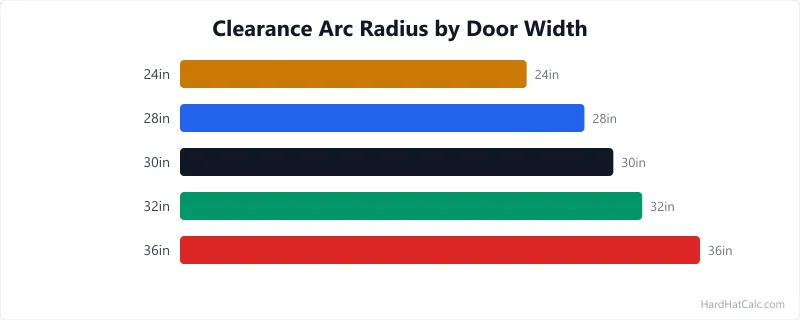
Standard hinged doors are simple, reliable, and the default for a reason — but they consume the most floor space. A 36-inch door swinging 90 degrees claims 7 square feet of floor area as its swing arc. In small bathrooms, closets, and utility rooms, that arc can collide with fixtures, furniture, or other doors.
Pocket doors eliminate the swing problem entirely. The door panel slides into a cavity inside the wall, leaving the full doorway open when retracted. The trade-off is wall space: the pocket cavity extends the full width of the door plus 2 inches into the adjacent wall. You cannot run electrical outlets, plumbing, or blocking inside a pocket door wall segment. If the wall contains wiring or pipes, a pocket door is off the table unless you reroute those services — a cost that often exceeds $500.
Pocket doors also have a reputation for going off-track and being difficult to repair once the wall is closed up. Modern pocket door hardware (Johnson, Hafele) has improved markedly, using ball-bearing rollers and adjustable guides that hold alignment better than the spring-loaded clips of older systems. Still, if accessibility is the goal, pocket doors do not meet ADA standards for most applications because the recessed pull handle is difficult for users with limited hand strength to grip. ADA-compliant pocket doors exist with push-plate or lever-activated soft-close mechanisms, but they cost two to three times as much.
Barn doors (also called sliding doors) mount on an exposed track on the room side of the wall. They slide parallel to the wall surface, so they need clear wall space beside the opening — at least the width of the door, which means a 36-inch barn door needs 36 inches of unobstructed wall beside the opening. Barn doors do not seal tightly against the frame, so they allow light, sound, and air to pass around the edges. They are a poor choice for bathrooms in shared spaces because of the privacy gap, but work well for closets, pantries, and room dividers where a full seal is unnecessary.
Bifold doors fold in half, reducing the swing projection to roughly half the door width. They are standard for closets and laundry areas where full swing clearance is impractical. Bifold hardware is the cheapest of the alternative types but also the least durable — plastic pivot pins break, top rollers jump the track, and the doors tend to bind at the fold joint over time. Metal pivot pins and heavy-duty top tracks solve most of these problems for a modest cost increase.
Floor Plan Impacts of Door Swing Direction
The direction a door swings affects furniture layout, traffic flow, and safety. Small decisions about swing direction compound across a floor plan with 15–20 doors.
Should a bedroom door swing in or out? Building codes require bedroom doors to swing into the bedroom (away from the hallway). This keeps doors from blocking hallway egress during an emergency evacuation. When the door swings in, it does not obstruct someone running down the hall toward an exit. The trade-off is that the swing arc consumes floor space inside the bedroom, which matters in bedrooms under 100 square feet.
Why do bathroom doors typically swing inward? Primarily for privacy — if the latch fails, the door stays closed by default when pushed from inside. Inward-swinging bathroom doors also keep the door panel out of the hallway. The risk: if someone collapses inside a small bathroom, an inward-swinging door can be blocked by their body. For elderly residents or assisted-living applications, outward-swinging bathroom doors or pocket doors are safer. Some codes require outward-swinging doors in accessible bathrooms for this reason.
Paired doors and closets. When two doors open toward each other (like a hallway bathroom door opposite a bedroom door), check that both arcs clear each other. This is easy to miss on paper and infuriating to live with. If the clearance is tight, consider swapping one door to a pocket or bifold type. If you are framing a new wall for a door opening, you can size studs and plates and the rough opening correctly — the rough opening is typically 2 inches wider and 2.5 inches taller than the door slab to allow for the frame, shims, and hardware.
How to Measure for Door Replacement
Replacing an existing door is straightforward if you measure correctly. Getting it wrong means a door that does not close, binds on the frame, or leaves visible gaps.
Measure the existing door slab. Remove the door from its hinges. Measure height, width, and thickness. Standard interior slabs are 80 inches tall, 1-3/8 inches thick, and 24–36 inches wide in 2-inch increments. Exterior doors are 1-3/4 inches thick. Measure at three points on each dimension — doors warp, and the widest or tallest measurement is the one that matters.
Measure the rough opening. If you are replacing the frame as well, measure the framed opening in the wall (the hole the frame sits in). A standard rough opening is the door width plus 2 inches and the door height plus 2.5 inches. Non-standard rough openings require a custom frame or shimming.
Check the hinge side for plumb. Hold a 4-foot level against the hinge-side jamb. If it is more than 1/4 inch out of plumb over its height, the frame needs adjustment or replacement — a new door slab will not hang correctly in a twisted frame.
Measure the clearance zone. Swing the old door (or simulate the swing with a tape measure from the hinge point) and mark the arc on the floor. Check that no furniture, fixtures, or opposing doors intrude into the arc. This is where the calculator results above are most useful — enter your new door dimensions and verify the clearance before ordering.
Verify ADA requirements. For any door in a commercial or public-access space, confirm the clear opening width (32 inches minimum) and the maneuvering clearances from the table above. If the existing rough opening cannot accommodate a 36-inch door, widening the opening may require reframing and potentially involves the steel beam sizing if the wall is load-bearing.
Standard vs. Pocket: Space Savings Compared
For a 36-inch-wide door in a 90-degree opening configuration, here is how much floor space each type claims:
Standard hinged door claims 7.07 square feet of floor area for the swing arc. That arc must remain clear of furniture and fixtures at all times. In a 5×8 bathroom (40 sq ft), the door swing consumes 18% of the floor area — nearly one-fifth of the room is unusable for a vanity, shelving, or a trash can.
Pocket door claims zero floor area for swing. The door disappears into the wall, leaving the entire 40 square feet available for fixtures. In that same 5×8 bathroom, switching from a hinged door to a pocket door is equivalent to gaining 7 square feet of usable space without moving a single wall.
Barn door claims zero floor area for swing but requires 36 inches of clear wall space beside the opening. In a small room where the adjacent wall holds a towel bar, mirror, or light switch, the sliding panel covers those items when open. Barn doors work best when the adjacent wall is blank.
Bifold door claims roughly 2.5 square feet of floor area for the folded panel projection. It is a middle ground between a full swing and no swing, typically used for closet openings rather than room entries. Where a standard closet door would block a hallway, a bifold tucks neatly against the closet frame.
For tight renovation projects — especially bathrooms and laundry rooms — pocket doors pay for themselves in usable space. If the wall behind a pergola entrance transitions indoors through a utility room, consider a barn door to maximise that transition zone without a swing conflict.
Worked Examples
Example 1
Scenario: A homeowner is replacing a bedroom door with a standard 36-inch hinged door that opens to 90 degrees. The door is 1-3/8 inches thick.
Calculation: Clearance depth = 36 × sin(90°) = 36.0 in. Clearance width = 36 × (1 − cos(90°)) + 1.375 = 37.4 in. Swing arc area = (90/360) × π × 36² = 1,017.9 sq in = 7.07 sq ft. Clear opening = 36 − 1.375 = 34.6 in, which is ≥ 32 in.
What this means: The door needs 36 inches of clear floor depth and 37.4 inches of width for the full swing. It claims about 7 square feet of floor area and passes ADA minimum clear opening.
Takeaway: In a small bedroom, 7 sq ft of swing area — roughly the footprint of a nightstand and lamp — eats into usable floor space. If the room is tight, consider a pocket or bifold door to reclaim that area.
Example 2
Scenario: A contractor is specifying a 48-inch barn door for a pantry entrance. The door is 1-3/4 inches thick with a standard standoff bracket.
Calculation: Clearance depth = 1.75 + 1.5 (standoff) = 3.3 in (3.25 exactly, rounded to one decimal). Clearance width = 48 × 2 = 96 in (opening + slide space). Swing arc area = 0 sq ft. Clear opening = 48 in ≥ 32 in.
What this means: The barn door projects only 3.3 inches from the wall when closed, with zero swing arc. However, it needs 96 inches (8 feet) of total wall width — the 48-inch opening plus 48 inches of slide space.
Takeaway: Barn doors save floor space but demand long stretches of blank wall. Verify no switches, outlets, or shelving fall within the slide path before committing.
Frequently Asked Questions
- What is the minimum clear width for an ADA-compliant door?
Per ADA Standards 2010 Section 404.2.3, the minimum clear opening width is 32 inches, measured when the door is open to 90 degrees. This is measured from the face of the door to the opposite door stop, not the nominal door width. A 36-inch door slab provides about 34.5 inches of clear opening. A 34-inch door provides approximately 32.5 inches — barely meeting the requirement. To be safe, most architects specify 36-inch doors for all accessible routes. The window and door sizing tool helps verify rough opening dimensions for ADA-compliant frames.
- How much wall space does a barn door need beside the opening?
A barn door needs at least the full width of the door in clear wall space beside the opening. For a 36-inch door, that means 36 inches of unobstructed wall with no light switches, outlets, artwork, or shelving in the slide path. The track itself extends about 2–4 inches beyond the door edge on each side, so the total hardware footprint is the door width plus 4–8 inches. If wall space is limited, a bypass (double-sliding) configuration lets two doors slide behind each other, but this requires twice the track length. For a sliding patio door, see the sliding door cost breakdown for unit and installation pricing.
- Can I install a pocket door in an existing wall without reframing?
Retrofitting a pocket door into an existing wall is possible but requires opening up the wall, relocating any wiring or plumbing inside the pocket zone, and installing a pocket door frame kit. The wall must be deep enough for the door panel — a standard 2×4 wall with 1/2-inch drywall on each side has about 4.5 inches of cavity, which is tight for a 1-3/8-inch door plus the split studs of the pocket frame. Many retrofits use a thinner 1-1/4-inch door or switch to a 2×6 wall to gain clearance. Budget $400–$800 for materials plus labour for the retrofit. Before opening the wall, confirm whether it is load-bearing — removing studs from a structural wall requires temporary support and a header.
- Do bifold doors meet ADA accessibility requirements?
Bifold doors generally do not meet ADA requirements because the folding action requires more hand strength and coordination than a standard lever-handle push/pull door. ADA Section 404.2.7 requires that doors be operable with one hand without tight grasping, pinching, or twisting of the wrist. Standard bifold knobs and pulls fail this test. Pocket doors and automatic sliding doors are better alternatives for accessible openings. Some manufacturers offer bifold doors with ADA-compliant D-pull handles, but the folding mechanism itself remains a barrier for many wheelchair users. The door frame size calculator can help you size the rough opening for an accessible replacement.
More Materials calculators
Browse all materials calculators — Paint coverage, roofing bundles, tile adhesive, welding time, parking lot sizing, and more.