
Sliding Door Cost Calculator
Use this sliding door cost calculator to estimate patio door prices by size, frame material, glass type, and install method. Get a fast, itemised quote.
Last updated:
Rough opening width. 6 ft is the most common residential size.
Vinyl is cheapest. Wood and fiberglass offer better insulation and aesthetics.
Triple pane and Low-E coatings improve insulation and reduce energy costs.
New construction requires framing and finishing a new wall opening.
Total sliding doors to install in this project.
How This Is Calculated
Door unit cost = base cost (by width) x material multiplier x glass multiplier. Installation labour = base labour (by width), doubled x 2.4 for new construction. Trim & finish = base trim (by width), x 1.7 for new construction. Total per door = unit + labour + trim. Project total = total per door x quantity.
Source: Glass performance ratings per NFRC (National Fenestration Rating Council) certification programme. Energy savings estimates reference ENERGY STAR residential windows, doors, and skylights specifications. Source-set correction of 2026-08-22: the door-unit pricing attribution to RS Means Residential Construction Cost Data 2026 and the labour attribution to RS Means and regional contractor surveys are withdrawn (no such 2026 product; subscription-only, never opened; no survey recorded). Second-pass correction of 2026-08-22: the manufacturer MSRP leg (Pella, Andersen, Milgard) is withdrawn after verification against the manufacturer sites themselves. Andersen publishes no dollar figures and states that pricing is determined by dealers; Milgard publishes only a company-agnostic market range in a site FAQ; Pella publishes live per-model online shop prices, which are not an MSRP, and no capture of any of these was recorded when this table was authored. The free Cost vs Value trade report carries no sliding or patio door project. The door and labour figures are unchanged and ship unverified.
8 min read
Replacement Sliding Doors vs New-Construction Installs
Sliding patio door quotes swing wildly — $1,800 from one contractor, $5,500 from the next — and the gap almost always traces back to installation scope rather than the door itself. The Sliding Door Cost Calculator separates the door unit, labour, and trim into distinct line items so you can see where money actually goes before collecting bids.
A replacement install fits a new sliding door into an existing wall opening. The old door comes out, the new one drops in, and the installer re-uses or patches the surrounding framing. Labour runs $400–$850 depending on door width (March 2026 estimate; the attribution behind it was withdrawn on 2026-08-22 and the range ships unverified). This is the straightforward path when the rough opening already matches a standard sliding door size and the surrounding framing is sound.
A new-construction install cuts a new opening in an exterior wall, builds the structural header above it, adds jack studs and cripple studs, installs flashing and a sill pan, and then sets the door. Labour jumps to $1,100–$2,100 because of the carpentry, waterproofing, and exterior finish work involved. Drywall patching and interior trim add further cost on top. Any time you are creating an opening where none existed before — converting a solid wall to a patio entrance, for instance — you are in new-construction territory regardless of whether the house itself is old or new.
The structural header above a new sliding door opening is load-bearing in most exterior walls. Header size depends on the span (door width) and the load from above (roof, second storey, or both). A 6 ft opening in a single-storey wall typically requires a doubled 2x10 or 2x12 header. An 8 ft or 10 ft span may need an engineered LVL beam or steel lintel. Your contractor should reference local building code (IRC Table R602.7) for header sizing — or check the window and door sizing calculator for rough opening dimensions.
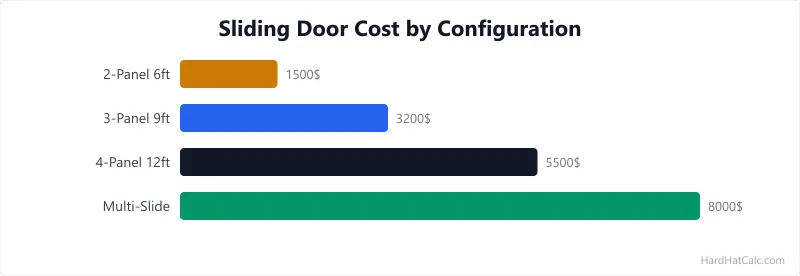
Sliding Door Costs by Material and Glass
Door unit cost depends on two big variables: frame material and glass package. The table below shows installed door-only prices for a standard 6 ft (72 in) two-panel sliding door. All figures are March 2026 estimates. Their former attributions (RS Means Residential Construction Cost Data 2026 and manufacturer MSRP) were both withdrawn on 2026-08-22; the figures ship unverified.
| Frame Material | Double Pane | Triple Pane | Low-E Triple Pane |
|---|---|---|---|
| Vinyl | $1,500 | $1,800 | $2,025 |
| Aluminum | $1,725 | $2,070 | $2,329 |
| Fiberglass | $2,025 | $2,430 | $2,734 |
| Wood | $2,175 | $2,610 | $2,936 |
Vinyl is the budget default and performs well for most residential applications. It resists moisture, never needs painting, and insulates adequately in moderate climates. The trade-off is appearance — vinyl frames look like vinyl, and dark colour options tend to fade.
Wood frames cost 40–50% more than vinyl but deliver the best thermal performance and a high-end interior aesthetic. The downside is maintenance: exterior wood cladding requires painting or staining every 3–5 years. Many manufacturers now offer wood interiors with aluminium or fiberglass exterior cladding to eliminate exterior maintenance while keeping the warm interior look.
Fiberglass splits the difference — stronger than vinyl, lower maintenance than wood, and a more convincing paint-grade surface. Fiberglass frames expand and contract at nearly the same rate as the glass itself, which reduces seal failure over time.
Aluminium is the thinnest profile (more glass, less frame) and suits modern architectural styles. Older aluminium frames conducted heat badly, but current products include thermal breaks that bring performance closer to vinyl. In mild climates where heating and cooling loads are low, aluminium's slim sightlines win on aesthetics without a meaningful energy penalty.
What Pushes a Sliding Door Project Over Budget
Door size is the single biggest cost lever. A 10 ft multi-slide unit costs 2.5 to 3 times more than a 5 ft two-panel door — not just because there is more glass and frame, but because the larger opening demands a heavier structural header, wider flashing, and often a wider sill track that requires custom ordering. For openings 6 ft and wider in load-bearing walls, an engineered header or LVL beam is typically required — and undersizing that header is a code violation that can cause sagging and cracked finishes above the door. If your budget is tight, verify that the opening size you want is a standard manufacturer size before requesting quotes. Custom widths carry a 15–30% surcharge over standard sizes.
Glass choice is the second lever, and it is where energy payback enters the calculation. Upgrading from double pane to Low-E triple pane on a 6 ft vinyl door adds roughly $525 to the unit cost. Whether that pays back depends on climate. In northern states (heating-dominated climates), the lower U-factor of triple-pane Low-E glass can save $50–$100 per year in heating costs per door (based on ENERGY STAR energy savings estimates for climate zones 5–7). That is a 5–10 year payback. In mild southern climates, the payback stretches beyond 15 years and the upgrade is harder to justify on energy alone — though the noise reduction and comfort improvement may still make it worthwhile.
NFRC (National Fenestration Rating Council) labels on every new door list the U-factor, SHGC (Solar Heat Gain Coefficient), visible transmittance, and air leakage. These are tested values, not marketing claims, and they are the numbers to compare across brands. A lower U-factor means better insulation. A lower SHGC means less solar heat gain — desirable in cooling-dominated climates, less desirable where passive solar heating helps in winter. The ENERGY STAR programme sets minimum performance thresholds by climate zone; look for the ENERGY STAR label as a baseline, then compare NFRC numbers between qualifying products.
Installation extras that frequently surprise homeowners include: removing and disposing of the old door ($75–$150), repairing rotted subfloor or sill plate discovered during removal ($200–$800), upgrading exterior flashing and a sill pan to current code ($100–$250), and matching new interior trim to existing baseboard and casing profiles ($100–$300 if stock trim does not match). When your project also involves re-framing the opening, the door frame size calculator provides rough opening dimensions for standard and non-standard door sizes.
Planning Your Sliding Door Installation Step by Step
Sliding door installation has a fixed sequence whether you hire a contractor or manage the project yourself. Skipping or reordering these steps leads to water leaks, air gaps, and warranty claims.
Measure the existing opening or plan the new one. For replacement, measure the rough opening width, height, and depth (wall thickness) at three points each — top/middle/bottom for width, left/centre/right for height. Sliding doors need the rough opening to be 1/2 inch wider and 1/2 inch taller than the door frame. Out-of-square openings over 1/4 inch require shimming or re-framing.
Select the door and confirm lead time. Standard sizes (5 ft, 6 ft, 8 ft) from major brands are typically in stock or ship within 2–4 weeks. Custom sizes, special colours, and impact-rated glass (required in coastal hurricane zones per IRC R301.2.1.2) can take 6–12 weeks. Order before scheduling the installer.
Prepare the opening. For replacement: remove the old door, clean the rough opening, inspect the sill plate and subfloor for rot, and repair any damage. For new construction: frame the opening with a properly sized header, jack studs, and king studs per IRC Table R602.7. Install a sill pan and flexible flashing tape following the manufacturer's waterproofing instructions.
Set the door and shim to plumb and level. Place the door in the opening, shim at hinge points and header, and check that the sliding panel rolls freely. Screw through the frame into framing at shim points — do not over-tighten, which bows the frame and binds the rollers.
Seal and insulate the gap. Apply low-expansion foam or backer rod and caulk between the door frame and rough opening. High-expansion foam can bow the frame and void the warranty. Seal the exterior with flashing tape overlapping onto the weather-resistive barrier.
Install interior and exterior trim. Attach casing, brick mould, or J-channel depending on exterior finish. Inside, install jamb extensions if the wall is thicker than the door frame, then add casing to match existing interior trim. For door swing clearance around adjacent doors, the door swing clearance calculator checks that nearby hinged doors do not conflict with the new slider path.
Warranty Claims, Energy Labels, and Sizing Mistakes
Voiding the warranty with improper installation is the most expensive mistake in a sliding door project. Every major manufacturer (Pella, Andersen, Marvin, Milgard) requires installation according to their published instructions to maintain warranty coverage. The two most common warranty-voiding errors are using high-expansion foam (which bows the frame) and failing to install a sill pan (which allows water intrusion at the bottom of the frame). Water damage discovered years later will not be covered if the installer skipped the sill pan. Always verify that your contractor follows the manufacturer's installation guide, and keep a copy of the guide for your records.
Ordering the wrong size wastes $200–$500 in restocking fees or return shipping — if the door is returnable at all. Custom-sized doors are rarely returnable. Measure the rough opening at least twice, and note that "door size" in manufacturer catalogues refers to the visible glass area or the frame exterior dimension, not the rough opening. A "6 ft sliding door" fits a rough opening of approximately 72-1/2 inches wide. Confirm the required rough opening in the manufacturer's spec sheet before ordering.
Ignoring the threshold and floor transition causes tripping hazards and fails accessibility requirements. The threshold height where the sliding door track meets the interior floor should be as low as possible — ADA-compliant thresholds are 1/2 inch maximum. Older sliding doors often have 1–2 inch raised tracks that are trip hazards. When replacing, choose a low-profile or flush-track model, especially if household members have mobility concerns.
Skipping the energy label comparison costs money every month the door is installed. Two doors that look identical can have U-factors differing by 0.10 or more — the difference between $40 and $100 in annual heating-season energy loss per door in a cold climate. Check the NFRC label on every door you compare. The U-factor and SHGC (Solar Heat Gain Coefficient) are the numbers that determine long-term energy cost. ENERGY STAR certification is a good baseline, but comparing NFRC numbers between ENERGY STAR-qualified products reveals meaningful differences that affect your heating and cooling bills for the 20–30 year life of the door.
Worked Examples
Example 1
Scenario: A homeowner replacing an existing 6 ft patio door with a vinyl-framed, Low-E triple pane unit. Replacement install into the existing opening, single door.
Calculation: Door unit cost: $1,500 base (6 ft) × 1.0 (vinyl) × 1.35 (Low-E triple) = $2,025. Installation labour: $550 (6 ft replacement). Trim & finish: $220 (replacement, reuse existing casing). Total per door: $2,025 + $550 + $220 = $2,795. Project total: $2,795 × 1 = $2,795.
What this means: $2,795 is mid-range for a 6 ft replacement sliding door in March 2026 (US national averages). The Low-E triple pane upgrade adds about $525 over the double-pane version. Labour and trim are modest because the opening already exists and framing is sound.
Takeaway: Replacement installs keep labour costs manageable. The glass upgrade to Low-E triple pane is the biggest add-on at about $525 — in heating-dominated climates (zones 5–7), that can pay back in 5–10 years through lower heating bills.
Example 2
Scenario: A new-build home installing two 8 ft wood-framed sliding doors with triple pane glass. New construction install requiring framing, flashing, and full interior/exterior trim.
Calculation: Door unit cost: $2,400 base (8 ft) × 1.45 (wood) × 1.2 (triple pane) = $4,176. Installation labour: $700 base (8 ft) × 2.4 (new construction) = $1,680. Trim & finish: $300 base (8 ft) × 1.7 (new construction) = $510. Total per door: $4,176 + $1,680 + $510 = $6,366. Project total: $6,366 × 2 = $12,732.
What this means: $12,732 for two 8 ft wood sliding doors with new framing is at the upper end of residential sliding door projects. Wood frames at 8 ft width push the unit cost above $4,100 each. New construction labour nearly triples the replacement rate because of header framing, flashing, and finish carpentry.
Takeaway: New-construction installs with wood frames are premium projects. If budget is a concern, switching to fiberglass frames saves $288 per door while keeping a paintable surface and strong thermal performance — without the exterior maintenance that wood demands.
Frequently Asked Questions
- How much does it cost to replace a sliding patio door in 2026?
A standard 6 ft vinyl sliding door with double-pane glass costs $2,050–$2,800 fully installed as a replacement on this page's March 2026 estimate (the attributions behind it were withdrawn on 2026-08-22 and the range ships unverified). That includes the door unit ($1,500–$2,000), labour ($400–$600), and trim work ($150–$300). Upgrading to triple pane, Low-E glass, or wood/fiberglass frames pushes the range to $2,800–$4,500 for the same 6 ft size. Wider doors (8 ft, 10 ft) and new-construction installs that require framing a new wall opening cost $4,000–$8,000+ per door. For the full energy retrofit cost picture, windows and doors are often bundled with insulation and HVAC upgrades.
- Is triple pane glass worth the extra cost on a sliding door?
Triple pane glass adds $300–$700 to a sliding door depending on size and frame material. The energy payback depends on your climate. In cold-climate zones (IECC zones 5–7 covering the northern US, Canada, and the UK), the improved U-factor saves $50–$100 per year in heating costs per door based on ENERGY STAR estimates, delivering a 5–10 year payback. In mild climates (zones 1–3), annual savings drop to $15–$30 per door and payback stretches past 15 years. Beyond energy, triple pane noticeably reduces outdoor noise transmission and eliminates condensation on the interior glass surface in cold weather — benefits that do not show up in a payback calculation but improve daily comfort. The insulation R-value guide covers how glazing performance fits into overall building envelope targets.
- What is the rough opening size for a 6 ft sliding door?
A 6 ft (72 in) sliding door typically requires a rough opening of 72-1/2 inches wide by 80-1/2 inches tall, though exact dimensions vary by manufacturer. Always check the specific product installation guide before framing or ordering. The extra 1/2 inch on each dimension provides shimming space to plumb and level the frame. If your existing opening is more than 1 inch larger than the required rough opening, you will need to fur out the framing with additional lumber or use wider trim to cover the gap. Openings that are too small require cutting back studs or the header — a more involved fix. The window and door sizing calculator covers rough opening math for all standard door and window types.
- How long does a sliding door installation take?
A replacement install into an existing opening takes 4–8 hours for a two-person crew, assuming no rot repair or re-framing is needed. New-construction installs that require cutting and framing a new wall opening take 1.5–3 days including header installation, waterproofing, door setting, insulation, and interior/exterior trim. The most common delay is discovering rot in the sill plate or subfloor when the old door comes out — repair adds 2–4 hours and $200–$800 in materials and labour depending on the extent of damage. Ordering the door well ahead of the installation date avoids a second common delay: lead times of 2–12 weeks on non-stock sizes and finishes. If framing a new opening in a load-bearing wall, the door header size calculator provides span tables for the required beam.
More Materials calculators
Browse all materials calculators — Paint coverage, roofing bundles, tile adhesive, welding time, parking lot sizing, and more.