
Gutter Sizing Guide
Gutter sizing guide: match K-style or half-round profile to roof area and rainfall intensity, then size downspouts and choose a gutter material that lasts.
The first sign of undersized gutters is not water pouring over the edge during a storm. It is the soft, discoloured wood behind the gutter — fascia board that has been absorbing splash-back and overflow for months or years. By the time you notice the paint bubbling or the fascia flexing under finger pressure, the rot has often spread into the rafter tails and roof sheathing behind it. Replacing rotted fascia and rafter tails runs $1,500-$4,000 on a typical two-storey house. Replacing the gutters that caused the problem runs $800-$2,000. The math is straightforward: right-sized gutters are cheaper than the damage wrong-sized gutters cause.
Gutter sizing is a drainage capacity problem. You need gutters that can handle the volume of water your roof collects during peak rainfall — not average rainfall, but the heaviest downpour your region experiences in a typical year. This guide walks through the calculation from roof measurement to gutter selection, covering profile shapes, material options, and downspout spacing.
Horizontal projection of the roof area draining to this gutter run.
Rise per 12 inches of horizontal run. A 5/12 pitch is common. Pitch factors follow Berger Table 1-1 (1.00 to 1.30).
Five-year, 5-minute peak rainfall. US ranges: 2–8+ in/hr. Check NOAA Atlas 14.
Total length of one continuous gutter section to a single downspout.
How This Is Calculated
Adjusted area = roof drainage area × pitch factor (Berger Table 1-1: 1.00 for level–3/12, 1.05 for 4–5/12, 1.10 for 6–8/12, 1.20 for 9–11/12, 1.30 at 12/12 and above). Gutter size: 5" K-style if adjusted area ≤ 5520 ÷ rainfall intensity; otherwise 6". Downspouts: max of (adjusted area ÷ downspout capacity) and (gutter run ÷ 40 ft). Cost = gutter run × cost per foot + downspout count × cost per downspout.
Source: Roof pitch factors follow Berger Building Products, Proper Gutter and Downspout Sizing, Table 1-1 (Design Areas for Pitched Roofs): 1.00 for level to 3/12, 1.05 for 4/12 to 5/12, 1.10 for 6/12 to 8/12, 1.20 for 9/12 to 11/12 and 1.30 at 12/12; pitches steeper than 12/12 take the 12/12 factor here because the table stops there (moved 2026-09-05 from the former 1.0 / 1.1 / 1.2 bands, SF20-A8 ruling 3). The half-round capacities shown on-page follow Berger Table 1-4 (Sloped Roof Gutters, level slope, 1 in/hr): 2,500 sq ft for a 5-in. gutter and 3,840 sq ft for 6 in., which are 625 and 960 sq ft at the 4 in/hr design intensity the table uses. The K-style capacity constants 5,520 and 7,960 sq ft (divided by the design rainfall intensity in in/hr) are commonly published figures the calculator applies to 5-in. and 6-in. K-style gutters as this site's convention: SMACNA's Architectural Sheet Metal Manual, which the trade cites as the origin of the gutter-sizing method, was not opened (its tables are sold and served inside a members-only application), and Berger's reprint of the SMACNA-form diameter table prints 5,520 and 7,960 as its 7-in. and 8-in. level-slope rows. The downspout capacities of 2,400 and 4,800 sq ft per in/hr for 2x3 and 3x4 outlets and the 40-ft spacing rule are this site's conventions (Berger prints 50 ft as a practical maximum run per downspout and sizes downspouts per square inch of outlet by city; Amerimax recommends one downspout per 20 ft). Rainfall intensity data from NOAA Atlas 14 (Precipitation-Frequency Atlas of the United States; NOAA Atlas 15 is being phased in for some regions); the regional benchmark ranges on-page are this site's compiled approximations, not a NOAA table. Ruling record: audits/sf20-a8-rulings-2026-09-03.md.
Step 1: Measure Your Roof Drainage Area
Gutter capacity must match the volume of water draining into each gutter run. That volume depends on two factors: the horizontal area of the roof section draining to each gutter, and the rainfall intensity in your location.
The drainage area is not the same as the roof surface area. It is the horizontal projection — the footprint of the roof as seen from directly above. A roof with a steep pitch has more surface area than a shallow roof, but both collect the same amount of rain per horizontal square foot because rain falls vertically. For gutter sizing, use the horizontal projection.
To calculate the drainage area for each gutter run, multiply the horizontal run of the roof (from ridge to gutter edge) by the length of the gutter. A 30-foot-long gutter collecting water from a roof section that extends 15 feet horizontally from ridge to eave has a drainage area of 30 × 15 = 450 square feet. If the gutter has a downspout only at one end, the entire 450 sq ft drains toward that single downspout. If it has downspouts at both ends, each downspout handles roughly 225 sq ft.
For accurate roof measurements, the roofing materials guide covers measuring techniques including ground-level measurement with pitch factor. You do not need to climb the roof to get an adequate drainage area estimate — a tape measure from the ground plus the roof pitch gives you the horizontal projection.
Step 2: Find Your Rainfall Intensity
Rainfall intensity for gutter sizing uses the one-hour, 10-year return period — the maximum rainfall rate (in inches per hour) expected to occur at least once every 10 years. This is the design standard from the Sheet Metal and Air Conditioning Contractors' National Association (SMACNA) and the standard used by the gutter sizing calculator.
Rainfall intensity varies dramatically across the US. The Pacific Northwest (Seattle, Portland) has surprisingly low peak intensity — about 2 inches per hour — despite high annual rainfall. The Southeast (Miami, Houston, New Orleans) experiences 4-6 inches per hour during thunderstorms. The Midwest and Northeast fall between 3-5 inches per hour. NOAA Atlas 14 provides exact values for any US location by latitude and longitude.
Common rainfall intensities by region (10-year, 1-hour):
| Region | Typical Intensity (in/hr) | Example Cities |
|---|---|---|
| Pacific Northwest | 1.5-2.5 | Seattle, Portland, Eugene |
| Northern California | 2.0-3.0 | San Francisco, Sacramento |
| Mountain West | 1.5-3.0 | Denver, Salt Lake City, Boise |
| Upper Midwest | 3.0-4.0 | Minneapolis, Chicago, Detroit |
| Northeast | 3.0-4.5 | New York, Boston, Philadelphia |
| Mid-Atlantic | 3.5-5.0 | Washington DC, Charlotte, Richmond |
| Southeast | 4.0-6.0 | Atlanta, Miami, Houston, New Orleans |
| South Central | 4.0-5.5 | Dallas, Oklahoma City, Memphis |
Using the drainage area and rainfall intensity together: a 450 sq ft drainage area in Chicago (3.5 in/hr) needs to handle 450 × 3.5 ÷ 12 = 131 cubic feet of water per hour, or about 980 gallons per hour. That is the flow rate your gutter and downspout system must carry without overflowing.
Step 3: Select Gutter Profile and Size
Residential gutters come in two primary profiles: K-style and half-round. Each has a different cross-sectional shape that determines its water-carrying capacity at a given size.
K-Style Gutters
K-style (also called ogee or OG) gutters have a flat back and a decorative front profile that resembles crown moulding. The flat back mounts flush against the fascia board. K-style gutters carry more water than half-round gutters of the same width because their flat bottom and angular sides create a deeper, more rectangular cross-section.
Capacity by size (at 1/16-inch-per-foot slope):
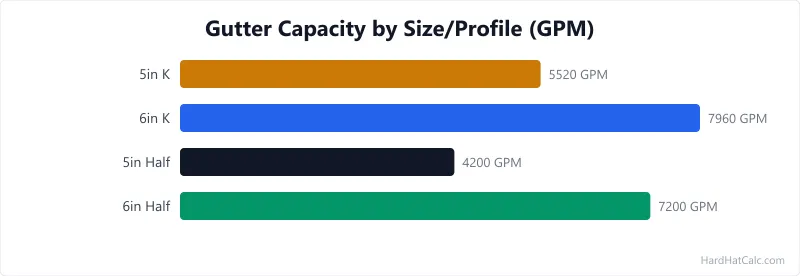
- 5-inch K-style: handles up to 5,520 sq ft of drainage area at 1 in/hr rainfall, or 1,380 sq ft at 4 in/hr. This is the standard residential size — it handles most single-storey and moderate two-storey roofs in all but the highest-rainfall regions.
- 6-inch K-style: handles up to 7,960 sq ft at 1 in/hr, or 1,990 sq ft at 4 in/hr. Used for large roofs, steep pitches, and high-rainfall areas. Required for most commercial buildings.
K-style gutters dominate the US residential market (roughly 80% of installations) because they carry more water per inch of width and their flat back simplifies mounting.
Half-Round Gutters
Half-round gutters are a semicircular trough. They carry less water than K-style at the same width but drain more cleanly — debris does not catch on interior corners because there are none. Half-round gutters are the standard on historic homes and are increasingly popular on modern designs for their clean aesthetic.
Capacity by size:
- 5-inch half-round: handles up to 2,500 sq ft at 1 in/hr, or 625 sq ft at 4 in/hr. About 45% of the capacity of a 5-inch K-style.
- 6-inch half-round: handles up to 3,840 sq ft at 1 in/hr, or 960 sq ft at 4 in/hr. The minimum recommended size for most residential applications in moderate to high rainfall areas.
If you are choosing between profiles and your drainage areas are borderline for 5-inch gutters, go with 6-inch — the cost difference is 15-25% more per linear foot, but the capacity increase is 40-50%. Undersized gutters overflow every storm; oversized gutters just look slightly larger.
Step 4: Choose a Gutter Material
Gutter material affects cost, lifespan, appearance, and maintenance requirements. All materials come in both K-style and half-round profiles. Prices below are per linear foot installed, as of March 2026 US national averages.
Aluminium ($6-$12/lf installed) is the default residential gutter material. Lightweight, rust-proof, available in 30+ colours, and compatible with seamless machine-formed gutters. Seamless aluminium gutters are formed on-site from a coil — no joints except at corners and downspout connections. Lifespan: 20-30 years. Weakness: aluminium dents from ladder contact and heavy hail.
Galvanised steel ($8-$14/lf) is stronger than aluminium and resists denting, but it rusts if the zinc coating is scratched or wears through. Lifespan: 15-25 years. Used where physical strength matters — commercial buildings, areas with heavy ice, and locations prone to falling branches.
Copper ($25-$45/lf) is the premium option. It does not rust, does not need painting, and develops a green patina over 10-20 years that many homeowners find attractive. Copper gutters last 50-80 years with minimal maintenance. The trade-off: cost. A copper gutter system for a 2,000 sq ft house runs $5,000-$10,000 installed versus $1,500-$3,000 for aluminium.
Vinyl (PVC) ($3-$6/lf installed) is the cheapest option and the only one suitable for DIY installation (snap-together sections, no soldering or riveting). Vinyl gutters are lightweight and never rust. Weaknesses: they become brittle in cold weather, sag in sustained heat above 100°F, fade from UV exposure within 5-10 years, and cannot be formed into seamless runs. Lifespan: 10-20 years. Use vinyl for budget projects in mild climates with moderate rainfall.
Step 5: Size and Space Downspouts
Downspouts are the bottleneck of any gutter system. An undersized or poorly placed downspout causes the gutter to fill up and overflow even if the gutter itself has adequate capacity. The general rule: one downspout per 20-30 linear feet of gutter run, or one per 600 sq ft of drainage area, whichever results in more downspouts.
Standard residential downspout sizes:
- 2×3-inch rectangular: handles up to 600 sq ft of drainage area at 4 in/hr rainfall. Pairs with 5-inch gutters.
- 3×4-inch rectangular: handles up to 1,200 sq ft at 4 in/hr. Pairs with 6-inch gutters.
- 3-inch round: handles about 700 sq ft at 4 in/hr. Used with half-round gutters for aesthetic consistency.
- 4-inch round: handles about 1,250 sq ft at 4 in/hr. The professional choice for large or high-rainfall installations.
Downspout placement matters as much as sizing. Place downspouts at the lowest point of each gutter run. The gutter should slope toward the downspout at 1/16 inch per foot (a 30-foot run drops 1-7/8 inches from high end to low end). If a single gutter run exceeds 40 feet, install a downspout at each end with the high point at the centre — this splits the drainage and keeps the slope manageable.
Direct downspout discharge at least 4-6 feet away from the foundation using splash blocks, downspout extensions, or underground drain lines. Water pooling against the foundation is the leading cause of basement water intrusion and foundation erosion. The inlet capacity calculator can help size underground drain inlets if you are routing downspout water to a storm drain system or dry well.
Gutter Guards and Leaf Protection
Gutter guards reduce but do not eliminate cleaning. No guard design handles all debris types equally. Mesh screens catch leaves but pass pine needles and seed pods. Reverse-curve (helmet) guards shed leaves but can overshoot water in heavy downpours — the water follows the curve over the guard and past the gutter opening. Foam inserts fill the gutter and let water filter through while blocking debris, but they degrade from UV and become breeding grounds for moss and algae within 3-5 years.
The most effective approach for most homes: micro-mesh gutter guards (stainless steel mesh over an aluminium frame) installed professionally. They handle leaves, needles, and seed pods while maintaining full gutter flow capacity. Cost: $15-$30 per linear foot installed. They require occasional brushing of accumulated fine debris from the mesh surface, but they eliminate the dangerous task of climbing a ladder to scoop wet leaves out of gutters twice a year.
Before installing gutter guards, verify that your roofing is in good condition — shingle granule wash-off can clog mesh guards faster than organic debris. If the roof is due for replacement within 5 years, wait to install guards until after the new roof goes on.
When to Replace vs. Repair
Repair gutters when the damage is localised — a single rusted-through section, a loose hanger, a leaking joint. Replacement is warranted when the gutters show systemic failure: widespread rust or corrosion, sagging along the full run length, or repeated overflows that indicate the gutters are undersized for the roof. If you are replacing waterproofing membrane or roofing at the same time, replace the gutters during the same project — the scaffolding or ladder setup is already in place, and the roofer can install gutter apron flashing that integrates with the new roofing membrane.
On older homes, gutter replacement is also an opportunity to correct sizing. Many homes built before 1990 have 4-inch K-style gutters — a size that is undersized for all but the smallest roofs in low-rainfall areas. Upgrading to 5-inch or 6-inch K-style during replacement costs only 10-20% more than replacing with the same undersized profile, and it eliminates the overflow problems that caused the fascia rot in the first place.
Frequently Asked Questions
- What size gutters do I need for my house?
For most single-storey homes with moderate rainfall (2-4 inches per hour peak), 5-inch K-style gutters with 2×3-inch downspouts are adequate. Two-storey homes, steep roofs, and high-rainfall areas (Southeast US, Gulf Coast) should use 6-inch K-style gutters with 3×4-inch downspouts. The key calculation is drainage area times rainfall intensity — if the product exceeds 5,500, you need 6-inch gutters. If you are unsure about your local rainfall intensity, use the NOAA Atlas 14 tool or default to 6-inch gutters for peace of mind. The gutter sizing calculator runs this capacity math automatically for your roof dimensions.
- How many downspouts do I need per gutter run?
Install one downspout per 20-30 linear feet of gutter or one per 600 square feet of roof drainage area, whichever results in more downspouts. A 50-foot gutter run needs at least two downspouts — one at each end, with the gutter sloping from a high point at centre toward both ends. Gutter runs longer than 40 feet without adequate downspouts overflow because the water volume exceeds the gutter cross-section capacity long before it reaches the single downspout at the far end. Where downspouts discharge to an underground system, the inlet capacity calculator sizes the collection points at ground level.
- Are half-round gutters better than K-style?
Half-round gutters are not better or worse — they serve different needs. K-style gutters carry 40-50% more water at the same width and cost less to install because they mount flat against the fascia. Half-round gutters have fewer interior corners where debris catches, drain more cleanly, and suit historic and modern architectural styles. If water capacity is the priority, K-style wins. If aesthetics and self-cleaning behaviour matter more, half-round is the better choice — just size up to 6-inch to compensate for the lower capacity. If you are replacing the roof at the same time, the shingle bundle calculator estimates materials for the surface above the gutters.
- How much slope should gutters have toward the downspout?
Standard gutter slope is 1/16 inch per linear foot toward the downspout. A 30-foot gutter run drops 1-7/8 inches from the high end to the downspout. Some installers use 1/8 inch per foot, which drains faster but creates a more visible slope line against the horizontal fascia. For runs longer than 40 feet, install downspouts at both ends and slope from a high centre point in each direction — this halves the total drop and keeps the gutter visually level while maintaining drainage. If the fascia shows rot from previous overflow damage, check whether the rafter tail lengths need repair before installing new gutters.